


This blog was originally published on October 23, 2025, and has been fully updated on May 28, 2026. All statistics, trends, technology references, and best practices have been revised to reflect the current landscape of custom software development.
Python has become the language of artificial intelligence, driving everything from Netflix’s recommendation algorithm to Tesla’s autonomous vehicles. In 2026, 78% of Fortune 500 businesses use Python as their primary AI system, and it’s no coincidence. The reason Python is successful is because of its enormous ecosystem of specialist tools that simplify creating intelligent applications as simple as jotting down a grocery list.
The market for artificial intelligence is growing at an unprecedented rate, and worldwide spending hit $93.95 billion in 2026. At the root of this explosive growth is Python’s rich and mature ecosystem of libraries that have made AI a staple of everyday business operations, rather than a curiosity of research. Business leaders are no longer debating whether to implement AI – they’re debating which Python tools will provide them with the competitive advantage.

Flowchart of deployment of machine learning pipeline with CircleCI and Google Cloud services such as Cloud Build, Artifact Registry, Container Registry, Cloud Storage, Cloud Functions, and Vertex Pipelines.
Understanding the AI Library Landscape
Imagine Python’s AI ecosystem as a well-equipped toolbox. A carpenter requires various tools for various tasks, just like a business requires specialized AI libraries for various problems. Some of them are great at image recognition, some at natural language understanding, and yet others at prediction from pattern in data.
The elegance of Python is that it is simple. While other programming languages demand a lot of technical expertise, Python lets business teams concentrate on developing solutions instead of grappling with hard code. Python’s openness has democratized AI creation, making it possible for businesses of all sizes to develop smart applications without huge technical squads.

Production market share distribution of major Python AI/ML frameworks in 2026, showing TensorFlow’s dominance in enterprise deployments
TensorFlow: The Reliable Workhorse
TensorFlow is the undisputed king with 38% market share in the enterprise space, and for a good reason. Built by Google and proofed through billions of customers every day, TensorFlow is the Toyota Camry of AI libraries – dependable, effective, and long-lasting. When businesses want AI systems that operate 24/7 without failing, TensorFlow is often their go-to.


What makes TensorFlow special for businesses?
TensorFlow is great at processing huge workloads. Consider Google’s search engine handling millions of queries per second, or YouTube’s recommendations system serving billions of videos every day. These are use cases that demand bulletproof stability and the power to scale effortlessly as demand increases.
Real-world TensorFlow success stories include:
- Banks handling millions of real-time fraud detection checks
- Retailers giving personalized shopping experiences for millions of customers at once
- Healthcare systems interpreting medical images with accuracy comparable to human experts
- Manufacturing firms forecasting equipment breakdowns prior to their occurrence
The strength of the framework is that it is production-grade. Once you train an AI model using TensorFlow, putting it out to serve actual customers is easy, whether you’re operating it on smartphones, web browsers, or huge data centers.
PyTorch: The Innovation Engine
PyTorch has taken 55% of research environments and 23% of production systems, becoming the fastest-growing AI framework. While TensorFlow is the dependable Camry, PyTorch is the Tesla – innovative, on the bleeding edge, and the choice of pioneers.
Why researchers and innovative companies love PyTorch:
PyTorch is more akin to writing common Python code, which makes it quicker for teams to test and iterate. This adaptability has caused it to become the first choice for innovative AI research, with 85% of state-of-the-art AI papers employing PyTorch today. This translates to quicker access to new AI breakthroughs for businesses.
Companies using PyTorch are seeing remarkable results:
- Startups creating AI-driven products can prototype 50% quicker than before
- Technology firms building new features can experiment with ideas in days instead of months
- Research groups cracking tough problems can change and adjust course in real-time
The framework’s growing maturity means it’s no longer just for experiments. Major companies are running production systems on PyTorch, benefiting from both innovation speed and business reliability.

Performance benchmark comparison across key metrics for the three leading deep learning frameworks
The Supporting Cast: Specialized Tools for Specific Needs
Hugging Face: Making Language AI Accessible
Hugging Face democratized natural language processing so any business can create ChatGPT-like functions. Businesses have access to more than 200,000 pre-trained models, so they can incorporate advanced language comprehension without the enormous investments that would normally be required.
Practical applications businesses are implementing:
- Customer support chatbots with context awareness and responsive answers
- Document processing systems that pull important facts out of contracts and reports
- Content tools that assist marketing teams in creating ideas and copy
- Translation services that facilitate worldwide business communication
The platform has made advanced language AI as easy to use as any business software, with enterprise plans starting at $20 per user.
JAX: The Speed Demon
JAX is the state of the art in high-performance AI, providing orders-of-magnitude speed gains for computationally demanding tasks. With just 3% of the market today, JAX is the best-kept secret of enterprises working on the most challenging AI problems.
Where JAX shines:
- Financial modeling requiring complex mathematical calculations
- Scientific research processing massive datasets
- Advanced simulations for product design and testing
- Large-scale optimization problems that traditional tools can’t handle efficiently
Scikit-learn: The Business Intelligence Foundation
Even with all the hype about deep learning, scikit-learn holds steady at 15% market share for a very good reason. It’s the business analytics Swiss Army knife, offering dependable utilities for the analysis of data trends and prediction.
Everyday business applications:
- Inventory and staffing optimization through sales forecasting
- Targeted marketing campaigns through customer segmentation
- Lending and insurance risk assessment
- Manufacturing process quality control
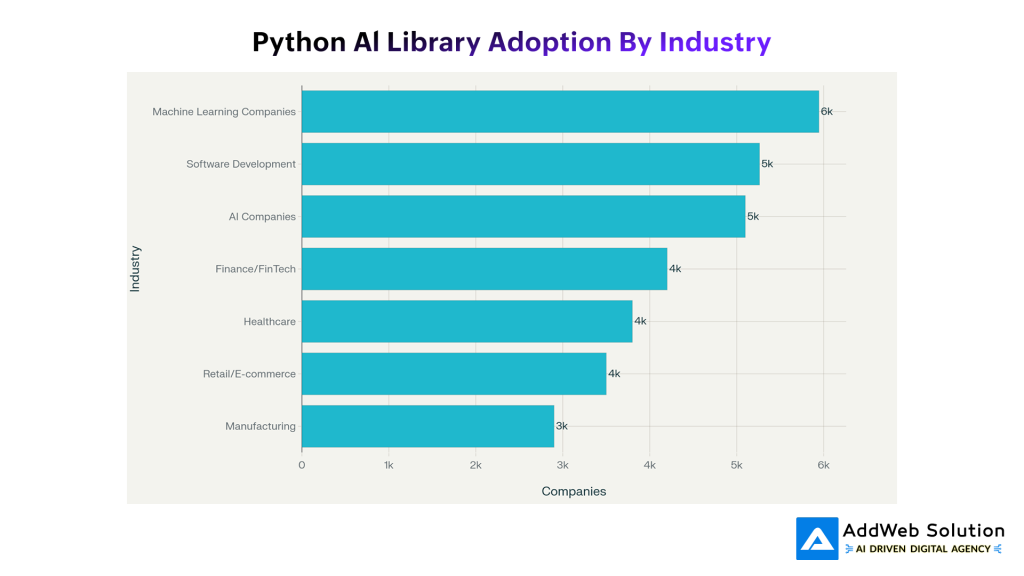
Industry breakdown showing which sectors lead in adopting Python AI libraries for enterprise applications
Industry Adoption: Who’s Using What and Why
Machine learning firms are the leaders in adoption with close to 6,000 organizations currently using Python AI tools, but the actual tale is how these technologies have permeated into every sector possible.
Financial Services Revolution
Banks and investment companies have adopted Python AI to revolutionize their business:
- Fraud detection systems which identify suspicious transactions within milliseconds
- Algorithms for trading that execute investment decisions in a matter of seconds
- Credit scoring algorithms that evaluate loan applications better than legacy approaches
- Customer care platforms that dispense customized financial recommendations
Healthcare Transformation
Medical institutions are using Python AI to improve patient outcomes:
- Diagnostic tools identifying disease in medical images before human physicians
- Platforms for drug discovery that quickly identify potential treatments
- Patient monitoring systems that forecast health complications prior to their occurrence
- Optimization of treatment that tailors medical treatment for unique patients
Retail and E-commerce Innovation
Online and brick-and-mortar retailers are leveraging AI for competitive advantage:
- Recommendation engines that drive more sales by offering relevant products
- Inventory management that helps minimize wastage while maintaining stock availability
- Price optimization that maximizes revenue but keeps prices competitive
- Customer experience personalization that produces one-of-a-kind shopping experiences
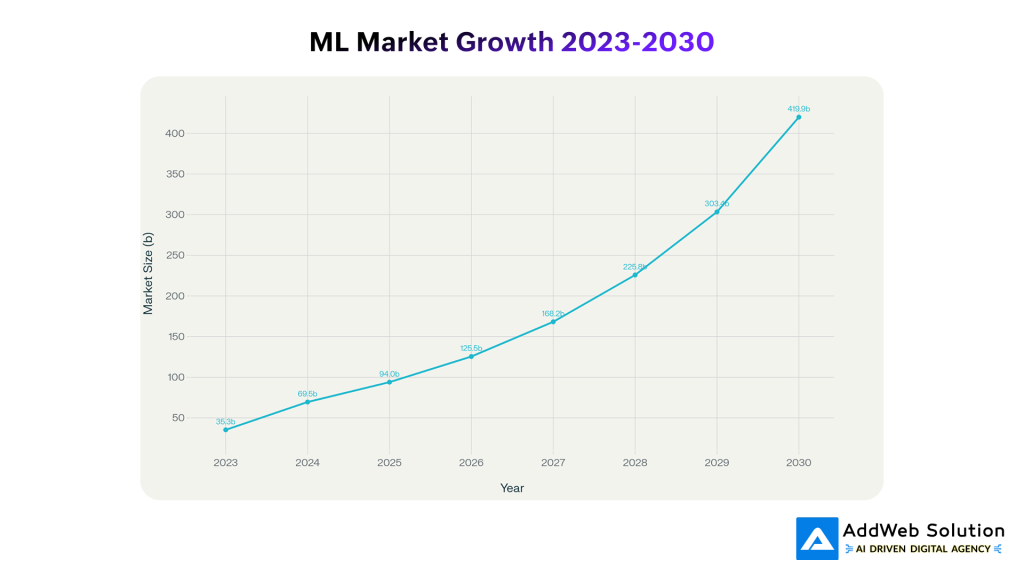
Projected exponential growth of the global machine learning market showing 35.09% CAGR through 2030
The Cloud Revolution: Making AI Accessible to Everyone
69% of AI workloads are currently executed on cloud platforms, revolutionizing the way businesses think about AI development. Cloud services have democratized access to powerful AI capabilities without the need for enormous technical infrastructure investments.
What this means for businesses:
- Reduced barriers to entry: Small businesses have the same access to AI tools as tech giants
- Dynamic scaling: Pay for what you need, scaling up when demand picks up
- Less complexity: Cloud providers take care of technical infrastructure
- Quicker deployment: New AI programs can be operational in days, not months
Major cloud platforms are competing for AI dominance:
- Amazon Web Services with 32% market share, providing end-to-end AI services
- Microsoft Azure at second place with 27%, integrating tightly with business applications
- Google Cloud Platform with 22%, capitalizing on Google’s AI capabilities
Performance and Practical Considerations
When selecting AI tools,companies must take into account real-world considerations in addition to technical specifications:
Ease of Use vs. Power
- TensorFlow: More difficult to learn but allows for greatest control and scalability
- PyTorch: Easy to learn, ideal for new AI teams
- Specialized tools: Usually easiest solution for the use case
Support and Community
- Big communities translate to more resources for learning and debugging
- Enterprise support offers professional support for mission-critical applications
- Regular updates keep tools in sync with new AI innovations
Integration with Existing Systems
- API compatibility with today’s business applications
- Integration of data pipeline with existing analytics tools and databases
- Security in accordance with industry standards and regulations
Future Trends Shaping the AI Landscape
The Blending of Tools
AI tools are becoming more interoperable, allowing businesses to mix and match the best solutions for different needs. This flexibility reduces risk and enables companies to optimize for both innovation and reliability.
Democratization Through Automation
Automated Machine Learning (AutoML) is making AI development more accessible, reducing the need for specialized technical expertise by 30%. This trend means more business professionals can directly contribute to AI initiatives.
Industry-Specific Solutions
Industry-specific AI solutions are surfacing that provide pre-configured answers to typical business problems in healthcare, finance, manufacturing, and retail.
Future-Proof Your AI Stack with Python’s Powerhouses

Pooja Upadhyay
Director Of People Operations & Client Relations
Strategic Recommendations for Business Leaders
Begin with Business Challenges, Not Technology
The most effective AI deployments start with specific business goals. Rather than “How can we use AI?”, successful organizations ask “What business challenges can AI address?”
Begin with Proven Solutions
For most companies, beginning with tried-and-true tools such as TensorFlow or PyTorch is a good idea. These environments have rich documentation, huge communities, and established histories in production environments.
Invest in Team Development
To succeed, one needs technical acumen and business awareness. The best AI teams pair domain knowledge with technical strength, focusing on solutions that meet actual business requirements.
Plan for Scale from Day One
Successful AI applications tend to scale rapidly. Designing for scalability up front avoids the expense of redesigning as demand escalates.
Conclusion: The AI-Powered Future is Here
Python’s AI platform has matured from experimental programming into the basis of contemporary business acumen. The technologies of 2026 support capabilities that were science fiction a mere few years prior.
The business opportunity is unparalleled. Firms that adopt these technologies wisely – prioritizing genuine business value over technological flair – will create lasting competitive edges. Those that procrastinate will be left behind as AI becomes as ubiquitous to business as email or spreadsheets.
The question is not if your company will employ AI, but how soon you can determine and utilize the solutions that will make your company successful. Python’s wide ecosystem has the tools; the vision to effectively utilize them is all that is needed.
The future belongs to organizations that can harness AI’s potential while maintaining focus on the human problems they’re solving. 2026 marks the transition from AI experimentation to AI execution – and Python’s ecosystem provides everything needed to succeed in this new landscape.
References:
- https://www.digitalocean.com/community/conceptual-articles/python-libraries-for-machine-learning
- https://codewave.com/insights/python-ai-machine-learning-libraries/
- https://vasundhara.io/blogs/top-machine-learning-libraries-in-2025
- https://huggingface.co
- https://developers.googleblog.com/en/jax-symbolic-power-unlocks-new-frontiers-in-scientific-computing/
- https://sqmagazine.co.uk/machine-learning-statistics/
- https://dev.to/dev_tips/pytorch-vs-tensorflow-2025-which-one-wins-after-72-hours-a2b
