


Sustainability isn’t just an ethical imperative, it’s an emerging competitive advantage. As environmental responsibility rises on stakeholder agendas, forward-thinking startups are finding that green software not only reduces costs, but also fuels loyalty, compliance, and investor interest. The MERN stack, with its full-stack flexibility and strong efficiency profile, is increasingly the backbone of eco-conscious codebases. But how can founders use MERN and modern green coding practices to make a real impact?
Green Coding: What Does It Mean in 2025?
Green coding is the practice of designing, developing, and deploying digital products with minimal energy consumption and carbon footprint. Sustainable applications:
- Optimize algorithms for energy savings
- Minimize resource demands on servers and clients
- Use efficient databases and APIs
- Deploy to carbon-neutral clouds
- Reduce digital waste: unused code, assets, dependencies
MERN’s Eco Credentials: How Does It Stack Up?
MERN stands out thanks to its modular approach, vibrant open-source ecosystem, and deep support for native optimization, asset minification, and cloud-neutral deployment. Here’s how MERN compares to other major stacks:
Chart: Average Energy Usage by Tech Stack (2025)
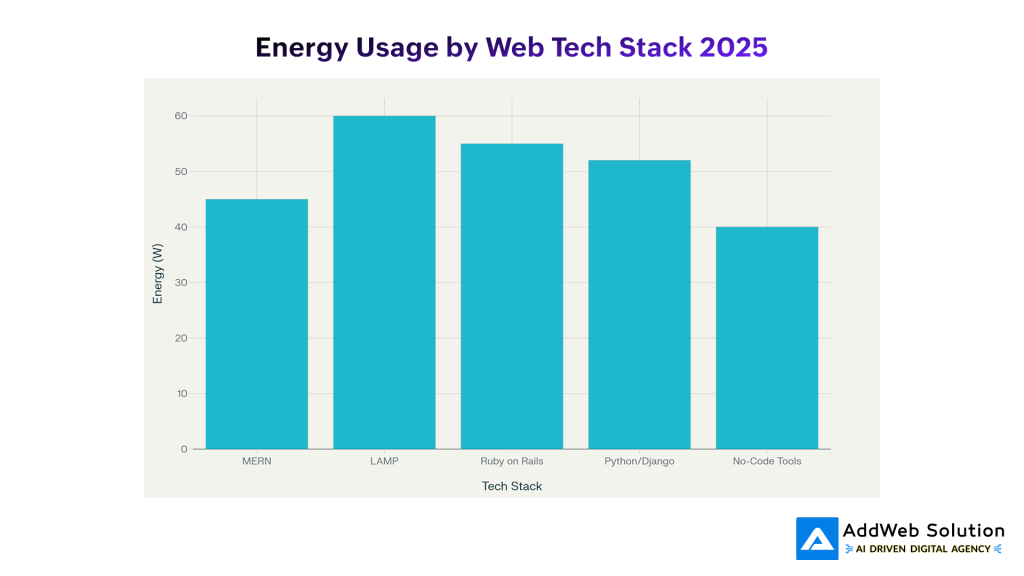
Average Energy Usage by Tech Stack (2025)
| Stack | Avg Energy Usage (W) |
| MERN | 45 |
| LAMP | 60 |
| Ruby on Rails | 55 |
| Python/Django | 52 |
| No-Code Tools | 40 |
MERN stack apps typically use less energy per workload than alternatives (excluding some specialized no-code platforms), thanks to efficient Node.js runtime, React’s virtual DOM, and MongoDB’s optimized queries.
Additional
Read

Key Green Coding Practices for MERN
13 Proven Ways to Practice Green Coding:
- Minimize Dependencies: Audit and trim your npm packages.
- Optimize Algorithms: Refactor for leaner, more efficient code.
- Smart Caching: Layer browser, CDN, app, and DB caches.
- API Call Reduction: Batch and debounce requests.
- Compress & Minify Assets: Use WebP/AVIF, strip unused CSS/JS.
- Right-Size Infrastructure: Adopt containerization and auto-scaling.
- Carbon-Aware Hosting: Deploy on renewable-powered clouds.
- Async Programming: Avoid blocking, use non-blocking IO.
- Loop & Recursion Refactoring: Minimize depth and redundant loops.
- Green Tools Monitoring: Track with CarbonAPI, EcoCode, PowerAPI.
- Integrate Sustainability in PRs: Include green checks in code review.
Pie Chart: Green Coding Practice Usage in MERN Startups (2025)
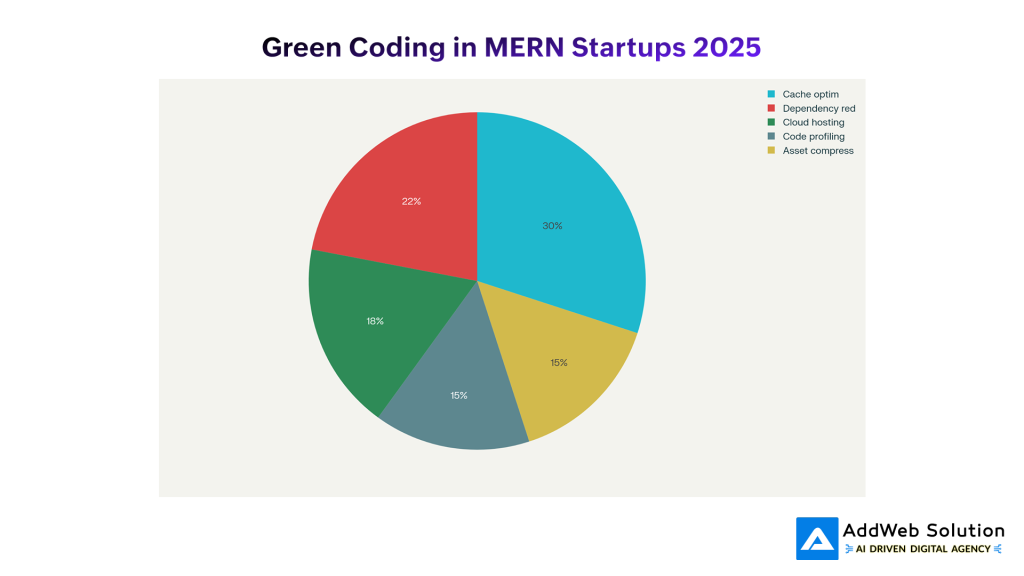
Green Coding Practices in MERN Startups (2025)
| Practice Type | Adoption Share (%) |
| Caching optimization | 30 |
| Dependency reduction | 22 |
| Cloud carbon-aware hosting | 18 |
| Code profiling & analysis | 15 |
| Asset compression/minify | 15 |
Deploying on Green Infrastructure
Major clouds (AWS, GCP, Azure) operate in global regions on renewable power. MERN deployments benefit from:
- Serverless Node.js, reducing idle CPU
- Multi-region MongoDB Atlas hosting for scale with minimum footprint
- Energy-efficient container orchestration (Kubernetes)
- Certifications: ISO 14001, Carbon Trust Standard
Green Hosting Providers by Region
| Cloud Provider | Green Regions | Certification | Special Features |
| AWS | Oregon, Frankfurt, Ireland | ISO 14001 | Carbon footprint dashboard |
| Azure | Netherlands, Sweden | Carbon Neutral | Optimized VM scheduler |
| Google Cloud | Finland, Netherlands | Carbon-Aware Infra | Real-time usage analytics |
| DigitalOcean | Frankfurt, SGP | Renewable Sourcing | N/A |
Asset Optimization and Efficient Frontends
Modern browsers and MERN’s React architecture support green coding with:
- Virtual DOM for minimal re-rendering
- Tree-shaking for JS bundle reduction
- Lazy loading for images and modules
- WebP/AVIF image formats for low-bandwidth delivery
- CDN-first design for distributed asset caching
Flowchart: Sustainable Asset Pipeline in MERN Apps
- Developer builds React UI → 2. Tree shake & minify assets → 3. CDN distribution → 4. Browser lazy-loads only required components → 5. User experience: fast, low carbon footprint
Backend Efficiency: Optimizing Node.js and MongoDB
Backend energy efficiency in MERN comes from:
- Indexed queries & aggregation pipelines in MongoDB (reduces CPU cycles)
- Express.js middleware for request filtering and compression
- Node.js async handlers for non-blocking operations
- Serverless architectures (auto-scale, zero-idle)
- Profiling tools: PM2, GreenValidator, Node Clinic
Case Studies: Eco-Conscious MERN Startups in Action
EcoMarket (E-commerce)
This startup built its entire eco shopping platform with MERN, leveraging:
- Smart asset compression, caching, and hosting on green AWS regions
- Demand-driven serverless APIs (Node.js)
- Product recommendation algorithms converting sustainability metrics to personalized results
Result: Reduced monthly energy consumption by 32% versus PHP solution, gained “green tech” PR and investment attention.
Waste Management Platform
A waste collection system used by MERN to optimize routes with live MongoDB geolocation mapping, cutting vehicle miles, energy use, and carbon footprint.
EdTech Green Portal
React’s modular dashboard and Node.js stream processing made resource-heavy online learning more bandwidth-efficient, saving costs and improving accessibility in low-energy settings.
Feature Comparison Heatmap: MERN vs Other Stacks for Sustainability
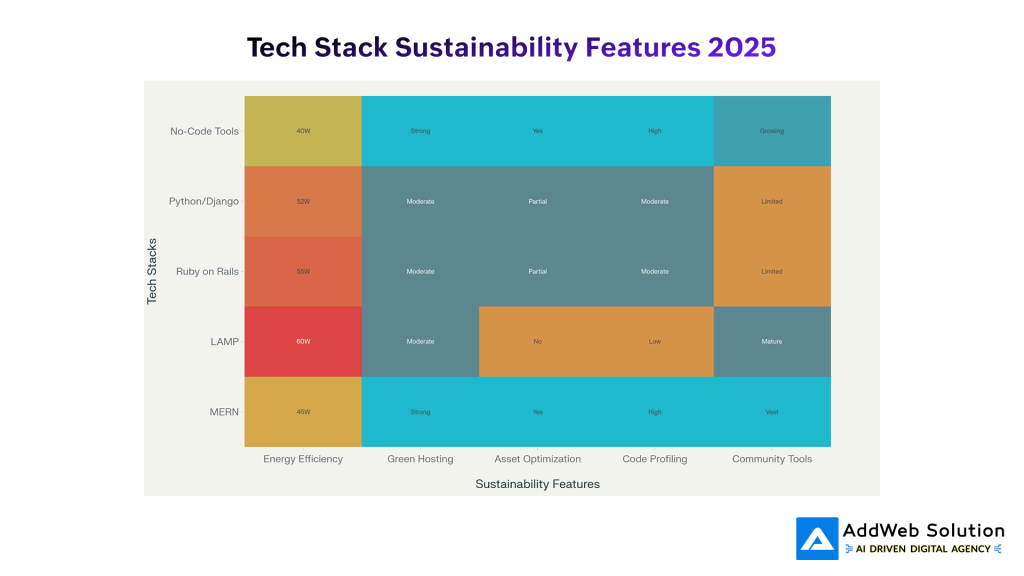
Sustainable Feature Comparison: MERN vs Other Stacks (2025)
| Stack | Energy Use | Green Hosting | Asset Opt. | Code Profiling | Community Tools |
| MERN | 45W | Strong | Yes | High | Vast |
| LAMP | 60W | Moderate | No | Low | Mature |
| Ruby on Rails | 55W | Moderate | Partial | Moderate | Limited |
| Python/Django | 52W | Moderate | Partial | Moderate | Limited |
| No-Code Tools | 40W | Strong | Yes | High | Growing |
MERN leads in practical code profiling, asset optimization, and community resources for sustainability.

Ready to accelerate your MERN project? Contact us today to discuss your stack, timeline, and goals.

Pooja Upadhyay
Director Of People Operations & Client Relations
Practical Steps: Greening Your MERN Workflow
| Step | Action | Impact |
| Audit npm/yarn packages | Remove unused, heavy dependencies | Smaller footprint, quicker builds |
| Enable asset minification | Use webpack, compress images | Faster loads, less bandwidth wasted |
| Monitor server usage | PM2, Node Clinic, cloud dashboards | Spot energy leaks, auto-scale |
| Choose green cloud regions | Deploy on renewable-powered infrastructure | Concrete emissions cuts |
| Code review for green | Add carbon profiling to PR workflow | Catches bad patterns early |
| Integrate smart caching | Browser, CDN, backend DB layer | Reduces repeated processing |
Trends: Sustainability in Tech Funding and Brand Value
- Investor interest: VC surveys cite “climate-resilient software” as a top-5 priority in funding for 2025.
- Brand impact: Eco-labels for digital products now influence user adoption, services showing real carbon metrics outperform those without.
- Employee attraction: Developers increasingly want to work for companies using modern sustainability tooling and practices.
Future Outlook: The Next Wave of Green MERN
- AI optimization: ML models help auto-suggest code changes for energy reduction.
- End-to-end eco metrics: GitHub Actions and cloud dashboards unify carbon tracking from local dev to global deployment.
- Zero-waste UIs: React and server-side rendering optimize not just desktop, but mobile and IoT endpoints for sustainability.
Conclusion
Eco-conscious startups are building the future with MERN, delivering not just scalable, lightning-fast apps but digital platforms that actively minimize carbon and energy footprints. With disciplined green coding, asset optimization, and sustainable hosting, founders can prove environmental responsibility at every stage, earning client trust and investor leverage in a climate-aware ecosystem.
Need help implementing green coding with MERN? Addweb Solution (www.addwebsolution.com) offers expert guidance, hands-on implementation, and cutting-edge sustainability practices for startups serious about their tech and their impact.
