


If you’ve spent any time around Zoho lately, you’ve probably noticed a pattern: the businesses that really win with it rarely “just install Zoho CRM.” They have someone in the middle translating chaos into workflows, tools into outcomes, and data into decisions. That “someone” is usually a Zoho consultant.
This article breaks down, in plain language, what a Zoho consultant actually does all day, where they add real value, and how to know if you need one. Think of it as a field guide from someone who has sat in far too many “our CRM is a mess” calls.
Why Zoho Consulting Exists Today
Zoho isn’t “just a CRM” anymore
In 2024, more than 250,000 businesses were actively using Zoho CRM, with usage growing about 30% year-on-year and customers spread across 180+ countries. At the same time, the global CRM software market hit around 80-101 billion USD and is projected to cross 260 billion USD by 2032. That’s a lot of companies betting their revenue engine on CRM.
Zoho is now a full operating system for business: CRM, finance, support, HR, marketing, collaboration, analytics, low-code and more than 50+ apps in one ecosystem. For a lean team that already juggles dozens of SaaS tools, that’s both exciting and intimidating. In 2023, SMBs alone used an average of 253 SaaS apps, and enterprises went above 470, with many licenses unused. No wonder people feel overwhelmed.
A Zoho consultant exists to cut through that noise: to design the right subset of Zoho, wire it together properly, and make sure it actually supports how the business runs.
From “tool setup” to transformation partner
Older-school CRM work often meant “help us create fields and pipelines.” That still happens, but it’s only a small slice of the job now.
Independent research shows that the average CRM initiative returns around 211% ROI, and organizations with high user adoption and strong utilization see more than three times that payoff. Those numbers don’t come from simply buying licenses. They come from:
- Designing processes that make sense
- Aligning tools with those processes
- Training people to actually use the system
- Iterating based on real data over time
Modern Zoho consultants live at the intersection of business process, technology, change management, and analytics. The tech is the easy part; getting humans, data, and strategy aligned is where the real work lies.
What a Zoho Consultant Really Does
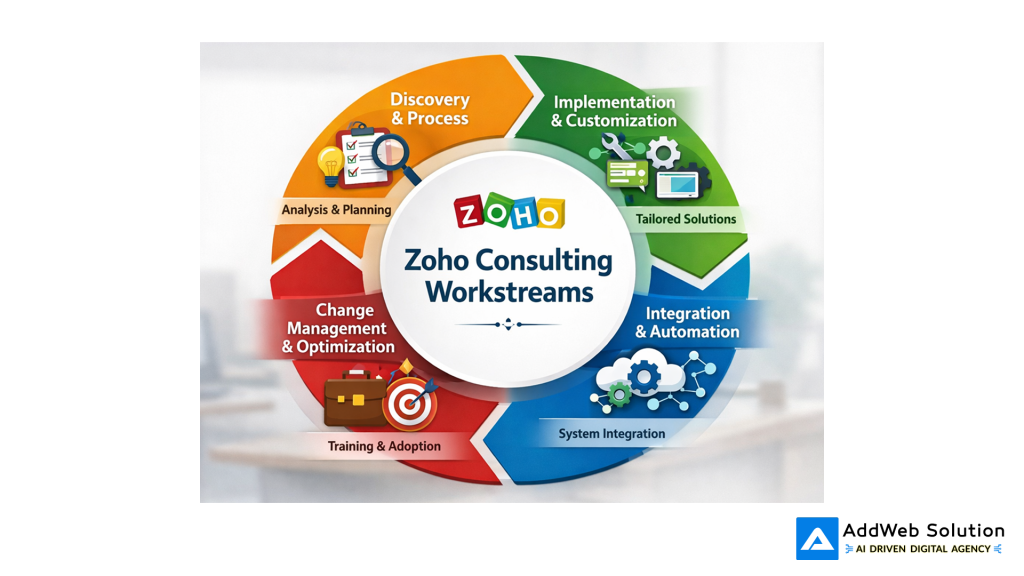
1. Discovery and business process mapping
The best Zoho projects do not start with “let’s create modules.” They start with “how do you actually sell, serve, and get paid?”
A good Zoho consultant will typically:
- Talk to sales, marketing, support, finance, and operations, not just the founder.
- Map current flows like lead → deal → invoice, or ticket → resolution → feedback.
- Identify the messy parts: spreadsheets, side tools, manual approvals, “only Rohan knows this step.”
- Clarify key metrics—lead response time, win rate, quote-to-cash time, CSAT, churn, etc.
The point is simple: Zoho should reflect how the business should run, not just mirror today’s chaos.
Visual: Core workstreams of a Zoho consulting engagement
2. Solution architecture across the Zoho stack
Once the consultant understands your business, they design which Zoho apps you actually need and how they talk to each other.
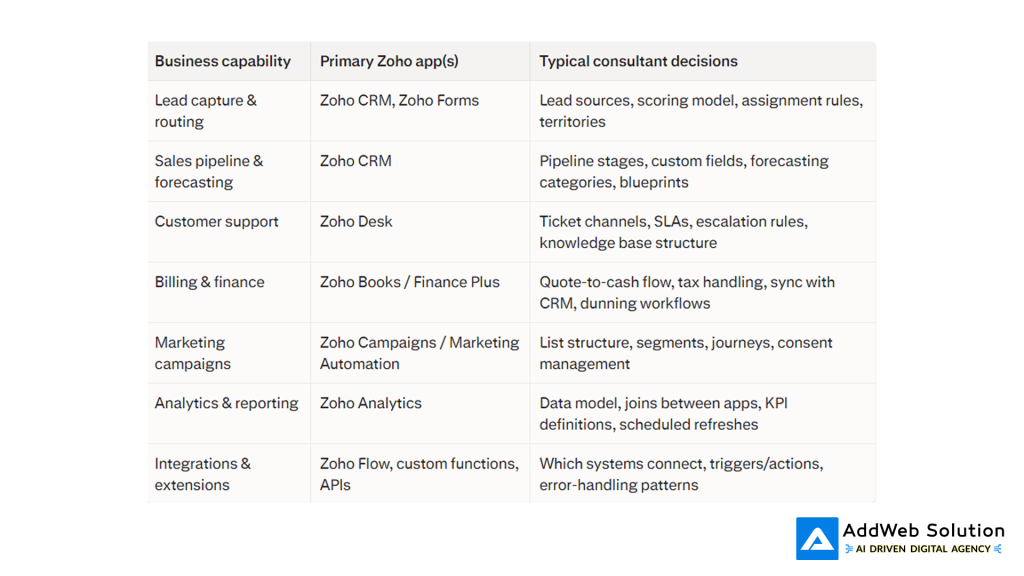
Zoho itself positions partners and consultants as independent, certified firms that help organizations implement, customize, integrate, and extract full value from its suite not just resell licenses. In practice, a typical architecture might look like:
- Zoho CRM – Leads, deals, accounts, activities, forecasting
- Zoho Books / Finance Plus – Quotes, invoices, payments, tax, revenue
- Zoho Desk – Support tickets, SLAs, customer service reporting
- Zoho Campaigns / Marketing Automation – Email, journeys, nurturing
- Zoho Analytics – Cross-app reporting for leadership
- Zoho Flow / custom functions / APIs – Integrations and automations
Table: Example Zoho app roles in a B2B stack
How a Zoho consultant typically maps business capabilities to specific Zoho applications.
This is where many DIY implementations stumble: trying to make one app (usually CRM) do absolutely everything. The consultant’s job is to give each app a clear job and avoid a Frankenstein stack.
3. Implementation, customization, and automation
This is the hands-on build phase most people picture—but done in a disciplined way.
A Zoho consultant typically:
- Configures modules, fields, relationships, validation rules, and layouts in Zoho CRM.
- Design blueprints so important steps (KYC, compliance checks, approvals) are actually enforced.
- Builds approval flows for discounts, refunds, credit limits, and exceptions.
- Creates email templates, sequences, and journeys across CRM and Campaigns.
- Uses Zoho Flow, Deluge, and APIs to integrate with external tools (e.g., accounting, ERP, telephony, CPQ).
Why does this matter so much for ROI? Independent research shows that productivity gains and process efficiency driven largely by automation and reduced manual data entry account for roughly half of total CRM ROI.
Visual: Time saved by automating with Zoho

4. Data, reporting, and decision-support
A system that feels “busy” but doesn’t answer business questions is just an expensive admin.
Zoho consultants spend a surprising amount of time on:
- Defining KPIs that actually matter for your model (e.g., expansion MRR, NRR, first-contact resolution, pipeline coverage).
- Building reports in Zoho CRM and Zoho Desk for day-to-day management.
- Designing executive dashboards in Zoho Analytics that pull data from CRM, Desk, Books, and external tools.
Research on CRM ROI shows that organizations get significantly better returns once they move beyond simple tracking to analytics-driven decision making.
Table: Example executive dashboard a Zoho consultant might deliver
Core KPIs Zoho consultants commonly surface using CRM, Desk, and Analytics.

5. Change management, training, and adoption
Here’s the uncomfortable truth: the best-designed system fails if your team hates using it.
Multiple CRM ROI studies show that user adoption is the single biggest driver of payoff; once adoption climbs into the 70–80%+ range, ROI jumps sharply above the average. That’s why Zoho consultants invest heavily in:
- Role-based training (sales, support, finance, leadership—each gets a different view).
- Simplifying screens so each role sees only what they need.
- Writing playbooks and SOPs that say, “this is how we sell / serve / invoice using Zoho.”
- Creating feedback loops so the configuration evolves as the team works in it.
Adoption is not a one-day training session; it’s an ongoing conversation between your people and the platform.


6. Continuous improvement and roadmap ownership
Zoho ships updates and new features at a brisk pace. The overall CRM market is also expanding, driven by AI-powered features, better automation, and deeper integrations, with forecasts putting the CRM space above 260 billion USD by 2032.
Rather than expecting an internal generalist to keep up, many teams lean on a Zoho consultant as a part-time product owner for the platform. Typical responsibilities:
- Prioritizing which new features and apps are worth adopting (e.g., AI-based scoring, conversation intelligence, advanced analytics).
- Cleaning up legacy clutter—old fields, unused modules, redundant automations.
- Managing integration roadmap as new tools enter or leave your stack.
- Aligning Zoho work with quarterly and annual business goals.
It’s less about “end of project” and more about “ongoing evolution.”
Data-Driven Impact: What Changes With a Consultant Involved?
CRM ROI and speed to value
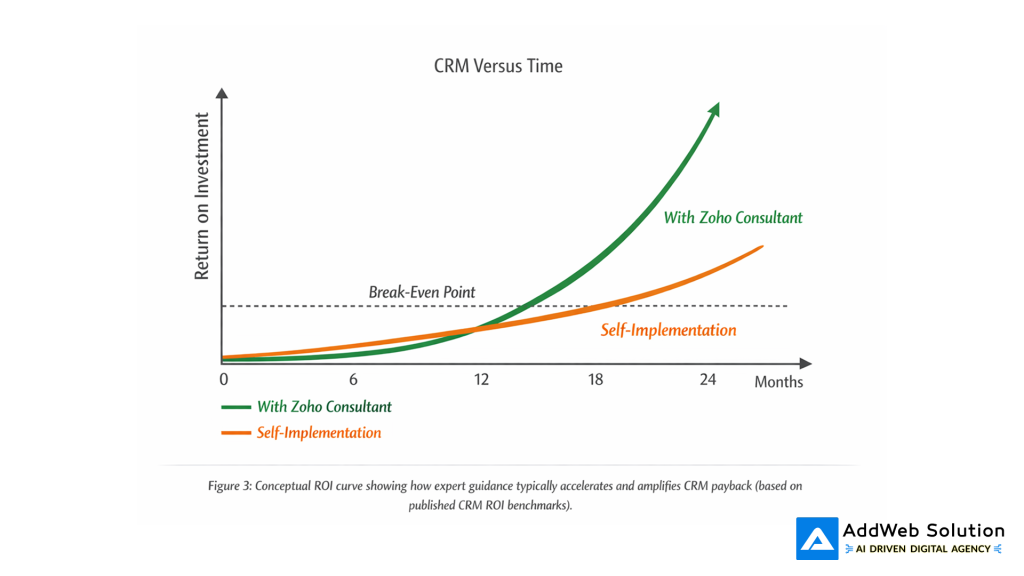
Across vendors, research puts the average CRM ROI at roughly 211%, with top performers those with strong user adoption and solid processes seeing more than triple that figure. Another CRM ROI analysis notes that many businesses start seeing clear returns within 6–12 months of implementation, with full optimization often taking 18+ months.
A capable Zoho consultant helps you:
- Reach that ROI curve faster by avoiding re-implementations and dead ends.
- Achieve higher adoption by designing workflows that match reality.
- Tie the platform directly to revenue, margin, and retention metrics so executives clearly see value.
Visual: CRM value curve with vs without consulting
When a Zoho consultant makes the biggest difference
Patterns repeat across companies. Zoho consulting service tends to create the most leverage when:
- You’re moving from spreadsheets or a legacy CRM into Zoho.
- Sales, support, and finance all have their own view of the customer and none match.
- You’ve started with Zoho CRM and now want to add Desk, Books, Analytics, etc.
- Investors, lenders, or the board are asking for more sophisticated reporting.
- You’re a small team wearing many hats; owning a 5–10 app platform internally is unrealistic.
These inflection points also map to a broader trend: SMB IT and application spending is tilting heavily toward SaaS as a lever for growth and efficiency, with business applications expected to grow strongly across 2024–2025.
Interesting Fact Box
Quick facts that shape the Zoho consulting landscape:
- Zoho CRM adoption is exploding.
More than 250,000 businesses were actively using Zoho CRM in 2024, up around 30% from 2023, across 180+ countries.
Source: Zoho CRM statistics – https://electroiq.com/stats/zoho-crm-statistics/ - The CRM market isn’t slowing down.
The global CRM market is expected to grow from about 101.41 billion USD in 2024 to 262.74 billion USD by 2032, at a CAGR of 12.6%.
Source: CRM market report – https://www.fortunebusinessinsights.com/press-release/global-customer-relationship-management-crm-market-10148 - CRM can be a serious moneymaker if adopted.
Independent research finds average CRM ROI around 211%, and up to three times higher where adoption and utilization are strong.
Source: CRM ROI research – https://crmsearch.com/crm/crm-roi/ and https://johnnygrow.com/crm/crm-roi/
Quote Section
“The real job of a Zoho consultant is not to turn every feature on. It’s to decide what to ignore so your team can actually sell, support, and build instead of babysitting a tool.”
“CRM platforms can deliver exceptional ROI, but only when user adoption and software utilization are high; companies with strong adoption see more than three times the average payback.”
— Based on findings from CRM ROI benchmark studies
How to Tell If You Need a Zoho Consultant
Red flags you shouldn’t ignore
You probably don’t need a consultant to create a single custom field. But you should consider one if you recognize yourself in these scenarios:
- Reps keep private spreadsheets because they don’t trust CRM data.
- Leadership can’t get a single, reliable view of customer health across sales, support, and billing.
- Different teams have spun up separate Zoho accounts or parallel setups.
- Every “small enhancement” requires firefighting and no one clearly owns the platform.
- Integrations to finance, marketing, or ops tools keep breaking—or were never completed.
Overlay that with the fact that many IT leaders already believe they’re overspending on SaaS, and it’s clear why a well-structured Zoho stack with proper ownership is becoming non-negotiable.
What a healthy Zoho engagement looks like
When the relationship is working, a Zoho consultant will:
- Start with discovery and a written solution design before heavy build.
- Iterate with demos and feedback, not vanish for three months and deliver a surprise.
- Push back on requests that hurt usability or maintainability, even if they’re technically possible.
- Leave behind documentation, training material, and clear ownership—not just a black box.
- Maintain a backlog and roadmap that aligns Zoho improvements with business priorities over the next 6–18 months.
That’s the difference between “we hired someone on a marketplace to set up Zoho” and “we have a partner who treats Zoho as part of our operating system.”
Ready to Streamline Your Business with Zoho?

Pooja Upadhyay
Director Of People Operations & Client Relations
Key Takeaways for Business & IT Leaders
- Zoho + CRM are only getting bigger.
Zoho CRM’s customer base and the global CRM market are both growing rapidly, which makes implementations more important and more complex at the same time. - A Zoho consultant’s job is wider than you think.
It spans discovery, architecture, implementation, analytics, training, and continuous improvement—not just field creation and workflow setup. - The upside is measurable.
Independent studies show that well-run CRM initiatives can deliver triple-digit ROI when processes and adoption are done right; consultants help you reach that level faster and with fewer missteps. - For growing teams, it’s a leverage play.
Instead of adding headcount everywhere, a strong Zoho implementation led by someone who has done it many times before—can compress cycle times, improve forecasting, and unify your customer view.
If your Zoho environment feels more like a collection of screens than a growth engine, that’s usually the moment to bring in a consultant. The tools are already powerful. The missing piece is often someone who knows how to connect them to the way your business actually works.
