


In the globalized digital world, no application stands alone. Elegant PHP framework Laravel has become a force to be reckoned with when it comes to developing high-end web applications that naturally integrate with dozens of outside services and tools. From handling databases to processing payments to scaling on the cloud, the integration strengths of Laravel can revolutionize your development process and give your application a serious boost in functionality.
The Laravel Integration Advantage: Why Seamless Connections Matter
Laravel’s “convention over configuration” philosophy carries over nicely into its integration platform. The framework comes with native support for many third-party services and has clean, readable code that developers adore. This minimizes development time to as much as 60% less than when developing integrations from scratch.
Modern web applications are usually linked to 8-12 various services on average, from databases and payment gateways to email providers and cloud storage. Laravel’s strong integration framework deals with this complexity well, enabling developers to concentrate on business logic instead of integration mechanics.

Laravel integration categories distribution where database systems come first at 95% usage, then development tools at 92%
Database Integration: The Foundation of Every Application
The Backbone of Every Application
MySQL and PostgreSQL Take the Lead
Database integration is the foundation of 95% of Laravel projects. Laravel’s Eloquent ORM establishes smooth connections with several database systems without needing developers to make intricate SQL queries.
MySQL Integration is still the most widely used option because it is easy and has extensive hosting support. Configuration is easy:
text
DB_CONNECTION=mysql
DB_HOST=127.0.0.1
DB_PORT=3306
DB_DATABASE=your_database
DB_USERNAME=your_username
DB_PASSWORD=your_password
PostgreSQL Integration has gained significant traction, particularly after Laravel Cloud’s initial PostgreSQL-first approach. PostgreSQL offers superior performance for complex queries and better online JSON handling capabilities. Setting up PostgreSQL requires minimal configuration changes:
text
DB_CONNECTION=pgsql
DB_HOST=127.0.0.1
DB_PORT=5432
DB_DATABASE=your_database
DB_USERNAME=postgres
DB_PASSWORD=your_password
Laravel also provides first-party support for SQLite for lightweight applications and SQL Server for enterprise environments. The framework’s database abstraction layer ensures your application code remains consistent regardless of the underlying database system.


Payment Gateway Integration: Powering E-commerce Success
Payment integration drives revenue generation for 88% of Laravel applications dealing with transactions. Laravel’s ecosystem provides robust support for major payment processors with minimal setup complexity.
Stripe Integration: The Developer Favorite
Stripe consistently ranks as the most developer-friendly payment gateway due to its comprehensive API and excellent documentation. Laravel Cashier simplifies Stripe integration significantly:
bash
composer require stripe/stripe-php
Key benefits include:
- Subscription Management: Built-in support for recurring billing
- Webhook Handling: Automatic processing of payment events
- Security: PCI compliance handled by Stripe
- International Support: 39+ countries supported
PayPal Integration: Global Reach
PayPal remains essential for businesses targeting international markets, offering trusted brand recognition and buyer protection. The srmklive/laravel-paypal package provides comprehensive PayPal integration:
bash
composer require srmklive/paypal
PayPal’s advantages include:
- Global Acceptance: Available in 200+ markets
- Multiple Payment Methods: Credit cards, bank transfers, PayPal balance
- Buyer Protection: Enhanced trust and conversion rates
Email Service Integration: Connecting with Your Users
Email integration powers 82% of Laravel applications for user communication, notifications, and marketing campaigns. Laravel’s Mail facade provides unified access to multiple email service providers.
Mailgun: The Laravel Community Choice
Mailgun offers exceptional reliability and deliverability rates, making it the preferred choice for Laravel applications:
text
MAIL_MAILER=mailgun
MAILGUN_DOMAIN=your-domain.mailgun.org
MAILGUN_SECRET=your-mailgun-secret
Mailgun’s strengths include:
- High Deliverability: 99%+ inbox placement rates
- Powerful Analytics: Open rates, click tracking, bounce handling
- Bulk Sending: Efficient newsletter and notification campaigns
- Laravel Integration: Native support with minimal configuration
Alternative Email Services
SendGrid provides robust email marketing features and detailed analytics. Amazon SES offers cost-effective solutions for high-volume sending at $0.10 per 1,000 emails.
Frontend Framework Integration: Enhancing User Experience
Laravel’s flexibility shines when integrating with modern JavaScript frameworks, powering 75% of applications requiring dynamic user interfaces.
Vue.js Integration: The Natural Partnership
Vue.js pairs exceptionally well with Laravel, offering seamless two-way data binding and component-based architecture:
- Laravel Mix: Simplified asset compilation and hot module replacement
- Inertia.js: Single-page application benefits without complex API development
- Real-time Features: WebSocket integration via Laravel Echo and Pusher
React and Angular Options
React integration provides powerful UI capabilities with Laravel handling backend API operations. Angular excels for enterprise applications requiring complex data management and scalable architecture.

Scatter plot comparing setup difficulty versus popularity for various Laravel integration tools across different categories
Cloud Platform Integration: Scaling Your Applications
Cloud integration enables 70% of Laravel applications to achieve enterprise-scale performance and reliability. Laravel provides excellent support for major cloud platforms.
Amazon Web Services (AWS)
AWS integration offers comprehensive cloud services including:
- S3 Storage: Scalable file storage with CDN capabilities
- RDS: Managed database services with automatic backups
- Lambda: Serverless function execution for background tasks
- EC2: Virtual servers for application hosting
Google Cloud Platform
Google Cloud provides competitive alternatives with strong AI/ML integration capabilities and global infrastructure.
Microsoft Azure
Azure offers excellent enterprise integration, particularly for organizations already using Microsoft technologies.
API and Third-Party Service Integration
Laravel’s HTTP client and service architecture make integrating with external APIs straightforward and maintainable.
RESTful API Integration
Laravel’s HTTP client, built on Guzzle, provides powerful API integration capabilities:
php
use Illuminate\Support\Facades\Http;
$response = Http::withToken($token)
->get(‘https://api.example.com/data’);
return $response->json();
Popular API Integrations
- Social Media APIs: Twitter, Facebook, Instagram for social sharing and authentication
- CRM Integration: Salesforce and HubSpot for lead management and customer tracking
- Analytics Services: Google Analytics, Mixpanel for user behavior tracking
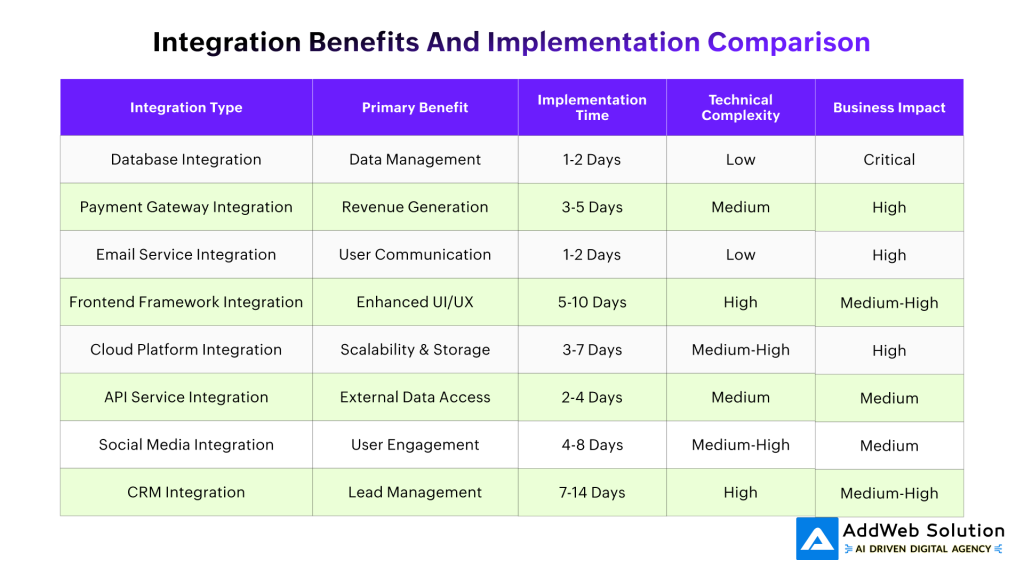
Integration Benefits and Implementation Comparison
Development Tools Integration: Streamlining Your Workflow
Laravel’s development ecosystem includes numerous tools that integrate seamlessly to enhance productivity:
Essential Development Tools
- Laravel Debugbar: Real-time debugging and performance monitoring
- Laravel Tinker: Interactive REPL for testing and debugging
- Laravel Nova: Admin panel for rapid CRUD interface development
- Laravel Telescope: Application monitoring and debugging dashboard
Testing and Quality Assurance
- Laravel Dusk: Browser automation testing with Chrome driver
- PHPUnit: Comprehensive unit and feature testing
- Laravel Pest: Modern testing framework with expressive syntax
Emerging Integration Trends in 2025
AI and Machine Learning Integration
Laravel is embracing AI integration with support for OpenAI, Hugging Face, and AWS Bedrock APIs. These integrations enable:
- Content Analysis: Automated content moderation and classification
- Personalization: Dynamic user experience customization
- Predictive Analytics: User behavior prediction and recommendation systems
Serverless Architecture
Laravel Vapor enables serverless deployment on AWS Lambda, providing:
- Automatic Scaling: Resources scale based on demand
- Cost Efficiency: Pay-per-execution pricing model
- Reduced Maintenance: Infrastructure management handled by AWS

Diagram showing the architecture and request flow of a PHP Laravel application highlighting integration of components like HTTP Kernel, Service Providers, Router, Middleware, and Views
Best Practices for Laravel Integration Success
1. Environment Configuration Management
Always use environment variables for sensitive configuration data and API keys. Laravel’s .env file system provides secure configuration management.
2. Service Container Utilization
Leverage Laravel’s service container for dependency injection and service binding, making integrations testable and maintainable.
3. Error Handling and Monitoring
Implement comprehensive error handling with services like Flare or Bugsnag to monitor integration health in production.
4. Rate Limiting and Caching
Implement rate limiting for external API calls and cache frequently accessed data to improve performance and reduce costs.
5. Security Considerations
- Use Laravel Sanctum or Passport for API authentication
- Validate all external data inputs
- Implement proper HTTPS and SSL certificate management
- Regular security audits of third-party integrations
Learn Laravel integration techniques to boost your development workflow

Pooja Upadhyay
Director Of People Operations & Client Relations
Real-World Integration Examples
E-commerce Platform Stack
- Frontend: Vue.js with Inertia.js
- Database: PostgreSQL with Redis caching
- Payments: Stripe for cards, PayPal for international
- Email: Mailgun for transactional, SendGrid for marketing
- Storage: AWS S3 with CloudFront CDN
- Monitoring: Laravel Telescope with Flare error tracking
SaaS Application Architecture
- Frontend: React with Laravel API
- Database: MySQL with automated backups
- Authentication: Laravel Sanctum with social login via Socialite
- Subscriptions: Laravel Cashier with Stripe
- Analytics: Google Analytics with custom event tracking
- Deployment: Laravel Vapor for serverless scaling
The Future of Laravel Integration
Laravel’s integration landscape keeps growing with new technologies. The framework’s focus on developer experience means that new integrations have the same expressive, elegant syntax that developers adore.
Upcoming Integration Opportunities
- Blockchain and Web3: Cryptocurrency payment processing and NFT marketplace integration
- IoT Devices: Smart home and industrial device management
- Edge Computing: CDN-integrated application deployment
- Advanced AI Services: Computer vision and natural language processing APIs
Laravel’s integration features turn it from a basic web framework into a full-fledged platform for crafting contemporary, interconnected applications. Whether you’re beginning anew or scaling your current one, Laravel’s rich integration ecosystem offers the tools and versatility required to reach any service or platform out there.
The key to successful Laravel integration lies in understanding your specific requirements, choosing the right tools for your use case, and following Laravel’s conventions for clean, maintainable code. With proper planning and implementation, Laravel integrations can significantly accelerate development while providing robust, scalable solutions that grow with your business needs.
