


If you ever plan to exit, raise a round, or sell a product line, your tech stack suddenly becomes a financial asset (or a liability).
Laravel often gets chosen for developer happiness and speed of delivery. But there is a quieter advantage that shows up only when lawyers, CTOs, and investment committees start doing due diligence: Laravel applications are simply easier to sell and acquire than many alternatives.
This article unpacks the “hidden” business value behind that, backed by real market numbers, and gives you a practical checklist to make your Laravel app more acquisition-ready.
1. Why tech stack suddenly matters when you’re selling
From a buyer’s perspective, acquiring a software product is a risk equation:
- Can this product be maintained and evolved without heroic effort?
- Is there enough talent in the market to staff and scale it?
- How much tech debt is hidden behind the UI and feature list?
- How painful will migration, integration, and compliance be?
A product built on a little-known or heavily customized stack pushes all those risks upward. A product built on a mainstream, well-structured framework like Laravel does the opposite: it reduces uncertainty, shortens due diligence, and makes post-acquisition integration more predictable.
That reduction in perceived risk is where Laravel quietly boosts valuation multiples and “sellability.”
2. Laravel’s market position: what the numbers say
Before talking about business value, it helps to understand where Laravel actually sits in the PHP and web ecosystem.
- A 2024 market trends analysis based on W3Techs data estimates Laravel at around 26% share of the PHP framework market, placing it among the most widely used PHP frameworks globally.
- Another 2025 analysis suggests Laravel powers over 1.5 million websites worldwide and attributes a majority share of PHP framework usage to it, underlining its dominance across production deployments.
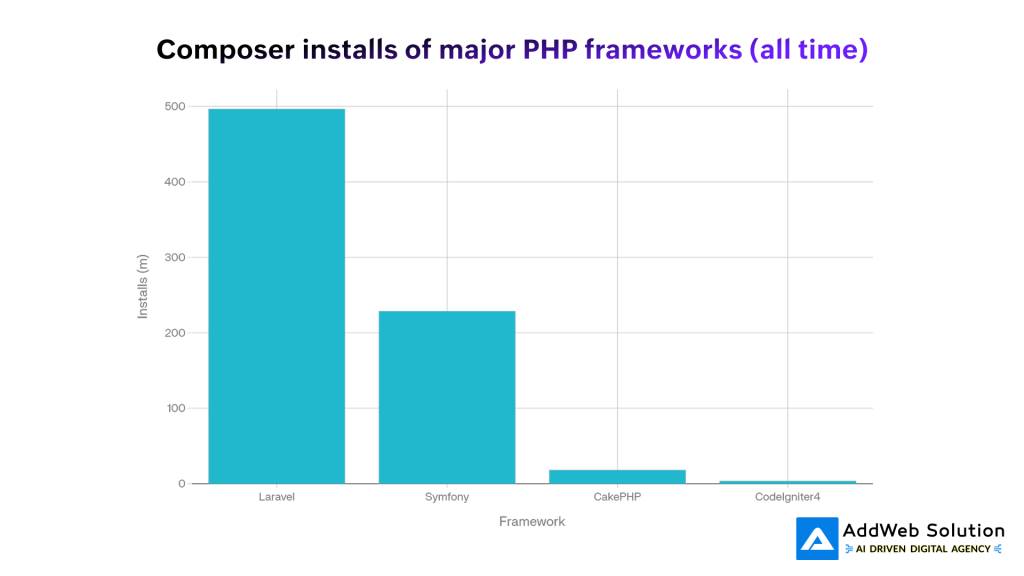
- Composer download stats show Laravel’s core framework with roughly 496 million installs on Packagist, more than double Symfony’s framework bundle and an order of magnitude above CakePHP and CodeIgniter.
- JetBrains’ Developer Ecosystem survey continues to list Laravel as the most popular PHP framework developers use regularly.
Visual 1: Laravel’s share among PHP frameworks
(Based on W3Techs data summarized within a 2024 market trends report.)
Laravel accounts for about a quarter of the PHP framework market; the rest is split across Symfony, CodeIgniter, CakePHP, Yii, and others.

Visual 2: Composer installs of major PHP frameworks (all-time)
Using Packagist install counts as a proxy for real-world adoption, Laravel clearly leads the PHP framework landscape, with Symfony, CakePHP, and CodeIgniter far behind in raw install numbers.
Why this matters for buyers:
When an acquirer sees “Laravel” in your stack, they immediately know:
- There is a large, active talent pool.
- The framework is mature, battle-tested, and not a dead end.
- Tooling, docs, and best practices exist for almost every common requirement.
That alone sets a very different tone in technical due diligence compared to “custom PHP framework from 2014” or a niche or homegrown stack.


3. Hidden Business Value #1: Lower talent and maintenance risk
Talent risk is one of the biggest hidden costs in any acquisition. Buyers don’t want a product they can’t staff.
Laravel’s talent pool is wide and growing
- Articles tracking Laravel hiring trends note that as of 2024, Laravel holds about 26% of the PHP framework market, which translates directly into a sizeable developer base.
- A 2025 SaaS-focused report highlights that SaaS companies are still aggressively hiring Laravel developers thanks to wide adoption, community support, and a strong ecosystem.
- The same report pegs the average Laravel developer salary in the US around 102,000 USD per year, reflecting strong and healthy demand rather than a thin or niche skill set.
From a buyer’s lens, this means:
- It is not hard to hire Laravel engineers in most major markets.
- There are plenty of agencies and partners who can step in if they want to outsource.
- They are not locked to your founding team for the product’s survival.
Why this makes your application easier to sell
A buyer’s internal due diligence often asks:
“If the core team leaves after the earn-out, can we still run and grow this thing?”
With a Laravel application, the honest answer is usually “yes” — and that’s incredibly valuable.
4. Hidden Business Value #2: Predictable architecture and faster due diligence
Laravel enforces a predictable way of building backend applications: MVC structure, clear routing, configuration conventions, and familiar directory layouts.
For an acquiring CTO or technical advisor, that means:
- Faster codebase orientation. They don’t waste hours just figuring out “how this thing is wired.”
- Standard patterns. Controllers, models (Eloquent), migrations, queues, jobs, events — all follow conventions.
- Reachable complexity. Even if your domain is complex, the framework structure itself is not exotic.
This has three direct business effects:
- Due diligence is cheaper and quicker. Reviewing a Laravel project usually takes fewer billable consultant hours than a messy custom stack.
- Red flags are easier to detect. Because the expected patterns are well-known, it’s easier for auditors to spot anti-patterns and areas of tech debt.
- Integration planning is more accurate. Buyers can estimate effort to integrate your app into their existing systems (auth, billing, logging, observability) with more confidence.
When a buyer is comparing two similar products, the one that takes a week, not a month, to understand is naturally more attractive.
5. Hidden Business Value #3: Ecosystem leverage instead of custom one-offs
Another angle buyers evaluate is how much of your functionality rests on proven packages and ecosystem tools versus risky one-off implementations.
Laravel shines here:
- The Laravel ecosystem — first-party tools like Horizon, Scout, Sanctum, Cashier, Jetstream, and a huge landscape of community packages — drastically reduces the need for reinventing the wheel.
- The Packagist stats and Laravel package ecosystem analyses show that Laravel-compatible packages are numerous and actively maintained, ensuring that typical business needs (payments, queues, search, permissions, admin panels) can piggyback on stable libraries rather than custom code.
From a buyer’s standpoint, an app that uses:
- Laravel Cashier instead of a custom Stripe integration,
- Laravel Sanctum/Passport instead of a custom auth protocol,
- Well-known admin panels (e.g., Filament, Nova) instead of a tangled custom admin,
feels safer. The risk of hidden bugs and security holes is lower, and the cost of extending or swapping parts is easier to forecast.
6. Hidden Business Value #4: Security, compliance, and cloud readiness
Compliance and security evaluations are non-negotiable for serious buyers, especially in finance, health, and B2B SaaS.
Laravel brings several “built-in” comforts to that conversation:
- First-class security features: CSRF protection, password hashing, rate limiting, encryption helpers, and battle-tested authentication scaffolding out of the box.
- Modern PHP versions: The Laravel community tends to adopt new PHP versions fairly quickly, which reduces the surface area of legacy vulnerabilities.
- Testability and CI-friendly design: Laravel integrates well with modern CI/CD, containerization, and cloud-native practices (Docker, Kubernetes, serverless PHP runtimes).
For a buyer, that often translates to:
- Shorter security review cycles.
- Easier mapping to compliance frameworks (ISO 27001, SOC 2, PCI-DSS) because many security controls can be satisfied by configuration plus policy, not major code rewrites.
- Confidence that the tech stack will keep receiving security patches, since Laravel and its dependencies are actively maintained.
7. How different stacks look through a buyer’s eyes
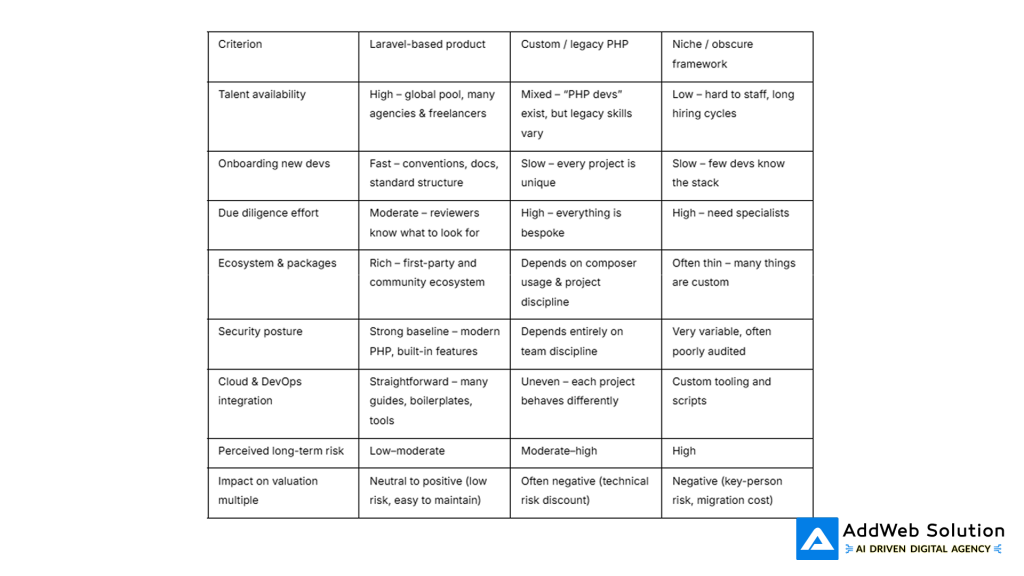
Here is a simplified comparison of how a typical buyer might view different backend stacks from a “sellability” standpoint:
Table: Buyer perception across backend stacks
8. What buyers actually look for in a Laravel application
The phrase “built with Laravel” is a good start, but it’s not enough on its own. Professional buyers will look beneath the label.
Here’s what they typically care about in a Laravel codebase:
- Framework hygiene
- Up-to-date Laravel version (or at least on a currently supported major).
- Minimal core hacks; features implemented via packages and extensions, not framework modifications.
- Clear separation of concerns between Controllers, Services, Models, and Jobs.
- Database & migrations
- All schema changes captured via migrations, no “migrations drift.”
- Reasonable indexing strategy and foreign keys.
- No business logic buried in database triggers without documentation.
- Domain logic organization
- Business logic moved into services, actions, or domain classes rather than bloated controllers.
- Clean use of Eloquent relationships and scopes rather than raw SQL sprinkled everywhere.
- Testing & quality
- A meaningful test suite (feature, unit, integration tests) running in CI.
- Static analysis / coding standards: PHPStan/Psalm, PHP-CS-Fixer or Laravel Pint.
- Limited use of facades in deep logic where dependency injection would be clearer.
- Security & configuration
- Secrets stored in .env or secret managers, not in code.
- Auth and authorization implemented using Laravel’s guards, policies, or gates.
- No obvious security anti-patterns (e.g., disabled CSRF, manual password hashing).
If your Laravel app checks most of these boxes, an acquiring team will see it as lower risk and cheaper to integrate, which naturally makes it easier to sell.
9. Making your Laravel application “acquisition-ready”
If you’re already on Laravel, you can intentionally shape your codebase to look attractive to future buyers. Think of it as “technical staging” for an exit.
9.1. Stabilize your stack
- Upgrade to a currently supported Laravel and PHP version.
- Standardize on core Laravel libraries and a small set of well-maintained community packages.
- Remove abandoned or redundant packages; replace them with mainstream alternatives.
9.2. Clean and document the architecture
- Introduce or refine a layered architecture:
- Controllers: request handling and orchestration.
- Services / Actions: business use cases.
- Models: persistence and domain relationships.
- Add a concise architecture overview document (one or two pages) explaining:
- Major bounded contexts or modules.
- How background jobs, queues, and events flow.
- How third-party services (payments, messaging, search) integrate.
9.3. Bring your database under control
- Ensure 100% of schema changes are represented as Laravel migrations.
- Normalize naming (tables, columns, indexes) and remove unused tables/columns.
- Create a short data model diagram or textual map of core entities and relationships.
9.4. Raise your quality bar
- Introduce or expand tests:
- Critical features covered by feature tests.
- Key domain logic covered by unit tests.
- Add static analysis (PHPStan/Psalm) to CI and fix high/medium severity issues.
- Enforce the official Laravel coding style using Pint or a similar tool.
9.5. Harden security and configuration
- Audit all configuration:
- Use environment variables and secret managers.
- Disable debug mode in production.
- Ensure HTTPS is enforced at the app or proxy layer.
- Leverage Laravel’s:
- Built-in authorization policies for sensitive actions.
- Password reset, email verification, and two-factor patterns where applicable.
9.6. Prepare “buyer-friendly” documentation
Create a lightweight, non-marketing technical pack you can hand over during due diligence:
- Tech stack overview (Laravel version, PHP version, key packages, infra).
- High-level architecture diagram.
- Deployment pipeline description (CI/CD, environments).
- Known limitations and technical debt areas (honesty here builds trust).
When a buyer sees a well-explained, well-structured Laravel application, you shift the conversation from “Can we maintain this?” to “How fast can we scale this?”
10. Example of a “visual content” structure for your blog post
Since you’ll likely repurpose this topic for your own blog or company site, here is how you might structure the visuals to keep the article engaging:
- Hero image (top of the article)
- Concept: Business leader and developer shaking hands above a dashboard with Laravel code and charts.
- Alt text: “Business and engineering alignment around a Laravel application’s metrics.”
- Figure 1 – Pie chart
- Title: Laravel’s share of the PHP framework market (2024)
- Content: Laravel vs Other PHP frameworks (26% vs 74%).
- Figure 2 – Bar chart
- Title: Composer installs of major PHP frameworks (all time)
- Content: Laravel vs Symfony vs CakePHP vs CodeIgniter install counts in millions.
- Table – Buyer perception across stacks
- Placed mid-article to summarize why Laravel stacks feel safer.
These visuals break up the text and lend credibility by anchoring your narrative in real numbers.
Start building smarter Laravel apps today! Scalable AI-powered features await your next release.

Pooja Upadhyay
Director Of People Operations & Client Relations
11. Bringing it back to business value
Underneath all the technical detail, the core point is simple:
- Buyers pay for predictability and lower risk.
- Laravel, as a mainstream, well-structured, well-documented framework with a large talent pool, reduces engineering and operational risk in an acquisition.
- If you pair Laravel with good engineering discipline, tests, documentation, and clean architecture, your product doesn’t just function well — it becomes a clean, investable asset.
In other words, when you choose Laravel and treat your codebase like something you might one day sell, you’re quietly compounding value long before any term sheet lands on your desk.
If you’d like, a next step could be to turn this into a founder-facing landing page or a pitch deck slide that explicitly markets your product as “Laravel-based and acquisition-ready,” positioned for investors and potential acquirers.
- https://packagist.org/packages/laravel/framework
- https://packagist.org/packages/symfony/framework-bundle
- https://packagist.org/packages/codeigniter4/framework
- https://packagist.org/packages/cakephp/cakephp
- https://blog.jetbrains.com/phpstorm/2024/09/laravel-trends-2024-the-latest-market-insights/
- https://laravel-news.com/state-of-laravel-survey-2024
- https://survey.stackoverflow.co
- https://survey.stackoverflow.co/2024/technology
