


Introduction
Building fast is no longer optional for founders. In a market where new ideas surface daily and investor pressure for “proof” hits earlier milestones, the prototyping process is now a strategic edge. But which approach delivers: custom code, visual builders, or a hybrid blend?
Startups in 2025 are increasingly merging the best of both worlds—leveraging the mature MERN stack (MongoDB, Express, React, Node.js) for control and scalability, and integrating modern No-Code tools for instant UI, workflows, and testing. This article explores how these approaches compare, when and how to hybridize, and what the latest data tells us about real-world outcomes.
Why Speed Matters More Than Ever
- Investor Expectations: Investors now expect to see a real, usable product at seed stage, not just wireframes or pitch decks.
- Customer Discovery: User feedback is faster if you iterate live, not on paper.
- Market Crowding: The edge goes to teams who deploy, test, and pivot in days, not quarters.
Graph: Prototype Development Time Comparison (2025)
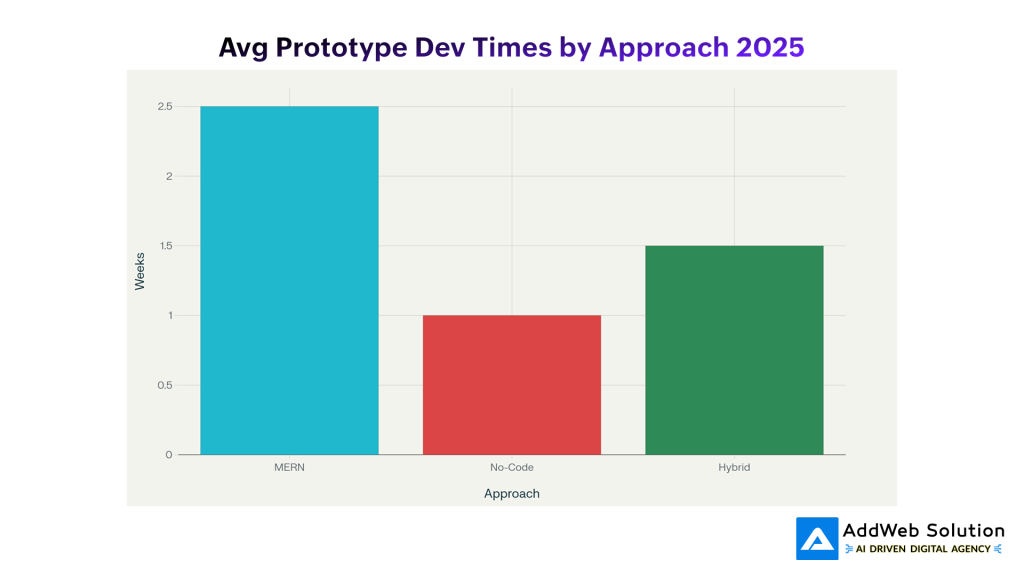
Average Prototype Development Time by Approach (2025)
| Approach | Avg Development Time (Weeks) |
| No-Code | 1 |
| Hybrid | 1.5 |
| MERN | 2.5 |
No-Code dominates on pure speed. But hybrid approaches narrow the gap sharply, blending instant builds with backend logic and future extensibility.
The Rise of Hybrid Prototyping: A New Standard in 2025
Hybrid prototyping means founders can:
- Drag-and-drop UI or workflow with No-Code tools (think: Bubble, Retool, WeWeb).
- Layer in custom MERN modules for crucial business logic, data integration, or advanced features.
- Swap out fragile No-Code blocks with robust code as the product matures.
Pie Chart: Startup Prototype Approaches (2025)
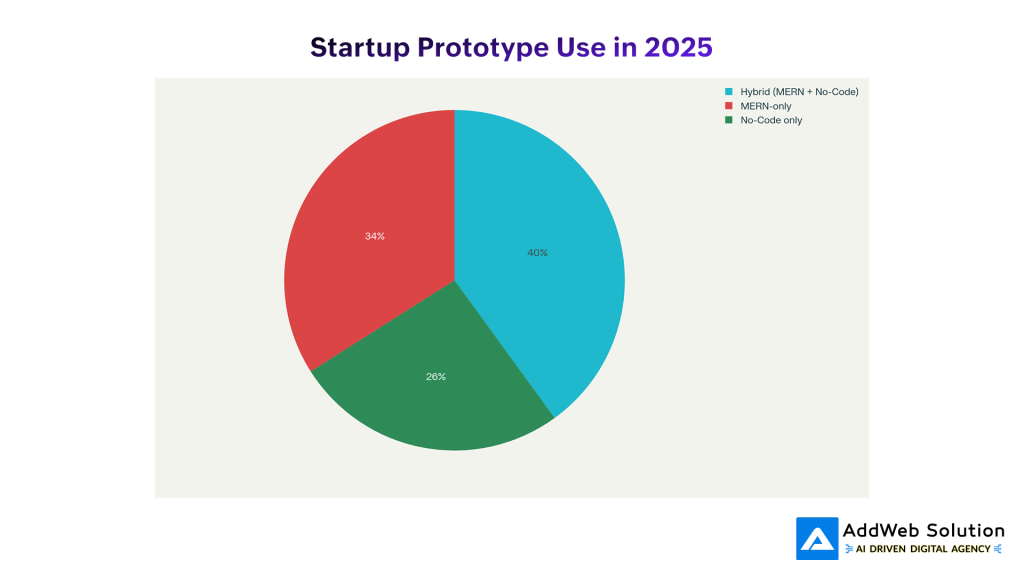
Startup Prototype Methods in 2025
| Method | Share (%) |
| MERN-only | 34 |
| No-Code only | 26 |
| Hybrid (MERN + No-Code) | 40 |
Hybrids have become the top choice for new startups, reflecting the value of flexibility and rapid validation.
What Each Method Excels At: A Comparative Snapshot
Feature Comparison Table
| Feature/Attribute | MERN | No-Code | Hybrid |
| Customization | High | Moderate | High |
| Speed | Fast | Instant | Very Fast |
| Scalability | Enterprise | Limited | Enterprise |
| Cost | Medium | Low | Medium |
| Flexibility | High | Low/Med | High |
| Learning Curve | Steep | Flat | Moderate |
| Ideal Use Cases | SaaS, AI, data-rich apps | MVPs, landing pages, workflows | MVPs, dashboards, complex validation |
Graph: Feature Scoring: MERN vs No-Code vs Hybrid (2025)
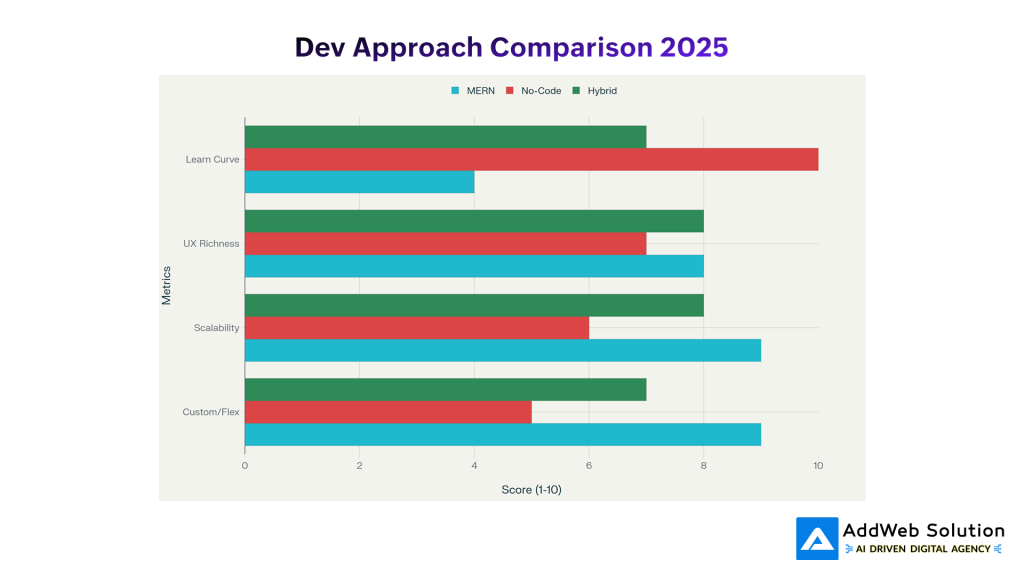
Feature Comparison: MERN vs No-Code vs Hybrid (2025)
How a Typical Hybrid Build Works
- Ideation: Start with a visual builder for landing page, contact flows, and basic app shell.
- Code Injection: Integrate MERN APIs for auth, real-time data, or custom backend logic.
- Iteration: Use No-Code for A/B tests, quickly tweak UI/UX based on user feedback.
- Scale Up: As traction grows, migrate high-use or mission-critical components fully to MERN for robustness and control.

Additional
Read

- The Ultimate Zoho Guide for Small Business Owners
- The Ultimate Guide to Zoho CRM and How It Can Help Your Business Succeed
Case Studies: Hybrid Wins in 2025
Fintech MVP
- Used Bubble for UI and basic workflows.
- MERN modules powered secure KYC, analytics, and real-time notifications.
- Result: Launched investor-ready MVP in 3 weeks; easily swapped out visual components for high-scale React as user base grew.
EdTech Startup
- No-Code for course management dashboards and basic user flows.
- Custom MERN for video streaming, AI-based recommendations, and progress tracking.
- Rapid feedback cycle: UI changes happened daily in No-Code, engine logic evolved in parallel.
SaaS AI Tool
- Visual No-Code front-end for onboarding and settings.
- MERN microservices for data crunching, ML model inference, and serverless API endpoints.
- End result: Fast investor pitches, continuous delivery, and codebase ready for Series A scaling.
Risks and Limitations: What to Watch
- Data Silos: Mixing platforms can fragment analytics; implement unified data layers early.
- Handoff Hurdles: Migrating from No-Code to full code needs foresight—modular design helps.
- Performance Caps: No-Code UIs may lag under heavy loads; hybrid lets you shift to code as needed.
Table: No-Code vs Hybrid (Pitfalls and Safety Nets)
| Pitfall | No-Code Only Risk | Hybrid Mitigation |
| Vendor Lock-in | High | Switch UI, keep data layer |
| Scale Ceiling | Quickly reached | Swap bottleneck for MERN |
| Custom Integrations | Limited | Direct code when required |
| API or Security Gaps | Possible | Code modules fill gaps |
| Future Talent Recruitment | Hard | Standardized (JS) codebase |
Adoption Trends & Ecosystem Stats
- MERN Developer Ecosystem: One of the largest open-source communities worldwide; thousands of GitHub packages and active contributors.
- No-Code/Low-Code Platforms: Market to reach $29.5B by 2025; top tools include Bubble, Adalo, Make, Retool, Glide, and Softr.
- Hybrid Demand: 68% of surveyed founders in 2025 report using at least one hybrid (code + visual) tool to get a user-ready MVP live.
When to Use What: Decision Matrix
| Prototype Goal | Best Fit | Why? |
| < 1 week MVP | No-Code / Hybrid | Fastest build, test in market quickly |
| Investor Demo | Hybrid / MERN | Control + slick UI = credibility |
| Complex Data/AI | MERN / Hybrid | Custom models, advanced integration |
| Growth Hacking | Hybrid | Change campaigns instantly |
| B2B / Compliance Heavy | MERN | Security, scale, control |
Real-World Startup Quotes
“If we hadn’t started with a hybrid approach, our MVP would have taken two extra months. Instead, we wowed investors early, then swapped critical flows to custom code as we grew.”
— CTO, Series A SaaS Startup
“No-Code gave us wings, but hybrids let us land safely. We keep the agility but now scale without barriers.”
— Founder, EdTech AI
Visual Roadmap: Evolving from Idea to Scale
Hybrid Workflow Flowchart:
- Ideate 🚀 → 2. Drag & Drop MVP (No-Code) 🧩 → 3. Plug MERN APIs 🔌 → 4. User Feedback 🔄 → 5. Swap to Code for Scale ⚙️
Beyond 2025: The Future of Hybrid Prototyping
- AI-Driven Builds: LLMs and auto-code tools generate code blocks based on user stories, further closing the gap.
- Universal Integrations: Seamless components for payments, auth, and analytics as visual and code tools converge.
- Edge and Mobile: Serverless MERN and mobile-first No-Code solutions power global-ready apps faster than ever.
Launch your MVP faster with MERN and No-Code.

Pooja Upadhyay
Director Of People Operations & Client Relations
Conclusion
Hybrid approaches with MERN and No-Code aren’t a trend, they’re the new foundation for ambitious startup prototyping. Founders are able to validate, impress, and ship at record speeds, then grow without having to rebuild from scratch. The synergy between custom code and visual builders means you can optimize for both velocity and future-proofing.
For 2025 and beyond, startups that marry agility with deep customization will stand out to users, investors, and even future talent.
Looking for expert help in hybrid prototyping or scaling your MVP? Teams like Addweb Solution (www.addwebsolution.com) specialize in rapid, risk-free builds combining all the newest tools, reaching out to turn your next idea into a launch story.
- https://www.castelis.com/en/news/custom-development/comparison-of-full-stack-code-generators-and-no-code-low-code-platforms/
- https://www.geeksforgeeks.org/blogs/the-future-of-mern-stack/
- https://edure.in/mean-stack-vs-mern-stack-which-tech-stack-to-choose-in-2025/
- https://www.mongodb.com/resources/languages/mern-stack
