


“The Setup: AI Isn’t Coming to Websites Anymore – It’s Already Here”
AI adoption hit 54.6% among US workers in 2025, up 10 points in one year. South Korea’s at 81.4%. Meanwhile, 65% of new applications will be built on low-code platforms by 2026. The market is exploding: $28.75 billion today, $264 billion by 2032.
But here’s the tension: Not every business needs “simple.” Some manage 50 brands in 12 languages. Some need AI that stays on-premise, with human approval workflows. Plug-and-play builders start looking insufficient.
Enter Drupal 2026. It’s not the Drupal you knew five years ago.
The AI Adoption Crisis (and Opportunity) for Website Builders
The Data Behind the Shift
Let’s ground this in numbers, not hype.
Global AI user base crossed 378 million in 2025 – the largest jump ever recorded. Corporate AI adoption in North America hit 62%, with businesses using AI across five or more business functions (8x the rate in 2022). And here’s the kicker: AI-driven website visitors convert 4.4x better than organic search traffic

The geographic disparity matters. UAE leads at 64% adoption, Singapore at 60.9%, South Korea at 81.4% – but Latin America sits at 28%, and parts of Africa at 6-8%. This creates a weird business moment: Your enterprise clients expect AI on their websites. Your smaller markets are still building traditional CMS sites. You need a platform that can handle both.
The Low-Code Explosion (And What It Means)
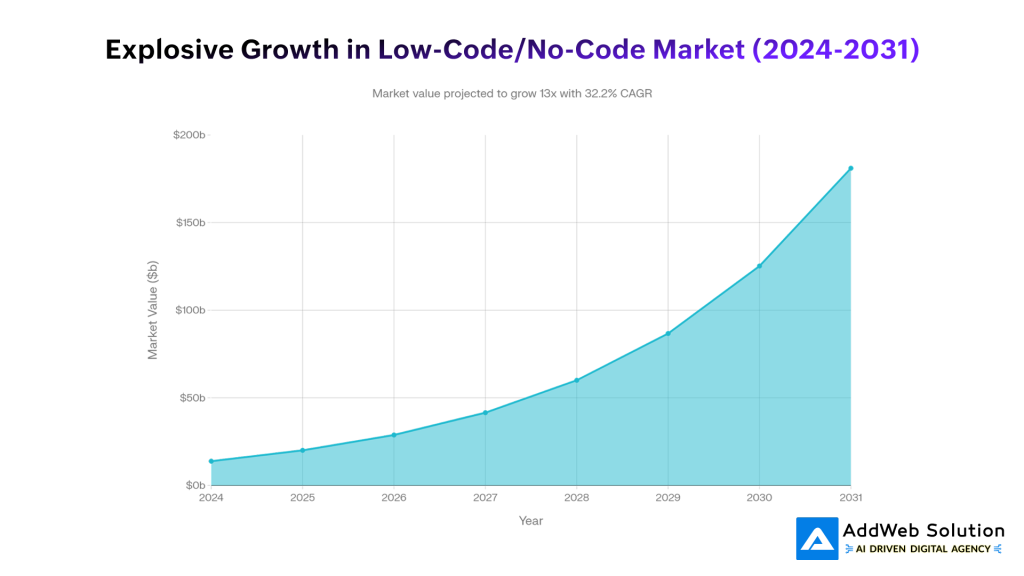
The low-code/no-code market grew from $13.8 billion in 2024 to $28.75 billion in 2026. That same market hits $187-264 billion by 2031-2032. More relevantly: 500 million applications will be built on no-code platforms by 2026. Seventy-five to eighty percent of new enterprise applications will use low-code or no-code by 2026 – up from 25% in 2020.
What does this mean for websites? It means the era of “plug in a third-party widget and call it AI” is ending. Enterprises now expect:
- AI that generates content in brand voice
- AI agents that orchestrate workflows across multiple systems
- AI that works offline or on-premise (not just cloud)
- Full visibility into what AI did, why, and how to reverse it
- Multi-brand governance without rebuilding the wheel
The Plug-and-Play Ceiling
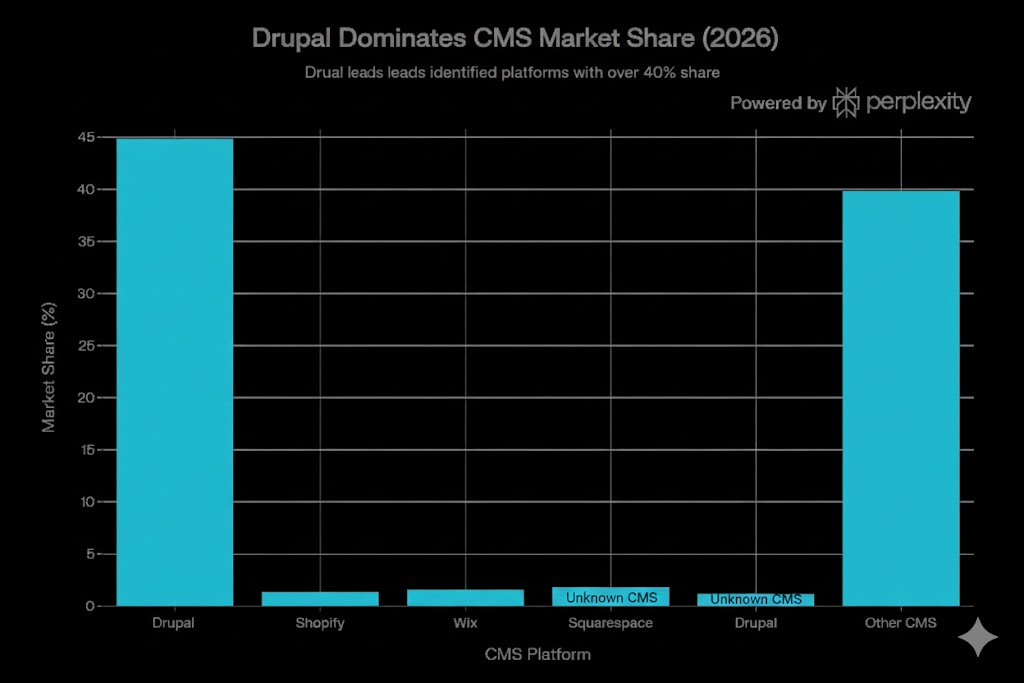
WordPress powers 43.5% of websites. Shopify dominates e-commerce at 6.2% of the web (and 26% of online stores). Wix hits 3.9%, Squarespace 3%. Drupal? 0.7%.
But – and this is important – Drupal’s market share per se doesn’t tell the story. Look at the type of websites. According to data, high-traffic enterprise sites use Drupal disproportionately more than consumer builders. Drupal powers millions of pages for Fortune 500 companies, federal agencies, and enterprise publishers.
The split is clear: Consumer builders win on ease and affordability. Enterprise CMS win on control, customization, and AI integration.


What Changed in 2026 (And Why Drupal Suddenly Matters)
Drupal CMS 2.0: A 24-Year Platform Finally Gets the Update It Needed
At DrupalCon Vienna in October 2025, Dries Buytaert (Drupal’s founder) delivered what many are calling the most significant keynote in the platform’s 25-year history. Three announcements dominated:
- Drupal Canvas 1.0 (visual page builder, RC now, full release November 2025)
- Drupal CMS 2.0 (launching January 2026 – potentially on Drupal’s 25th birthday)
- Drupal AI Initiative ($1 million raised, 22 agency partners funding it)
Let that sink in. The largest AI investment Drupal has ever seen. A $1M war chest to embed AI directly into the platform’s core, not as a plugin.
What This Means: Experience Builder (Canvas) Meets AI Agents
The flagship innovation is the Canvas AI Assistant. Here’s what it does:
You type a natural language prompt: “Create a section showing three key features of my product.”
The AI agent:
- Scans your site’s library of pre-built components
- Selects the right ones
- Arranges them intelligently
- Drops them onto your page
No coding. No hiring a developer. No waiting three weeks.
But unlike Wix’s AI builder or WordPress’s Elementor Pro, this runs on Drupal’s industrial-strength backend. Which means:
- Multi-site governance built in (manage 100 sites, 50 brands, one control center)
- Security that passes federal audits (30-person security team, government-grade compliance)
- Performance that doesn’t degrade under 10,000 concurrent users
- Structured data and AI agent optimization baked in (not bolted on)
The Site Templates Shift: 40% Faster Launch
Drupal CMS 2.0 ships with industry-specific Site Templates. Pre-built, composable starting points for:
- E-commerce
- Media publishers
- B2B SaaS
- Financial services
- Government agencies
Why this matters: Implementation time drops ~40%. Marketers can spin up new campaigns in hours instead of months. Junior developers can configure templates without understanding Drupal’s guts.
It’s the low-code philosophy applied to enterprise CMS.
Performance, Security, and the “Drupal Crushes Everything Else” Numbers
The Backend Reality Check
Let’s talk numbers. In a head-to-head test by Tag1, comparing Drupal CMS to WordPress out-of-the-box:
| Metric | Drupal | WordPress |
| Backend execution time | 29.3 milliseconds | 182.6 milliseconds |
| Function calls per request | 7,178 | 34,711 |
| Memory usage | 5.3 MB | 7.9 MB |
| Database queries | 4 | 27 |
Drupal wasn’t just faster – it was 6x faster. Function calls were 80% lower. Under high load, Drupal delivered 22% better performance.
Why? Drupal’s caching architecture is 20+ years old and relentless. Immutable caches, dynamic page cache, block-level caching – it stacks them all. WordPress relies on plugin-based caching (Redis, Memcache), which adds complexity.
For a website running millions of page views, that’s the difference between $50K/month in infrastructure and $150K/month.
Enterprise Security: Why Fortune 500s Choose Drupal
Here’s what you don’t see in WordPress or Shopify marketing:
- 30-person dedicated security team reviewing every line of code
- Government-grade compliance: FISMA, FedRAMP, SOC 2, HIPAA-ready
- User role granularity: Not just “Admin / Editor / Viewer.” Drupal supports 100+ custom roles with permission matrices that would make a CISO weep.
- Structured access control: Multi-tenant, multi-language, multi-brand, with fine-grained permissions per node, per field, per user.
Shopify? You get what Shopify gives you. You trust Shopify’s infrastructure, their security, their decisions.
Drupal? The code is open. Thousands of eyes. Community review. Your own security team can fork, audit, and customize if needed.
Real-World Scaling: Millions of Users, Hundreds of Thousands of Pages
Drupal powers:
- The Economist, managing 100K+ articles across 12 languages
- The Victoria & Albert Museum, handling millions of artifacts and public queries
- Federal.gov, managing 10,000+ agency websites under one governance model
- Multiple Fortune 500 financial services firms, processing millions of account holders per day
WordPress can scale these. Shopify can scale e-commerce. But ask them to manage 50 brands in 8 currencies with multi-level approval workflows and AI agents that optimize content for ChatGPT and Google and voice search simultaneously?
That’s where Drupal enters a different category.
Supercharge Your Content With Drupal AI

Pooja Upadhyay
Director Of People Operations & Client Relations
The Drupal AI Arsenal (Canvas + Agents + Framework)
Three Layers of AI, Each Solving a Different Problem
Drupal CMS 2.0’s AI strategy isn’t a single tool. It’s three layers:
Layer 1: Canvas AI Assistant (Visual)
- Natural language page building
- Component library scanning and selection
- Real-time responsive previews
- Human-in-the-loop approval workflow
Layer 2: AI Agents (Autonomous)
- Content generation and SEO optimization
- Image processing with auto alt-text
- Multi-page consistency checking and updates
- Brand voice enforcement across the site
Layer 3: Drupal AI Framework (Extensible)
- Open integration layer supporting OpenAI, Anthropic, Google Gemini
- Self-hosted model support (Ollama, LMStudio) for data sovereignty
- Content personalization based on user behavior
- Semantic search powered by embeddings
- Custom AI module development
Acquia Source: The Managed SaaS Version
If you don’t want to run Drupal yourself, Acquia (the company behind Drupal) launched Acquia Source in December 2025 – a fully managed, AI-powered SaaS CMS.
Three new AI agents shipped immediately:
- Content Creation Agent: Generates on-brand content from prompts or existing assets
- SEO Optimization Agent: Auto-tags, rewrites for search, updates metadata
- Governance Agent: Checks compliance, enforces brand guidelines, flags outdated content
Early customers report 40-60% reduction in content operations overhead.
Real Example: Why This Matters
A global luxury brand manages 12 region-specific websites in 8 languages. Their challenge: A price drop on a key product needs to update across 96 product pages, in different currencies, with region-specific promotions.
With Shopify? Manual edits on each storefront, or hope your developer scripts it right.
With Drupal CMS 2.0? Context Control Center learns the price change, an AI agent scans all 96 pages, proposes updates (with human review), and deploys atomically across all sites. A 2-hour task becomes 20 minutes, with zero human error.
That’s real cost savings. That’s the enterprise AI story.
Where Drupal Fits (And Where It Doesn’t)
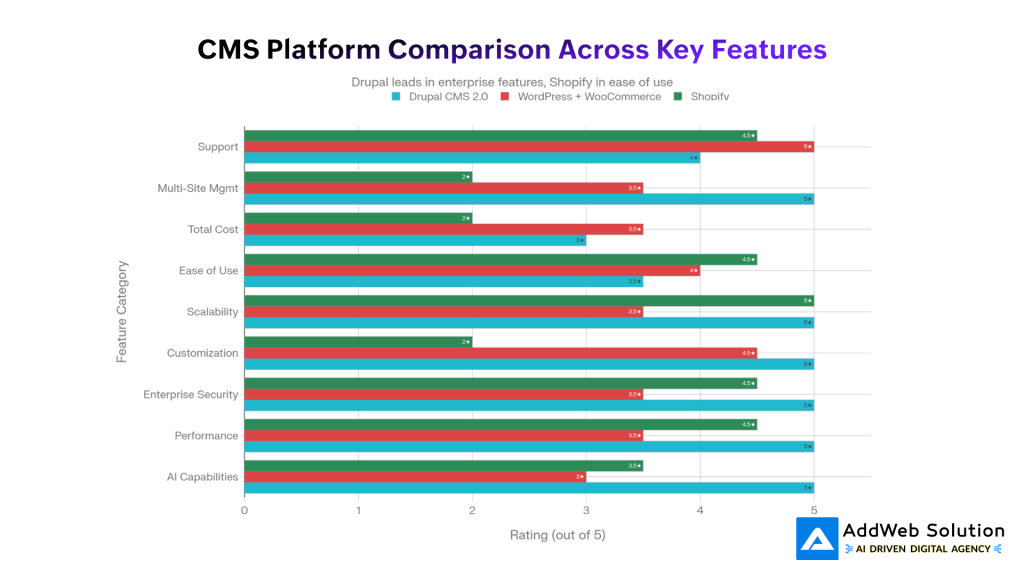
Drupal Wins When You Have:
- Multiple brands or sites (5+): Governance, centralized content hubs, cross-site component reuse
- Complex workflows: Multi-level approval, role-based dashboards, integration with CRM/marketing automation
- High-traffic requirements: Millions of page views, thousands of concurrent users, strict performance SLAs
- Enterprise security needs: On-premise hosting, data sovereignty, custom auditing, role granularity
- Content complexity: 100K+ pages, multilingual, complex content models, media-rich experiences
- Long-term roadmap: You need a platform that evolves with your business, not one owned by a single company
Shopify Wins When You Have:
- E-commerce focus: Built-in payments, inventory, shipping integrations
- Rapid launch requirement: 48-hour setup, not 48-day implementation
- Budget constraints: $30-300/month, not $100K+ annual development
- Hands-off preference: Let Shopify handle scaling, security, uptime
WordPress (+ WooCommerce) Wins When You Have:
- Content-heavy, smaller scale: Blogs, publications, small e-commerce
- Plugin ecosystem preference: 60,000+ free/premium plugins
- Abundant freelancer availability: Every WordPress developer is affordable
- Simplicity first: You want to “set it and forget it”
Conclusion: The Future Isn’t Plug-and-Play Anymore
If you’re building a website in 2026 and you think about it for 30 seconds, AI is on your checklist. It has to be.
But here’s what’s becoming clear: AI on websites isn’t monolithic. Consumer AI (ChatGPT, Claude) is powerful but generic. Enterprise AI needs:
- Control: Over models, data, governance, approval workflows
- Scale: Millions of users, hundreds of sites, zero performance degradation
- Integration: With existing systems, workflows, brand guidelines, compliance rules
- Customization: Because no two enterprises are identical
Plug-and-play builders (Shopify, Wix, Squarespace) optimized for speed and simplicity. They’re excellent for what they do. But when you need enterprise AI – AI that orchestrates workflows, learns your brand voice, respects your governance model, and lets you own your data – you move into a different category.
Drupal CMS 2.0, launched January 2026, is Drupal’s answer to that question. It’s not a complete replacement for Shopify (which handles e-commerce better) or WordPress (which has more plugins). It’s a third answer: enterprise CMS with AI as infrastructure, not an afterthought.
For agencies, for enterprises, for anyone scaling beyond “one site” to “a digital ecosystem” – Drupal’s 2026 update isn’t something to ignore.
Source URLs
- https://explodingtopics.com/blog/ai-statistics
- https://www.mckinsey.com/capabilities/quantumblack/our-insights/the-state-of-ai
- https://www.microsoft.com/en-us/corporate-responsibility/topics/ai-economy-institute/reports/global-ai-adoption-2025/
- https://www.stlouisfed.org/on-the-economy/2025/nov/state-generative-ai-adoption-2025
- https://www.drupal.org/about/core/policies/core-release-cycles/schedule
- https://www.drupal.org/project/cms/releases
- https://colorlib.com/wp/website-builder-market-share/
