


“Drupal 11 is not just another upgrade-it’s the point where a lot of organizations will finally outgrow their legacy CMS and look for a platform that matches how they actually build experiences now.”
If your CMS feels more like a bottleneck than a backbone, you’re not alone. Teams everywhere are discovering that the system they picked years ago simply can’t keep up with how they build, market, and scale digital experiences today.
Drupal sits in an interesting spot in this landscape: it doesn’t own the biggest market share, but it quietly powers some of the most demanding, high-traffic, compliance-heavy websites in the world. According to W3Techs, Drupal is used by about 1.0% of all websites whose CMS is known (0.7% of all websites), yet Acquia estimates roughly 1 in 8 enterprise websites run on Drupal-exactly the kind of projects where flexibility, security, and integration depth matter most.
So how do you know when it’s time to migrate to Drupal-and not just patch your current system one more time?
Let’s walk through the seven clearest signs, backed by real data and real-world patterns we see in enterprise projects.
The Drupal Landscape in 2024–2026
Drupal’s usage looks small if you only glance at global CMS share-but that misses the story.
W3Techs shows Drupal powering about 1.0% of all sites where a CMS is detected and 0.7% of all websites overall as of March 2026. Those numbers are modest compared to mass-market platforms, yet Drupal’s adoption is heavily concentrated in government, education, media, and large enterprises that need deep customization, integrations, and governance.
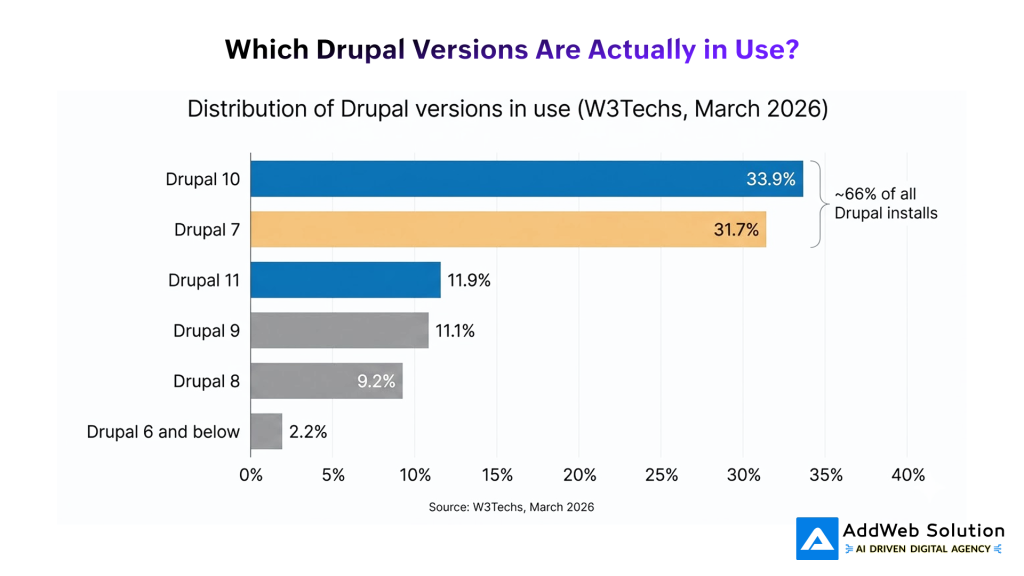
A surprisingly large chunk of sites still run on Drupal 7 or even older releases-despite clear end-of-life timelines and the availability of more secure, more performant versions.


Why Organizations Outgrow Their Current CMS
It rarely starts with a dramatic failure. Instead, pain builds up in three areas:
- Workflows slow down. Storyblok’s State of CMS 2023 report found 22.5% of respondents say their current CMS workflows are “difficult” or “very difficult,” with time-consuming processes as the top issue.
- Security anxiety increases. In the same research, 23% of users cited security issues as a main reason to look for a new CMS, and 18% mentioned the challenge of learning new systems and stacks.
- Downtime suddenly has a very real price tag. Recent downtime studies show average costs above 14,000 USD per minute for midsize and large organizations, with more than 90% of companies reporting that a single hour of downtime now costs over 300,000 USD.
That’s the backdrop against which a Drupal migration either becomes a smart optimization-or a non-negotiable risk decision.
Seven Signs It Is Time to Migrate to Drupal
1. You’re sitting on an end-of-life (or nearly EOL) CMS
If your CMS vendor or project has announced end-of-life, you’re essentially running your digital front door on unsupported software.
- Drupal 7 support officially ends on 5 January 2025, which means no regular security updates and a shrinking ecosystem of modules and expertise.
- Many proprietary and legacy CMSs show similar patterns-minimal updates, vague security roadmaps, and thin documentation-often called out as a top migration trigger in CMS re-platforming guides.
Moving to Drupal 10 or 11 brings you back under an active security team, clear release cadence, and a community plus commercial backing (notably from Acquia) focused on long-term sustainability.

2. Security incidents and compliance conversations are happening too often
If security and compliance teams keep bringing your CMS into risk reviews, that’s a strong sign you’ve outgrown your platform.
Storyblok’s research shows security issues are cited as a main reason to change CMS by 22–23% of respondents globally and in regional reports. Legacy stacks with outdated modules, custom code nobody fully owns, and limited patching routines create a wide attack surface-especially problematic for government, healthcare, and finance.
Drupal’s security model-backed by a dedicated security team, public advisories, and a strong review culture-is one of the reasons it’s so popular in high-assurance environments. Acquia explicitly positions its platform as “the world’s most secure and scalable platform for Drupal,” and points to deployments across brands like Johnson & Johnson, Bayer, and large public transit authorities as proof.
What this looks like on the ground:
- Security reviews repeatedly flag CMS components.
- Pen tests keep surfacing plugin/module vulnerabilities that are hard to patch.
- Compliance teams struggle to map your CMS setup to frameworks like GDPR, HIPAA, or government security baselines.
At that point, “let’s just upgrade the same platform” usually isn’t enough.
3. Your content team is fighting the CMS daily
You can feel this one without any analytics. Editors complain. Campaigns slip. “Can we please get rid of this CMS?” becomes a recurring theme.
Storyblok’s State of CMS 2023 found:
- 22.5% of respondents say their current CMS workflows are difficult or very difficult.
- Time-consuming processes are the most commonly cited issue pushing users away.
In Australia-specific research, 38% of respondents highlighted time-consuming processes, 22% flagged security issues, and 15% pointed to the need to learn new tech stacks as the key reasons they changed CMS.
On the flip side, modern Drupal setups-especially with low-code tools like Acquia Site Studio-give editors drag-and-drop layouts, reusable components, and strong preview capabilities, while still respecting roles, permissions, and brand guardrails.
You’ll feel the difference when:
- Marketers can launch landing pages without booking developer time.
- Localization and A/B tests become routine, not “special projects.”
- The editorial experience starts to feel closer to a design system than a static page builder.
4. Performance and uptime make everyone nervous
The more your revenue depends on digital, the more expensive “small” outages become.
A 2026 analysis of IT downtime data estimates average costs above 14,000 USD per minute for midsize and large organizations, with more than 90% reporting over 300,000 USD in losses for a single hour-long outage. Other sector-specific studies show online publishers losing tens of thousands of dollars in ad or subscription revenue from even short incidents.

Meanwhile:
- Legacy CMSs often sit on single-region hosting, manual scaling, and minimal caching.
- Modern Drupal environments on platforms like Acquia Cloud are designed for global traffic, autoscaling, and enterprise-grade SLAs, and are used to deliver high-profile events and transit systems.
A good litmus test:
If each new campaign or traffic spike prompts “will the site hold?” conversations, you’re probably holding onto the wrong CMS.
5. You want omnichannel content, but your CMS still thinks in pages
Content is no longer “the website.” It’s:
- App screens
- Digital signage
- Chatbots
- Partner portals
- Smart devices
Storyblok’s State of CMS 2023 reports that 36% of businesses already use a headless CMS to manage content centrally and publish to multiple channels, and notes a small but clear shift from monolithic to headless setups between 2022 and 2023. The same research points out that monolithic architectures force 57% of users to juggle multiple CMSs at once.
Drupal is comfortable in both worlds:
- As a traditional CMS with flexible templates.
- As an API-first, headless content hub that feeds apps, signage, and external systems.
Acquia cites, for example, the New York Metro Transit Authority using Drupal to push content to more than 1,800 signs across 400 stations. That’s not just a website; it’s operational information, updated in near real time.
If your current CMS “could maybe do headless someday with a plugin,” that’s already a warning sign.
6. Integrations and data flows feel brittle or impossible
Most digital teams now live in an ecosystem:
- CRM / CDP
- Analytics and event tracking
- Search and recommendations
- Personalization engines
- Payment, identity, and third-party services
Older or proprietary CMSs can become a dead-end here. Integration guides read like science projects. APIs are limited. Every new connection needs a custom, fragile patchwork.

Drupal’s open, composable design and more than 50,000 integrations and modules mean there’s usually a well-trodden path to connect with major enterprise tools. You’re not starting from scratch each time.
A few tell-tale symptoms:
- “We can’t get the data we need out of the CMS” becomes a common complaint.
- Marketing wants to test a new tool, but the CMS is the blocker.
- Your architecture diagrams show a spaghetti of point-to-point integrations centered around a rigid core CMS.
That’s when migrating to a Drupal-based architecture stops being just a CMS decision and becomes a broader integration strategy.
7. Total cost of ownership keeps rising, but value doesn’t
Licensing, specialist developers, firefighting, and “we can’t do that right now” conversations all add up.
CMS migration checklists consistently mention:
- Outdated and unsupported platforms.
- Growing security incidents.
- Poor usability for editors.
- Inability to integrate with new systems.
Those are all just different faces of an unhealthy total cost of ownership (TCO).
With Drupal you typically get:
- No core license fees.
- A broad implementer ecosystem instead of one locked-in vendor.
- Optionally, a fully managed enterprise platform (e.g., Acquia Cloud) to offload infrastructure, security hardening, and DevOps.
Acquia highlights Mars as an example: the company used Drupal and Acquia to launch 55 brand sites in 10 months and cut brand site development time by 20–40%, illustrating both speed and economies of scale.
When you add up platform licenses, delays, downtime, and missed opportunities, “doing nothing” often proves far more expensive than a structured Drupal migration.
Why Teams Switch CMS Platforms
Let’s quantify what’s really pushing teams to re-platform.
Storyblok’s Australian State of CMS report surfaces three leading reasons for CMS change: time-consuming processes, security issues, and the need to learn a new system or tech stack.
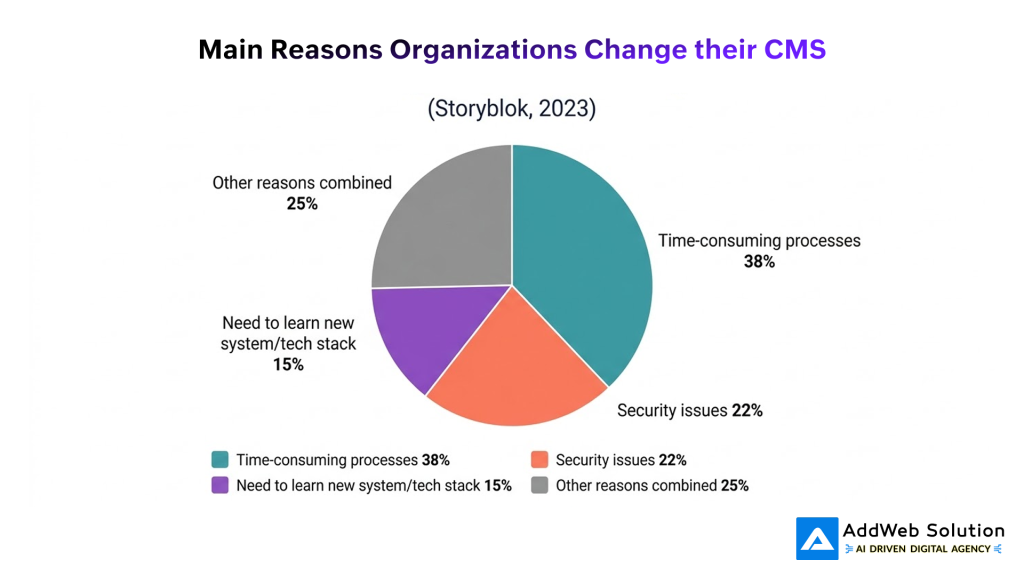
If your internal complaints mirror those three categories, you’re in the statistical mainstream of teams preparing to move.
Legacy CMS vs Modern Drupal Stack
Now let’s put a “before vs after” picture on the table.
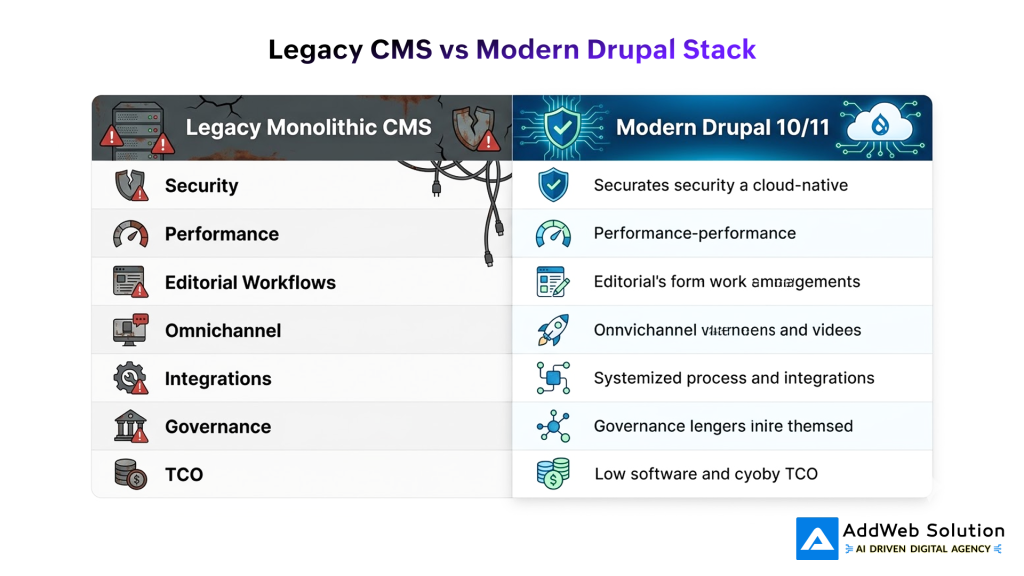
If your “current” column looks uncomfortably familiar, the migration conversation is less about “if” and more about “when and how”.
Final Takeaway: When Drupal Becomes the Obvious Next Step
If you recognize yourself in most of these patterns-
- an end-of-life or stagnating CMS,
- security and compliance worries,
- frustrated editors and slow publishing,
- brittle integrations and limited omnichannel reach,
- rising costs with flat or declining value-
then “waiting one more year” usually just increases the migration bill.
Migrating to modern Drupal (10 or 11), ideally on top of a robust platform and with an experienced implementation partner, shifts the conversation from “What can we still get away with on this CMS?” to “What do we want our digital experience to look like in three years?”
That’s the inflection point where Drupal stops being just another CMS option and starts looking like an upgrade to your entire digital operating model.
At AddWeb Solution, this is exactly the kind of transition we help teams manage-balancing SEO, performance, security, content velocity, and stakeholder change management so the move to Drupal feels like an accelerator, not a disruption
Source URLs
- https://w3techs.com/technologies/details/cm-drupal
- https://www.drupal.org/project/usage
- https://www.drupal.org
- https://www.storyblok.com/mp/state-of-cms-2023
- https://www.storyblok.com/lp/state-of-cms-2023-global
- https://cmscritic.com/storyblok-publishes-reports-on-the-state-of-cms-in-2023-reveals-insights-on-us-and-global-markets
- https://www.atlassian.com/incident-management/kpis/cost-of-downtime
Turn Drupal into a complete digital experience platform

Pooja Upadhyay
Director Of People Operations & Client Relations
