


“A composable DXP entails more than just product modularity and API‑based integrations; it’s about delivering contextualized digital experiences at scale.”
Introduction: When “Scheduled Downtime” Stops Being Cute
Picture this: it’s quarter-end, your sales team has a paid campaign live in five regions, and your main product site throws a 503 because the CMS migration ran long.
In 2025, average website downtime across industries costs around 14,056 USD per minute, and jumps to 23,750 USD per minute for large enterprises – contributing to an estimated 400 billion USD in annual losses for Global 2000 companies. That’s not just “some IT problem”; it’s a material hit to revenue, reputation, and board-level confidence.
At the same time, the CMS landscape is shifting fast. Drupal alone powers roughly 1.7 million active websites and about 360,000 live sites, making up around 1.5% of all websites and 12.8% of the world’s top 10,000 sites – a clear signal that it’s a serious enterprise player, not a niche platform. With Drupal 7 reaching end of life in January 2025 and Drupal 11 now in play, many organizations are migrating under time pressure.
So the real question isn’t “Should we move to Drupal?” It’s: “How do we move to Drupal without breaking anything people care about?”
Why zero-downtime matters for enterprise Drupal migrations
Enterprises aren’t just moving to Drupal because it’s open source; they’re moving because their current CMS is slowing down content velocity, integrations, and experimentation.
A 2026 CMS modernization report from Contentstack found that 89.7% of surveyed digital experience professionals expect their companies to increase CMS spend over the next 12 months, and that only 23% use a single CMS – 53% run two and 22% juggle three or more. This fragmentation is exactly why migrations are now framed as business transformation projects, not “IT upgrades.”
At the same time, modern CMS stats show that 61% of teams still use more than one CMS, while 2025 saw a 20% increase in single‑CMS adoption as companies look to simplify workflows and cut maintenance overhead. In other words, leadership wants fewer platforms, fewer outages, and faster go‑to‑market – and your Drupal migration is expected to deliver all three.

When you overlay this with Drupal’s strengths – security, structured content, API‑first capabilities, and proven use in government and large enterprises – it’s no surprise it’s the destination platform for many of these modernization journeys.
But recognizing the “why” is only half the job. To achieve zero downtime, you need to rethink how you move.


Architecting a zero-downtime Drupal migration (with comparison table)
A zero-downtime migration is not a fancy label for “fast cutover.” It’s a deliberate combination of:
- Parallel run architecture (old CMS + Drupal live side by side)
- Blue‑green or canary release patterns at the infrastructure level
- Near real-time content sync between legacy and new platforms during the transition
- Feature flags and routing rules to control who sees what, when
Done right, your business users barely notice the moment of switch – except that everything feels faster and easier to manage.
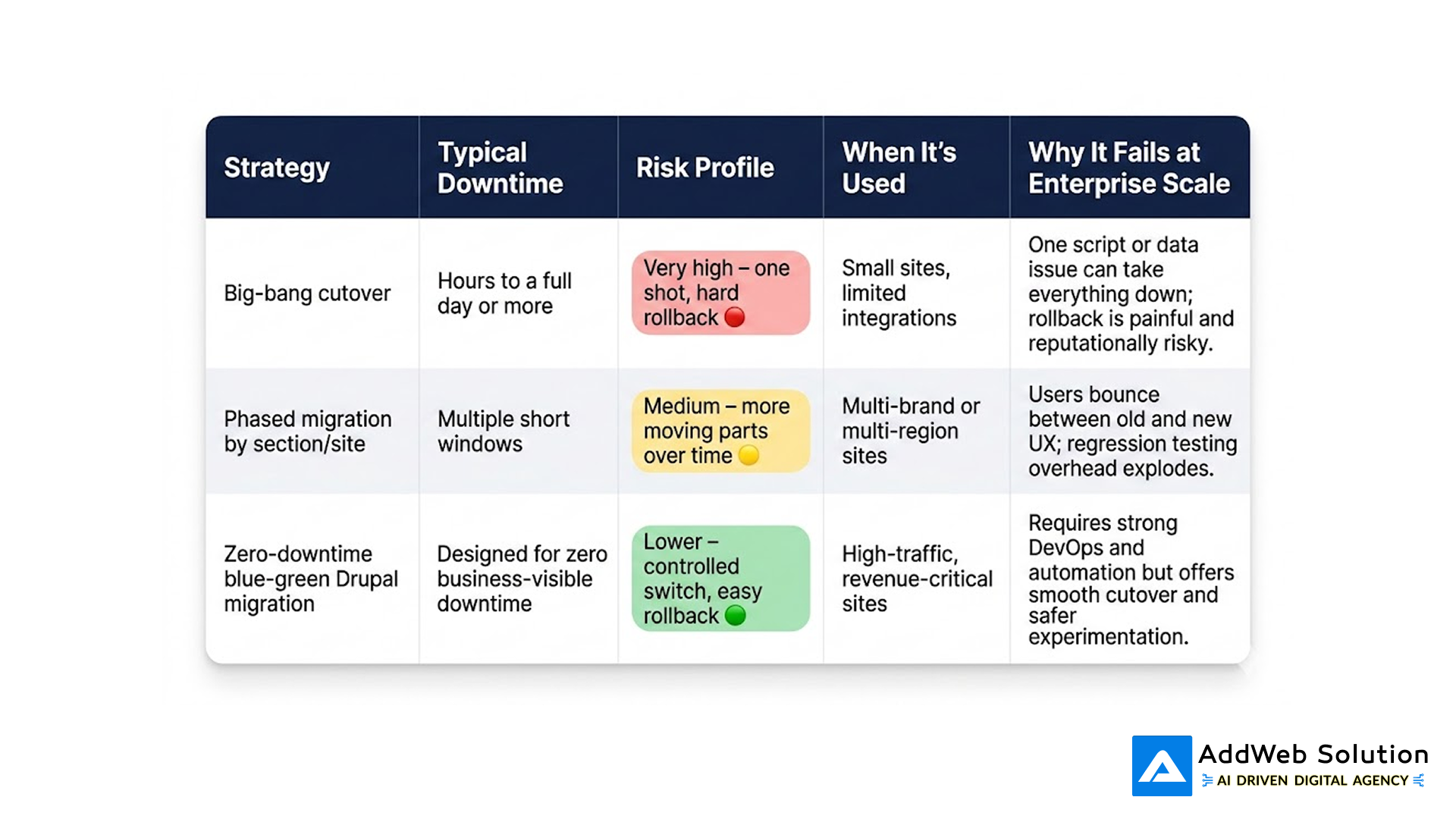
What a practical zero-downtime Drupal migration plan looks like
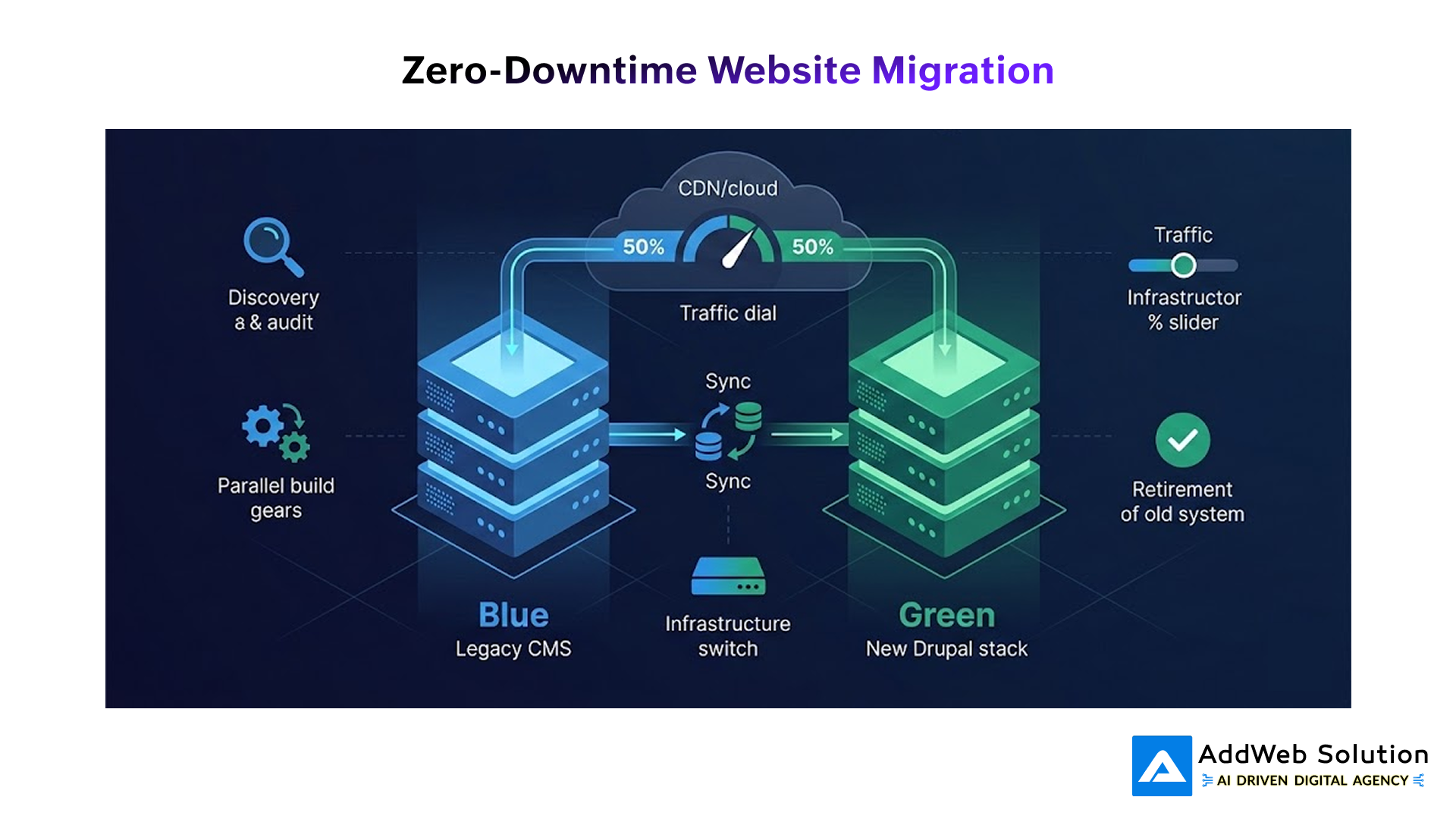
1. Discovery first, rebuild second
Before touching anything, audit what exists:
Content types, taxonomies, SEO URLs, integrations like CRM, CDP, DAM, ERP.
Then design Drupal 10 or 11 content models that preserve your SEO equity while setting you up for personalization and omnichannel delivery. No rankings were harmed in the process.
2. Build Drupal in parallel
Spin up a fully functional Drupal environment on a scalable platform such as Acquia, Kubernetes, or cloud PaaS.
Set up CI/CD, automated testing, integrations, and theming. All of this happens without touching live traffic.
If upgrading from Drupal 7, tools like Acquia Migrate Accelerate speed things up with prebuilt mappings and migration UI.
3. Keep content in sync
Instead of a one-time migration, create repeatable sync pipelines.
Content flows from the legacy CMS to Drupal nightly or even more often. Editors keep working as usual while Drupal quietly stays in near lockstep.
4. Use blue-green infrastructure
Blue = current live CMS
Green = new Drupal stack
Both sit behind the same CDN or WAF. The green environment is tested with load testing, monitoring, and health checks before users ever see it.
5. Roll out gradually
Send a small slice of real traffic, maybe 1 to 5 percent, to Drupal.
Monitor performance, errors, and conversions. If everything looks good, increase traffic gradually to 100 percent. If something breaks, instantly switch back to blue.
No downtime. No drama.
6. Retire legacy
Once stable, freeze the old CMS, run a final sync if needed, and decommission it.
This is where the long-term wins show up: fewer licenses, lower infra costs, simpler maintenance, and a modern content pipeline.
When done right, zero-downtime migration is less about “big launch day” and more about controlled evolution.
Platforms like Acquia Cloud report improvements such as faster load times, lower infrastructure costs, and higher engagement after migration. The key is not just moving to Drupal, but moving safely, iteratively, and with production-like testing from day one.
What the numbers say: CMS growth, Drupal adoption, and performance gains
Zero‑downtime migration is often framed as “too much engineering.” The market data disagrees.
The CMS and ECM markets are growing, not shrinking
The global enterprise content management (ECM) market is projected to grow from 47.6 billion USD in 2024 to 78.4 billion USD by 2029, at a CAGR of 10.5%. That reflects a simple truth: enterprises are investing more, not less, in the platforms that store, govern, and deliver content.
Similarly, the global content management software (CMS) market is expected to grow from 25.55 billion USD in 2024 to 45.64 billion USD in 2032, at a 7.52% CAGR, driven by e‑commerce, personalization, and AI‑assisted content workflows.
In this context, a hasty, high‑downtime migration is a false economy. You’re investing into a growth category anyway; doing it without resilience is like buying a race car and skipping the brakes.
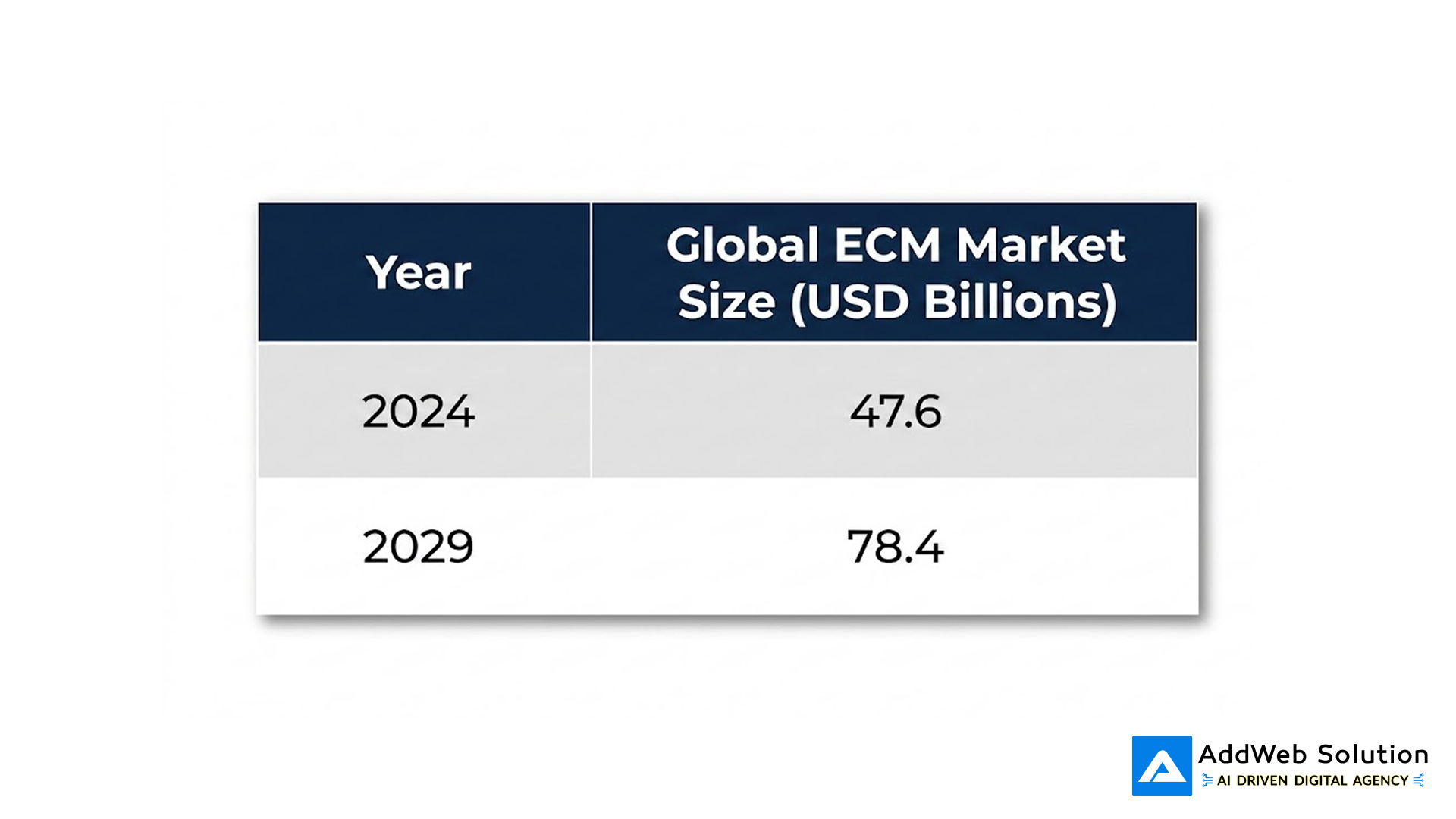
Use this data as the basis for a line chart in your blog: a clean upward slope from 47.6 to 78.4, annotated with the 10.5% CAGR.
Drupal is small by volume, big by impact
While Drupal’s raw market share looks modest compared with mass‑market CMSs, its enterprise concentration is disproportionately high.
Recent statistics show Drupal powering around 1.68 million active websites, including 360,832 live sites, and powering roughly 1.5% of all websites worldwide, yet 12.8% of the world’s top 10,000 websites, including brands like Tesla, NBC, and Pfizer.
From a CIO’s perspective, that’s exactly the profile you want: not the platform everyone blogs on, but the one high‑stakes organizations trust when failure is expensive.

Once stakeholders see these numbers, the extra engineering to design a blue‑green Drupal migration suddenly looks cheap.
Conclusion
Enterprise CMS migration is no longer an IT event. It is a revenue decision.
When downtime can cost over 23,000 USD per minute for large organizations, a risky “big-bang” cutover becomes a liability, not a shortcut. At the same time, the CMS and ECM markets are growing rapidly, and enterprises are consolidating platforms to move faster and innovate safely.
Drupal’s strong presence among high-traffic, high-trust brands reflects exactly what enterprises need: scalability, security, and structured content built for modern digital experiences.
The real advantage, however, lies in how you migrate. A zero-downtime, blue-green approach replaces launch-day anxiety with controlled transition, real-time monitoring, and instant rollback.
In a growth market where digital performance directly impacts revenue and reputation, moving to Drupal is strategic. Moving without disruption is essential.
Turn Drupal into a complete digital experience platform

Pooja Upadhyay
Director Of People Operations & Client Relations
Source URLs
- https://w3techs.com/technologies/details/cm-drupal
- https://w3techs.com/technologies/overview/content_management
- https://www.marketsandmarkets.com/Market-Reports/enterprise-content-management-market-226977096.html
- https://www.marketsandata.com/industry-reports/content-management-software-market
- https://www.atlassian.com/incident-management/kpis/cost-of-downtime
- https://en.wikipedia.org/wiki/Drupal
- https://www.cmswire.com/digital-experience/what-you-need-to-know-about-digital-experience-platforms/
