


Introduction: From “launch a store” to “orchestrate a commerce engine”
Five years ago, “getting on Shopify” mostly meant picking a theme, installing a few apps, and turning on ads.
In 2026, the conversation I’m having with brands at AddWeb looks very different:
- “How do we plug our catalog into AI shopping agents?”
- “Can Sidekick actually help my team ship campaigns faster?”
- “Do we need headless with Hydrogen, or can we stay on Online Store 2.0 for now?”
Global ecommerce is still growing fast — forecasts put worldwide online retail at roughly 6.9 trillion dollars in 2026, with ecommerce reaching about 21% of total global retail sales.[5]
Shopify is right in the middle of that curve, processing about 292.3 billion dollars in gross merchandise volume (GMV) in 2024 (up 24% from 2023) and crossing 1 trillion dollars in cumulative GMV.
For modern brands, the question isn’t “Should we be on Shopify?” anymore.
It’s “How do we use the 2026 version of Shopify to compete, not the 2019 version we’re familiar with?”
What’s Actually Changing Inside Shopify in 2026
Shopify’s 2025–26 Editions (Summer ’25 “Horizons” and Winter ’26 “Renaissance”) make one thing obvious: AI is now baked into the platform, not bolted on as a gimmick.
1. AI assistants go from “nice to have” to core workflow
- Shopify Magic & Sidekick
- Shopify Magic now generates product descriptions, FAQs, emails and even custom theme blocks from simple prompts, cutting content and UX iteration time dramatically for non‑technical teams.
- Sidekick has evolved from a “fun chatbot” into a multi‑step reasoning assistant that can analyze sales trends, inventory, and campaigns, then recommend and even execute actions inside your admin.
- Winter ’26 pushes Sidekick toward being a true “commerce copilot” — it can generate custom theme blocks for any Shopify theme, recommend apps contextually, and work off your specific store setup and pain points.
For a lean brand team, that’s the difference between “we’ll test that upsell next quarter” and “Sidekick, set up a buy‑more‑save‑more promotion for our top 10 SKUs this weekend.”
2. Agentic storefronts and AI shopping channels
The Winter ’26 Edition introduces Agentic Storefronts and Storefront MCP, letting you embed AI agents directly into your storefront and control how your products appear in AI shopping chats (think ChatGPT, Perplexity, and similar tools).
- Your Shopify catalog can now be exposed through a Catalog API to AI assistants, opening a new “agentic commerce” channel where shoppers ask a bot open‑ended questions and it recommends your products.
- Storefront MCP lets you integrate custom AI agents into Hydrogen storefronts hosted on Oxygen, so conversational shopping happens on your domain, not just in third‑party chats.
For brands, this is effectively a new “SEO” layer, but for AI.
If your product data, policies, and FAQs aren’t machine‑readable and well structured, you’ll be invisible in those experiences.
3. Hydrogen, Oxygen and the “headless but not painful” era
Headless commerce used to be code for “expensive and fragile.”
Shopify’s Hydrogen (React framework) and Oxygen (global hosting) are maturing into a much more approachable headless stack:
- Hydrogen’s recent releases improve server‑side rendering performance, caching strategies and routing flexibility, aimed at faster storefronts with less boilerplate.
- Oxygen provides a managed, globally distributed runtime tuned for Hydrogen apps, so frontend teams don’t have to reinvent hosting and deployment.
For a growing brand, this means:
You can start on “classic” Shopify themes, then move select experiences (product discovery, bundles, landing pages, B2B portals) to Hydrogen when you actually hit the limits, without abandoning the Shopify ecosystem.

Shopify commands about 10.32% of the global ecommerce platform market and close to 29–30% of the U.S. ecommerce software market, making it one of the top four platforms worldwide and a domestic leader.
The Numbers Behind Shopify’s Momentum
The story behind Shopify’s feature updates only makes sense if you zoom out and look at the financial and usage curve.
Shopify growth snapshot: 2023 vs 2024
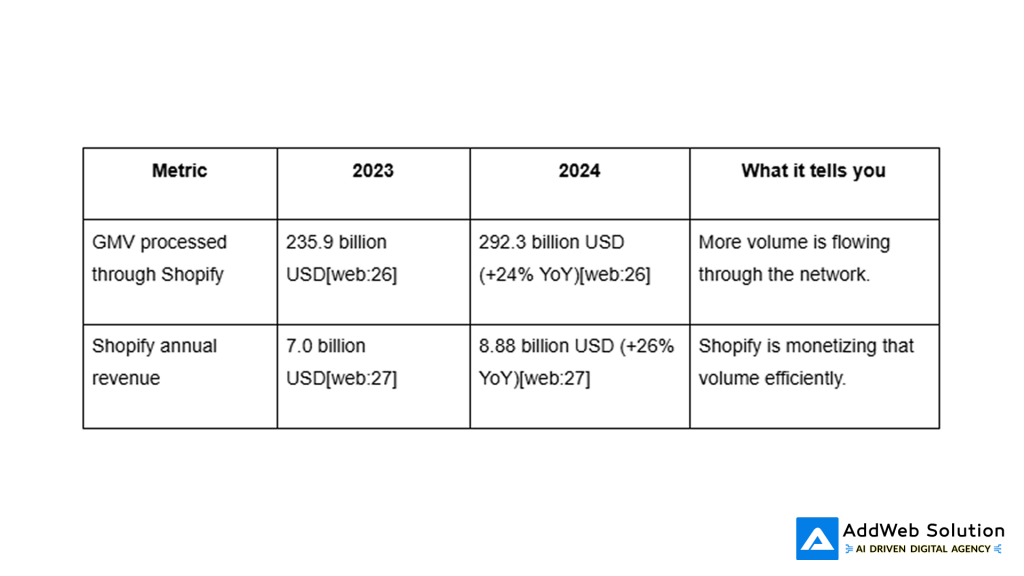
- GMV jumped from about 235.9 billion dollars in 2023 to 292.3 billion in 2024, a 24% increase.
- Full‑year 2024 revenue hit 8.88 billion dollars, up 26% from 7 billion in 2023.
For modern brands, this matters because ecosystem scale compounds:
- Payments, shipping, and capital products get better unit economics.
- App and theme developers keep investing because there’s a huge addressable base.
- Enterprise‑grade features (B2B, functions, AI) are cross‑subsidized by that volume.
How many brands are actually on Shopify now?
Depending on methodology (code detection vs verified active stores), estimates differ, but most credible sources converge on a big number:
- BuiltWith detects around 6.9 million live websites powered by Shopify globally.
- Analyses that filter for “actually trading” stores suggest roughly 2.5 – 3.5 million active Shopify stores.
Either way, Shopify is not a niche platform for hobby stores anymore.
It’s infrastructure for everyone from solo founders to names like Alo, Vuori, and Gymshark that Shopify itself often references in its talks.
Growth Curves: Why Shopify Keeps Winning Enterprise‑Mindshare
Let’s put some shape to that growth.
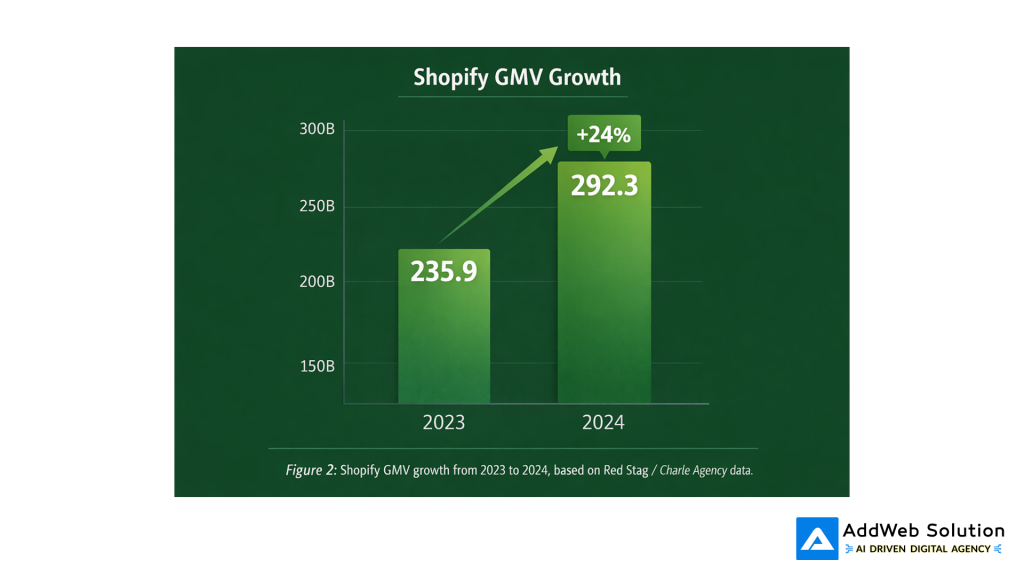
Why this is interesting in 2026:
- The overall ecommerce pie is still growing.
Global ecommerce sales are forecast at about 6.419 trillion dollars in 2025 and around 6.9 trillion in 2026. - Shopify’s share of serious merchants is high.
Among the top 1 million ecommerce websites by traffic, Shopify’s share is around 28–29%, significantly higher than its overall platform share.
So while WooCommerce may power more total sites numerically, Shopify is heavily represented among brands that care about performance, composability, and enterprise‑grade features.
For a mid‑market or scaling DTC brand, that’s your competitive set:
You’re not just competing with other Shopify stores, you’re competing in a world where “Shopify + serious investment in UX, data and AI” is becoming the default.
Where we see brands actually using the new stack
From our work at AddWeb, most practical wins in 2025–26 cluster around three types of moves (none of which require you to rewrite your entire stack tomorrow):
- AI‑assisted merchandising and content ops
- Use Shopify Magic and Sidekick to ship variant descriptions, bundles, FAQ blocks, and seasonal landing pages faster, then let your team focus on strategy and creative.
- Selective headless for high‑leverage journeys
- Move only your most critical experiences — bundles, quiz flows, B2B checkout, regional storefronts — to Hydrogen, while keeping the core store on OS 2.0 themes.
- Being “AI‑discoverable” beyond your own domain
- Clean up product data, rich media, and policies so that Shopify Catalog and knowledge‑base tools present your brand accurately inside AI assistants and multi‑agent shopping flows.
You don’t need to become an AI lab.
You just need to make sure your store isn’t invisible in this new discovery layer.
Interesting Fact Box: Quick Stats to Share With Your Team
Shopify & Ecommerce in 2026 – At a Glance
These are the numbers behind why Shopify is doubling down on AI, multi‑channel, and performance, the stakes are simply too high for incremental updates.
What Shopify’s leadership is saying
“The one thing you need to know about commerce in 2025? It’s everywhere. And consumers are calling the shots.”
Harley Finkelstein, Shopify’s President, shared this on LinkedIn when talking about commerce showing up on surfaces like Roblox, Spotify, YouTube, and beyond — not just in traditional online stores.
Source: Harley Finkelstein on LinkedIn – https://www.linkedin.com/posts/harleyf_the-one-thing-you-need-to-know-about-commerce-activity-7298362384170053632-icNI
“Our task here at Shopify is to make our software unquestionably the best canvas on which to develop the best businesses of the future. For that we need to be absolutely ahead.”
That line comes from CEO Tobi Lütke’s now‑famous internal AI memo, where he also said that “reflexive AI usage” is a baseline expectation at Shopify.
When the company building your platform thinks this way, it’s a pretty clear signal of where the product and the ecosystem are going.
How we look at it from the AddWeb side
As an implementation partner, our take is more grounded in day‑to‑day reality than in product keynotes.
“For most brands we work with, the leap in 2026 isn’t ‘migrate everything to headless’. It’s getting far more intentional about data, content, and UX so Shopify’s new AI‑powered layers have something useful to work with.”
In other words: you’ll get more ROI from fixing your product data, photography, and on‑site journeys than from chasing every shiny new feature.
The good news is that Shopify in 2026 finally gives you the tools to operationalize those improvements without burning out your team.
What Smart Brands Should Do With This in 2026
Let’s make this practical.
If you’re a modern ecommerce brand on (or moving to) Shopify, here’s how to use all of this without boiling the ocean.
1. Audit your “AI‑readiness” before you chase AI features
- Is your product data complete, consistent, and structured (attributes, sizing, materials, care, bundles)?
- Are your policies and FAQs written clearly enough that Shopify’s knowledge‑base and AI tools can surface them in AI chats?
- Do your collections and tags reflect how humans actually shop (“gifts under 50”, “capsule wardrobe”, “sensitive skin”)?
This is unsexy work, but it’s exactly what makes agentic storefronts, Catalog, and Sidekick’s recommendations useful instead of generic.
At AddWeb, we typically start 2026 Shopify engagements with a content and data audit before touching any Hydrogen code or design refresh.
2. Use Magic and Sidekick to compress operational drag
Pick 2 – 3 workflows where your team spends a painful amount of time and pilot AI there first:
- Localizing or rewriting product descriptions for different audiences
- Spinning up seasonal campaign pages with consistent blocks and layout
- Creating support macros and FAQ content that align with your brand voice
Have a human set the guardrails, then let Shopify Magic and Sidekick handle first drafts and repetitive tasks.
Measure cycle time and error rates before and after; that’s where you’ll see whether AI is actually moving the needle.


3. Treat headless as a scalpel, not a religion
Hydrogen and Oxygen are brilliant for certain problems, but you don’t need them everywhere:
- Use Hydrogen for high‑traffic, high‑value flows: configurators, complex B2B carts, and interactive storytelling experiences.
- Keep lower‑leverage surfaces (basic collections, content pages) on OS 2.0 themes, leveraging Shopify’s native performance optimizations and AI‑assisted theme editing.
This hybrid approach keeps your stack understandable and your TCO under control – something we emphasize heavily when advising brands who feel “behind” because they’re not fully headless yet.
4. Plan for “AI commerce channels” the way you once planned for marketplaces
A few years ago, brands had to figure out how to show up on Amazon and marketplaces.
In 2026, the equivalent conversations are:
- How does our catalog appear when a shopper asks an AI assistant for “the best sustainable bedding under 200 dollars”?
- Are our reviews, UGC, and policy info consistent enough that an AI agent can answer nuanced questions correctly?
- Do we want our own on‑site AI shopping assistant, or are we comfortable relying purely on third‑party agents?
This is still early, but Shopify’s Catalog, Agentic Storefronts, and Storefront MCP are giving you hooks now that your competitors might ignore for another year.
From our perspective, that’s a window for differentiation.
Shopify “then” vs “now”
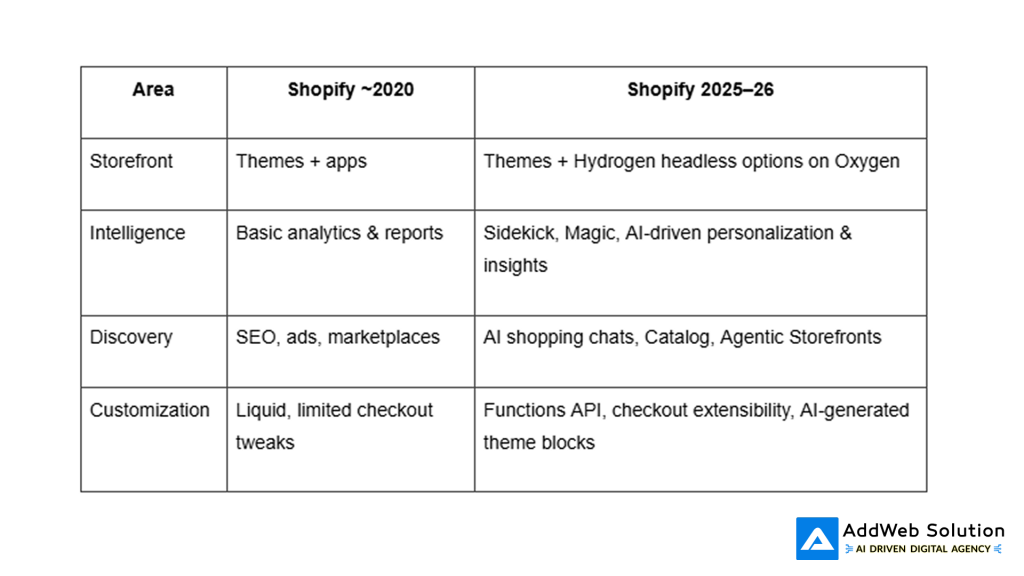
The bottom line: if you still treat Shopify as “just the place where we host our catalog,” you’re leaving a lot of leverage on the table.
Tell us about your store and goals, and connect with developers who fit your needs, from store setup to performance optimization.

Pooja Upadhyay
Director Of People Operations & Client Relations
Conclusion: Use 2026 to modernize your Shopify foundation, not to panic‑replatform
Shopify in 2026 is powerful enough to feel overwhelming if you try to absorb every Edition announcement at once.
But you don’t need to.
If you:
- Get your data and content “AI‑ready,”
- Use Shopify’s own AI tools to compress operational drag, and
- Introduce headless and agentic storefront ideas only where they clearly support your brand strategy,
You’ll already be ahead of a large chunk of the market, including competitors still treating Shopify like a prettier version of their 2015 cart.
At AddWeb Solution, this is exactly the work we’re doing with ecommerce brands right now: turning the noise around “Shopify + AI + headless” into a clear roadmap, a phased implementation plan, and measurable lift in conversion, AOV, and lifetime value.
If you’d like a sanity check on your current Shopify architecture or a second opinion on whether Hydrogen, Sidekick, or Catalog makes sense for your brand, this is the perfect year to start that conversation.
- https://hydrogen.shopify.dev/update/december-2025
- https://www.shopify.com/editions/winter2026
- https://www.shopify.com/news/winter-26-edition-renaissance
- https://www.shopify.com/magic
- https://www.retailbrew.com/stories/2024/01/25/shopify-president-harley-finkelstein-on-the-future-of-retail
- https://techcrunch.com/2025/04/07/shopify-ceo-tells-teams-to-consider-using-ai-before-growing-headcount/
- https://www.forbes.com/sites/josipamajic/2025/04/08/hire-ai-not-humans-shopify-ceos-radical-mandate-catching-vc-attention/
- https://www.cnbc.com/2025/04/07/shopify-ceo-prove-ai-cant-do-jobs-before-asking-for-more-headcount.html
