


The FDA investigator walks up to your packing line. She picks one batch and asks a simple question.
“Show me how this batch was inspected. Who checked it, when, and what did they reject?”
For many small plants, the honest answer is a signed register and a few tired inspectors. The paper may be fine. The proof behind it is thin.
That gap is where audits go wrong. This guide shows how Indian pharma MSMEs use AI visual inspection to close it, in plain words, without a giant budget.
Quick answer: AI inspection uses cameras and trained software to check every unit on your line. It saves a time-stamped image and a decision for each one, linked to the batch. That gives you steady quality and a clear record you can show an inspector in seconds. It will not pass an audit by itself. It gives your quality team stronger evidence.
Why FDA Audits Feel Tougher Now
Three things have changed for Indian manufacturers.
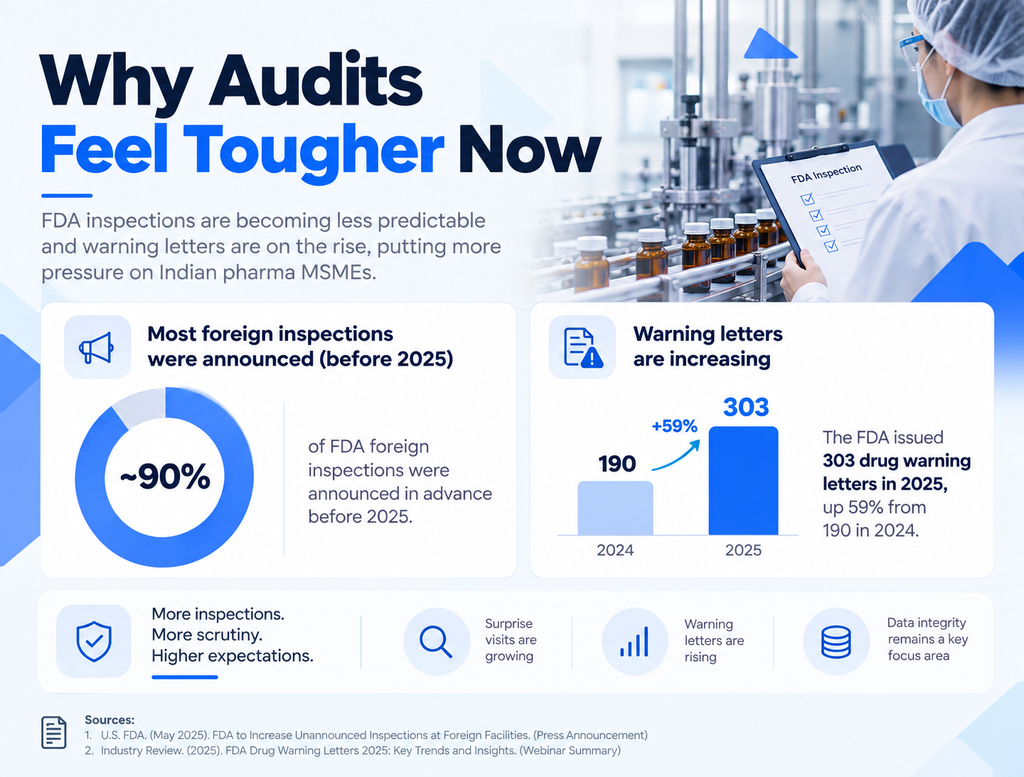
1. Surprise visits are growing. In May 2025, the FDA said it would increase unannounced inspections at foreign facilities. Until then, nearly 90% of foreign inspections were announced in advance. You can no longer count on a few weeks to tidy up.
2. Warning letters are rising. One industry review reports that the FDA issued 303 drug warning letters in 2025, up 59% from 190 in 2024.
3. Data integrity is the weak spot. The same review says about 15% of warning letters mentioned data integrity, and the share rose to 60% for Indian manufacturing sites. Please check these numbers against the FDA’s own data before you publish, as the review is a webinar summary.
A real example shows what this looks like. In a 2025 warning letter, the FDA said an Indian maker of patches lacked raw data to support tests on released products. The company could not explain how it released the batch without that data.
Then there is home turf. The revised Schedule M raises the GMP bar for every Indian unit.
About 8,500 of India’s roughly 10,500 pharma units are MSMEs, and only around 2,000 of those held WHO-GMP certification when the extension was announced. MSMEs were given until 31 December 2025.
That date has now passed, so please confirm the current position with CDSCO.
What Inspectors Really Look For
Inspectors do not only check your product. They check whether you can prove how it was checked.
Data integrity follows a simple rule called ALCOA. Records should be Attributable, Legible, Contemporaneous, Original and Accurate. Good practice adds Complete, Consistent, Enduring and Available.
Here is how manual checking and AI checking compare against those questions.
| What the inspector asks | Typical manual weakness | What AI inspection adds |
| Who inspected this unit? | A signature on a batch sheet | Each decision logged by system and user |
| When was it inspected? | Time written later | An automatic timestamp at capture |
| What was rejected, and why? | A tally count | Image of every reject with its defect class |
| Is the record original? | Copied or rewritten pages | Original image saved, edits tracked |
| Is the process consistent? | Varies by person and shift | Same rules on every unit, every shift |
The point is not to replace your people. It is to give your quality team records nobody can question.
Why Manual Inspection Struggles
Human eyes get tired. Anyone who has watched a night shift knows that.
A patent filing on the subject describes manual visual inspection as commonly graded at about 70% probability of detection, against roughly 90% or more for automated systems. Treat that as a rough guide, because results depend on product and setup.
Be fair to both sides. Experts note that visual inspection, human or machine, is always probabilistic. No method catches every defect.
For deep learning, a proof of concept shown at the 2018 Visual Inspection Forum in Berlin reported detection above 99% with false rejects below 1% on complex parenteral defects. Real plants will vary, which is why validation matters (more on that below).
What AI Inspection Does on a Pharma Line
You do not need to understand the code. The flow is simple:
- Capture. Cameras and controlled lighting photograph each unit as it passes.
- Judge. Trained software decides pass or reject in milliseconds.
- Act. A reject gate or alert pulls the unit off the line.
- Record. The image, time, batch and decision are saved.
- Report. A dashboard shows reject trends by shift, line and defect type.
Where it helps most:
- Injectables: particles, cracks, fill level and stopper problems.
- Tablets and capsules: chips, cracks, broken units, colour variation and black spots.
- Blister packs: missing or damaged tablets.
- Labels and cartons: wrong batch number, expiry date, print quality and mix-ups.
- Leaflets and cartons: missing inserts and wrong packs.
For injectables, USP <790> says parenteral products should be essentially free of visible particles. USP <1790> adds that you must qualify your inspection system and show it stays consistent over its life.
The Audit Trail: Your Biggest Win
This is the benefit small plants feel most.
Imagine the inspector’s question again. With AI inspection, you search the batch number and see:
- Total units inspected
- Every rejected unit, with its image and defect label
- Time stamps for each decision
- Who changed any setting, and when
- Reject trends across shifts
You answer in minutes, not hours. That calm answer builds trust at the start of an inspection.
The same records help your team too. If rejects spike on Line 2 every Tuesday night, you can trace it to a machine, a supplier lot or a shift habit.


Validation: The Part You Cannot Skip
An AI system you cannot explain is a risk, not a help. The FDA does not “approve” inspection tools. It checks whether you can show that yours is controlled and fit for purpose.
A reliable setup should include:
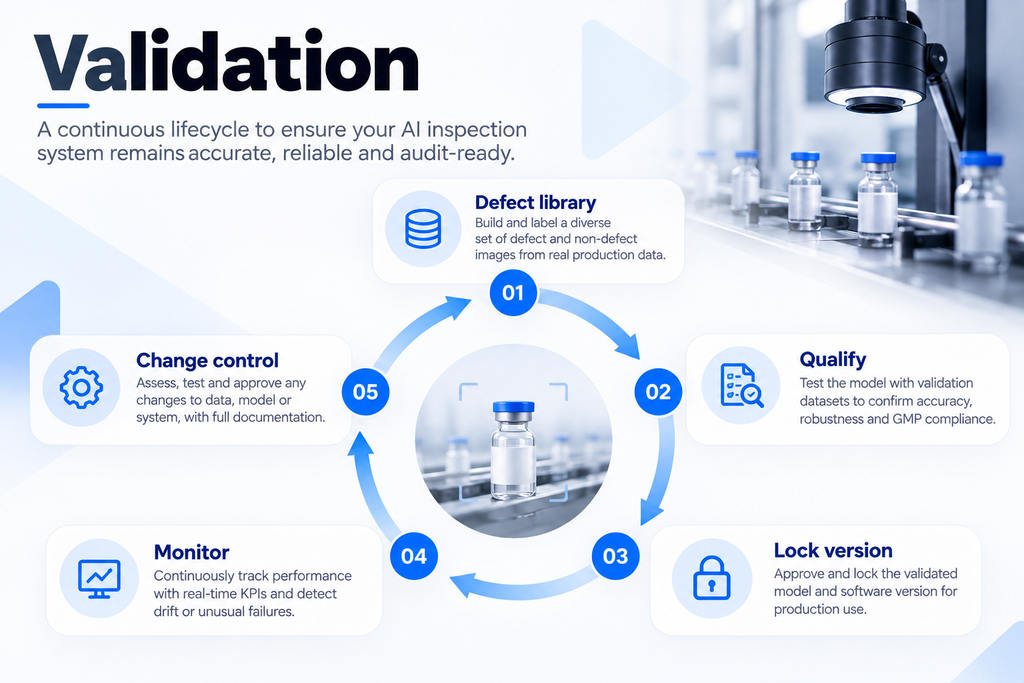
- A defect library. Real examples of good units and each defect type, used to test the system.
- Written acceptance limits. Detection rate and false-reject rate agreed in advance.
- Qualification and validation. Installation, operation and performance checks, with records.
- Locked versions. The model does not change on its own.
- Change control. Any retraining or setting change is reviewed, tested and approved.
- Access control. Only named, trained people can change rules.
- Regular re-checks. Performance is reviewed over time, not just at go-live.
You should also know that the FDA has already raised concerns about AI being misused in cGMP documentation. According to one webinar description, it issued its first warning letter on this. The lesson is simple: use AI under control, never as a shortcut.
Ask a qualified QA or regulatory consultant to review your validation plan. This post is general guidance, not regulatory advice.
Is It Affordable for an MSME?
Yes, if you start small.
- Add a station, not a new line. Many setups fit a camera station over your existing conveyor or packing line.
- Pick one defect, on one line. Do not try to inspect everything at once.
- Run in parallel first. Keep your manual check running while AI runs beside it, then compare results.
- Reuse your existing systems. Connect to current line controls where possible.
The goal in the first phase is proof, not a big purchase.
Common Myths, Cleared Up
Myth 1: AI inspection means the FDA approves us. Not true. The FDA does not certify tools. It judges your process and your records.
Myth 2: AI replaces our QA team. Not true. People set the rules, review rejects and own every decision.
Myth 3: It is only for big pharma. Not true. A single line with one defect type is enough to start.
Myth 4: AI is a black box. Not true when it is built for audits. Every reject has an image, a label and a log.
Myth 5: Once installed, we are done. Not true. Validation, change control and regular review keep it audit-ready.
Where AI Inspection Goes Wrong
Be honest about the risks:
- Weak training data. Too few defect samples means missed defects.
- Poor lighting or camera setup. Bad images give bad results.
- No validation. An undocumented system creates new audit risk.
- Too many false rejects. Good product is wasted and operators stop trusting the system.
- Editable records. If settings or results can be changed without a trail, you have a data integrity problem.
Most of these are solved in the design phase.
Is Your Plant Ready? A 2-Minute Checklist
AI inspection is probably worth a pilot if:
- You still inspect visually by hand on at least one line
- Your batch records rely on signed registers and tally counts
- You ship, or plan to ship, to regulated markets like the US
- You find defects late, at packing or in customer complaints
- Your team spends days gathering records before an audit
If you ticked two or more, start with a pilot.
A 90-Day Pilot Plan
- Days 1 to 15: Choose. Pick one line, one product and one or two defect types.
- Days 16 to 30: Collect. Gather real good and defective units, and agree on acceptance limits.
- Days 31 to 60: Install and train. Set up the camera station, train the model and run it in parallel with manual checks.
- Days 61 to 80: Validate. Test against your defect library and write up the results.
- Days 81 to 90: Review. Compare detection, false rejects and record quality, then decide on scale-up.
Your Questions, Answered (FAQ)
Can AI inspection help us pass an FDA audit?
It can strengthen your evidence and consistency. It cannot guarantee a pass. The FDA looks at your whole quality system.
Does the FDA approve AI inspection systems?
No. You must show that your system is validated, controlled and fit for its purpose.
What data does AI inspection record?
Usually an image of each unit, a timestamp, the batch, the decision and the defect type. Setup changes should also be logged.
Can it check injectables, tablets and packs?
Yes, with the right cameras and lighting for each. Each product type needs its own tuning and testing.
Do we need to replace our machines?
Usually not. Many systems add a camera station to your existing line.
How long does a pilot take?
A focused pilot on one line often runs about 90 days, including validation.
What about revised Schedule M?
It raises the standard for GMP records, quality systems and controls. AI inspection supports it, but you still need your full quality system in place.
How do we start?
Pick one line and one defect type. Run AI beside your manual check and compare.
Ready for a Smarter, Audit-Ready Inspection Process?

Pooja Upadhyay
Director Of People Operations & Client Relations
The Bottom Line
FDA audits are not only about clean products. They are about clear proof.
AI inspection gives small plants a fair way to build that proof. Every unit checked, every decision recorded, every reject explained.
You do not need a giant project. Start with one line, one defect and a 90-day pilot.
