


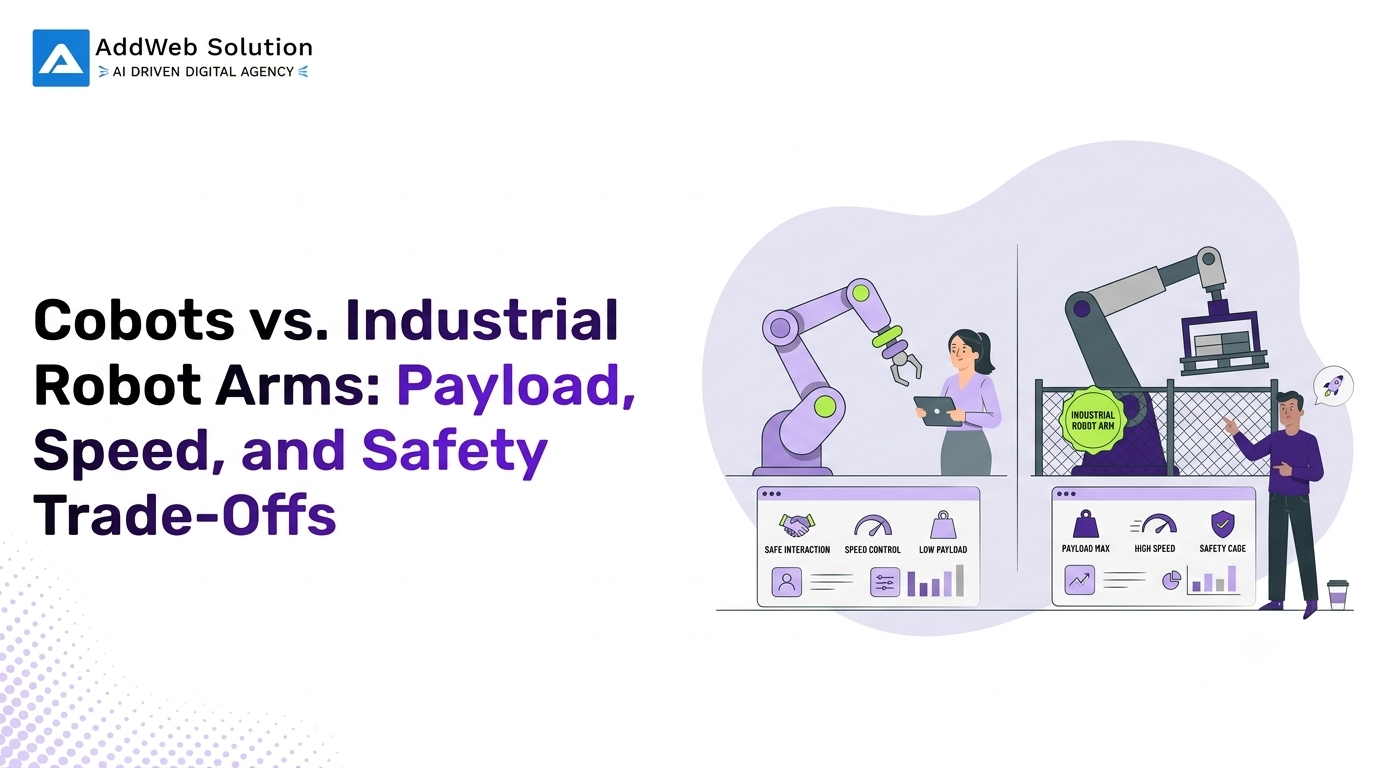
Every automation project starts with the same question. Do you want a robot that works beside your team, or one that works behind a barrier at full tilt?
The answer comes down to three trade-offs: how much the robot lifts, how fast it moves, and how much safety equipment you need around it. Get these right and the rest of the project gets easier.
The short answer: Choose a cobot when people and robots share space, tasks change often and loads stay under about 30 kg. Choose an industrial robot arm when you need heavy lifting, top speed and a guarded cell.
Cobots are growing fast, but they are still a minority. IFR reports that cobots made up 10.5% of the 541,302 industrial robots installed worldwide in 2023. In 2024, global cobot installations reached 64,542 units, up 12% year over year, or 11.9% of the total.
That growth does not signal a takeover. IFR describes cobots as complementing traditional robots, not replacing them.
Speed: The Careful Walker vs. the Sprinter
Speed is where safety costs you the most.
A cobot has to limit force if it touches a person. That usually means its motion is held back when people are nearby. Industrial arms have no such limit inside a guarded cell, so they can run flat out.
IFR notes that traditional industrial robots operate at much faster speeds. It also says they remain important for productivity when product margins are tight.
Think of it this way:
- Cobot: A steady, predictable colleague.
- Industrial arm: A relay sprinter that repeats the same fast move thousands of times a day.
When does speed matter most?
For high-volume lines with short cycle times, the industrial arm wins on parts per hour. Even a small gain per cycle adds up over millions of parts.
For mixed, low-volume work, the picture flips. A cobot can be moved between stations and reprogrammed quickly, so uptime on varied jobs can beat raw speed.


Safety: Built-In Manners vs. Bolt-On Barriers
Both robot types can be used safely. They simply get there by different routes.
The cobot route
Cobots use built-in force sensors, torque limiters and collision detection to share space with humans. This often means less physical guarding.
It does not mean no risk. A cobot carrying a sharp tool or a heavy part can still injure someone.
The industrial arm route
Industrial robots with external safety measures can work near people without giving up speed or payload. Typical safeguards include physical barriers, light curtains, safety mats and area scanners.
What changed with ISO 10218:2025
The rulebook changed recently. ISO 10218-1:2025 and ISO 10218-2:2025 were published in February 2025. They are the first major revision since 2011.
The key updates are:
- The requirements of ISO/TS 15066 were absorbed into the ISO 10218 series.
- The terms “collaborative robot” and “collaborative operation” no longer appear in the revised standard.
- ISO 10218-1:2025 defines two robot classes, because large heavy robots differ from smaller ones used in collaborative work.
The takeaway is simple. Safety belongs to the whole application, including the end-of-arm tool, the layout and the task. A non-compliant installation can invalidate CE marking for the workcell, even if the robot itself is compliant.

Side-by-Side: The Trade-Off Cheat Sheet
| Factor | Cobot | Industrial robot arm |
|---|---|---|
| Typical payload | Light to medium, up to about 30 kg in top models | Light to ultra heavy, up to 2,300 kg |
| Speed | Limited near people | Much faster |
| Safety setup | Built-in force limiting, risk assessment still needed | Fences, scanners, light curtains |
| Redeployment | Easy, often movable | Fixed cell |
| Best for | Mixed tasks, small runs, shared workspaces | High volume, heavy loads, long cycles |
Cost and Payback: What the Numbers Suggest
Budget pulls many buyers toward cobots. One industry guide estimates a complete cobot system at $40,000 to $150,000, versus $250,000 to $500,000 or more for traditional robotic cells. The same guide says most deployments pay back in 12 to 24 months.
Treat these as ballpark figures. Real quotes depend on tooling, vision, guarding and integration work.
The Bigger Picture: Both Markets Keep Growing
This is not a rivalry with one winner. IFR reports the global operational stock of industrial robots rose 9% to a record 5 million units in 2025. It forecasts installations to rise 9% to 655,000 units in 2026 and reach 806,000 units in 2029. International Federation of RoboticsYahoo Finance
Many factories will run both types side by side. Heavy arms handle the main line, while cobots take flexible cells and tasks that need a human nearby.
How to Choose in Four Questions
- How heavy is the load? Above roughly 30 kg, an industrial arm is usually the only option.
- How close will people be? Frequent hands-on contact favors a cobot.
- How many parts per hour? Very high volume favors an industrial arm.
- How often will the task change? Frequent changeovers favor a cobot.
FAQ: People Also Ask
What is the main difference between a cobot and an industrial robot?
A cobot is designed to work near people, with built-in force and collision limiting. An industrial robot arm is built for speed and payload, and it usually works behind external safeguards.
Are cobots safer than industrial robots?
Not automatically. Safety depends on the robot, the tool, the task and the risk assessment. A cobot holding a sharp tool can still be hazardous.
Can cobots work without safety fences?
Often yes, if a risk assessment under ISO 10218:2025 supports it. Sharp tools, fast moves or heavy parts can still require guarding.
How much weight can a cobot lift?
Most cobot sales are in the light classes, led by the up to 5 kg segment. Top models such as the FANUC CRX-30iA reach 25 to 30 kg.
Are cobots slower than industrial robots?
Generally yes. IFR notes that traditional industrial robots operate at much faster speeds.
What is ISO/TS 15066 and is it still used?
It set force and pressure limits for collaborative applications. Its requirements now live inside the 2025 edition of ISO 10218, so new risk assessments should cite ISO 10218:2025.
What percentage of robots sold are cobots?
IFR reported 10.5% in 2023. Market research based on IFR 2025 data puts it near 11.9% for 2024.
Are cobots cheaper than industrial robots?
Often the whole system costs less, but it depends on payload, tooling and integration. Ask for quotes on the full application.
Ready to Pick the Right Robot?
Not sure whether a cobot or an industrial arm fits your line? Share your payload, cycle time and workspace layout, and our automation team will recommend a safe, cost-effective setup.
Request a Free Robot Selection Consultation

Pooja Upadhyay
Director Of People Operations & Client Relations
