


The artificial intelligence revolution isn’t just happening at the top. While giants like OpenAI push massive models, Small Language Models (SLMs) are transforming how mid-market companies access and deploy AI, with a fraction of the cost and complexity. This shift represents a maturation of enterprise AI strategy: efficiency and specialization now trump raw scale. For mid-market companies struggling with tight budgets and data privacy concerns, SLMs offer genuine strategic opportunity.
Why Large Models Aren’t Always the Answer
The reality is sobering: 90% of mid-market firms use generative AI, yet more than half feel unprepared to implement it effectively. Large Language Models like GPT-4 are powerful but problematic. Training GPT-3 costs approximately $1.4 million per session and consumes around 1,287 megawatt-hours of electricity. The recurring cloud costs, infrastructure demands, and lack of data control create barriers that many mid-market organizations simply can’t overcome.
86% of CFOs struggle to achieve real ROI from AI investments, citing data quality challenges, privacy concerns, and integration complexity. The conventional wisdom breaks down: bigger isn’t always better if it doesn’t fit your business reality.
The SLM Advantage: Right-Sized AI
Small Language Models represent a different approach. These models typically contain between a few hundred million and 20 billion parameters, a fraction of LLMs, yet deliver exceptional performance on specific tasks. This isn’t a limitation; it’s by design.
Microsoft’s Phi-3.5 Mini, with only 3.8 billion parameters trained on 3.3 trillion tokens of curated data, outperforms much larger models like Mixtral 8x7B in conversational AI and code generation. The key insight: quality and specialization matter more than raw scale.
The Cost Dynamics
For budget-constrained organizations, the economics are compelling. SLMs reduce training costs by 75%, deployment costs by 50%, and use 60% less energy than LLMs. Operationally, the impact is transformative: A customer service chatbot costs $0.50 per interaction versus $5 for human agents, for 50,000 monthly interactions, that’s $225,000 in monthly savings.
SLMs run efficiently on standard CPUs and modest GPUs, eliminating the need to overhaul infrastructure or negotiate expensive cloud contracts.

SLM Market is projected to grow from $0.93B in 2025 to $5.45B by 2032 at a 28.7% CAGR
Market Momentum: Explosive Growth
The SLM market was valued at $0.93 billion in 2025 and is projected to reach $5.45 billion by 2032, growing at 28.7% CAGR. Regulatory compliance is pushing organizations toward localized, on-premises solutions. Simultaneously, 68% of enterprises deploying SLMs report improved accuracy and significantly faster ROI compared to LLM users.
Real-world examples validate this. A financial institution deploying an SLM for compliance automation processed documents 2.5 times faster while maintaining 88% accuracy and using only 20% of the originally projected cloud budget. A supply chain company reduced response latency by 47% and cut costs by 50% after switching from LLM to specialized SLM.
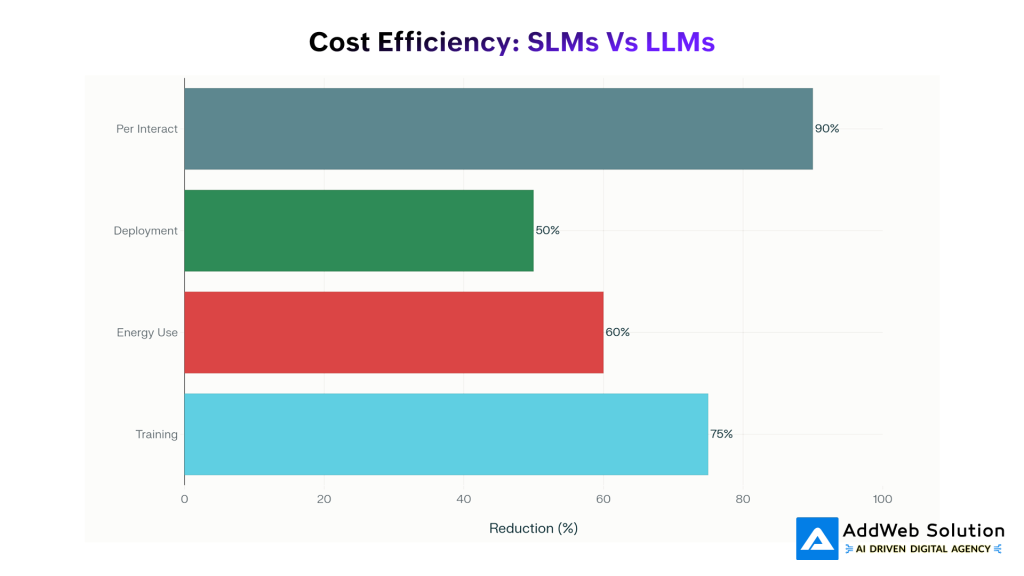
SLMs deliver substantial cost advantages across all dimensions, reducing training costs by 75%, energy consumption by 60%, deployment costs by 50%, and cost per interaction by 90% compared to large language models
How Mid-Market Companies Are Using SLMs
Rapid Deployment
Training cycles for custom SLMs take hours to days, compared to weeks or months for LLMs. Fine-tuning for specialized tasks takes weeks instead of months, enabling rapid experimentation and iteration.
Domain-Specific Precision
An enterprise SaaS provider replaced their generic LLM chatbot with an SLM fine-tuned on internal documentation. Internal chatbot usage increased 62% within three months, with users reporting higher satisfaction due to more accurate, contextually relevant responses. The smaller model wasn’t less capable, it was more capable for their specific use case.
Data Privacy as Competitive Advantage
Organizations can deploy models on-premises or in private clouds, ensuring sensitive data never leaves their infrastructure while maintaining full GDPR and HIPAA compliance. A healthcare provider implementing SLMs achieved patient support automation with complete data control, a combination prohibitively expensive with cloud APIs.
The hybrid deployment model is emerging as the sweet spot, combining cloud flexibility with on-premises security.

Enterprises employ diverse deployment strategies for SLMs, with Cloud leading at 35%, followed by On-Premises (30%), Hybrid (25%), and Edge Computing (10%)


Breaking Down the Skills Barrier
Fine-tuning SLMs requires significantly less expertise than training LLMs from scratch. Techniques like LoRA and quantization enable mid-sized teams to achieve exceptional results with minimal training data. The open-source ecosystem, Hugging Face, Ollama, community repositories, democratizes access without requiring PhD-level expertise.
The ROI Story
When mid-market companies implement SLMs strategically, financial returns are substantial:
A retail company deploying an SLM chatbot achieved 72% containment on targeted inquiries, saving 8,600 agent hours ($215,000), generating 15% additional revenue ($180,000), and improving satisfaction. Total first-year return: $395,000 on $90,000 investment, 338% ROI with 2.7-month payback.
A financial services organization reduced routine support costs by 65% ($450,000), increased mobile engagement by 22% ($320,000), and reduced churn by $280,000. Combined return: $1,050,000 on $310,000 investment, 239% ROI with 3.5-month payback.
Top SLMs for Mid-Market Applications
| Model | Parameters | Best For | Key Advantages |
| LLaMA 3 (8B) | 8B | Dialogue, reasoning | Strong benchmarks, commercial license, excellent support |
| Phi-3.5 Mini | 3.8B | Math, coding, long-context | Best-in-class for size, 128K tokens, mobile-friendly |
| Mistral 7B | 7B | Logic, code, instruction-following | Fast inference, efficient, widely integrated |
| Mistral Nemo 12B | 12B | Complex NLP, real-time dialogue | Balances complexity with practicality |
| Gemma 2 | 2-27B | Varied tasks | Efficient architecture, strong reasoning |
| Qwen 2.5 | 1.5-72B | Multilingual | Exceptional multilingual support |
Implementation Strategy: Proven Playbook
Phase 1: Opportunity Identification – Map AI opportunities across functions. Highest-ROI use cases: customer service automation, document processing, predictive maintenance, lead scoring, fraud detection.
Phase 2: Proof of Concept (3-8 weeks) – Select one use case, collect 500-2,000 labeled examples, fine-tune an SLM base model, test against success metrics. Typical cost: $15,000-$50,000.
Phase 3: Deployment (9-16 weeks) – Deploy on-premises or hybrid infrastructure, integrate with existing systems, implement monitoring, establish feedback loops.
Phase 4: Expansion (Ongoing) – Scale systematically to 3-5 use cases within 18 months.
Real Challenges and Solutions
Narrow Specialization: SLMs excel in focused domains. Solution: match the model to your use case; deploy multiple specialized SLMs for different domains.
Data Quality Dependency: Solution: invest in data curation during fine-tuning; ensure representative, accurately labeled, unbiased training data.
Integration Complexity: Use standardized platforms like LangChain; 40-50% of effort typically goes into integration rather than the model itself.
Ongoing Maintenance: Implement automated monitoring and retrain quarterly or when performance degradation is detected.
Innovate and Thrive with AI Development Solutions – Let’s Collaborate!

Pooja Upadhyay
Director Of People Operations & Client Relations
Why Now Is Critical
Three factors create an inflection point: SLM technology has matured dramatically in 12-18 months, the talent bottleneck has eased as frameworks standardized, and mid-market organizations face genuine competitive pressure from AI-enabled competitors. The question isn’t whether to adopt AI, it’s how quickly you can do so without breaking your budget.
Conclusion: The Smart Scale Era
Specialized, efficient SLMs deliver better value than massive general-purpose models for most organizational problems. The technology works. The economics are compelling (238-338% ROI). The barriers have dropped dramatically. The competitive pressure is mounting.
The smart move is to start now with a focused pilot, prove value quickly, and expand systematically. The democratization of AI through SLMs isn’t a future possibility, it’s happening now. The question for your organization is whether you’ll lead this shift or react to it.
Key Takeaways
- Cost Advantage: SLMs reduce training costs by 75%, deployment costs by 50%, operational costs by 90% versus LLMs, making enterprise AI accessible to mid-market budgets
- Market Growth: SLM market projected to grow from $0.93B (2025) to $5.45B (2032) at 28.7% CAGR
- Proven ROI: 238-338% first-year ROI on customer service automation with 3-month payback
- Deployment Flexibility: Cloud, on-premises, hybrid, or edge options based on compliance needs
- Specialization Edge: Domain-specific SLMs outperform general LLMs on targeted tasks, delivering 68% higher accuracy improvements
- Accessibility: Pre-trained SLMs are freely available with proven fine-tuning techniques enabling mid-market customization
Resources:
- https://www.arcee.ai/blog/7-key-advantages-of-slm-over-llm-for-businesses
- https://ajithp.com/2025/05/26/small-language-models-slm/
- https://www.marketsandmarkets.com/Market-Reports/small-language-model-market-4008452.html
- https://www.microsoft.com/en-us/research/blog/phi-2-the-surprising-power-of-small-language-models/
- https://www.anaconda.com/blog/small-language-models-efficient-future-ai
- https://www.redhat.com/en/blog/rise-small-language-models-enterprise-ai
- https://huggingface.co/blog/jjokah/small-language-model
