


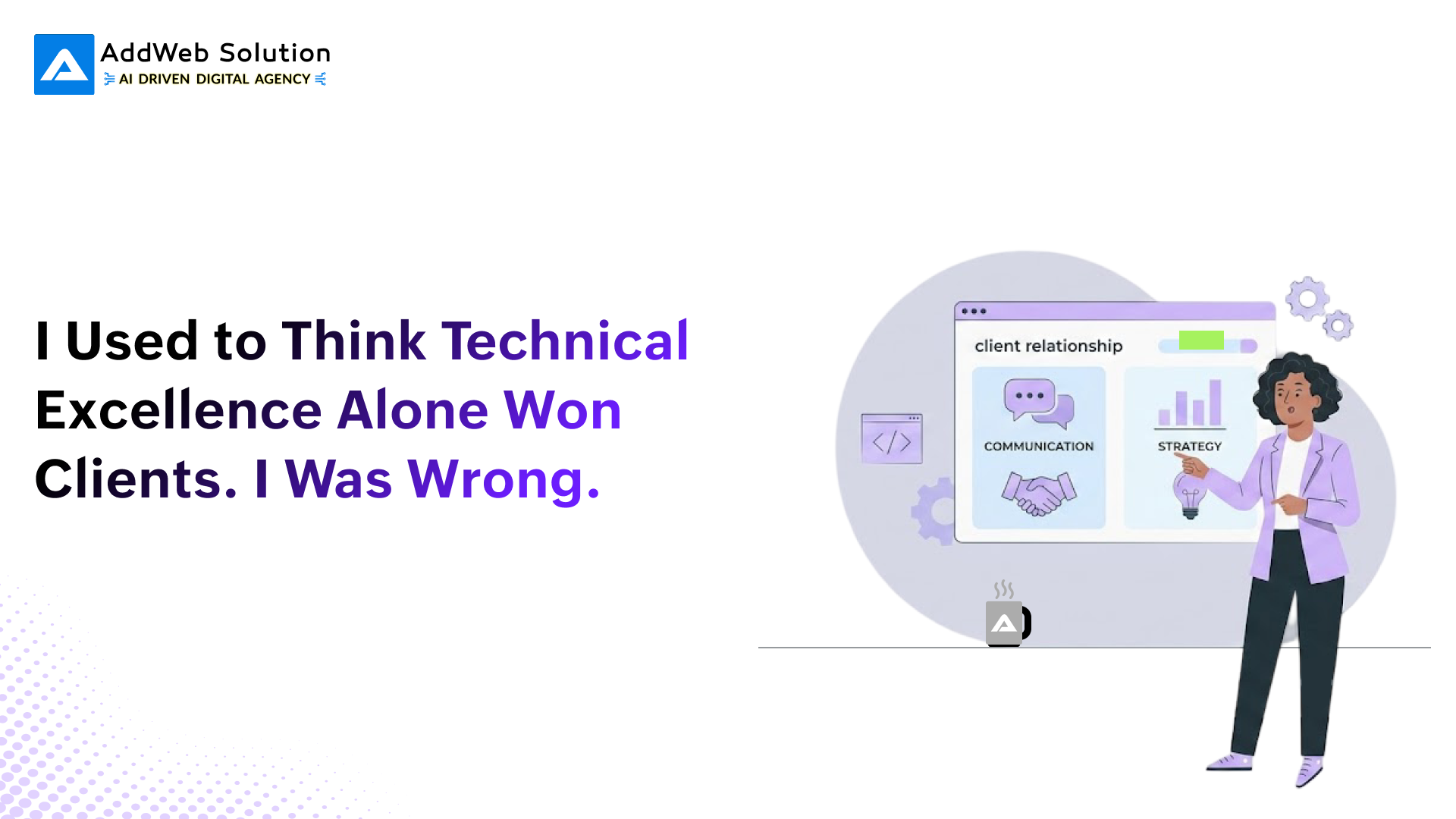
Introduction
When you spend years learning software engineering, you naturally begin to believe something.
The better the code…
…the better the business.
It’s an incredibly logical conclusion.
Software projects exist because software needs to be built.
Therefore, better software should naturally create happier clients.
For a long time, I genuinely believed that.
If our architecture was stronger…
If our developers were better…
If our delivery quality remained consistently high…
Clients would stay.
Clients would recommend us.
Clients would choose us over competitors.
Looking back, I wasn’t completely wrong.
Technical excellence absolutely matters.
In fact, I would argue it is non-negotiable.
Poor engineering eventually creates poor outcomes.
But over the years I discovered something that completely changed my thinking.
Technical excellence is often the reason you get shortlisted.
It is rarely the only reason clients continue the journey with you.
That realization took me years to fully appreciate.
1. The Belief That Shaped My Early Career
Like many people entering the IT industry, I fell in love with technology long before I understood business.
I enjoyed solving difficult problems.
Learning new frameworks.
Improving architecture.
Optimizing performance.
Writing cleaner code.
Those things still matter deeply to me today.
Back then, I assumed clients evaluated agencies the same way engineers evaluated software.
The cleaner the solution…
The higher the quality…
The stronger the relationship.
From an engineering perspective, that logic feels almost impossible to argue against.
Because inside technical teams, excellence is respected.
Among developers, better engineering earns admiration.
Among architects, elegant solutions earn credibility.
I unconsciously projected that thinking onto clients.
I assumed they measured success using the same lens.
Most of them don’t.
2. Why It Made Perfect Sense
Looking back, I understand exactly why I believed it.
Technology was my world.
It was where I felt confident.
It was measurable.
Good architecture.
Maintainable code.
Automated testing.
Scalability.
Performance.
These things have objective value.
You can improve them.
You can measure them.
You can compare them.
Business relationships don’t work the same way.
Trust isn’t measured with benchmarks.
Communication isn’t represented in code quality reports.
Confidence doesn’t appear inside Git commits.
Yet those factors often influence client decisions just as much – sometimes even more.
That realization was uncomfortable.
Because it meant technical excellence alone wasn’t enough.
3. The First Time I Questioned That Belief
I don’t remember one dramatic moment.
Instead, it happened gradually.
I noticed something interesting.
Sometimes the technically strongest project wasn’t the one clients spoke most enthusiastically about.
Another project – with fewer technical challenges – generated stronger referrals.
Longer relationships.
Greater trust.
That puzzled me.
Eventually I stopped looking only at the software.
I started observing the relationship.
How often did we communicate?
How transparent were we?
Did the client understand why decisions were made?
Did they feel involved?
Did they trust us when uncertainty appeared?
Slowly a different picture emerged.
Clients weren’t only evaluating what we built.
They were evaluating what it felt like working with us.
That distinction changed everything.
4. Great Code Isn’t Always a Great Client Experience
Engineers often judge projects by technical outcomes.
Clients usually judge projects by business outcomes and the overall experience.
Imagine two agencies.
Agency A produces technically superior software.
Agency B produces software that is still excellent – but communicates better, manages expectations well, explains trade-offs clearly, and proactively identifies risks.
Which agency creates the stronger client relationship?
The answer isn’t always the one with better architecture.
Because clients experience projects differently than developers do.
Most clients never open the source code.
They don’t evaluate naming conventions.
They don’t inspect database normalization.
What they experience is confidence.
Responsiveness.
Clarity.
Reliability.
Partnership.
That doesn’t reduce the importance of technical excellence.
It simply reminds us that technical excellence is only one component of the experience clients actually buy.


5. Clients Don’t Buy Technology
This realization probably changed my thinking more than any technical framework ever did.
Clients rarely wake up thinking:
“I need better code.”
They wake up thinking:
- I need to grow revenue.
- I need happier customers.
- I need operational efficiency.
- I need fewer support issues.
- I need a reliable partner.
- I need someone who understands my business.
Technology is simply the vehicle.
The destination is business improvement.
That distinction is subtle.
But once you see it, it’s impossible to unsee.
As engineers, we naturally focus on the vehicle.
Clients focus on the destination.
The best agencies learn to master both.
6. The Difference Between Developers and Trusted Advisors
As my career progressed, I began noticing something that had little to do with technology.
The agencies that clients spoke most highly of were not always the ones with the smartest engineers.
Nor were they always the cheapest.
Or the largest.
Or the fastest.
Instead, they shared a different characteristic.
Clients trusted them.
That trust changed the nature of every conversation.
When problems arose, clients asked for advice instead of assigning blame.
When uncertainty appeared, they looked for guidance rather than demanding guarantees.
When priorities shifted, discussions focused on finding the best path forward instead of debating who was responsible.
That isn’t the result of technical excellence alone.
It’s the result of consistently demonstrating good judgment.
I’ve come to believe there is an important difference between being an excellent software company and becoming a trusted business partner.
The first earns respect.
The second earns long-term relationships.
7. Technical Excellence Is the Entry Ticket
One lesson has stayed with me over the years.
Technical excellence is no longer a competitive advantage.
It’s the minimum expectation.
Think about your own buying decisions.
When you hire an accountant, lawyer, architect, or surgeon, you already assume they possess professional competence.
You don’t choose them because they’re competent.
You choose them because you trust them.
Software has reached a similar point.
Clients assume your developers are capable.
They assume you understand your technology stack.
They assume you know how to build software.
The real questions they ask themselves are different.
Can I rely on them?
Will they tell me the truth when something goes wrong?
Will they challenge my assumptions?
Will they protect my business interests?
Do they genuinely care about our success?
Those are trust questions.
Not technical questions.
8. What Clients Actually Remember
Years after a project finishes, clients rarely remember every feature that was delivered.
They remember moments.
The difficult production issue that was resolved calmly.
The honest conversation about project risks.
The time expectations were managed realistically instead of optimistically.
The meeting where someone admitted uncertainty instead of pretending to know everything.
These moments create confidence.
And confidence compounds.
Over time I realised something simple.
Clients don’t just evaluate outcomes.
They evaluate experiences.
The experience becomes the story they tell others.
And those stories shape your reputation far more than any portfolio page ever will.
9. What I Believe Today
If someone asked me today what wins clients, my answer would be very different from the one I would have given fifteen years ago.
I would say great agencies combine five things exceptionally well.
Technical Excellence
Because quality still matters.
Communication
Because uncertainty is inevitable.
Commercial Understanding
Because clients invest in business outcomes, not technology alone.
Judgment
Because every important project involves trade-offs.
Trust
Because long-term partnerships are built on confidence, not contracts.
Remove any one of those five elements, and the relationship becomes weaker.
Together, they create something much more valuable than excellent software.
They create peace of mind.
Statistics
Research consistently shows that business relationships are influenced by far more than technical capability.
PwC’s Global Customer Insights Survey found that trust and positive customer experience are among the strongest drivers of long-term business relationships and loyalty.
Source:
https://www.pwc.com/gx/en/issues/c-suite-insights/global-customer-insights-survey.html
Harvard Business Review explains that trust grows through authenticity, empathy, and sound logic – not expertise alone.
Source:
https://hbr.org/2020/05/begin-with-trust
Edelman’s Trust Barometer consistently shows that competence and ethics together build lasting trust. Competence alone is not enough.
Source:
https://www.edelman.com/trust
Quote
Stephen R. Covey wrote:
“When the trust account is high, communication is easy, instant, and effective.”
That sentence has become increasingly meaningful to me.
Because the best projects I’ve worked on weren’t the ones with the fewest problems.
They were the ones where trust allowed both sides to solve problems together.
Interesting Facts
- Clients often judge professional services by responsiveness and communication before they can accurately judge technical quality.
- Referrals are usually based on the overall experience of working together, not just the final deliverable.
- High-trust relationships tend to require fewer approvals, fewer meetings, and less administrative overhead.
- Many successful consulting firms compete on judgment and insight rather than purely on technical capability.
FAQs
Does this mean technical excellence is less important?
Not at all.
Technical excellence remains essential.
The difference is that it has become the foundation – not the complete value proposition.
Can great communication compensate for poor engineering?
No.
Trust cannot survive consistently poor delivery.
The strongest relationships combine technical excellence with outstanding communication.
What should agencies prioritize?
Not one over the other.
The goal should be to continuously strengthen technical capability while also investing in communication, business understanding, and client trust.
How does an agency become a trusted advisor?
By consistently demonstrating honesty, sound judgment, commercial awareness, and the willingness to recommend what is best for the client – even when it is not the easiest option.
A Thought to Leave You With
People rarely buy the best code. They buy the confidence that you’ll solve their problem.
Technical excellence earns respect.
Trust earns referrals.
Judgment earns long-term partnerships.
When all three come together, clients stop viewing you as a vendor.
They begin seeing you as someone they can rely on.
That transition changes the relationship completely.
Conclusion
If I could go back and speak to the younger version of myself, I wouldn’t tell him to spend less time becoming a better engineer.
I’d encourage him to become an even better listener.
A better communicator.
A better business thinker.
Because software projects don’t succeed through technology alone.
They succeed when talented people earn the confidence of the people they serve.
Technical excellence opened many doors throughout my career.
I’m grateful for that.
But over time, I’ve learned that what keeps those doors open is something much harder to build.
Trust.
Final Reflection
Early in my career, I believed clients hired us because we wrote better software.
Today, I believe they stay because they trust our judgment.
Looking back, I don’t think technical excellence won our best clients.
It simply gave us the opportunity to earn something far more valuable.
Their confidence.
Great software starts with excellent engineering, but lasting success starts with trust.

Pooja Upadhyay
Director Of People Operations & Client Relations


