


Data monetization refers to the practice of extracting monetary value from raw information and insights through the development of products or services as well as decision-making.
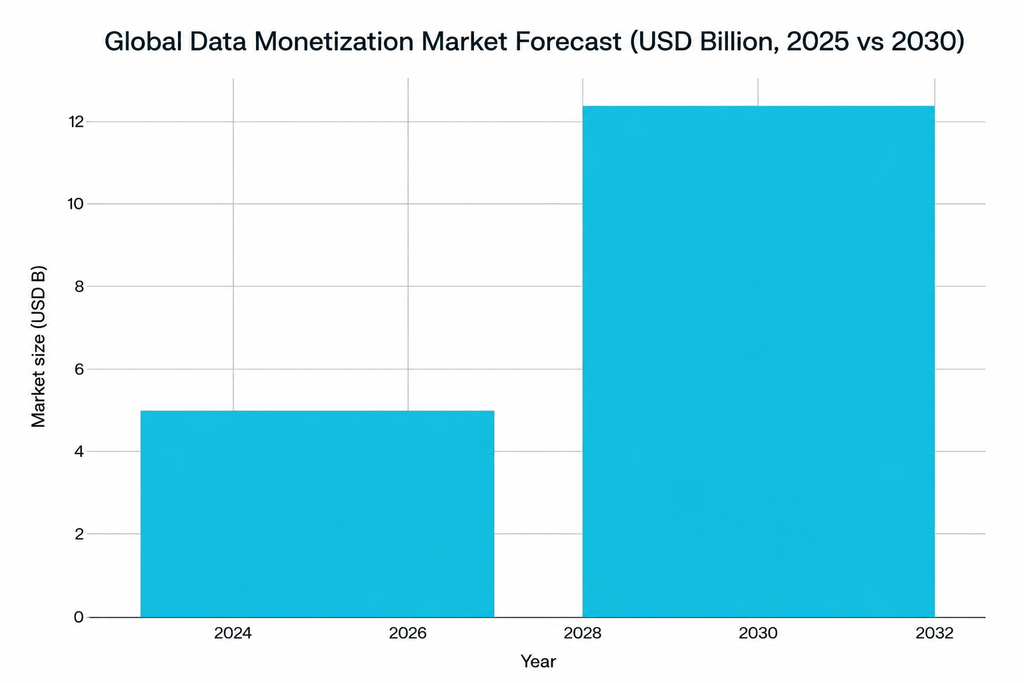
This trend has been recognized as more than a buzzword and has made its way into board-level agenda as global expenditures on data monetization solutions and services go from 4–6 billion USD in mid-2020s to over 12 billion USD by early 2030s.
What Is Data Monetization?
According to Gartner, “data monetization is the use of data to extract quantifiable economic value.” This process includes the extraction of value either internally or through some outside channels.
Barb Wixom explains data monetization as “a process whereby financial gain is derived from data assets,” pointing out that value can come in the form of revenue, cost savings or risk reduction.
In reality, organizations create data through all kinds of sources – transactions, applications, sensors, marketing platforms and then monetize it when they use data to drive better results: improved pricing, reduced churn rate, optimized logistics or creating data products and selling them.
Internal vs External Data Monetization
A useful way to frame data monetization is to distinguish between internal (indirect) and external (direct) value realization.
| Monetization type | What it means | Typical examples | Economic impact |
| Internal / indirect | Use data to improve decisions, processes, and experiences inside the business. | Price optimization, churn prediction, supply‑chain optimization, personalization in owned channels. | Higher margin, lower operating cost, reduced risk. |
| External / direct | Turn data or analytics into a product or service and sell or trade it. | Data APIs, analytics dashboards offered to customers, participation in data marketplaces. | New revenue streams, licensing income, bundled value in core offerings. |
Internal monetization is often less visible but usually delivers the first wave of ROI – better targeting, smarter inventory, and improved workflows.
External monetization typically comes later, once data quality, governance, and analytical capabilities are strong enough to support products with paying customers.
Market Outlook: The Data Monetization Market is About to Explode for Good Reasons
Analysts across the board have come to regard data monetization as a separate market that comprises various tools and services allowing enterprises to make money out of data.
- According to Fortune Business Insights, the data monetization market size is projected to be 4.05 billion USD in 2025, rising up to 16.11 billion USD in 2034.
- ResearchAndMarkets predicts the growth of the data monetization market from 5.0 billion USD in 2025 to 12.41 billion USD in 2030, which means 20% annual CAGR.
- Precedence Research expects that the size of the market will be close to 48.55 billion USD in 2035 with a CAGR of approximately 25%.
- Mordor Intelligence forecasts that the market will grow from 5.67 billion USD in 2026 to 12.66 billion USD in 2031, which would mean 17% CAGR.
These ranges differ by methodology, but the direction is clear: data monetization is scaling fast and moving into mainstream enterprise spend.
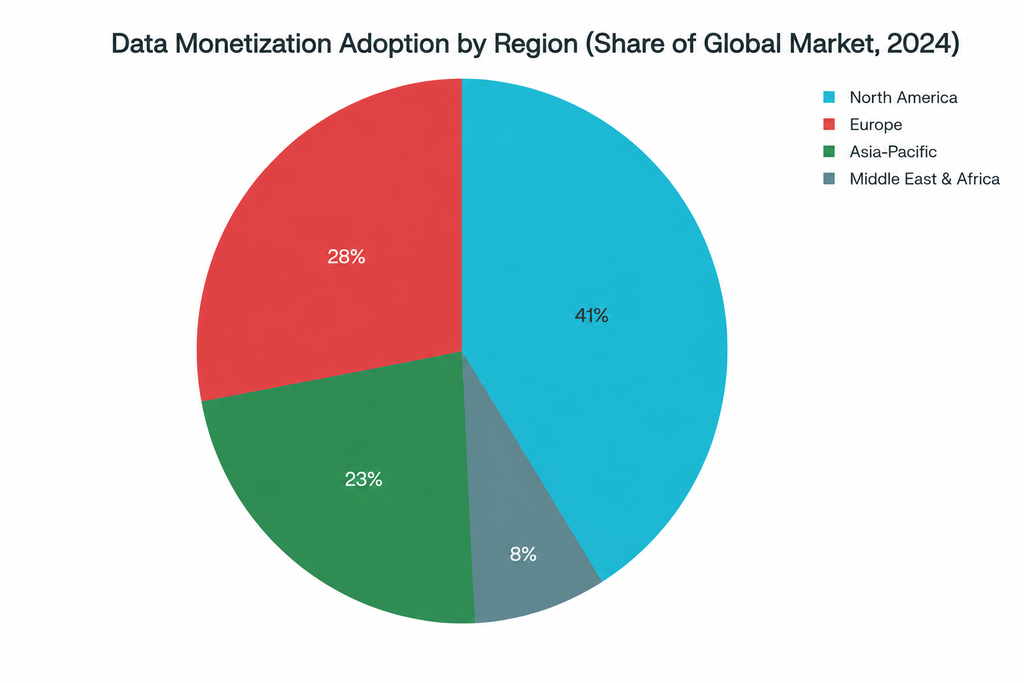
At the regional level, North America holds the largest share with about 41% of data monetization adoption followed by Europe with 28% while Asia Pacific has 23%, and the Middle East and Africa account for 8%.
This is consistent with analytics and cloud adoption trends whereby the US companies and European financial/industrial companies are early adopters.
Core Data Monetization Models
Even though no company’s strategy is alike, most mature strategies employ one of three major frameworks.
1. Process and Decision Optimization (internal)
Companies use internal operational, transactional, and behavioral data to improve business operations. Some initiatives include:
- Dynamic pricing and revenue management: optimization of pricing and promotions based on past trends and competitor behavior.
- Customer life cycle management: modeling of customer churn, upselling, cross-selling and optimization of lifetime value.
- Operational effectiveness: improvements in routing, staffing, inventory and quality through predictive analytics.
Monetization takes the form of margin, cost savings or loss reduction, not a data product profit/loss statement.
2. Products/services with embedded analytics
Under this strategy, analytics can be built in products, portals, and/or services.
- Self-service analytics tools are integrated by SaaS firms in the user interface as dashboards, benchmarking, and anomaly detection tools, and then sold at premium pricing under “insights.”
- Predictive ETA, risk analysis, and optimization tips are offered by logistics portals to their clients in the premium offerings.
- Portfolios analytics, alerts, and scenario modeling are provided as part of financial experiences of the financial organizations.
ThoughtSpot calls this “Embedded Analytics 2.0”, low code, self-service analytics within portals to drive retention and upselling.
3. Data monetization (commercialization directly)
In this case, data is the product.
- Enterprises sell their curated data feeds or analyzed datasets via data marketplaces such as Snowflake Data Cloud, Google Cloud Analytics Hub, or Databricks marketplaces.
- For instance, retailers and payment processors license aggregated and anonymized transactional data to manufacturers, advertisers, or hedge funds.
- Telco operators create “data-as-a-service” platform aimed at cross-industry customers.
For example, London Stock Exchange Group provides quantitative analytics data and many other data products using Snowflake Financial Services Data Cloud.
Examples from Industries: Real Applications of Monetizing Data
Various industry experts, including TechTarget and Snowflake, describe examples of each model used by companies from different industries.
Retail and E-commerce
- Using basket and loyalty data allows suppliers to purchase insight subscriptions (information about category performance, price elasticity, and promotion ROI).
- On-site behavior data is used to create dynamic merchandising, recommendation engines, and personalized offers, increasing conversion rates and AOV.
- Certain retailers sell aggregated point-of-sale data to agencies and brands.
Banking and FinTech
- Transactions provide information for fraud detection, credit risk scoring, and financial advice, helping to avoid losses and retain customers.
- FinTech companies develop premium dashboards and APIs showing customers’ financial behavior and benchmarking, which is sold on a subscription or usage basis.
Telecom and Media
- Using network, location, and usage data, telcos create audience segments and campaigns’ metrics for advertisers.
- Streaming providers use viewership information to optimize content investments and sell anonymized audience insights to partners.
Manufacturing and IoT
- Data from sensors on equipment is turned into predictive maintenance services and sold back to customers under equipment-as-a-service model.
- Quality and throughput analytics are provided via consulting and software solutions on top of physical products.
A simplified view by sector:
| Sector | Key datasets | Monetization levers | Typical business models |
| Retail/e‑commerce | Transactions, loyalty, clickstream. | Assortment optimization, personalized offers, data subscriptions for brands. | SaaS dashboards, data feeds, revenue share. |
| Banking/fintech | Payments, balances, credit events. | Risk scoring, advisory, premium analytics. | Subscription, usage‑based APIs, tiered accounts. |
| Telecom/media | Network logs, location, usage. | Audience segments, campaign measurement, content optimization. | DaaS platforms, licensing, bundled media services. |
| Manufacturing/IoT | Sensor readings, maintenance logs. | Predictive maintenance, productivity insights. | Service contracts, performance‑based fees, SaaS. |


The Ingredients of Monetizable Data
Data monetization success is rarely the result of one magic algorithm but rather of data and product fundamentals.
1. High-quality, effectively governed data
Companies need:
- Data ownership and definitions so people understand what each metric actually means.
- Strong data quality checks, anomaly detection, and master data management to ensure that essential fields stay clean.
- Privacy-preserving technology for anonymizing, aggregating, and implementing differential privacy if data is going outside the company.
Without these, monetization efforts grind to a halt in constant cleaning or fall victim to mistrust in the numbers.
2. Contemporary data architecture
The majority of the advanced applications work with:
- Cloud-based data warehouses or lakes that allow for scalable storage and processing.
- ETL/ELT pipelines that provide data to analytical models and tools for BI.
- APIs and data products that deliver curated data sets and features to end consumers.
It becomes possible to serve both internal analytics and external users from one sound base.
3. Analytics & data science capabilities
The monetization process depends on the ability to:
- Find patterns, correlations, and segments within large and noisy data sets.
- Build predictive and prescriptive models like forecasting, risk scoring, recommendations, etc. that can generate business value.
- Turn statistical results into actions and product features.
Businesses that cannot link insight with action will have difficulties proving ROI from data initiatives.
4. Thinking about product and UX
Monetization through direct means involves treating data and analytics as a product:
- Dividing the target audience (executives, analysts, end users) and creating an experience for each.
- Focusing on functionality providing clear value rather than “cool charts” only.
- Developing a straightforward interface for exploration, notifications, and decision-making.
Standard Business and Pricing Models
Standard business and pricing models of data products and analytics-enabled services usually rely on known software-as-a-service and platform business models.
- Tiers of subscription pricing: Basic analytics versus more advanced segmentations, benchmarks, predictive analytics, priced per user or account.
- Usage-based pricing: Priced based on number of API requests, events processed, storage volume, or queries performed.
- Outcome-oriented pricing: Revenue-sharing, performance bonus, or savings-oriented pricing for optimization and risk reduction services.
- Licensing and data feeds pricing: Either fixed or variable licensing fees for custom datasets made available via secure connections or marketplaces.
In many cases, the most robust way to go would be hybrid pricing model such as subscription plus usage for intensive API requests.
KPIs: What to Look For So That You Are Monetizing Data, Not Only Communicating About It
In order to not end up in what I call “dashboard theater,” the success of your data monetization projects needs to be tracked against corporate-level KPIs.
Internal Monetization:
- Revenue/margin from pricing/personalization/cross-sell models.
- Transaction/order costs and cycle times showing operational efficiency.
- Customer churn, retention, CLV from CX programs based on analytics.
External Monetization:
- Data/insights ARR and MRR as separate revenue streams.
- Adoption and engagement with analytics-driven features (active users, time-to-value, feature usage).
- Sales in marketplaces and partnership deals coming from data products/APIs.
Ideally, you should prove that data products are just like any other product line within your company – revenue/margin/growth.
Data Monetization Risks, Ethics, and Compliance
While there is much to gain from data monetization, there are also many risks and compliance concerns.
- Privacy and regulations: GDPR, CCPA, and sector-specific laws place limits on how personal information can be used and traded.
- Reputation and brand risk: Aggressive data monetization in sensitive industries such as health care or finance may backfire due to exploitation concerns.
- Fairness and bias: Data models used for data monetization, such as those used in pricing and credit scores, should be carefully audited for any bias.
Organizations deal with all these challenges by monetizing anonymized or aggregated data.
A Pragmatic Roadmap to Data Monetization
For a company that wants to move beyond “we have dashboards” into genuine monetization, a staged approach helps.
- Align with business and digital strategy
Start with a clear articulation of how data can support existing strategic goals – growth, margin, and risk reduction – rather than treating monetization as a side project. - Audit your data landscape
Map key datasets, quality issues, ownership, and existing analytics; identify high‑value use cases where data can move the needle in 12–18 months. - Deliver internal wins first
Prioritize 2–3 internal initiatives (pricing, churn, logistics, fraud) with strong executive sponsorship to prove value and build organizational confidence. - Industrialize the data platform
Invest in robust pipelines, governance, cataloging, and self‑service analytics so new use cases can be built quickly and safely. - Design and pilot external products
Identify segments that would pay for your data or insights – suppliers, partners, or customers and co‑design pilots with clear value propositions. - Choose monetization models and pricing
Experiment with subscriptions, usage‑based fees, or licensing, and refine based on usage data and customer feedback. - Scale and iterate with governance
As adoption grows, formalize product management, legal review, data ethics boards, and continuous monitoring of privacy and fairness.
Where Marketing, Product, and Data Teams Meet
For digital marketing and product teams, data monetization is not just a technical exercise, it’s a content, experience, and storytelling opportunity.
- Position analytics as a value proposition in your messaging: “real‑time insights,” “predictive recommendations,” “benchmarks vs peers” become tangible hooks for prospects.
- Use audience research and behavioral data to prioritize which insights matter most to your users, avoiding feature overload.
- Collaborate with data teams to translate complex models into clear visual narratives – dashboards, graphs, and reports that feel intuitive and actionable.
Done well, data monetization turns the information your company is already generating into differentiated experiences and revenue streams, while giving marketing and content teams rich material for high‑value campaigns and thought leadership.
Unlock the Business Value of Your Data

Pooja Upadhyay
Director Of People Operations & Client Relations
Source URLs:
https://www.gartner.com/en/information-technology/glossary/data-monetization
https://www.thoughtspot.com/data-trends/embedded-analytics/data-monetization
https://www.techtarget.com/it-strategy/definition/What-is-data-monetization
https://docs.aws.amazon.com/whitepapers/latest/aws-caf-business-perspective/data-monetization.html
https://www.snowflake.com/en/fundamentals/data-monitization/
https://www.fivetran.com/learn/data-monetization
https://www.jaspersoft.com/articles/what-is-data-monetization
