


The healthcare sector is undergoing a revolutionary shift, with artificial intelligence and cross-platform development tools revolutionizing the way patient care is provided. The convergence of AI-enabled healthcare applications developed using Flutter presents phenomenal opportunities for enhanced patient engagement, improved operational effectiveness, and better clinical outcomes across the healthcare continuum.
Market Expansion and Investment Environment
The health technology industry is experiencing explosive growth driven by increasing demand for digital healthcare solutions and AI-based patient engagement platforms. The global mHealth applications market is seeing phenomenal growth, with the market predicted to expand from $40.65 billion in 2025 to $86.37 billion by 2030, with a compound annual growth rate (CAGR) of 14.8%. At the same time, healthcare mobile apps in general are set to grow from $114.17 billion in 2024 to $1,070.58 billion in 2030, registering a remarkable CAGR of 45.2%.
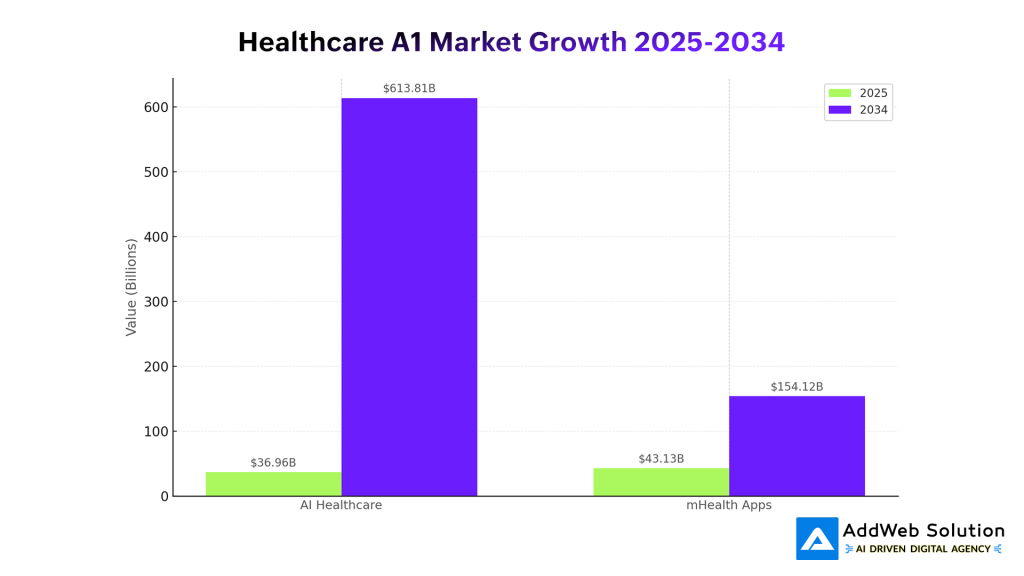
Healthcare AI and mHealth Apps Market Growth Projection (2025-2034)
Even more dramatic is the artificial intelligence space in healthcare, which is estimated to grow from $29.01 billion in 2024 to $504.17 billion in 2032. More aggressive growth has been estimated, with AI health market growth reaching as high as $674.19 billion in 2034, growing from $37.98 billion in 2025 at a CAGR of 37.66%.
This dramatic expansion reflects healthcare organizations’ growing recognition that AI-driven patient engagement platforms deliver measurable returns on investment. Healthcare providers implementing AI-powered systems report substantial operational improvements, including 15-20% boosts in clinic revenue and 10-20% reductions in overall operational costs.
AI Transforming Patient Engagement
Intelligent Virtual Assistants and 24/7 Support
AI-driven virtual assistants are transforming healthcare provider-patient relationships by providing round-the-clock 24/7 support beyond the restrictive traditional business hour limitations. These smart systems provide judgment-free platforms where patients do not hesitate to talk about sensitive health issues. Evidence suggests that 20% of studies report that users freely give detailed personal data to chatbots that they may refrain from describing directly to health professionals.
Real-world applications illustrate the profound effect on healthcare systems. Cleveland Clinic has been incredibly successful with its virtual health assistants, driven by AI, with patient satisfaction levels reaching 85%. Patients repeatedly mention convenience and accessibility as main advantages, with the system performing appointment scheduling, medication reminders, and overall health questions while allowing healthcare professionals to concentrate on intricate clinical activities.
Cleveland Clinic’s Virtual Emergency Medicine Program brings remote emergency physicians together with patients in 13 emergency departments and 26 Express Care clinics, with a remarkable 94% accuracy rate through its virtual triage system that is powered by artificial intelligence. This diagnostic telehealth innovation is a major leap forward, and patients can normally connect with physicians within less than two minutes.
Predictive Analytics and Personalized Care
AI’s predictive power allows healthcare professionals to detect at-risk patients and act early to prevent complications from escalating. The partnership between Johns Hopkins Hospital and Microsoft Azure illustrates the revolutionary potential of AI-based predictive analytics in medicine. Through processing large amounts of patient data such as electronic health records, medical imaging, and genomic data, their AI algorithms can reliably forecast disease progression, readmission likelihood, and treatment outcomes.
This forward-thinking strategy enables early intervention by healthcare professionals, optimizing treatment, and ultimately better patient outcomes. In real-world implementations, these AI systems have greatly improved patient care by facilitating early interventions for the avoidance of complications and hospital readmissions. Forecasts of patient trajectories with high degrees of accuracy enable more effective deployment of resources, priority identification of high-risk patients, and targeted interventions.
Mayo Clinic’s remote monitoring system utilizing AI is a prime example, significantly reducing hospital readmissions by 40% using wireless sensors across hospital wards with their Continuous Vital Sign Monitoring system. Instead of using pre-set thresholds, their system generates individual baselines for every patient based on patient-specific factors such as age, gender, medical history, and acute health status.


Improved Diagnostic Accuracy and Clinical Decision Support
Diagnostic systems powered by artificial intelligence are reaching unprecedented levels of accuracy in several areas of medicine. Mount Sinai Health System’s AI scored 94.6% for diagnosing pneumonia from chest X-rays, beating human radiologists handily at 82.9%. Likewise, the University of Rochester Medical Center used Butterfly Network’s AI-driven ultrasound technology and saw a 116% improvement in ultrasound charge capture and a 74% increase in scanning sessions.
Cleveland Clinic’s use of AI in stroke detection is an example of the life-saving capabilities of these tools. When brain scans are taken of patients suspected of having strokes, AI software such as Viz.ai inspects the images before humans can even look at them. When a large vessel occlusion is detected, the software pre-coordinates treatment by alerting all the appropriate specialists, with a potential savings of precious minutes that usually decide patient outcomes.
Flutter: The Perfect Framework for Healthcare App Development
Flutter has proven to be the top-rated cross-platform framework for healthcare application development, providing special benefits that specifically cater to the needs of the industry in terms of security, performance, and regulatory compliance.
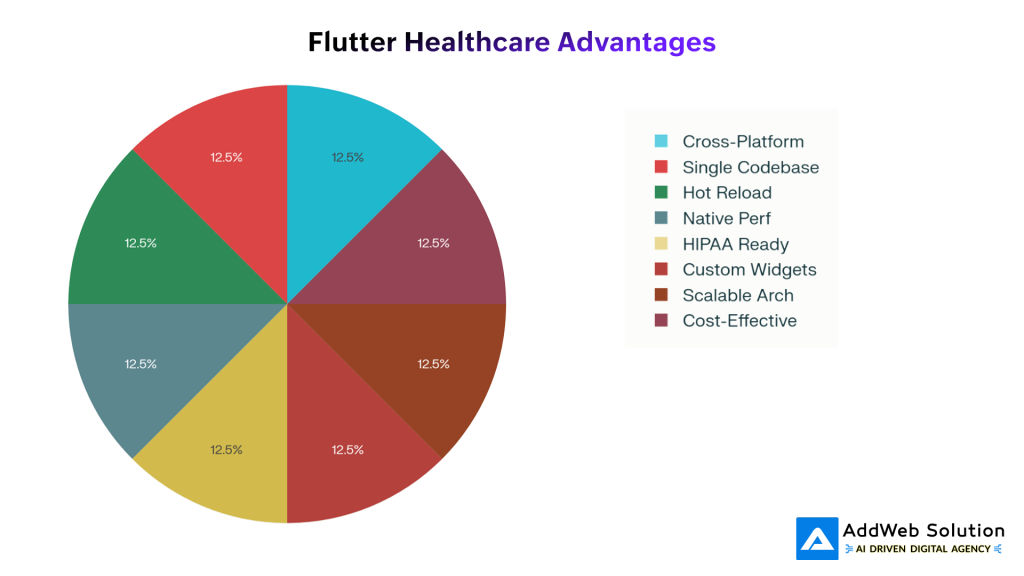
Flutter Framework Advantages for Healthcare App Development
Cross-Platform Excellence and Cost Efficiency
Flutter’s unified codebase strategy supports concurrent deployment on iOS and Android platforms, saving development time and expenses by 30-50%. This saves healthcare organizations resources to invest in feature development and patient engagement features instead of supporting two different platform-specific codebases.
Hot reload functionality in the framework speeds up development cycles by allowing developers to see changes in real time, allowing for efficient rapid iteration and testing that is crucial in healthcare applications, where user experience and function are paramount. This is especially useful when creating intricate healthcare interfaces that need constant adjustment based on clinical input.
Healthcare organizations that have adopted Flutter-based solutions have seen considerable improvements in user engagement and operational efficiency. A 25% increase in users and a 15% increase in operating speed were reported by one healthcare client after they adopted Flutter’s cross-platform mobile app development.
Security and Compliance
Healthcare apps have to meet strict regulatory conditions, such as HIPAA compliance and GDPR regulation. Flutter has native security mechanisms that safeguard user information from unauthorized access and provide immunity to some attacks against it in comparison to interpreted languages. The architecture of the framework promotes end-to-end encryption, secure data transfer, and healthcare regulations.
Flutter’s multi-layered architecture allows for effortless adaptation and extension, making it easy to integrate new features and technologies as healthcare demands change. Such systematic agility is vital in healthcare applications that have to support changing technologies and practices without losing out on regulatory compliance.
Performance and Scalability
Flutter’s scalable design can handle large patient registries and increasing user populations, making it perfect for healthcare organizations developing long-term digital transformation projects. The framework’s focus on performance optimization using Dart’s Ahead-of-Time (AOT) and Just In Time (JIT) processing features guarantees that healthcare applications run as smoothly as native alternatives.
Large-scale healthcare applications exemplify Flutter’s strengths in practical applications:
– Practo: India’s top healthcare app for booking appointments and ordering medicines
– 1mg: Health platform simplifying ordering of medicine and booking of health tests
– Cure.Fit: Fitness app providing live sessions of classes and diet tips
Case Studies: Real-World Success Stories
Valley Medical Center: Operational Efficiency through AI
Valley Medical Center deployed Xsolis’s AI solution (Dragonfly Utilize) to streamline case reviews and enhance patient classification, realizing transformative outcomes. In just one month after implementation, the facility ramped up case reviews from 60% to 100%, demonstrating a 67% increase in case review volume.
The system enabled Valley Medical Center to significantly increase its observation rates from 4% to 13%, bringing them more in line with Centers for Medicare and Medicaid Services (CMS) and other local facilities’ averages. Additionally, they reduced extended observation rates (patients discharged in observation status who stay longer than two midnights) by 25%, from 36.2% to 27.3%.
Kim Petram, Valley Medical Center Director of Care Management, said that the nurses were glad to no longer have to navigate convoluted guideline routes. Rather, they were given the power to apply clinical merit to inform patient status determinations, and that resulted in more efficient and accurate care decisions.
UAB Medicine: Remote Monitoring Innovation
UAB Medicine used the Sickbay platform to gather and interpret perioperative information from remote devices to enhance patient tracing after surgeries and reduce complications. This use case demonstrates AI’s power for managing chronic disease and remote patient monitoring, illustrating how healthcare organizations can take care beyond the usual clinical environment.[5]
Healthcare Provider Success: Automated Patient Engagement
A prominent healthcare provider implemented an AI chatbot integrated with their patient management system, achieving a 60% reduction in call abandonment rates. The system managed comprehensive patient interactions, including inquiry handling, appointment scheduling, customer surveys, and delay notifications, demonstrating the full potential of AI-driven patient engagement platforms.

ROI Benefits and Impact Timeline for AI Healthcare Applications
The rollout led to enhanced efficiency in appointment scheduling and increased patient satisfaction through real-time reminders and updates. This end-to-end solution illustrates how AI can evolve several touchpoints within the patient journey at the same time.
ROI Benefits and Impact Timeline for AI Healthcare Applications
Quantifiable Returns and Business Impact
Healthcare AI investments deliver both direct financial returns and indirect operational benefits that compound over time. AI-powered chatbots can reduce call abandonment by 60% while generating savings of $4 million annually for healthcare systems. Predictive analytics implementations demonstrate even more substantial returns, with some organizations achieving 20% reductions in readmissions and over $4 million in annual savings.
Clinical decision support systems have 30% quicker diagnosis times with accurate improvement in real-time, and remote patient monitoring lowers emergency visits by 68% and hospitalizations by 35%. These statistics indicate that AI healthcare investments normally register returns within 3-12 months of deployment.
Studies show that patient engagement technology can return up to a $62 million boost in net present value (NPV), and in certain instances, return on investment (ROI) of more than 500 times. A study estimated the net savings of $260,348 at an ROI of 14.85x for 1,753 patients over a period of 88 weeks.
Organizations that deploy AI-based smart call routing technology see 85% drops in call abandonment rates and 79% boosts in response times. These gains have a direct impact on increased patient satisfaction and greater trust in healthcare systems.
Patient Engagement Impact on Cost Reduction
Patient engagement programs show quantifiable cost savings in various healthcare outcomes. With each 10% increase in medication adherence, healthcare costs can be greatly minimized, particularly for chronic disease care. Patients who are involved are 30% less likely to be readmitted to hospitals, and this results in significant cost savings for healthcare systems.
Health plans that actively involve members in their own care can lower medical expenses by 5.3% and hospitalizations by 12.5%. Optimized patient engagement results in improved health outcomes and lower costs, including 50% fewer complications and a 25% decrease in readmissions.
Integration Challenges and Solutions
Data Security and Privacy
Healthcare apps manage sensitive patient information that needs secure security protocols throughout the development process. Flutter architecture has provisions for end-to-end security protocols such as data encryption, access controls, and audit trails. End-to-end encryption should be implemented, and regulations such as HIPAA, GDPR, and other global standards for protecting data should be followed.
Regulatory Compliance
Healthcare applications have to operate in highly regulated environments that differ by region and application type. Flutter’s framework facilitates the creation of compliant applications using native security features and an adaptable architecture that can support regulatory needs. Organizations must engage regulatory specialists during early development stages and create transparent compliance roadmaps.
Integration with Legacy Systems
Most healthcare organizations have legacy systems that must be integrated with contemporary AI-driven applications carefully. Flutter’s open architecture and large pool of plugins support smooth integration with current healthcare information systems, electronic health records, and medical equipment. This backward compatibility minimizes implementation obstacles and allows organizations to capitalize on past technology investments.
Future Outlook and Emerging Trends
Generative AI in Healthcare
The health care generative AI market is expected to grow exponentially from $3.3 billion in 2025 to $39.8 billion by 2035, at a CAGR of 28%. This technology will facilitate personalized learning content generation, automated reports, and better clinical decision support through natural language processing.
Healthcare organizations have already begun looking at applications such as clinical note generation, creation of patient education materials, and optimization of treatment plans. These features will diminish the administrative workloads of healthcare professionals while enhancing patient communication and engagement.
Advanced Patient Engagement Features
Future healthcare applications will incorporate multimodal AI interactions, including voice, text, and visual interfaces that adapt to patient preferences and accessibility needs. Remote patient monitoring will expand through Internet of Things (IoT) integration, wearable devices, and real-time health tracking capabilities that provide continuous health insights.
Virtual assistants powered by AI will be more advanced, providing individualized health coaching, medication management, and support for chronic disease. These platforms will adapt to individual patient interactions and respond with more relevant and timely healthcare advice.
Predictive Healthcare Analytics
AI systems will evolve beyond reactive care to proactive health management by predictive analytics to detect impending health problems before symptoms arise. These features will allow healthcare providers to make preventive interventions and decrease overall healthcare expenses while enhancing patient outcomes.
Machine learning algorithms will examine information from various sources such as electronic medical records, wearable trackers, genetic data, and social determinants of health in order to deliver evidence-based risk assessment and customized prevention measures.
Implementation Strategy for Healthcare Organizations
Assessment and Planning
Healthcare organizations should start with a thorough needs assessment, determining particular patient engagement issues and operational inefficiencies that can be improved using AI. Pilot programs confirm AI effectiveness in practice before widespread implementation, minimizing risk and facilitating successful adoption.
Organizations need to define clear success measures such as diagnostic accuracy, patient satisfaction, efficiency in operations, and financial returns. These need to be tracked regularly to prove value and inform system refinements.
Discover how AI and Flutter transform healthcare apps

Pooja Upadhyay
Director Of People Operations & Client Relations
Technology Selection and Development
Flutter’s cross-platform, security features, and health care-specific benefits make it a good candidate for building AI-driven patient engagement apps. Organizations must collaborate with skilled healthcare app development organizations that are familiar with regulatory needs and clinical processes.
Development teams must focus on user experience design to support a wide range of patient populations and accessibility requirements. The iterative development process facilitated by Flutter’s hot reload capability supports ongoing refinement according to user input and clinical needs.
Measurable Outcomes and Continuous Improvement
Successful AI implementation requires continuous performance monitoring, measuring impact through specific key performance indicators, and refining applications based on user feedback and clinical outcomes. Organizations must establish feedback loops that enable rapid response to changing clinical needs and emerging technologies.
Long-term success relies on change management strategies that facilitate healthcare staff adoption and regular training programs that keep users up to date with developing capabilities. Organizations must plan for scalability at the starting point, so systems can adapt to growth in the user base and functionality.
The union of AI and Flutter in healthcare app development presents a disruptive opportunity for healthcare organizations looking to accelerate patient engagement, optimize clinical outcomes, and attain sustainable operational effectiveness. Offering demonstrated ROI potential, regulatory compliance ability, and flexible scalability, this technology pairing enables healthcare organizations to keep up with changing patient needs while driving quantifiable business value.
Healthcare providers that strategically invest in AI-powered, Flutter-based patient engagement platforms will gain competitive advantages through improved care quality, operational efficiency, and patient satisfaction. The future of healthcare lies in intelligent, accessible, and patient-centered digital solutions that bridge the gap between clinical expertise and patient needs, creating a more connected and effective healthcare ecosystem.
1) https://www.grandviewresearch.com/industry-analysis/healthcare-mobile-applications-market
2) https://www.fortunebusinessinsights.com/mhealth-apps-market-102020
3) https://www.towardshealthcare.com/insights/ai-in-healthcare-market
4) https://pmc.ncbi.nlm.nih.gov/articles/PMC7061301/
5) https://www.statista.com/topics/2263/mhealth/
7) https://www.strategyand.pwc.com/de/en/industries/pharma-life-sciences/ai-healthcare-revolution.html
