


When enterprises scale with Webflow, the real challenge isn’t the tech—it’s the mindset. Hosting, CMS limits, and integrations matter, but what truly drives success is leadership willing to rethink how teams work and make decisions.
Webflow doesn’t just change your platform; it changes your culture. The companies that win with it—like Dropbox Sign cutting dev tickets by 67%, Copy.ai slashing content time from days to hours, or Rakuten trimming a 5-hour task to 20 minutes—didn’t just adopt a tool. They empowered their teams.
These aren’t tech upgrades. They’re leadership upgrades.
The Leadership Paradox: Why Smart Companies Still Resist
Let’s start with an uncomfortable truth: the organizations that most desperately need Webflow often resist it hardest.
In a 2024–2025 survey on no-code adoption, 42% of organizations cited existing in-house solutions as their biggest barrier. It’s not about capability—it’s about sunk costs and inertia. Leaders think, “we’ve already invested in this,” and miss the opportunity cost of staying stuck.
Another 25% said their barrier was simply “lack of consideration.” That’s the real red flag—it means many teams haven’t even put Webflow on the table, not because it’s unfit, but because no one questioned the old model: developers build, marketers wait, and backlogs grow.
When companies do try adopting no-code tools, the main hurdles are training (54%), time constraints (45%), and internal momentum (38%)—not technology. The issue isn’t that Webflow doesn’t work; it’s that people and culture need to catch up.
In the end, leadership mindset is what determines whether these barriers stay walls—or become doors.

A diverse team collaborating using a futuristic digital interface, symbolizing innovation and leadership in digital transformation
The Webflow Moment: Why Now?
Webflow didn’t invent no-code, but it’s the one that made it enterprise-ready. Today, it powers 1.2% of all CMS websites globally, up from 0.4% in 2021—a 3x growth in four years. That’s massive for a platform competing head-on with WordPress, Wix, and Squarespace.
But the real story isn’t market share—it’s business impact.
A 2024 Forrester Total Economic Impact study found that Webflow delivered a 332% ROI over three years. Teams saved $850,000 on legacy systems and labor, saw a 94% faster time-to-market, and cut developer tickets by 67%.
In short, Webflow doesn’t just simplify websites—it transforms how teams work and deliver results.
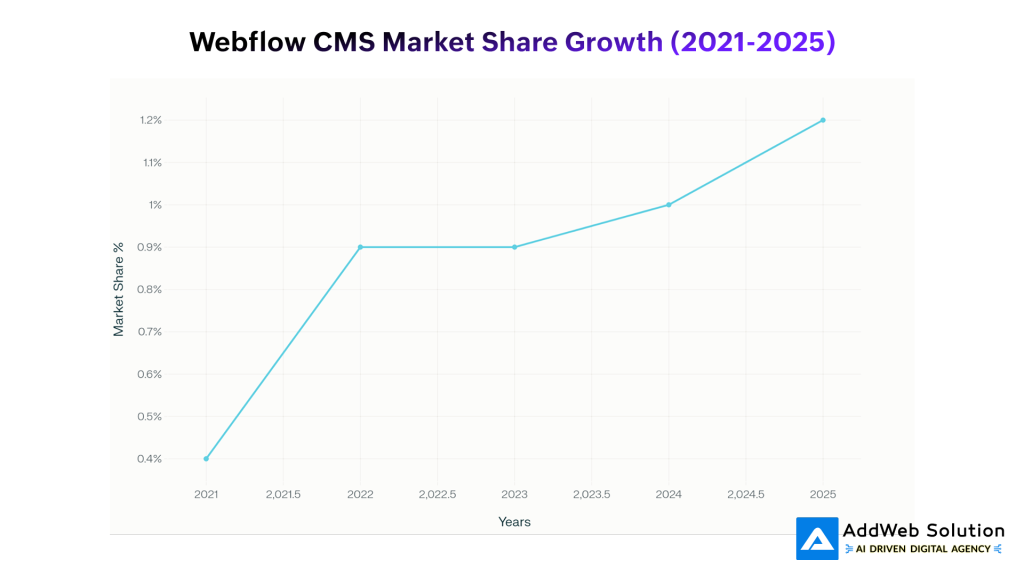
Webflow’s market share among CMS platforms has tripled since 2021, growing from 0.4% to 1.2%, demonstrating significant enterprise adoption momentum
These results happened because leaders asked better questions—like “What if marketing could publish on its own?” or “What if speed, not cost-cutting, was our edge?”
The difference between teams that thrive with Webflow and those that don’t? They treat it as a transformation, not a tool.
The Data-Driven Leadership Case: Beyond ROI Spreadsheets
The numbers are impressive—but they only tell half the story. What really changes when leadership decides to move?
Speed: Webflow compresses timelines. Landing pages that once took 2–3 weeks now ship in 2–3 days. Updates go from days to hours. A/B tests that used to take weeks launch within days. Over a year, that means 2–3x more experiments and faster growth.
Cost: Instead of hiring more developers, teams use the ones they have better. Designers, marketers, and product managers can now build without code. A Forrester study found teams saved $850K – not from layoffs, but from freeing developers from repetitive work to focus on strategy.
Conversions: SaaS teams switching to Webflow often see conversion rates jump from ~1.8% to 3%+. For a site with 15,000 visitors a month, that’s around 180 extra leads—or $130K in new annual revenue.
But here’s the real insight: none of this happens by accident. These results come when leaders treat Webflow as an organizational shift – not just a new tool.

A collaborative executive leadership team analyzing a business chart during a strategy meeting
Where Industry Distribution Reveals Leadership Choices
Webflow adoption reveals where leadership mindset thrives—and where it still needs to grow.
Tech and electronics lead the way with 8.85% adoption, driven by leaders who already value speed and independence from heavy development cycles.
But here’s the real story: 84.71% of Webflow users come from other sectors. The mindset shift is spreading far beyond tech—and that’s where the real transformation is happening.
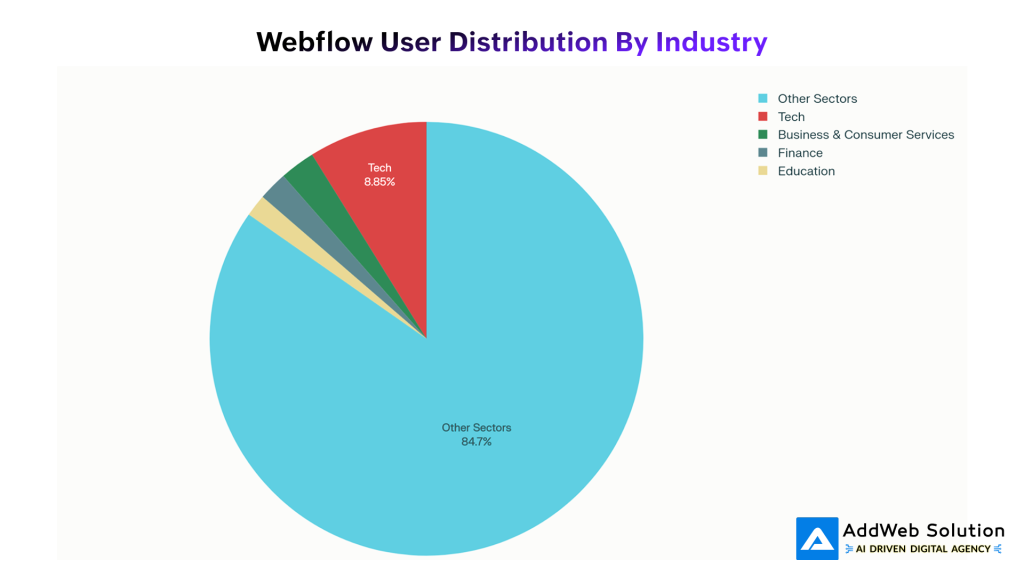
While technology companies lead Webflow adoption at 8.85%, the platform’s versatility enables usage across diverse industries, with 84.71% of users spanning various sectors
So what does that really mean?
Smaller companies, startups, and nonprofits are turning to Webflow out of necessity, not trend. With limited resources, they need to do more with less—to compete with lean teams and tighter budgets.
The key insight: Webflow adoption mirrors leadership maturity.
Organizations that trust teams and decentralize decisions move faster. Those clinging to hierarchy and control fall behind.
The Three Pillars of Leadership Mindset for Webflow Adoption
Research into digital transformation and no-code adoption shows three leadership traits consistently drive successful Webflow implementation at scale:
1. Vision Over Technical Know-How
Great leaders don’t need to know how Webflow works—they need clarity on what winning looks like in a faster, more independent setup.
Dropbox Sign cut request queues. MURAL gave design ownership. Rakuten empowered marketers.
They started with problems, not platforms—that’s visionary leadership.
2. Change Management as Core DNA
Top adoption barriers—lack of consideration (25%) and training (54%)—point to weak change management.
Successful teams treat Webflow as organizational transformation, not just a new tool.
They engage stakeholders early, communicate openly, and invest in training and autonomy.
Dropbox Sign didn’t just install Webflow—they reshaped collaboration and freed engineers from maintenance.
3. Courage to Decentralize Authority
Webflow thrives where leaders trust teams to move fast.
Marketers publish, designers iterate, product teams test—without bottlenecks.
Copy.ai proved it: after decentralizing with Webflow Enterprise, they shipped updates in hours instead of days and drove millions in new pipeline.
The real shift isn’t the tool—it’s the leadership mindset.

Diverse team collaborating around a table using laptops and digital devices during a meeting


The Organizational Barriers: What Leadership Actually Faces
Let’s be specific about what trips up adoption efforts. The data reveals a clear hierarchy of challenges:
Chart 1: Barriers Before Adoption
The fundamental barriers to even considering Webflow adoption are legacy commitments (42%) and organizational inertia (25%). These aren’t technology problems. They’re leadership conversation problems. They require an executive who’s willing to ask: “Are we optimizing for what we built five years ago, or are we optimizing for where we want to go?”
Chart 2: Challenges During Implementation
Once leadership commits to adoption, the implementation roadmap hits different friction:
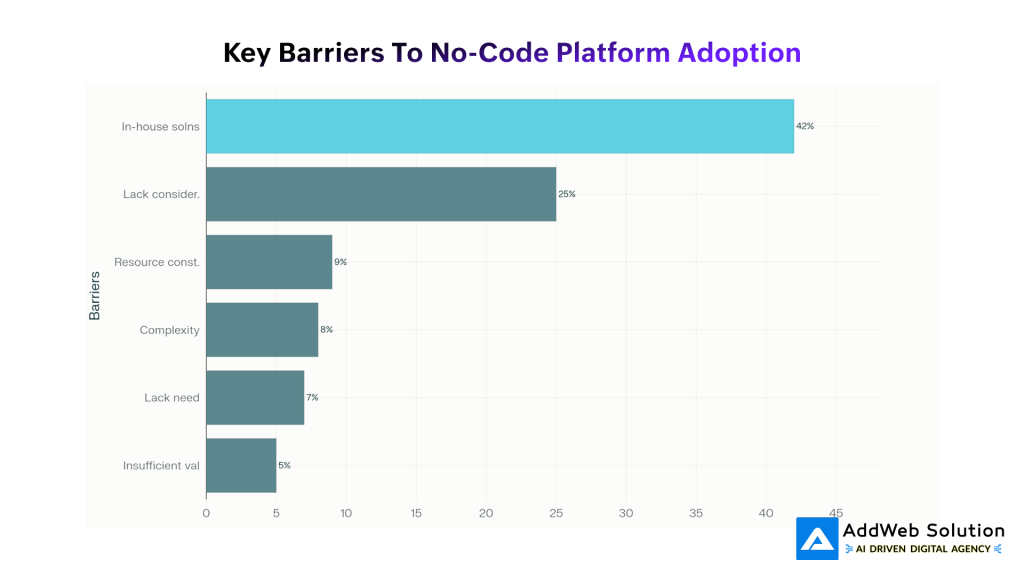
Legacy systems and lack of consideration represent 67% of adoption barriers, indicating that leadership mindset and organizational readiness are critical to successful platform transitions
The top challenge is training (54%), followed closely by time constraints (45%). These map directly to leadership decisions:
- Is the organization willing to invest time in team development?
- Do leaders protect calendar space for learning, or is it expected to happen “in free time”?
- Is training treated as a project line item, or as overhead that should be squeezed?
The answers to these questions determine whether adoption stalls or accelerates.
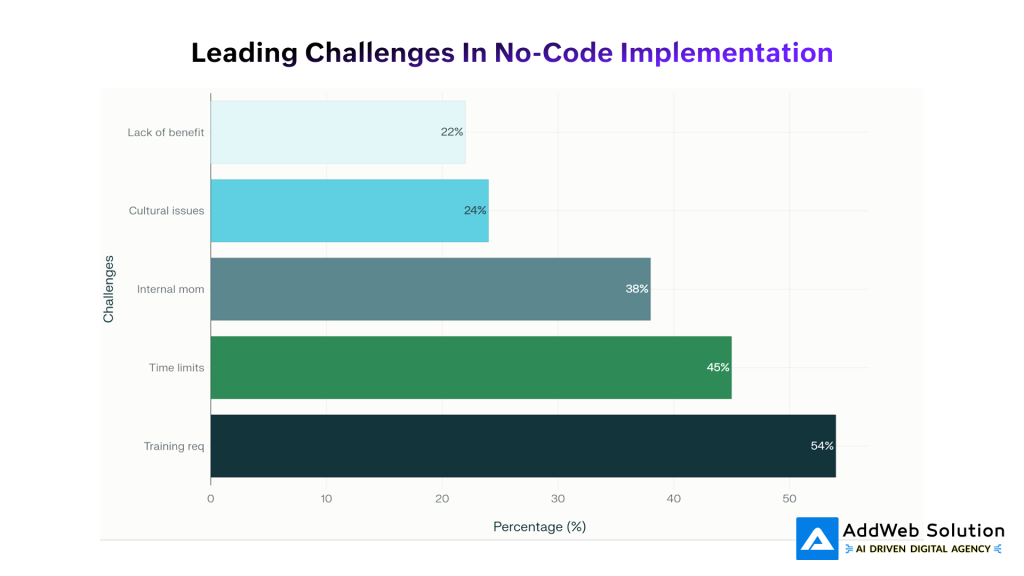
Training and time management represent nearly 100% of implementation challenges, highlighting that successful Webflow adoption requires dedicated resources and structured change management.
Ready to scale Webflow with leadership-driven governance? Explore the mindset that accelerates design-led growth.

Pooja Upadhyay
Director Of People Operations & Client Relations
Building the Decision-Making Framework
1. Check Your Readiness
Before testing the tool, test your culture.
Do leaders embrace learning and experimentation?
Can teams suggest new ideas safely?
Are decisions shared or centralized?
Companies confident in adoption usually already use digital tools, invest in people, and reward experimentation, not punish it.
2. Define What “Winning” Means
Be clear on why you’re adopting Webflow.
Common goals:
- Speed: Go from weeks to days.
- Autnomy: Let marketers and designers build without dev bottlenecks.
- Cost: Drop legacy systems.
- Experimentation: Run 2–3x more A/B tests.
If you can’t name your “win,” the project risks becoming just another shiny tool.
3. Plan the Change Journey
Adopt in waves:
- First: Early adopters (design, marketing, product).
- Next: Team leads and managers.
- Then: Leadership and governance.
When adoption starts bottom-up, momentum builds. When it’s forced top-down, it usually stalls.
4. Build the Right Foundations
This isn’t about servers – it’s about structure.
- Training: Give teams real time to learn.
- Champions: Empower internal advocates.
- Governance: Create smart guidelines that enable, not restrict.
- Metrics: Track impact—like time-to-publish, tests per quarter, or developer hours saved.
Real-World Implementation: What Successful Leaders Actually Do
Let’s look at three case studies that show this framework in practice:
Case Study 1: Dropbox Sign — From Bottlenecks to Breakthroughs
The challenge: Every marketing update needed engineering help, slowing growth.
The move: Leadership migrated to Webflow Enterprise, giving marketing full control and freeing developers for high-impact work.
The results:
- Developer tickets down 67%
- Page launches cut from 3 weeks to 3 minutes
- Full site rebuild for Dropbox rebrand done in 2 weeks (vs. 2+ months)
A perfect example of distributed authority and faster execution.
Case Study 2: Copy.ai — Autonomy That Scales
The challenge: Publishing content was painfully slow due to external dependencies.
The move: Switched to Webflow Enterprise, built internal governance, and empowered teams to publish directly.
The results:
- Publishing time dropped from days to hours
- Millions added to organic sales pipeline
- Engineers freed from maintenance to focus on innovation
Proof that autonomy drives both speed and growth.
Conclusion
Here’s the bottom line: Webflow works. Teams move faster, costs drop, autonomy rises.
But success isn’t about the tool—it’s about leadership. The real question is:
Are you optimizing for what you’ve built, or for what you want to build?
The gap today isn’t technical, it’s cultural—trust, agility, and the courage to let teams lead.
At AddWeb Solution, we’ve helped organizations make that shift.
The future’s here. The choice to move is yours.
Source URLs
- https://webflow.com/blog/forrester-tei-study
- https://www.thealien.design/insights/webflow-usage-statistics-2025
- https://webflow.com/blog/roi-metrics-that-matter-to-the-c-suite
- https://duplocloud.com/ebook/state-of-no-code-low-code-cloud-automation/
- https://emeritus.org/in/learn/what-is-visionary-leadership/
- https://quixy.com/blog/all-about-no-code-development/
- https://www.bain.com/insights/solution-spotlight/platform-strategy/
