


I’ve been watching something wild happen over the last few years, and honestly, it caught me off guard.
You know how we all grew up thinking retail was this untouchable game? Amazon owns everything, Walmart dominates, and if you’re a small business, you’re basically fighting for scraps. Right? Wrong. That story’s changing fast, and not in the way anyone expected.
Here’s what’s happening: tiny brands—I’m talking single-person operations, friends running stores from their apartment—are genuinely outcompeting massive retailers. Not just surviving. Actually winning. And I’m not talking about some niche corner of the market either. I mean real revenue, real growth, real customer loyalty that puts big box stores to shame.
The numbers alone tell you something’s shifted. Direct-to-consumer brands went from $35 billion in 2019 to $220 billion today. That’s not a gradual climb. That’s someone hit the accelerator and forgot to ease off. Meanwhile, traditional retail? Growing at maybe 2–3% a year. Boring. Stagnant. Meanwhile these micro-brands are scaling 529% in six years.
I keep asking myself why. Why is someone buying from a random Shopify store instead of Amazon? Why would they choose a subscription box from a founder they’ve never met over the certainty of a major retailer? The answer surprised me because it’s not about luck. It’s not about timing. It’s actually about something retailers lost along the way.
Customer loyalty used to mean something. Now it’s just a program nobody cares about.
When Warby Parker started selling glasses online in 2010, people literally thought they were insane. How do you sell glasses when you can’t see someone’s face? But here’s the thing—they didn’t just solve a logistics problem. They actually gave a damn.
They created a home try-on program because they understood that people were scared. Instead of dismissing that fear, they removed it. Transparent pricing because retailers had been ripping people off for decades with markups nobody understands. “Buy a Pair, Give a Pair” because the founder actually believed in something beyond making money.
Fast forward to today, and that company is worth $1.7 billion. A billion and a half dollars. For selling glasses online. That’s not a fluke. That’s what happens when you actually listen to what your customers want instead of telling them what they need.
Compare that to what happens when you walk into a Lenscrafters. Pushy sales staff. Marked-up frames. This weird territorial feeling like they’re doing you a favor. Warby Parker made the opposite choice at every single turn.
The personalization thing is way more powerful than people realize
Glossier’s founder Emily Weiss started with a blog. Just… a blog. Called “Into the Gloss.” She was literally writing about products she loved, and it wasn’t even a business at first. It was just her sharing opinions with people who actually cared enough to read.
That’s it. That’s the whole origin story.
But here’s what most beauty companies miss: she wasn’t writing for everyone. She was writing for people like her. People who actually think about skincare. People who want real recommendations from someone who tested stuff and isn’t working on commission.
Now Glossier is valued over $1 billion. The margins are different. The relationship with customers is totally different. When you buy from Glossier, you don’t feel like you’re filling out a transaction. You feel like you’re part of a movement. You’re supporting something. You get an actual person responding to your emails sometimes.
Try that at Sephora. I dare you. See how long it takes to get a generic response from a bot.
Statista did research on this—76% of customers will pay more for a brand that actually personalizes their experience. And 80% of businesses see customers spend more money when they feel recognized. That’s not edge case stuff. That’s basic human psychology. People want to feel known.
Amazon and big retailers have the technology to do this. They absolutely do. They just don’t care enough because you’re a transaction to them. One of millions. But to a micro-brand on Shopify? You’re everything. You’re the person they’re thinking about when they wake up at 5 AM and can’t sleep because they’re worried about getting your order right.
Speed matters more than you think, and big retailers can’t keep up
There’s this brand called Beardbrand. How it started is actually funny. The founder Eric Bandholz was just making YouTube videos about beard grooming as a hobby. Not trying to sell anything. Just… passionate about beards, I guess?
Then The New York Times featured him. One article. Suddenly his inbox exploded. He had 24 hours to actually launch a store if he wanted to capitalize on it.
Most companies would panic. They’d write a memo. Form a committee. Schedule some meetings. Three months later, nothing would happen.
Eric’s team launched a complete Shopify store in literally one day.
That’s the advantage micro-brands have. When a TikTok trend starts, they’re shipping products in days. When customers ask for something different, they test it in a week. When something isn’t working, they pivot by next month.
Big retailers? Their product development cycle is like a cruise ship. You can see it moving, but good luck steering it. By the time corporate approves a new product line, the trend is already dead and customers have moved on to three new things.
I work with founders all the time, and the speed is what shocks big retailers the most. They’re used to operating at a pace that makes sense for massive organizations. They’re not used to someone making a decision and implementing it before lunch.
You own Amazon. Amazon doesn’t own you. That changes everything.

This one’s almost obvious but people still miss it.
When you sell on Amazon, Jeff Bezos owns your customer relationship. Full stop. They own the email address. They own the purchase history. They own the communication channel. You don’t get to see any of it unless they let you.
On Shopify? You own all of it. The email list is yours. The data is yours. You know exactly what people buy, when they buy it, and what they looked at but didn’t purchase. You can email them directly. You can build an actual community.
McKinsey found that 95% of micro-brands with their own platform have direct access to customer data. Only 15% of big retailers selling through other people’s platforms do. That’s a massive difference. That means micro-brands can actually adapt to what customers want. Big retailers are stuck guessing based on what the algorithm shows them.
Real talk: building community is the most underrated competitive advantage

Peloton didn’t just sell exercise bikes. They built something people actually wanted to be part of. Leaderboards so you could compete with your friends. Private Facebook groups where people supported each other. Personal trainer connections. Monthly challenges that meant something.
Their retention rate is 95%. Netflix’s is 93%. Let that sink in. A bike company has better customer retention than Netflix. That’s not about the bike. That’s about community.
Crocs had basically become a joke, right? Like the thing your dad wore and everyone made fun of? But then they figured out something smart: people actually want to customize and personalize stuff. So they started collaborating with artists. Working with celebrities like Post Malone. Donating a million pairs to healthcare workers through their Crocs Cares program. They turned a product nobody wanted into a cultural moment.
Micro-brands just… understand this naturally. When you’re small, you can’t compete on price or distribution. You can only compete on making people actually care. So that’s what you do. You build something real.
GoPro’s entire marketing strategy is basically just showing user-generated content. They’re not running polished advertising campaigns. They’re just saying “look at what our customers made with this camera.” And suddenly the camera isn’t a product. It’s a tool for creating amazing moments.
When people see themselves in your brand story, they’re not customers. They’re part of something.
(see the generated image above)
The niche thing is actually genius
Beardbrand didn’t try to be for everyone. They built “The Urban Beardsman” as an identity. Not just men with beards. An identity. A lifestyle. They weren’t competing with every grooming brand in the world. They created their own category and became the undisputed authority in it.
That’s the opposite of what big retailers do. Big retailers are always trying to broaden their appeal. Capture more demographics. Sell more categories. Which means they dilute everything. They become mediocre at many things instead of exceptional at one thing.
When you’re selling to a niche, you don’t compete on price. You compete on understanding your people better than anyone else does. And you know what? Passionate niche customers will always spend more than price-conscious mass market customers.
Someone who cares about beards and specifically wants a product made by someone who shares that passion? They’ll pay a premium. They’re not shopping. They’re joining.


Omnichannel is way simpler than big retailers made it
Remember when “omnichannel strategy” meant hiring consultants and spending six months on implementation?
Now? You just sell where people already are. Your Shopify store, Instagram Shop, TikTok Shop, email, SMS. All managed from one dashboard. All syncing the same inventory. All the same brand voice.
Harvard Business Review did research showing 73% of customers use multiple channels when buying something. And 90% expect the experience to feel seamless. Big retailers spent billions building physical infrastructure. That infrastructure is now mostly a liability because it ties them down..
Micro-brands built digital infrastructure that moves with customers. No stores to manage. No overhead. Just the ability to show up where people are, when they’re looking.
Here’s the uncomfortable truth about margins and why it matters
On Amazon, if you’re a third-party seller, you’re giving up 15–45% of every sale in fees. Referral fees. Fulfillment fees. Advertising you basically have to run to be visible. On a $100 item, that’s $15–$45 just gone.
On Shopify with their basic plan at $29/month, you’re paying 2.9% + 30 cents per transaction with Shopify Payments. That’s roughly $3 on a $100 sale.
The difference compounds fast. That extra $12–$42 on every transaction? That’s reinvestment. That’s better packaging. That’s faster shipping. That’s hiring someone to handle customer service better. That’s testing new products.
Over thousands of transactions, that gap between 3% and 30%+ fees is literally the difference between a business that’s constantly struggling and one that’s generating real cash flow.
Big retailers spend an insane amount on logistics and overhead. Micro-brands have figured out how to be lean. And lean businesses survive downturns that would kill bloated competitors.
The challenges are real, though. Let’s not pretend they’re not.
Building a Shopify store is cheap. But getting customers to actually find you? That’s expensive. Amazon gives you traffic. Shopify requires you to drive it yourself. Ads. Content. Social media. Influencers. That costs money and most new store owners underestimate it.
Customers on Amazon came to shop. They’re already in buying mode. On Shopify, you’re asking cold traffic to trust a brand they’ve never heard of and give you their money. That’s a bigger psychological jump.
Operations get complicated too. You own the fulfillment. You own customer service. Returns are your problem. Technical issues are your problem. There’s no Amazon support team to blame when something goes wrong.
But here’s the thing nobody talks about: those challenges are actually advantages if you survive them. Because they force you to get really good at the fundamentals. Marketing. Operations. Customer service. By the time you’ve scaled past those challenges, your business is way more defensible than someone who just listed products on a marketplace.
What actually separates the winners from everyone else
I’ve worked with enough founders to see patterns. The ones who actually make it follow a specific playbook.
First, they don’t compete on price. They compete on connection. They understand that a customer who feels known will always spend more than a customer hunting for the cheapest option. So they build relationships instead of sales funnels.
Second, they think beyond the initial sale. Repeat customers become advocates. Advocates become communities. Communities become brand moats that nothing can break through. So they build loyalty programs. They ask for feedback. They actually listen to what people want.
Third, they go where customers are instead of trying to funnel everyone through one place. Instagram Shop for TikTok kids. Email for older customers. SMS for quick updates. They meet people where they already spend time instead of making people come to them.
Fourth, they do one thing exceptionally well before they try three things okay. So many founders see Shopify and immediately think “I’ll do product, consulting, and a podcast.” Nope. Do the product better than anyone. Build the community. Become the authority. Then extend.
Contact us for a bespoke Shopify app integration plan.

Pooja Upadhyay
Director Of People Operations & Client Relations
What this means if you’ve been thinking about starting something
Look. The infrastructure is dirt cheap now. Shopify starts at $29/month. You can launch a professional store for literally less than going out to dinner.
The tools are way better than they used to be. AI recommendations. Email automation. Inventory sync across multiple channels. Analytics dashboards. All built in. You don’t need to be technical.
Customers actually want to buy from people now. 81% of consumers say they’ll make at least one DTC purchase in the next five years. The audience is ready. They’re actively looking for alternatives to Amazon.
And honestly? The barrier to competing is lower than ever. You don’t need a massive marketing budget. You need to understand your people better than big retailers do. You need to build something genuine. You need to actually care about the community instead of just extracting money from it.
The micro-brand thing isn’t coming. It’s already happening. The question is whether you’re going to be one of the people building it or just watching it happen.
Three things to do right now if this resonates
One: Get clear on exactly who you’re serving and why you’re better for them. Don’t try to appeal to everyone. That’s the trap. Pick a specific person. Understand them deeply. Build for them obsessively.
Two: Build something you control. You can test on marketplaces. But your real business lives on Shopify or WooCommerce or something where you own the relationship. You own the data. You own the future.
Three: Build community before you build more products. Use email. Use social. Talk directly to your customers. Ask what they actually want. Show them they’re being heard. The best marketing is a customer who feels like they’re part of something bigger.
The retail landscape is shifting right now. The window for building something is genuinely open. That probably won’t be true forever.
Case Study: Fashion Brand That Actually Made It Work
I’ll give you one real example from our work at AddWeb. There’s this fashion brand that was grinding it out on Amazon and Etsy. Sales were happening, but the margins sucked and growth was basically flat. Customers weren’t loyal to the brand—they were loyal to the platform. Amazon knew their customers better than the brand did.
They were stuck in what I call the “marketplace trap.” Enough revenue to justify staying, but not enough margin to actually invest in anything. They knew something had to change.
So they came to us wanting to build a Shopify store. But it wasn’t just “throw some products online.” We actually redesigned how they presented themselves. Every page told their story. The product photography wasn’t generic marketplace photos—it showed who actually wore this stuff and why it mattered to them.
We migrated their customer list. Set up Klaviyo for email that actually felt like it was coming from people they liked, not a robot sending promotions. Built their Instagram Shop and TikTok Shop so people could shop where they already hung out.
The loyalty program wasn’t “spend $100, get $5 off.” It was early access to new drops. Exclusive product lines for repeat customers. DM access to the founder for questions. Making people feel like VIPs instead of transaction numbers.
The results: revenue jumped 165% in year one versus their historical 12% growth on marketplaces. Repeat customers went from 18% to 52%. Average order value up 34% because personalization actually works. Email open rates went from basically nothing to 22% because people actually wanted to hear from them.
The thing that surprised them most? They went from spending money on marketplace fees to spending money on their own brand. That’s a totally different feeling. One feels like you’re losing money. One feels like you’re building something.
The Data
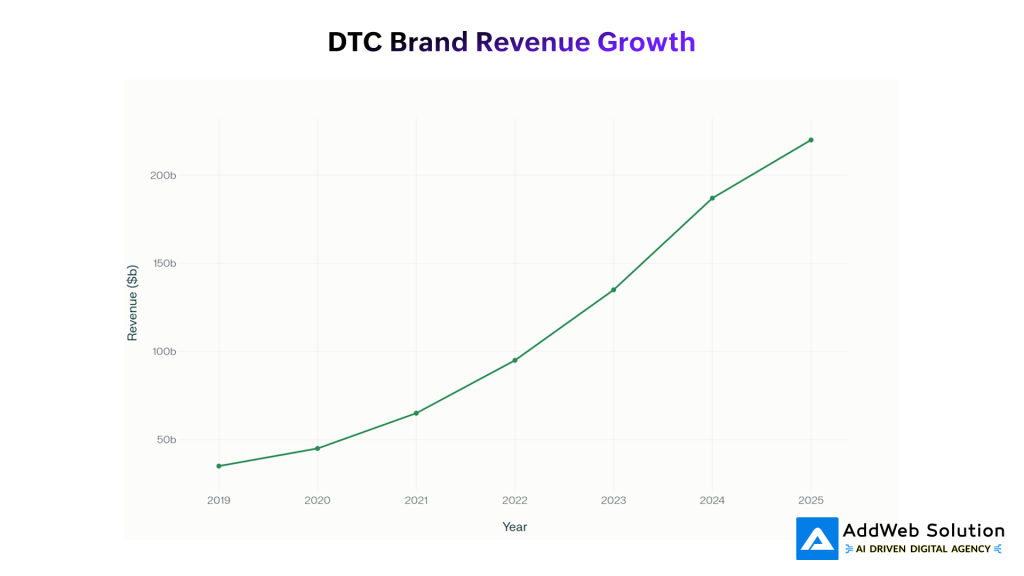
The explosive growth trajectory of DTC brand revenue demonstrates how small, direct-to-consumer businesses have scaled from $35 billion in 2019 to an projected $220 billion in 2025—a 529% increase in just six years.
Six years ago, DTC was $35 billion. Now it’s $220 billion. That’s not accidental. That’s not a trend. That’s a fundamental shift in how people want to buy stuff. They want relationships, not transactions. They want to know who they’re giving money to. Big retailers didn’t see this coming. Micro-brands did.
| Year | DTC Revenue (Billions) |
| 2019 | $35 |
| 2020 | $45 |
| 2021 | $65 |
| 2022 | $95 |
| 2023 | $135 |
| 2024 | $187 |
| 2025 | $220 |

Micro-brands significantly outperform big retailers in critical competitive dimensions, especially in brand control (92% vs 20%), direct customer data access (95% vs 15%), and product innovation speed (88% vs 32%).
Only category where big retailers win is margin efficiency, and that’s narrowing fast because they have so much overhead. Micro-brands win because they’re lean and actually understand their customers.
| Advantage | Micro-Brands | Big Retailers |
| Personalization | 85% | 45% |
| Speed to Market | 88% | 32% |
| Loyalty Building | 79% | 52% |
| Brand Control | 92% | 20% |
| Direct Data Access | 95% | 15% |
| Margin Efficiency | 78% | 65% |
Sources
Harvard Business Review: https://hbr.org/2021/11/how-direct-to-consumer-brands-can-continue-to-grow
McKinsey & Company: https://www.mckinsey.com/capabilities/strategy-and-corporate-finance/our-insights/what-is-e-commerce
Yotpo – Real case studies of brands: https://www.yotpo.com/blog/how-beardbrand-uses-community-to-dominate-their-niche
Statista: https://www.statista.com/topics/9694/sme-e-commerce/Shopify Documentation: https://www.shopify.com/pricing
