


Author’s Note
People often say,
“Experience is the best teacher.”
For a long time, I believed that.
Today, I think the statement is incomplete.
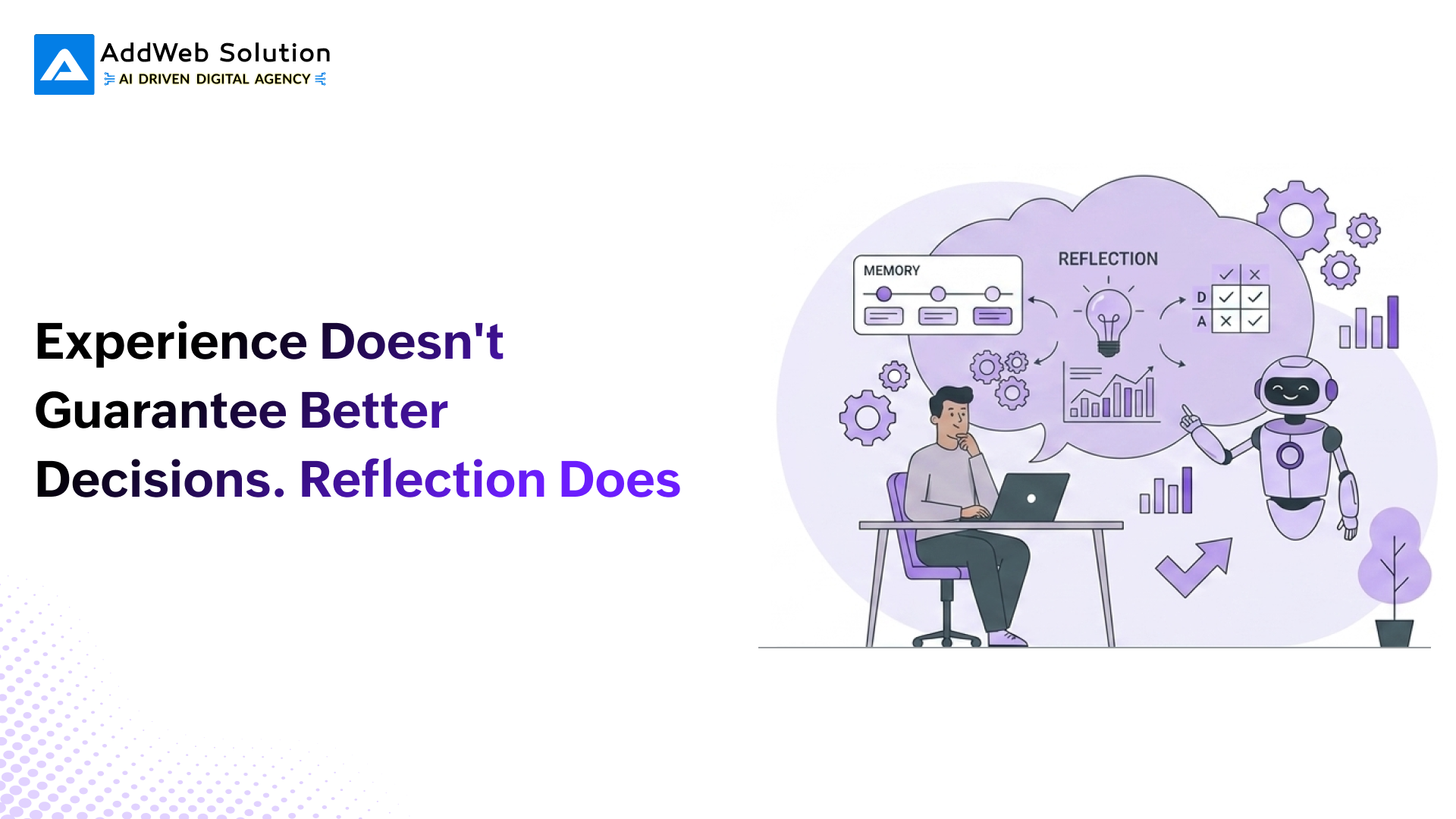
Experience gives us events.
Reflection gives those events meaning.
Two founders can go through the same failure.
One repeats it.
The other learns from it.
The difference isn’t time.
It’s reflection.
That realization has shaped many of the decisions I make today.
Key Takeaways
- Time alone doesn’t create wisdom.
- Reflection transforms experience into judgment.
- Better questions produce better decisions.
- Mistakes become valuable only when they’re examined.
- Leaders grow by reviewing their thinking, not just their outcomes.
Introduction
Twenty-one years is a long time to work in one industry.
During that time I’ve seen technologies rise and disappear.
Business models evolve.
Client expectations change.
Entire conversations shift.
But one thing has surprised me more than anything else.
Experience alone doesn’t automatically make us better decision-makers.
If it did, every experienced leader would consistently make outstanding decisions.
Reality tells a different story.
I’ve met people with decades of experience who still repeat the same mistakes.
I’ve also met relatively young leaders who display remarkable judgment.
That difference fascinated me.
Eventually I reached a conclusion.
The advantage wasn’t experience itself.
It was what they chose to do with it.
1. Why Experience Can Be Misleading
Experience has a way of making us confident.
Confidence is valuable.
Until it becomes certainty.
Earlier in my career, every successful project increased my confidence.
That’s healthy.
What wasn’t healthy was assuming success automatically proved every decision was correct.
Sometimes we succeed despite imperfect decisions.
Sometimes we fail despite making thoughtful ones.
If we judge only the outcome…
We risk learning the wrong lesson.
That realization changed how I evaluate my own work.
Instead of asking,
“Did this succeed?”
I increasingly ask,
“Would I make the same decision again knowing what I know now?”
Those aren’t the same question.
Daniel Kahneman observed,
“We are prone to overestimate how much we understand about the world.”
The first time I read that, it made me uncomfortable.
Now I think it’s one of the healthiest reminders a leader can have.
Experience should increase curiosity.
Not certainty.
2. The Difference Between Time and Wisdom
Time passes automatically.
Wisdom doesn’t.
I’ve known people who’ve spent twenty years repeating one year of experience.
I’ve also known people who transformed a few difficult years into extraordinary judgment.
The difference isn’t age.
It’s deliberate reflection.
Looking back after a project.
Questioning assumptions.
Inviting honest feedback.
Being willing to admit,
“I was wrong.”
Those habits are uncomfortable.
They’re also incredibly valuable.
I’ve gradually come to believe that reflection is one of the highest-return investments a leader can make.
Because every hour spent understanding yesterday improves tomorrow’s decisions.
3. Reflection Changes Future Decisions
Earlier in my career, once a project ended, my attention quickly shifted to the next one.
Clients needed support.
Teams needed direction.
New opportunities appeared.
Looking back, I probably moved on too quickly.
Today, I value the pause.
Not because the past can be changed.
Because the future can.
Reflection isn’t about dwelling on mistakes.
It’s about understanding them.
The goal isn’t guilt.
It’s growth.
One thoughtful question after a project often teaches more than another month of routine work.
John Dewey famously wrote,
“We do not learn from experience… we learn from reflecting on experience.”
That sentence has become one of the principles I return to repeatedly.
It captures exactly how I now think about learning.
4. Success Can Be a Poor Teacher
One of the most surprising lessons I’ve learned is that success doesn’t always improve decision-making.
Sometimes, it does the opposite.
When things go well, we naturally assume our thinking was correct.
Sometimes it was.
Sometimes we were simply fortunate.
The challenge is that success rarely forces us to examine our assumptions.
Failure usually does.
I’ve become increasingly careful about celebrating outcomes without examining the reasoning behind them.
A successful decision supported by weak thinking is still a weak decision.
It simply hasn’t revealed its weaknesses yet.
Likewise, a thoughtful decision that doesn’t produce the desired outcome isn’t automatically a poor decision.
Business is full of uncertainty.
The quality of a decision should be judged by the quality of the thinking behind it, not only by the immediate result.
That distinction has changed the way I review both successes and failures.
Annie Duke writes,
“Resulting is the tendency to judge a decision by its outcome rather than by the quality of the decision at the time it was made.”
That idea resonated with me because it’s something every founder experiences.
Sometimes we make the right decision and still get the wrong outcome.
Sometimes we make the wrong decision and still succeed.
If we confuse those two situations, we stop learning.
5. Learning to Question Your Own Thinking
Experience should make us more thoughtful.
Not more certain.
One habit I’ve tried to develop is questioning my own conclusions before someone else does.
What assumptions am I making?
What evidence contradicts my opinion?
If someone disagrees with me, what might they be seeing that I’m missing?
Those questions aren’t signs of weakness.
They’re signs of intellectual discipline.
Earlier in my career, I looked for answers.
Today, I spend more time evaluating the questions.
Because better questions usually lead to better decisions.
I’ve also realized that confidence and curiosity can exist together.
In fact, they should.
The strongest leaders I’ve met are confident enough to make decisions…
And humble enough to reconsider them when new information appears.
Albert Einstein is often credited with saying,
“The important thing is not to stop questioning.”
Whether we’re leading teams, serving clients, or building businesses, that mindset keeps us learning long after experience alone would have encouraged certainty.


6. The Habit That Quietly Improves Leadership
If someone asked me what habit has improved my leadership the most over the years, I wouldn’t say reading more books.
Or attending more conferences.
Or learning another technology.
I’d probably say this.
Taking time to think.
Not simply about what happened.
But about why it happened.
Could we have communicated better?
Did we solve the right problem?
Were we reacting to symptoms instead of causes?
Did we make assumptions too quickly?
Those conversations with ourselves and with our teams rarely create immediate results.
But they quietly improve every future decision.
Reflection doesn’t slow progress.
It sharpens it.
Statistics
Research consistently shows that deliberate reflection improves learning, judgment, and leadership effectiveness.
Harvard Business School research has found that individuals who spend time reflecting on completed work improve their future performance more than those who immediately move on to the next task.
Source:
https://www.hbs.edu/faculty/Pages/item.aspx?num=49471
Harvard Business Review has written extensively about learning from experience, emphasizing that structured reflection strengthens decision-making and leadership development.
Source:
McKinsey & Company highlights that organizations that regularly review decisions, challenge assumptions, and learn from outcomes are better equipped to adapt in rapidly changing environments.
Source:
https://www.mckinsey.com/capabilities/strategy-and-corporate-finance/our-insights
A Few Observations
- Experience creates memories. Reflection creates judgment.
- Success deserves review just as much as failure.
- Leaders improve fastest when they become students of their own decisions.
- Better questions often produce better businesses.
Frequently Asked Questions
Doesn’t experience naturally improve judgment?
It can.
But only if leaders actively reflect on what happened and why.
Without reflection, experience may simply reinforce existing habits.
How often should leaders reflect?
Regularly.
Some leaders review major projects.
Others keep a journal.
The method matters less than the habit.
Should teams reflect too?
Absolutely.
Shared reflection improves communication, strengthens processes, and helps organizations avoid repeating mistakes.
What’s one simple reflection question every leader should ask?
“Knowing what I know today, would I make the same decision again?”
That single question often reveals more than reviewing the outcome alone.
My Framework – The Reflection Loop™
Growth doesn’t come from experience alone.
It comes from what we do with experience.

The idea
Most people stop at the outcome.
Great leaders continue to the lesson.
Every important decision should leave behind something more valuable than the result itself.
A better way of thinking.
A Thought to Leave You With
Experience records the past. Reflection prepares the future.
Years in business are valuable.
But only if they change how we think.
Otherwise, time simply passes.
The goal isn’t to collect experiences.
The goal is to convert experiences into judgment.
Partner with a team that learns, adapts, and continuously improves with every project.

Pooja Upadhyay
Director Of People Operations & Client Relations
Closing Thoughts
When people ask what twenty-one years in IT has taught me, I don’t usually think about technology.
Technology changes.
Markets change.
Tools change.
The more enduring lessons have come from reflecting on people.
Clients.
Teams.
Decisions.
Mistakes.
Successes.
Conversations.
Those experiences shaped my career.
Reflection shaped my thinking.
And if there’s one habit I hope never to lose, it’s the willingness to pause long enough to ask,
“What is this experience trying to teach me?”
Because I no longer believe wisdom comes from the number of years we’ve worked.
I believe it comes from the number of lessons we’ve chosen to keep.
My Principle
Time gives us experiences. Reflection turns them into wisdom.
That’s the principle I hope continues guiding my decisions, regardless of how much more experience the years ahead may bring.
