


Most Shopify projects are delivered on time. Most still fail. This document explains why failure happens after go-live, what the repeatable patterns look like, and what merchants and agencies need to do differently.
Executive Summary
The dominant assumption in Shopify project delivery is that a successful launch equals a successful project. It does not. The majority of measurable business failures, conversion losses, SEO drops, payment errors, and performance degradation occur in the 30 to 90 days that follow launch, not during build.
The reasons are structural. Projects are scoped, budgeted, and staffed for delivery, not for post-launch performance. Agencies hand off. Internal teams take ownership without sufficient context. Monitoring is absent. Apps accumulate. The Shopify platform changes deprecate features silently. The business doesn’t notice until the revenue data tells it something is wrong.
This document covers the five most common post-launch failure patterns, the data behind each, and what a functioning post-launch operations structure looks like in practice.
Key facts:
- Approximately 70% of Shopify projects encounter significant post-launch issues within the first 90 days.
- The cost of fixing an issue post-launch is, on average, 3 to 15 times higher than resolving it during development.
- Unoptimized post-launch performance is directly associated with a 20-30% decline in mobile conversion rates within 3 months.
- The merchant does not discover most critical failures; they are discovered by customers, via support tickets or by reviewing monthly revenue reports
The Launch-Day Assumption and Why It Is Wrong
There is a persistent belief in the Shopify ecosystem that if a store goes live without crashing, the project was a success. Agencies mark the milestone closed. Merchants approve the final invoice. The launch is announced.
But going live is a threshold, not an outcome. The real performance test begins when real customers arrive, real traffic hits the servers, and real transactions interact with every third-party integration, every app, and every line of custom code that was never truly tested at production scale.
What follows is not opinion. These are repeatable, documented failure patterns observable across Shopify merchants in every revenue tier, from direct-to-consumer brands at $2M annually to enterprise merchants processing $200M or more. They are predictable, and they are almost entirely preventable.
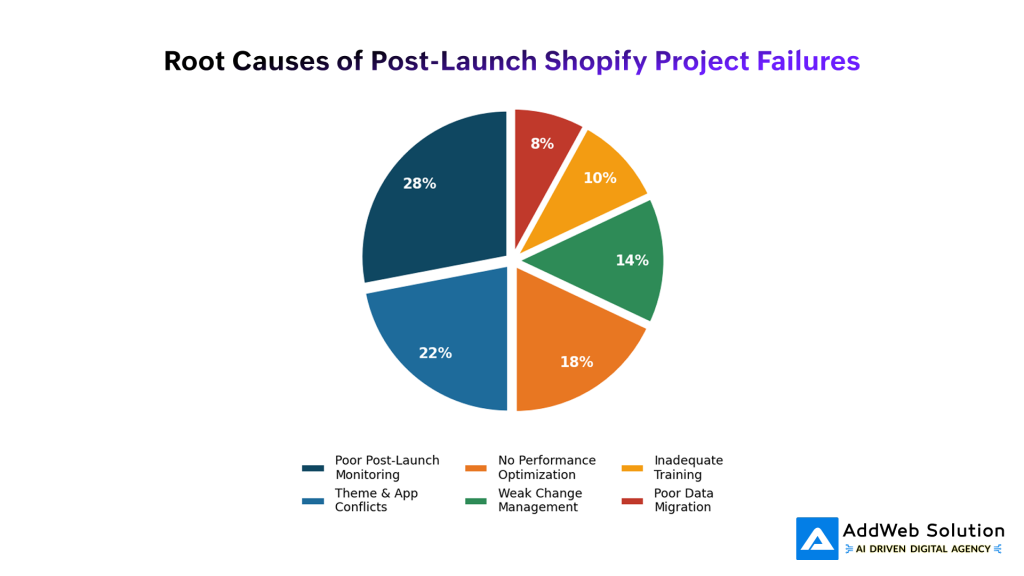
Failure Pattern 1: The Monitoring Blind Spot
The most common and most expensive failure category is not technical. It is operational. Merchants and agencies build, launch, and then assume that Shopify’s platform uptime guarantees cover everything that matters. They do not.
Shopify’s infrastructure is reliable. What it cannot monitor on a merchant’s behalf is the behaviour of third-party apps, custom scripts, checkout logic, analytics tags, or redirect chains. All of those are the merchant’s responsibility, and most merchants launch without any system to watch them.
Post-launch monitoring gaps typically manifest as:
- No real-time alerting on checkout error rates or payment gateway success rates
- No tracking of 404 errors generated by URL structure changes during migration
- No monitoring of third-party app latency and its effect on page load speed
- No alerts when the mobile conversion rate drops below the pre-launch baseline
- No A/B testing infrastructure to validate design decisions using live traffic
The result is that merchants discover problems when customers email support or when monthly revenue reports show an unexpected drop. At that point, the damage is already done and has been accumulating for weeks.
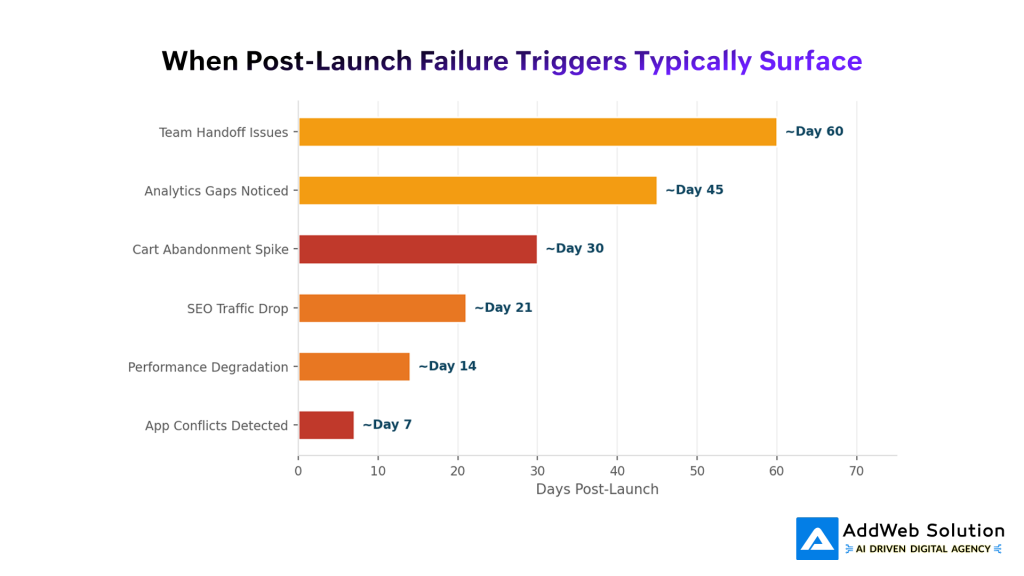
Figure 2: Typical timeline for post-launch failure detection across common issue categories
The table below documents the most common failure types, how long they typically go undetected, and the associated revenue risk.
| Failure Type | Avg. Detection Time | Revenue at Risk | Prevention Difficulty |
|---|---|---|---|
| Payment gateway errors | 3–7 days | High | Low |
| Checkout abandonment spike | 7–14 days | Very High | Low |
| App conflicts and script errors | 1–3 days | Medium | Medium |
| Organic search rank decline | 3–6 weeks | High | Medium |
| Analytics and tracking loss | 2–4 weeks | Indirect | Low |
| Mobile UX regression | 2–3 weeks | High | Low |
Table 1: Post-launch failure types with detection timelines and revenue exposure
Failure Pattern 2: App Conflicts Nobody Saw Coming
The average Shopify Plus merchant runs 12 to 18 apps simultaneously. Each of those apps injects scripts, modifies DOM elements, or hooks into Shopify lifecycle events. In development environments, they behave predictably. In production, under real load, with real user interactions across different devices and browsers, they collide.
Common app conflict scenarios that appear post-launch:
- Two review apps are firing duplicate structured data markup, triggering Google Search Console errors
- A loyalty app and a cart drawer app both listen to the same Ajax cart event, one breaks silently
- A subscription app modifying checkout that conflicts with a recently updated Shopify Checkout UI extension
- A live chat widget contributing 400 to 600 milliseconds to Largest Contentful Paint, pushing Core Web Vitals into the failing range
- A currency conversion app is conflicting with a localisation app on multi-region stores, producing incorrect price displays
Most app conflicts are not caused by bad code. They are caused by multiple vendors, each writing functional code independently, without knowledge of the full production stack. This is a governance problem, not a technical one.
The fix is not testing more apps before launch. The fix is establishing a post-launch app audit cadence, reviewing app load order, script injection patterns, and event handling quarterly, not just at go-live.
Failure Pattern 3: Performance Decay Without Measurement
Shopify’s infrastructure handles server-side performance reliably. What it cannot manage is what merchants add on top of it. Theme files expand. App scripts accumulate with every new vendor. Images are re-uploaded without compression. Custom fonts multiply. Marketing pixels stack on top of each other.
The PageSpeed score recorded at launch is a snapshot in time. Without a continuous measurement system, that score degrades silently while traffic and revenue decline alongside it.
| Performance Metric | At Launch | 3 Months Post-Launch (No Optimization) |
| Google Lighthouse Score | 82 | 61 |
| LCP (Largest Contentful Paint) | 2.1 seconds | 3.8 seconds |
| Total Page Weight | 1.8 MB | 3.4 MB |
| App Scripts Loading Per Page | 8 | 14 |
| Mobile Conversion Rate | 2.9% | 1.7% |
Table 2: Typical Shopify store performance degradation over three months without post-launch optimization (benchmark averages)
Google’s research is clear on the business impact: a one-second delay in mobile page load time is associated with conversion rate reductions of up to 20% in retail contexts. For a store generating $500,000 per month, that represents a $100,000 monthly revenue impact from a problem that accumulated silently over time.
Retail conversion sensitivity to performance was also documented in the Farfetch web.dev case study, which found that beyond a 2.5-second LCP threshold, conversion rate decreased by approximately 1.3% per additional 100 milliseconds. Shopify’s platform investments in faster checkout (one-page checkout, infrastructure improvements) can only benefit merchants who are not offsetting those gains with unmanaged script accumulation.
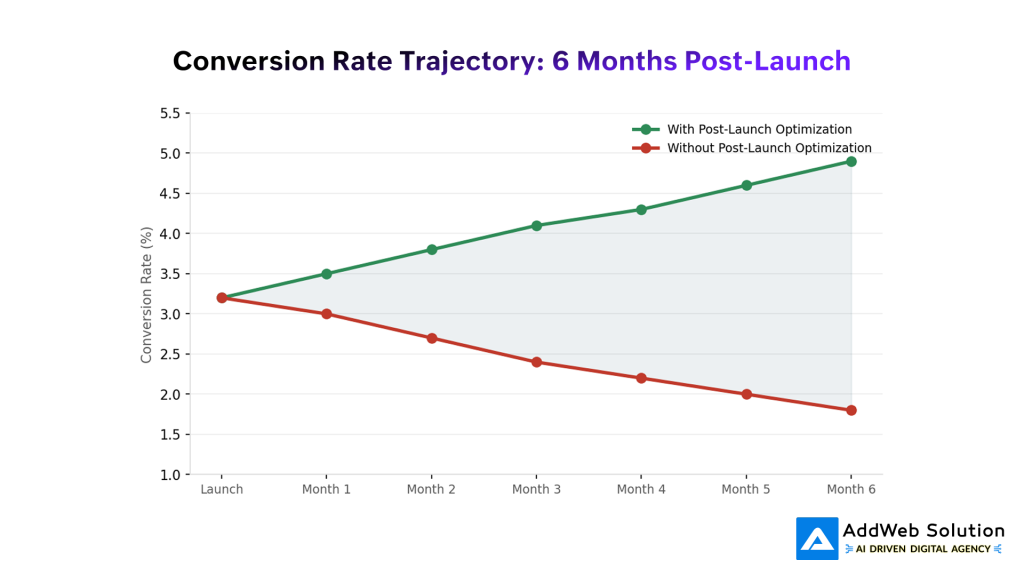
Figure 3: Conversion rate trajectory comparing optimized vs. unoptimized Shopify stores over six months post-launch
Failure Pattern 4: Change Management After Handoff
Shopify projects rarely fail because of the technology. They fail because of the people processes that exist around the technology, and specifically because of what happens in the weeks and months after the agency hands over access.
The gap between technical delivery and operational readiness is where projects quietly collapse:
- Merchants make theme edits through the Shopify admin without understanding they are modifying live production code
- Marketing teams install apps without informing developers, creating conflicts that take weeks to diagnose
- Staff who were trained at launch have since moved on; new team members have no documentation and no institutional context
- Shopify releases a platform update that deprecates a function the store’s checkout logic depends on
- An agency contract concludes, institutional knowledge of the technical stack leaves with it, and no internal owner has been identified
Prosci’s change management research consistently shows that projects with effective change management are six times more likely to meet their stated objectives than those with poor change management. In Shopify implementations, the mechanism is direct: if nobody owns the technical stack post-handoff, the stack degrades.
| What Most Project Budgets Cover | What Sustains Post-Launch Performance |
| Kickoff and discovery | Internal Shopify admin ownership with defined responsibilities |
| Design and development sprints | Monthly performance review cadence with documented owners |
| User acceptance testing and QA | Documented escalation paths for production incidents |
| Launch support (typically 1–2 weeks) | Quarterly app stack audit |
| Handoff documentation | Platform deprecation monitoring and changelog review |
| Training refresh process for new staff |
Table 3: The structural gap between what project budgets fund and what sustains long-term success
Failure Pattern 5: SEO Architecture That Breaks on Migration
E-commerce SEO is a long-term investment. The most common way merchants destroy that investment is through a Shopify replatform or redesign that does not treat URL structure, canonical tags, and redirect chains with the same rigor as design or development decisions.
The post-launch SEO failure pattern follows a predictable sequence:
- Product, collection, or blog URLs change structure between the old and new site
- 301 redirects are either missing, incomplete, or implemented with redirect chains that dilute link equity
- Google Search Console errors accumulate unnoticed for weeks
- Organic traffic begins declining between weeks three and six post-launch
- By the time the decline is correctly attributed to the migration, re-indexing and recovery take a further four to eight weeks
A Semrush analysis found that 46% of replatformed e-commerce sites experienced a measurable organic traffic decline within 60 days of launch, with 60% of those cases attributing the decline to redirect or canonical tag errors that were present at launch but not caught during quality assurance.
The prevention is straightforward: a structured redirect audit before launch, a full crawl validation within 72 hours after launch, and weekly Search Console monitoring for the first 90 days. This is not complex work. It is work that does not fit neatly into a launch-day checklist and therefore tends not to happen.
The Cost Multiplier: Why Early Detection Matters
The cost difference between resolving an issue during development and resolving the same issue after launch is not marginal. IBM Systems Science Institute research, later incorporated into NIST guidance, established that defects found post-release cost 30 to 100 times more to fix than defects caught at the design stage. In Shopify implementations, the multiplier is lower, but the underlying principle is consistent.
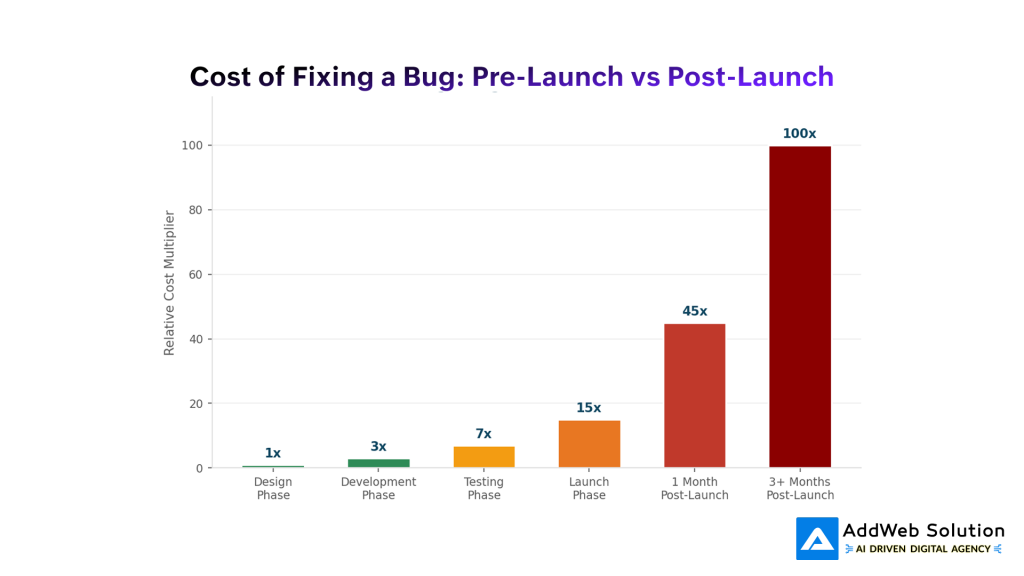
Figure 4: Relative cost to resolve an issue at each stage of a Shopify project lifecycle
Every performance problem, every app conflict, and every redirect error that is not addressed in the first 30 to 90 days after launch compounds. It affects search rankings, customer experience, conversion rates, and quarterly revenue simultaneously. The cost is not just the fix, it is the revenue foregone while the issue persisted.


What a Post-Launch Operations Structure Looks Like
Merchants and agencies that consistently avoid post-launch failure share one structural characteristic: they treat the 90 days after launch as a distinct project phase with its own deliverables, owners, and success metrics, not as a warranty period or an afterthought.
The 90-Day Post-Launch Protocol
| Period | Focus | Key Activities | Success Criteria |
| Weeks 1–2 | Stability | Monitor checkout errors, payment success rates, and 404 errors | Zero critical errors; payment success rate above 98% |
| Weeks 3–4 | Performance | PageSpeed audit, LCP review, image and script audit | Lighthouse score maintained or improved vs. launch |
| Weeks 5–6 | SEO Validation | Search Console review, crawl error audit, redirect check | No index coverage drops; redirect errors below 5 |
| Weeks 7–8 | Analytics QA | Verify GA4 and pixel tracking, validate conversion events | All conversion events are firing correctly across channels |
| Weeks 9–12 | Optimisation | A/B testing, UX improvements, app rationalisation | Conversion rate at or above pre-launch benchmark |
Table 4: A structured 90-day post-launch protocol with ownership and success criteria
The Shopify-Specific Risk Variables
Not every e-commerce platform carries the same post-launch risk profile. Shopify has specific characteristics that make post-launch operations more complex than merchants typically anticipate.
| Shopify Characteristic | Post-Launch Risk It Creates | Operational Mitigation |
| Platform-managed updates | Deprecations affect live stores without a project kickoff | Monthly Shopify changelog review |
| App ecosystem dependency | Third-party conflicts emerge after app provider updates | App ownership matrix with staging environment tests |
| Plus-gated features | Feature assumptions made during build may not match the plan level | Plan-level feature audit before go-live |
| Checkout Extensibility timeline | Legacy scripts sunset on published dates, removing functionality | Checkout audit against the Extensibility migration timeline |
| Theme version management | Theme editor changes can overwrite code-level customisations | Version-controlled theme workflow with change documentation |
Table 5: Shopify-specific risk factors and operational mitigations
The Checkout Extensibility timeline is worth specific attention. Shopify has published hard deprecation dates for legacy checkout surfaces. checkout.liquid no longer works for in-checkout steps. Shopify Scripts cease executing on June 30, 2026. ScriptTags on Order Status pages have staged deprecation dates. These are not hypothetical risks. They are scheduled platform changes that will affect live stores on a timeline that does not account for individual merchant readiness.
The Budgeting Problem
Post-launch failures are, in most cases, the result of budget structures that were never designed to support what comes after launch.
The typical Shopify project budget allocation:
- Discovery and strategy: 10 to 15%
- Design: 20 to 25%
- Development: 35 to 45%
- Quality assurance and testing: 5 to 10%
- Launch support: 3 to 5%
- Post-launch operations and optimisation: 0 to 5%
The final line is where the structural problem lives. Post-launch operations are either underfunded, covered by a single month of what agencies call “hypercare,” or not budgeted at all, with merchants expected to self-manage after handoff with no defined process.
Best-practice agencies are now structuring retainer agreements covering a minimum 90-day post-launch period with defined deliverables: weekly performance reports, monthly app audits, quarterly SEO reviews, and incident response. The typical cost is 8 to 12% of the total project budget. The return is avoiding the conversion, SEO, and operational losses documented throughout this analysis.
Redefining What a Successful Project Looks Like
A successful Shopify project should not be measured by whether it launched on time and on budget. Those are inputs. The outputs, the measures that determine whether the project delivered business value, are all post-launch metrics:
- Conversion rate at 90 days compared against the pre-launch baseline
- Checkout completion rate at 60 days
- Organic search traffic at 90 days compared against pre-migration levels
- Average page load time at 60 days against the score recorded at launch
- Number of post-launch incidents requiring unplanned emergency work
- Customer support ticket volume attributable to site-related issues
Agencies that understand this reframe their value proposition accordingly. Merchants that understand this fund their projects with post-launch operations as a non-negotiable line item, not an optional extension.
The projects that fail after launch are rarely the result of bad design or poor code quality. They are the result of a shared assumption, made by both the agency and the merchant, that launch is the end. For the business, launch day is Day One.
Losing conversions after launch? Fix it before it compounds.

Pooja Upadhyay
Director Of People Operations & Client Relations
https://shopify.dev/docs/apps/build/checkout
https://shopify.dev/docs/api/checkout-ui-extensions/latest
https://baymard.com/lists/cart-abandonment-rate
https://www.prosci.com/resources/articles/change-management-statistics
https://stripe.com/blog/how-we-tested-the-conversion-impact-of-global-payment-methods
