


I had a client call me last month. They’d just launched on Shopify Plus—the team spent six weeks redesigning their storefront, colors looked perfect, navigation was smooth—and then orders stopped processing correctly. Why? The ERP integration wasn’t ready. The data mapping was incomplete. The commerce engine was working, but the actual business wasn’t.
That conversation taught me something most platform comparisons skip: this isn’t really about Shopify vs. WooCommerce vs. BigCommerce. It’s about understanding what breaks when you scale.
Let me be direct. I’ve watched founders agonize over platform choice for months, only to realize the real decision came down to something they didn’t even consider. A transaction fee structure. A team’s ability to code. Whether they needed B2B features. The wrong choice doesn’t just cost money; it costs growth momentum at the exact moment you need it most.
Why This Matters More Than You Think
Here’s the thing: picking a platform is the second-most important decision you’ll make after “what are we selling.” The first platform decision usually doesn’t matter much. The second one can cost you $50,000-$200,000 to change.
Shopify powers over 4.8 million stores globally. In the US alone, it dominates with 29% market share. But dominance doesn’t mean “right for you.” I’ve seen $2M brands on Shopify standard doing fine, and I’ve seen $50M enterprises on WooCommerce struggling with overhead. The real question is: where are you headed, and what does that path actually require?
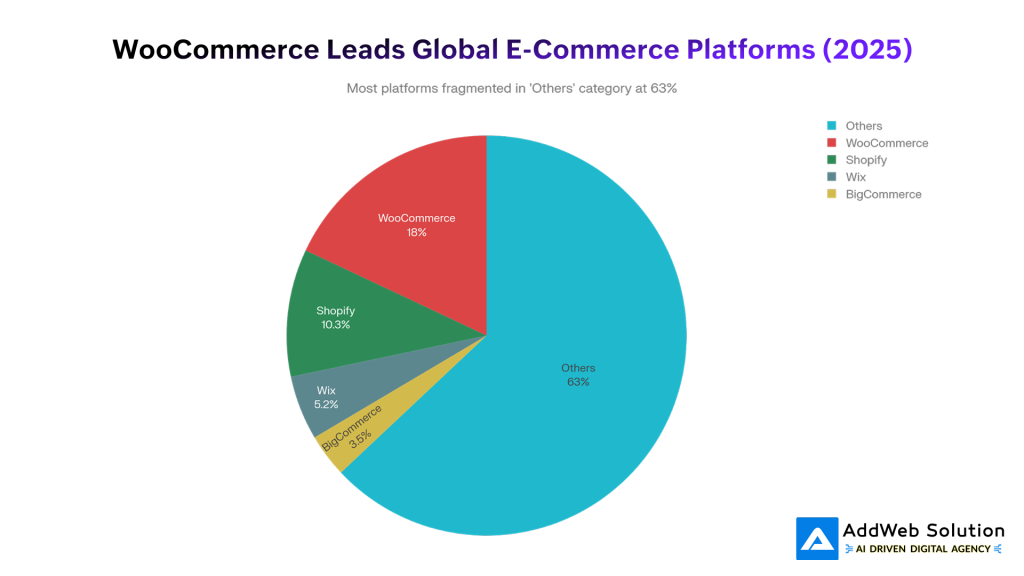
Shopify Market Leadership: Global vs US 2025
Let me walk you through what I’ve learned from working with brands across all three platforms.


The Shopify Decision: When Standard Stops Working
Shopify Standard ($19–$399/month) works beautifully if your life looks like this: you make products, sell them, ship them, repeat. The infrastructure is handled. The hosting is handled. Your team focuses on growth, not infrastructure. Monthly fees are predictable. You grab apps when you need features, and most apps work without headaches.
That’s genuinely great. It’s why small brands launch on Shopify first.
But here’s where it breaks. You hit $500K/month in revenue. Your app bill starts climbing—$50 here for inventory sync, $100 there for personalization, $200 for advanced analytics. Your transaction fee at 2.6% suddenly means $13,000/month is going to payment processing alone. Your team starts asking, “Why can’t our checkout look like this? Why can’t we customize this flow?” And the platform says, “you can’t, not really.”
At that moment, and this happens around $1M-$2M revenue for most D2C brands, founders start asking about Shopify Plus.
Shopify Plus ($2,000–$2,500/month minimum, plus revenue-based fees) is a completely different product. Same company, fundamentally different architecture. You get:
- Full checkout customization. Like, actually custom. Not templated, not app-based. Actual control.
- Your own dedicated team. A Merchant Success Manager. Someone who calls you quarterly to ask what you’re trying to do and whether the platform is actually helping.
- Multi-store infrastructure. You can run 9 expansion stores with unified inventory and customer data.
- Higher API limits. 10x the rate limits of standard Shopify.
But here’s the real kicker: you don’t pay transaction fees on Plus if you hit qualified status. Above $800K/month in volume, Plus charges a revenue fee capped at $40,000/month. That sounds high until you do the math.
A $5M/year brand paying 2.6% transaction fees on Shopify standard? That’s $130,000/year in transaction fees alone. Shopify Plus? Fixed pricing, no transaction fees, dedicated support. The economics flip.
I worked with Character.com when they transitioned to Plus. They’d been on standard Shopify but were hitting ceiling after ceiling—checkout customization, scaling load, and their ops team was drowning in Slack messages about features they needed. After the migration, their conversion rate jumped 40%. Mobile conversions specifically went up 65%. Year-over-year revenue grew 300%.
Were those results just from Plus? No. They also invested in better product photography, email sequences, and paid traffic optimization. But the platform got out of the way. It stopped being a bottleneck.
The migration cost them about $25,000. Implementation took six weeks. Their ROI window was basically one good quarter.
The BigCommerce Angle: If You Have B2B Components, Pay Attention
BigCommerce costs less than Plus on the surface. $39–$399/month depending on tier. But here’s what everyone misses: BigCommerce charges zero transaction fees regardless of payment processor.
For a $5M/year brand where each percentage point of transaction fees matters, this is material. You’re not paying 2.4%. You’re not paying anything. That’s roughly $120K/year you’re not hemorrhaging.
But the real story with BigCommerce is B2B.
BigCommerce serves 62 of the Top 2000 online retailers. That’s $3.8 billion in combined sales from their customer base. They’ve built B2B features into the platform by default: Configure-Price-Quote (CPQ), bulk ordering, role-based permissions, tiered pricing, payment terms negotiation.
If you’re selling to other businesses—wholesalers, retailers, corporate procurement teams—managing B2B on BigCommerce feels native. The workflows are there. The permission structures exist. You’re not duct-taping third-party apps together.
I had a client selling to restaurants. Standard Shopify felt like forcing a retail platform to do wholesale. Every feature required workarounds. BigCommerce had it built in.
The tradeoff? BigCommerce’s ecosystem is smaller. There are 6,000+ Shopify apps. BigCommerce has around 1,500. When you need something custom, you have fewer off-the-shelf options. Your development team needs BigCommerce expertise specifically—the community is smaller.
But if your business model is 80% B2B and 20% DTC, BigCommerce often wins on total cost of ownership just because the features you need are already there.
WooCommerce: The “I Want Total Control” Choice
WooCommerce is free. Your costs are hosting, developer time, maintenance, security, and ongoing optimization.
For a $20M revenue brand managing WooCommerce properly? You’re looking at $6,300–$18,500/month in real costs. That’s often more than Shopify Plus.
But WooCommerce gives you something Plus doesn’t: complete customization and deep integration with WordPress.
If your business model depends on content—review platforms, educational ecosystems, and publisher-merchants, WooCommerce’s tight integration with WordPress feels natural. Your product pages can tap into all of WordPress’s content infrastructure. Your SEO feels native. Your blog and store live in the same system, not bolted together.
The catch? You own all the complexity. Security updates are your responsibility. Performance optimization is your responsibility. Load testing before traffic spikes is your responsibility.
I had a technical founder launch on WooCommerce. They wanted complete control over checkout logic, custom shipping rules, and direct access to database queries. They had a strong engineering team and wanted to build custom features nobody else had. WooCommerce made sense. Shopify Plus would have felt restrictive.
But if you don’t have that technical team? Or if you want to spend weekends working on the product instead of the infrastructure? WooCommerce feels like choosing pain.
Let’s Actually Compare Costs (The Numbers That Matter)
Here’s what I actually see in real TCO calculations across three different business scenarios:

3-Year Total Cost of Ownership by Business Scale
Small Brand ($500K/year in sales)
- Shopify Advanced: Platform ($299/month) + 4-6 apps ($300-400/month) + 2.6% transaction fees ($130/month) = roughly $21,600 annually
- BigCommerce: Platform ($79/month) + 3-4 apps ($150/month) + 0 transaction fees = $18,900 annually
- WooCommerce: Managed hosting ($300/month) + SSL/security ($30/month) + occasional developer help ($500-1,000/month average) = $36,000+ annually
Growing Brand ($5M/year)
- Shopify Advanced: Platform ($299/month) + premium apps hitting $500-600/month + $130K/year in transaction fees = $86,400 annually
- Shopify Plus: Fixed $2,000/month + no transaction fees + dedicated support = $108,000 annually (but often justifies itself through improved conversion)
- BigCommerce: Platform ($299/month) + apps ($300/month) + 0 transaction fees = $72,000 annually
- WooCommerce: Full-time developer ($8-10K/month) + hosting + support = $180,000+ annually
Enterprise ($20M+)
- Shopify Plus: $2,500/month + capped revenue fee ($40K/month max) = $432,000 annually
- BigCommerce Enterprise: Similar fees, but 0 transaction fees = $288,000 annually
- WooCommerce: Dedicated team ($20-30K/month) + infrastructure + maintenance = $1,080,000+ annually
The numbers tell a story: at small scale, WooCommerce is expensive relative to the benefit. At mid-scale, BigCommerce often has the best TCO. At enterprise scale, it depends entirely on whether transaction fees matter more than the ecosystem.
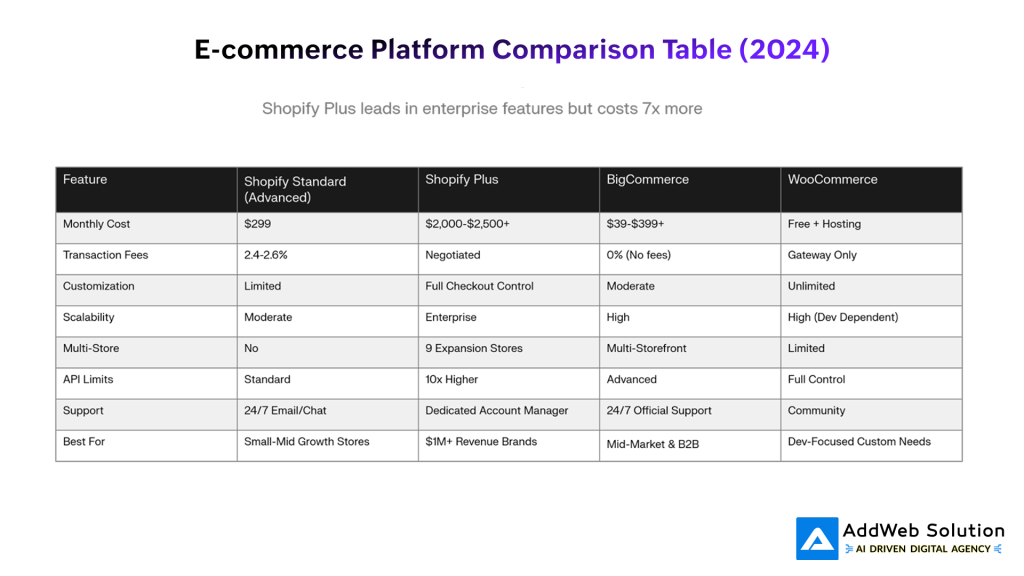
Platform Comparison: Feature & Cost Overview
The Migration Horror Story Nobody Talks About
I need to be honest about something most consultants gloss over: migrations fail quietly.
A Shopify Plus migration I consulted on for a business preparing to migrate to Shopify looked perfect in staging. The storefront was redesigned beautifully. The team had checked off every box in their project management software. Then launch day arrived and orders stopped processing correctly. Why? The ERP integration wasn’t actually synced with the new pricing logic. The data mapping was incomplete. The warehouse management system didn’t know about the new inventory structure.
The team had spent six weeks perfecting the customer-facing storefront and one week on the actual commerce engine. By launch, they’d built a beautiful shop window with no store behind it.
The lesson I learned: most migration failures aren’t technical. They’re organizational. The storefront team and the operations team weren’t talking. The integrations got treated as “phase two, post-launch” when they should’ve been phase one.
Common mistakes I see:
- Treating integrations as an afterthought. Your ERP, WMS, PIM, and CRM aren’t apps. They’re your platform. The storefront is just the face. If data isn’t flowing correctly between systems, nothing else matters.
- Rebuilding every old feature. Just because you had a feature on your old platform doesn’t mean you need it on the new one. Most “must-have” features are legacy workarounds. Migration is your chance to delete them.
- Ignoring the 30/60/90 day plan. Launch day is lap 1, not the finish line. Without hypercare, escalation support, and a clear 30/60/90 day improvement roadmap, quiet problems bleed into big problems.
- Wrong team involvement. Your CFO needs to be in discovery conversations. Your operations manager needs to understand the new order workflow before UAT. I’ve seen $2M migrations derail because the team running the store wasn’t part of the migration planning.
If you’re considering a migration, that’s where the real risk lives. Not in picking the “right” platform—in executing the migration correctly.
When Shopify Plus Actually Pays for Itself
Despite the higher cost, I’ve seen Plus justify itself surprisingly fast.
Darts Corner migrated to Plus and saw a 120% increase in sales in the first 30 days. A 200% boost in conversion rates. Why? Plus let them optimize their checkout flow in ways standard Shopify couldn’t. They removed friction points. They customized payment options. They built exactly what their customers needed, not what the template allowed.
SKIN FIRST grew from €3M to €5M in annual revenue in one year on Plus—66% growth. Organic traffic increased 24% in year one because Plus’s architecture performed better, pages loaded faster, crawl efficiency improved.
The pattern I see: brands that leverage Plus specifically for conversion optimization see fast payback. Brands that migrate to Plus and then don’t actually do anything with the customization flexibility? Those brands wonder why they’re paying more.
Plus is a tool. Like any tool, you get what you put into it.
The Honest Decision Framework
Let me give you what actually works when you’re stuck between platforms.
Pick Shopify Standard if:
- You’re under $1M in annual revenue OR
- Your team includes non-technical founders who value simplicity OR
- You’re launching fast and can optimize later OR
- Your entire business model is DTC with no B2B complexity
Pick Shopify Plus if:
- You’re $1M-$20M+ revenue and growing fast OR
- Transaction fees + app costs are eating into margins (math shows Plus wins) OR
- Checkout customization is directly connected to your conversion strategy OR
- You need 9 expansion stores for international growth OR
- You want dedicated commercial support guiding your strategy
Pick BigCommerce if:
- You have B2B components (wholesale, corporate, bulk ordering) OR
- You want zero transaction fees and can prove that savings matters OR
- You’re mid-market ($500K-$10M) and want advanced features included by default OR
- You’re comfortable with a smaller developer ecosystem in exchange for built-in capabilities
Pick WooCommerce if:
- Your business model is inseparable from content (publishers, educators, review platforms) OR
- You have a strong technical team and want complete control OR
- You need custom integrations that none of the other platforms support OR
- You’re willing to own operational complexity in exchange for unlimited customization
Honestly? The right choice usually becomes obvious once you answer: “Where are we in three years, and what will that business model actually need?”
The Mobile Thing (It’s Non-Negotiable)
I’m going to say this bluntly: 75% of e-commerce happens on mobile. If your platform doesn’t prioritize mobile-first design, you’re ceding three-quarters of your potential revenue to competitors.
All three platforms support responsive design. Shopify Plus has specific mobile optimizations built in. BigCommerce includes advanced mobile features. WooCommerce depends on your theme choice.
But this isn’t theoretical. I’ve seen stores where the checkout works on desktop but loads slowly on mobile. Where the product filtering is confusing on phones. Where the payment options don’t display correctly on smaller screens. These aren’t platform failures—they’re implementation failures.
Before committing to any platform, test the mobile experience. Actually try to buy something on your phone. See if it feels frictionless. If it doesn’t, that’s a feature you need to prioritize, not a nice-to-have.
One More Reality Check
The global e-commerce platform market is growing from $9.08B in 2025 to $16.51B by 2030. That growth is being driven by AI-powered personalization, better mobile experiences, and omnichannel capabilities.
Shopify Plus and BigCommerce are both investing heavily in AI. WooCommerce’s strength is flexibility, not AI innovation. If AI-driven personalization and recommendations matter to your growth strategy, that’s a differentiation point worth considering.
The Gartner Magic Quadrant for Digital Commerce 2025 positions Shopify and Adobe as leaders. That’s useful information—it means investment, stability, and likely longevity. It doesn’t mean they’re the only viable options, but it means they’re serious platforms with serious backing.
Tell us about your store and goals, and connect with developers who fit your needs, from store setup to performance optimization.

Pooja Upadhyay
Director Of People Operations & Client Relations
What I’d Actually Do If I Had to Choose Tomorrow
If I were launching a brand today, here’s my decision tree:
- Revenue reality check. What are you actually doing right now? $100K/year? $5M/year? That determines your tier instantly.
- Technical capability check. Do you have developers? Are they full-time? Can they manage infrastructure, or do you need a managed platform?
- Business model check. Is it DTC? B2B? Mixed? Do you need expansion stores? That influences the feature set you need.
- Cost sensitivity check. Are you bootstrapped? Funded? Do transaction fees matter to your margin math? Run real numbers, not assumptions.
- Growth trajectory check. Where do you want to be in 36 months? Work backward from that vision.
Then, and this is important, pick the platform that lets you move forward without overthinking it. The cost of delay is higher than the cost of choosing imperfectly today.
You can always migrate later if you pick wrong. It’s expensive, but it’s possible. You can’t get back the momentum you lose by spending six months analyzing every feature comparison matrix.
Source
- Shopify Market Share Statistics 2025 – https://redstagfulfillment.com/shopify-market-share/
- Shopify Plus Pricing & Features – https://www.yotpo.com/blog/shopify-plus-vs-shopify/
- Shopify Plus Capabilities – https://jetfuel.agency/best-ecommerce-platform-2025-shopify-woocommerce-bigcommerce/
- Shopify Plus Case Studies – https://www.shoptrial.in/shopify-case-studies/
