


With each step into the digital-first world, it is easier now than ever to launch a site.
Site-builders such as Wix, Squarespace, Shopify, and Webflow advertise that they allow you to quickly create elegant websites without any coding experience, which is nice when you are a small business owner, solopreneur, or startup who needs to get online with little time to mess around.
However, it has a twist.
By 2025, an effective site will not be enough. Your website must grow with your business and change along with evolving user expectations, work with your marketing plans, and above all, bring you perpetual viability and manageability. That is where the argument in favour of WordPress or in favour of website builders counts.


In this blog, we will spell out the actual differences between WordPress and website builders, not how easy they are to use, but how they are going to determine the digital future of your business.
This step-by-step guide can answer this question whether you are a non-technical founder, a marketing manager, or the owner of a small or medium-sized business, and want to grow the business in the first place, it will continue to have real, sustainable growth in 2025 and beyond.
WordPress vs Website Builders: Quick Comparison Table

Ease of Use vs Future Readiness
Website builders have a reputation for being plug-and-play. In a few minutes, one can choose a template, drag blocks of content, and post their site without the assistance of a developer.
This is why they become a good option when you are beginning your journey, since you can have an online presence soon and probably notch up significantly in the future.
WordPress is relatively more complicated initially, but exponentially more powerful going into the future, however.
A modern editing experience (such as Gutenberg block editor), easy-to-use page builders (such as Elementor or Bricks), as well as the tools of visual theme customization, make WordPress more accessible than it used to be only a few years ago.
This is how they match in terms of set-up simplicity, as well as scalability:
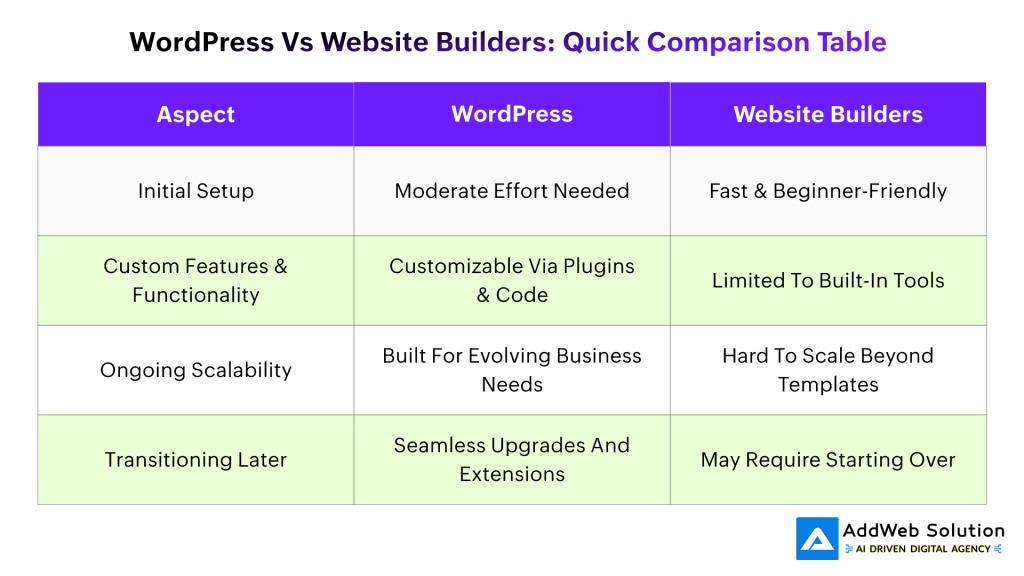
You shouldn’t have to start from scratch every time your business evolves. With WordPress, you won’t. Its flexibility and vast ecosystem ensure your website can grow and adapt alongside your business without the need for a complete rebuild.
Design and Branding Control: Templates vs Total Freedom
The majority of internet designers use a mixture of pre-made designs. In the case of simple businesses, that could be good enough. However, in the case of ambitious plans to develop a memorable brand with its personality, strict layouts accumulate daily in the form of a log jam.
WordPress gets rid of those restrictions completely.
Whether it is pixel-perfect custom themes, dynamic content displays, or global design controls, you can design the entire website experience. It can be a rebranding, opening the support in many languages, or adopting new trends in design, and WordPress will allow you to do everything independently.
It is of necessity in case your site is more than a brochure but rather represents a central facet of your marketing strategy, such as an e-commerce store, lead generation machine, or content portal.
SEO in 2025: Visibility Starts Under the Hood
Regardless of the changes that occur every now and then, search engine optimization is more technical and performance-based than ever.
The elements of Core Web Vitals, schema markup, mobile, structured data, and accessibility are all essential when it comes to the quality of your site on search results.
Website builders provide minimal SEO tools, such as meta tags, alt text on the images, and a sitemap. But WordPress does not stop at this.
By using such plugins as Rank Math, Yoast SEO, and SEOPress, it is possible to optimize:
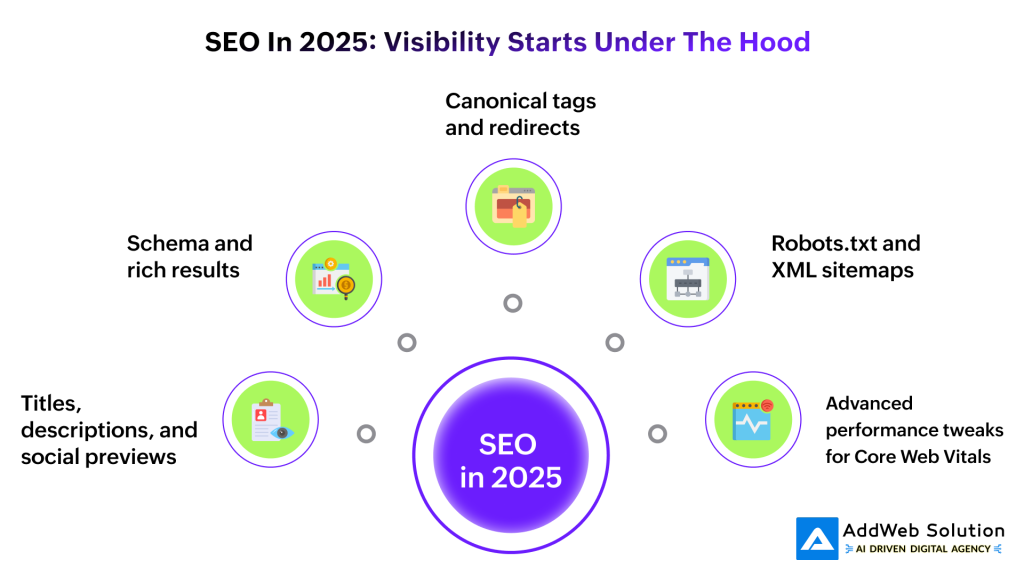
- Titles, descriptions, and social previews
- Schema and rich results
- Canonical and redirects
- Robots text and XML sitemaps
- Premium performance optimizations of Core Web Vitals
Such control is necessary in case SEO is a key channel towards the growth of your business.
Your business deserves more than a basic builder.

Pooja Upadhyay
Director Of People Operations & Client Relations
AI, Integrations, and the Modern Web
With AI being integrated into our businesses, your site must do the same. Site builders are beginning to ship their own AI features, but they tend to be walled gardens: restrictive, difficult to hook into, or only applicable within their own, closed system.
WordPress excels in such an area.
It is open-source and can be easily integrated with third-party APIs and AI technologies. You might use OpenAI, Google Gemini, or create your own: AI-driven workflows. The versatility is unique with innovative content makers, movable chatbots, and automatic CRMs.
Among the most popular WordPress AI tools of 2025, one may count:
- Bertha AI – content generation
- AI Engine – chatbot integration
- WPBot – AI-powered virtual assistants
- Custom GPT integrations with WooCommerce or LMS platforms
This openness future-proofs your website as the web evolves.
Long-Term Ownership and Scalability
The most crucial aspect that is often neglected could be ownership. By building around a shared platform, you rent. If the platform modifies its prices, conditions, or even closes down (as specific platforms did), your site and data will be at risk.
You hold your files, your content, and your database with WordPress. You are free to move to any hosting company, expand your traffic bandwidth, and introduce any software without seeking permission and paying the upgraded rates that platforms charge.
When you expect your site to be more than a business card, there is no better platform than WordPress, which is designed to scale and be versatile.
Breaking Down the Costs: Affordability in the Long Run
At a glance, it may seem that website builders are cheap. They begin at the rate of $10-30 per month.
However, once you have added such features as eCommerce, additional storage, analytics, or search engine optimization tools, or have more complicated integrations, the monthly cost begins to increase.
WordPress charges you based on the tools that you use. What you pay for:
- Hosting (~$5–$20/month)
- A domain (~$10/year)
- Optional premium themes/plugins
The biggest difference? You are not paying (every month) for all those small add-ons. You are not even stuck to tiered pricing.
The long-term savings with WordPress are the result of:
- Never wish to pay markups based on platform hosting or bandwidth
- Core functionality using free/open-source plugins
- Elastic upgrade on an on-demand basis
- Selecting the value-optimized providers (not simply the ones you are stuck with)
When WordPress Is the Smarter Choice
WordPress is not necessary for all of us. A website builder can work in the offing, especially when you do not intend to grow and numerically expand, at least until you have a taste of success.
However, when you look further than the next 6 months, when your business will expand, your brand will develop, or when you need strong integrations on your site, WordPress is the better choice.
Use WordPress when:
- Control over your content and platform is what you desire.
- The highest priority is SEO and performance.
- You intend to customize or scale your features.
- You require third-party integrations or AI-based integrations.
- You respect owning, fluidity, and futurism.
Final Thoughts: Ready to Future-Proof Your Website?
Your site is not just a virtual holding space; it is the basis on which you build your marketing, sales, and overall brand strategy.
By 2025, the selection of a platform will not be only about connecting online. It is about being ready to develop, progress, and compete in an increasingly transient digital world.
The website builders provide a good base, but as your aspirations become advanced, they may restrict you. Although WordPress needs an even more gradual inclination, it compensates for that cost with unbelievable control, flexibility, and savings in the long term.
WordPress is the future in case you want to have a platform that not only does not create challenges as your business grows, but also advances alongside it instead.
At AddWeb Solution, we help businesses move beyond website builders or launch scalable, search-optimized WordPress sites built for growth. Whether you’re starting from scratch or enhancing an existing site, our expertise ensures your digital success.
Upgrade from builders to WordPress for lasting success.
Pooja Upadhyay
Director Of People Operations & Client Relations
