


This blog was originally published on July 05, 2025, and has been fully updated on June 19, 2026. All statistics, trends, technology references, and best practices have been revised to reflect the current landscape of custom software development.
In 2026, enterprises need digital platforms that are fast, flexible, and cost-effective. And that’s why more of them are choosing WordPress. Gone are the days when WordPress was dismissed as “just a blogging platform” or suitable only for small business websites.
Today’s enterprise landscape demands agility, scalability, and innovation-qualities that modern WordPress delivers in abundance.
The global business environment has shifted dramatically, with companies requiring digital solutions that can adapt quickly to market changes, integrate seamlessly with existing systems, and provide exceptional user experiences without breaking the budget.
This transformation has led many CTOs, IT managers, and digital decision-makers to reconsider WordPress as a serious enterprise-grade content management system.
In this comprehensive guide, we’ll explore how WordPress has emerged as the CMS of choice for forward-thinking enterprises, debunk common misconceptions, and demonstrate how businesses can leverage a WordPress-based solution to achieve their digital transformation goals.
Why Enterprises Once Overlooked WordPress (and Why That’s Changing)
Enterprise decision-makers harboured deep-seated misconceptions about WordPress for years, effectively precluding it as a viable large-scale operations solution. Primary perception held that WordPress was tailored pretty much for bloggers and smallish websites lacking the robust architecture necessary for hefty enterprise demands.
Many enterprises assumed serious business applications necessitated pricey, elaborate solutions like Sitecore or Adobe Experience Manager, largely due to prior investments. WordPress’s scalable features and enterprise-focused capabilities have been quietly evolving over the years, largely unbeknownst to many people, apparently.
The landscape changed rather dramatically, meanwhile. The rise of enterprise-focused plugins and managed WordPress hosting solutions has morphed WordPress into a behemoth that often outshines traditional enterprise CMS platforms outright. Community maturity has yielded standard professional development practices, and major corporations now flaunt their WordPress success stories pretty publicly.


Top Reasons Enterprises Are Now Choosing WordPress
WordPress vs. Traditional Enterprise CMS: Cost Comparison

1. Unmatched Scalability
Enterprise Scale Stats:
· WordPress handles 70+ million posts published monthly
· Powers sites with 100M+ monthly visitors
· Supports 10,000+ concurrent users per site
WordPress’s scalability features have evolved remarkably far beyond humble blogging origins into a robust, multifaceted platform.
The platform now supports complex enterprise requirements via WordPress Multisite, allowing organizations to manage multiple websites from a single dashboard effectively.
Custom post types empower businesses to structure content outside traditional blog posts and pages, accommodating pretty complex data relationships somehow.
WordPress REST API unleashes headless and hybrid architecture possibilities, allowing enterprises to leverage WordPress as a content management backend powering multiple front-end applications, mobile apps or various digital experiences simultaneously.
2. Flexibility and Customisation Freedom
Design Freedom Stats:
· 60,000+ free themes available
· 59,000+ plugins in official repository
· Full Site Editing (FSE) capabilities
· 100% custom development possible
WordPress boasts unparalleled flexibility among its strongest enterprise advantages, largely due to an extremely robust underlying architecture, obviously.
Full Site Editing and block-based themes have drastically revolutionized enterprises’ digital customization capabilities without being saddled with stifling templates or needing copious development resources.
Businesses can construct precisely what they need precisely when required, owing largely to the platform’s modular framework. WordPress provides a foundation for bespoke user dashboards and complex workflow systems without imposing undue limitations on unique business process integrations.
Robust developer ecosystems facilitate building specialized functionality efficiently, and the open-source nature mitigates vendor lock-in concerns pretty effectively nowadays.
3. Significantly Lower Total Cost of Ownership
5-Year TCO Comparison Chart
WordPress Enterprise Setup:
Year 1: $50,000 (Development + Setup)
Years 2-5: $20,000/year (Maintenance + Hosting)
Total 5-Year Cost: $130,000
Traditional Enterprise CMS:
Year 1: $250,000 (Licenses + Implementation)
Years 2-5: $75,000/year (Licenses + Maintenance)
Total 5-Year Cost: $550,000
Savings with WordPress: $420,000 over 5 years

Enterprise CMS platforms such as Sitecore cost hundreds of thousands of dollars every year just for licensing before implementation and customization expenses pile up.
WordPress eliminates licensing fees, allowing enterprises to invest heavily in customization and security for sizable business growth rather than costly software.
An abundance of high-quality plugins and themes slashes development time and expenses, while a large pool of WordPress devs keeps implementation costs pretty competitive.
WordPress presents a starkly contrasting economic boon without sacrificing robust functionality or razor-sharp performance against pricey proprietary enterprise solutions requiring niche developer expertise.
4. Enterprise-Grade Security and Governance
Security Statistics:
· WordPress releases security updates within 24-48 hours of discovery
· 99.· 98% of sites that use WordPress are secure when properly maintained
· Enterprise security plugins scan 20+ billion requests daily
· Advanced access controls with role-based permissions and SSO support
Modern security for WordPress has evolved, meeting enterprise standards via a combination of core improvements and ridiculously sophisticated security plugins nowadays.
Enterprise-level protection, including malware scanning and firewall protection, is provided by security solutions like Wordfence and Sucuri pretty effectively nowadays.
WordPress’s frequent update cycle quickly addresses security vulnerabilities, and its transparency lets enterprise security teams audit security measures thoroughly while validating them.
Managed WordPress hosting providers furnish extra layers of security, such as automated backups and security monitoring, that meet stringent enterprise compliance needs.
5. Powerful Integration Capabilities
Integration Capabilities:
· REST API enables 1000+ third-party integrations
· GraphQL support for modern applications
· Webhook functionality for real-time data sync
· Custom API endpoints for proprietary systems
· Native support for Salesforce, HubSpot, Mailchimp, Google Analytics
· Seamless e-commerce integration with WooCommerce
Enterprises need their content management system to integrate rather seamlessly with existing biz systems, and WordPress excels quite remarkably in this particular area.
The platform easily integrates with CRM systems such as Salesforce and HubSpot, alongside ERP solutions and marketing automation platforms, and works very smoothly.
WordPress’s REST API and GraphQL support enable deeply intricate integrations with nearly every cutting-edge business app pretty much effortlessly nowadays.
WordPress provides flexibility to create seamless data flows across business operations by syncing customer data from CRM and pulling product information rapidly from inventory management systems or integrating with various financial reporting tools.
Supercharge Your Digital Presence Today

Pooja Upadhyay
Director Of People Operations & Client Relations
6. SEO and Performance Optimization
Performance Metrics:
· WordPress sites can achieve 90+ Google PageSpeed scores
· Average load time: Under 3 seconds (optimized)
· Core Web Vitals: 85% of WordPress sites pass Google’s standards
· SEO advantage: 70% better organic traffic potential
· Advanced tools: RankMath, WP Rocket, W3 Total Cache available
Enterprise digital marketing success hinges heavily on search engine optimization, and WordPress boasts top-notch SEO capabilities right out of the box.
The platform’s clean code structure and semantic markup provide a solid SEO foundation, while plugins like RankMath offer advanced optimization features extremely effectively nowadays.
WP Rocket and other performance optimization tools, alongside caching plugins and integration with CDNs, enable websites on WordPress to achieve excellent Core Web Vitals scores, which significantly boost user experience and search engine rankings.
Enterprises achieve remarkably fast loading times, surprisingly without the complexity often inherent in other beefy platforms, powering optimal performance somehow.
7. Global Ecosystem and Community Support
Community Power:
· WordPress community contributes 15,000+ hours weekly to core development
· 99% faster issue resolution compared to proprietary platforms
· $50B+ economy built around WordPress services
· 24/7 community support across all time zones
· 50M+ developers worldwide with WordPress expertise
· 10,000+ specialized WordPress agencies available
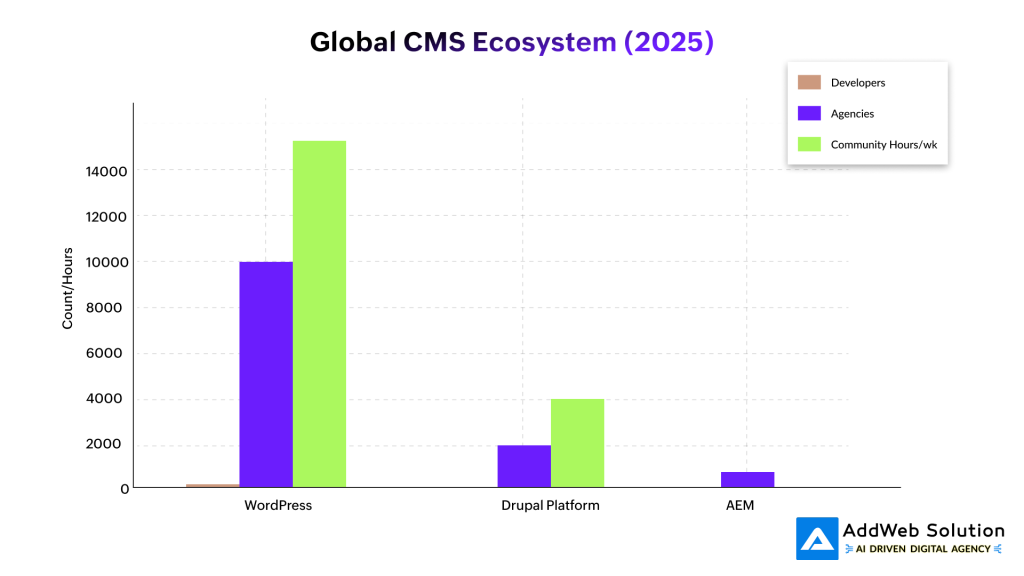
WordPress powers nearly half of websites globally, fostering a vast ecosystem comprising myriad developers, designers and highly skilled specialists possessing enterprise-level expertise.
Finding qualified talent becomes ridiculously easy and pretty cost-effective amidst such a vast thriving community, unlike with clunky proprietary platforms.
Active WordPress community fervour yields radical improvements and security tweaks alongside new functionality pretty regularly inside their platform.
Enterprises get a future-proof platform evolving rapidly with technological advances and rapidly changing business needs, backed by thousands of contributors.
Brands That Trust WordPress at an Enterprise Scale
Global WordPress Enterprise Users

WordPress Powers 43% of the Web
Over 810 million websites worldwide run on WordPress, including:
· 38% of Fortune 500 companies use WordPress
· 59% of top CMS websites are WordPress
· Available in 70+ languages
Major corporations across various industries have enthusiastically adopted WordPress for enterprise digital needs, proving it can handle extremely demanding requirements.
Microsoft News leverages WordPress heavily, delivering news content rapidly worldwide 24/7 to millions of users simultaneously, showcasing its capability rather remarkably in high-traffic, content-intensive environments.
TechCrunch operates a wildly popular technology news site built on WordPress, processing massive traffic with remarkably high uptime and snappy page loads.
Walt Disney Company harnesses WordPress pretty effectively for various swanky digital ventures, meeting the complex demands of global entertainment behemoths somehow.
The New York Times leverages WordPress pretty heavily for somewhat specific digital projects, proving traditional media behemoths trust it for super critical stuff.
Such success stories merely hint at numerous major enterprises having unearthed enterprise-grade capabilities within WordPress pretty quickly nowadays.
Household names from the tech and entertainment sectors trust WordPress with their online presence, indicating the platform has enterprise-grade capabilities.
Common Concerns-and Why They No Longer Hold True
Enterprise Readiness Checklist for WordPress

Security Concerns: Modern security practices thoroughly debunk perceptions of WordPress being inherently insecure, with a plethora of novel tools at disposal nowadays. Enterprise-grade security plugins and managed hosting solutions bolster security for WordPress when implemented properly and maintained rigorously by professionals.
Plugin Bloat Worries: Plugin conflicts and site bloat concerns are mitigated nicely through rigorous curation and sound development practices. Typically, enterprise implementations of WordPress leverage plugins selected with care and custom development for optimal performance and rock-solid stability.
Maintenance Complexity: Enterprise WordPress agencies and modern managed WordPress hosting providers employ heavily automated maintenance processes with proactive monitoring and staging environments. Enterprise websites built on WordPress can be maintained pretty efficiently with less complexity than most proprietary alternatives usually have in practice.
Conclusion: Is WordPress Right for Your Enterprise?
Evidence suggests WordPress has morphed into a fairly robust and secure platform, meeting the demanding requirements of enterprises nowadays.
WordPress offers enterprises a competitive edge on their digital transformation journey, owing largely to flexibility and a pretty robust community support. Your organization must be ready quite rapidly now to adopt WordPress, which offers substantially greater flexibility and significantly lower costs.
Enterprises choosing WordPress in 2026 are oddly positioning themselves for huge digital success with a rapidly evolving business platform.
Organizations still tethered to pricey proprietary CMS solutions should probably rethink their allegiance to such inflexible behemoths right now. Enterprise capabilities of the platform expand steadily as the ecosystem grows far stronger and competitive advantages become increasingly pronounced each year.
Ready to explore how WordPress can transform your enterprise digital strategy?
AddWeb Solution’s team excels at implementing solutions for enterprise with huge scalability and rock-solid security at bargain prices on WordPress. Let’s hash out details on building a rock-solid Solution built for the WordPress platform poised for stratospheric success and substantial future expansion rapidly.
Switch to Smarter CMS with WordPress
Pooja Upadhyay
Director Of People Operations & Client Relations
