
Cloud and DevOps Architecture That Ships Without Fear
Cloud and DevOps Architecture That Ships Without Fear. Downtime is brand damage. Every minute your platform is down is a support ticket, a churn signal, and a brand hit that compounds. Every slow deployment is a market opportunity handed to whoever ships faster. We build the infrastructure where neither of those things happens — because they were engineered out, not hoped away.








The Real Costs You Are Absorbing
Why Your Current Infrastructure Is Holding Your Business Back
Most engineering teams are not slow because of their people. They are slow because the infrastructure they were handed was never designed to scale. These are the six patterns we see in almost every engagement.

Unplanned Downtime Erodes Customer Trust
Your services go down during peak traffic and every minute of downtime is a support ticket, a churn signal, and a brand hit that compounds. You have no clear runbook and the recovery process is manual and inconsistent.

Deployments Take Days, Not Minutes
Your release cycle runs on hope. Deployments require multiple team members, a manual checklist, and a maintenance window. Shipping a hotfix on a Friday night is a team event nobody wants. Feature velocity is strangled before it reaches customers.

Infrastructure Costs Are Unpredictable and Rising
Cloud bills spike unexpectedly, idle resources accumulate, and reserved instance decisions were made two years ago without a cost engineering strategy. Finance is asking questions nobody in engineering can confidently answer.

Scaling Events Cause Outages, Not Celebrations
You run a product launch, a campaign, or a viral moment and the infrastructure buckles under the load. Auto-scaling is either not configured or not tested under real conditions. Your biggest growth moments become your worst infrastructure moments.

Security and Compliance Are Afterthoughts
IAM roles are over-permissioned, secrets management is inconsistent, and the last security audit flagged items that have not yet been resolved. SOC 2, HIPAA, or PCI scope is unclear and audit prep is dreaded by everyone involved.

No Observability Means You Are Always Reactive
You find out about problems from customers, not from your own monitoring. Logs exist but are not aggregated or actionable. There is no unified view of service health and incident response is a reactive scramble every single time.
HOW WE THINK ABOUT CLOUD ARCHITECTURE
We Build Systems That Get Better Under Pressure
We are not a staffing layer that plugs in engineers to manage tickets. We are an architecture partner that thinks about your infrastructure from the first conversation. Every cloud and DevOps system we design is built around three principles: it must handle your worst traffic day without human intervention, it must let your team ship with confidence, and it must get cheaper as you scale, not more expensive.
On AWS, Azure, or GCP, we design multi-region resilient architectures, implement CI/CD pipelines that treat infrastructure as code, and establish the observability foundations that turn reactive teams into proactive ones. The result is not just a better cloud setup. It is a faster company.

Core Capabilities
Cloud and DevOps Architecture Services Built for Scale
Our cloud and DevOps architecture practice covers every layer from infrastructure design to deployment automation. Each engagement is scoped to your actual technical debt, growth trajectory, and compliance requirements.
- Cloud Infrastructure Architecture
- DevOps Pipeline Modernization
- Kubernetes and Container Orchestration
- Cloud Security and Compliance Engineering
- Observability and Incident Response
- Cloud Cost Engineering
- Infrastructure as Code and Automation
- Cloud Migration and Modernization

We design production-grade infrastructure on AWS, Azure, and GCP from networking and compute to storage and IAM. Architectures are built for high availability, multi-AZ resilience, and predictable performance under variable load. We document every decision with a clear rationale tied to your business constraints.
Result: Infrastructure that survives your worst traffic day without a war room.

We build CI/CD pipelines using GitHub Actions, GitLab CI, or Jenkins that treat infrastructure as code from day one. Every pipeline includes automated testing gates, environment promotion logic, rollback capabilities, and deployment frequency tracking. Shipping becomes a mundane non-event, not a team-wide adrenaline spike.
Result: Deploy to production multiple times per day with zero downtime and full rollback.
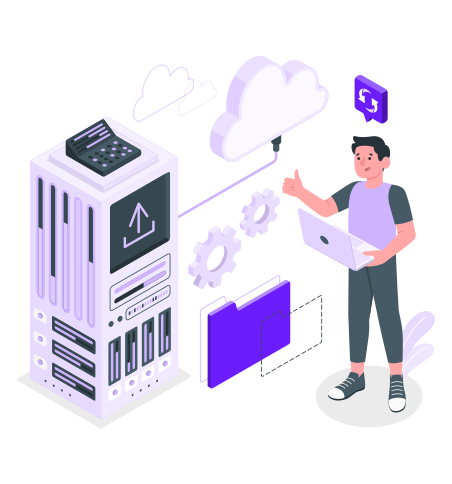
We design and manage Kubernetes clusters on EKS, AKS, and GKE that handle production workloads reliably. This includes pod autoscaling, cluster autoscaler configuration, namespace isolation, resource quotas, and Helm chart management. We build the operational model around it, not just the cluster.
Result: Container workloads that scale horizontally without engineer intervention.
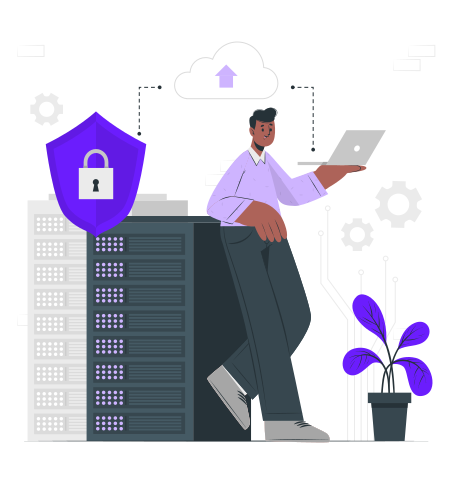
We audit and harden your cloud posture using the CIS Benchmarks, AWS Well-Architected Framework, and Azure Security Center recommendations. This covers IAM policy cleanup, secrets management with Vault or AWS Secrets Manager, network segmentation, and logging pipelines that satisfy SOC 2, HIPAA, and PCI DSS requirements.
Result: Pass your next compliance audit without a sprint dedicated to emergency cleanup.

We implement full-stack observability using Prometheus, Grafana, Datadog, or New Relic tailored to your service topology. This includes SLO definition, alert fatigue reduction, distributed tracing, and runbook creation so the person on call actually knows what to do when the alert fires.
Result: Know about problems before your customers do and resolve them in minutes.

We run a structured FinOps engagement that identifies every dollar of waste in your current cloud spend: overprovisioned instances, unattached volumes, unused reservations, data transfer costs, and logging verbosity. We implement automated cost controls and right-sizing policies that prevent bill creep from returning.
Result: Predictable cloud costs with a 25-40% reduction in most first-year engagements.

We convert manually managed infrastructure into version-controlled, repeatable Terraform or Pulumi configurations. Every environment is provisioned identically. Drift detection, automated remediation, and module-based reusability mean your infrastructure governance scales with your team.
Result: Spin up a new environment in minutes, not days, with full auditability

We design and execute cloud migration strategies for monolithic applications moving to microservices, on-premise workloads migrating to cloud-native services, and legacy infrastructure being containerized. A phased approach keeps your business running throughout and eliminates big-bang cutover risk.
Result: Complete migration to cloud-native architecture with zero service interruption.
Why Choose AddWeb Solution
We Build Systems That Get Better Under Pressure
We are not a staffing layer that plugs in engineers to manage tickets. We are an architecture partner that thinks about your infrastructure from the first conversation. Every cloud and DevOps system we design is built around three principles: it must handle your worst traffic day without human intervention, it must let your team ship with confidence, and it must get cheaper as you scale, not more expensive.
On AWS, Azure, or GCP, we design multi-region resilient architectures, implement CI/CD pipelines that treat infrastructure as code, and establish the observability foundations that turn reactive teams into proactive ones. The result is not just a better cloud setup. It is a faster company.

13 Years of Cloud Architecture Experience
We have been designing cloud systems since AWS had fewer than a dozen services. That context matters when evaluating architectural tradeoffs that will affect your infrastructure for the next five years.

Multi-Cloud Without Vendor Bias
We are certified on AWS, Azure, and GCP with no commercial incentive to recommend one over another. Your workload characteristics and existing contracts drive the platform decision.

Observability Built In, Not Bolted On
Every system we design includes SLO definitions, alert fatigue reduction, distributed tracing, and runbook creation. You find out about problems from your dashboards, not from your customers.

Outcome-Based Delivery Model
We measure success by deployment frequency, incident rate, and infrastructure cost per unit of throughput. Not by hours billed. Our engagements are structured around milestones that matter to your engineering and finance teams equally.

Knowledge Transfer Built Into Every Engagement
We document everything, record walkthroughs, and pair your engineers with ours throughout. When we leave, your team understands the system and how to evolve it. Dependency on us is not the goal.
Industries and Use Cases
Cloud Architecture Built for Your Specific Growth Constraints
The same architectural patterns do not apply to a healthcare platform with HIPAA requirements and a fintech company running real-time fraud detection. We know the difference and design accordingly.
- Multi-Tenant Architecture for B2B SaaS
- Ecommerce and Retail
- Healthcare And Meditech
- Media And Streaming
- Logistics And Supply Chain

Growing SaaS companies need tenant isolation, per-tenant resource scaling, and infrastructure that can onboard enterprise customers with custom data residency requirements without a bespoke engineering effort every time.
Result: Reduced tenant onboarding time from 3 days to 20 minutes.

Ecommerce platforms that cannot handle a 50x traffic spike during a campaign have a business continuity problem disguised as a technology problem. We design and load-test auto-scaling architectures that treat Black Friday as a regular Tuesday.
Result: Handled 100x traffic spike with zero downtime and 40% lower cost.

Healthcare platforms need encrypted data pipelines, BAA-compliant cloud services, and infrastructure audit logs that hold up to scrutiny. We design environments where HIPAA compliance is a structural property of the architecture from day one.
Result: Cleared HIPAA audit in first attempt with complete documentation coverage.

Media platforms require edge caching strategies, adaptive bitrate processing pipelines, and origin infrastructure that handles bursty global traffic without spiraling egress costs. We optimize both performance and unit economics simultaneously.
Result: Reduced video delivery latency by 65% while cutting CDN costs by 35%

Logistics platforms processing millions of sensor events per hour need durable ingestion pipelines, real-time stream processing, and data warehousing that does not require a PhD to query. We design the full data path from device to dashboard.
Result: Processing 4 million events per hour with 99.97% pipeline reliability
The Platforms and Tools We Work With Every Day
We are certified on AWS, Azure, and GCP with no commercial incentive to recommend one over another. The platform decision follows your workload, your team, and your existing contracts.






Your infrastructure should be your fastest engineer, not your biggest risk.

Our Engagement Process
How We Go from Discovery to a System That Works

Need a Team of Cloud Consulting and DevOps Experts?
Tell us where your infrastructure is slowing you down or costing you more than it should. We’ll audit it and give you a prioritized fix list, whether or not you work with us.
Risk-free 15 Days Trial


+91-903-317-7471
Our Cloud Consulting & DevOps Projects Portfolio
No matter whether you choose us for a small or large project, we assure you that you will get the best in class customer service and solutions.

Skin Motion
AddWeb Solution helps an international, patent-pending proprietary cloud platform streamline its resource management with Kubernetes.
SageFlow
Sageflow is a consulting company that builds business and improve organizational capacity. It provides strategic solutions for changing markets and developing organizations and individuals to realize potential and improve performance.

Frequently Asked Questions
What Engineering and Business Leaders Ask Us Before Starting
Cloud and DevOps architecture consulting means designing the infrastructure and deployment systems your engineering team runs on. The outcome is not a document. It is a cloud environment that is resilient, cost-optimized, and supports deployment without manual intervention, and a DevOps pipeline where shipping new code is predictable and reversible.
A focused infrastructure audit and architecture design takes two to four weeks. A full implementation including CI/CD modernization, Kubernetes migration, and observability setup typically runs eight to sixteen weeks depending on existing technical debt. We deliver phased value throughout rather than a single end-of-project delivery.
Building the expertise to architect multi-cloud systems, Kubernetes at scale, and CI/CD pipelines in-house requires hiring multiple senior engineers and takes twelve to eighteen months to reach proficiency. An architecture consulting engagement delivers the same outcome in weeks and transfers knowledge to your existing team rather than creating a dependency on new hires.
The core principles of resilience, scalability, and security apply across all three platforms, but the implementation differs significantly. AWS has the deepest service breadth. Azure integrates more naturally with Microsoft enterprise tooling. GCP leads on data and machine learning workloads. We recommend the platform based on your workload characteristics, not our preferences.
DevOps pipeline modernization means replacing manual or fragile deployment processes with automated CI/CD systems that test, validate, and deploy code with full auditability. You need it when deployments require more than one person, when rollbacks take more than fifteen minutes, or when your team avoids shipping on Fridays because of the risk involved.
Yes, and this is the most common engagement model. We audit your existing infrastructure, identify what is sound and what is high-risk, and implement targeted improvements in priority order. A full rebuild is rarely necessary. We work with your current state and improve it systematically.
We run a structured FinOps audit covering instance sizing, reserved capacity opportunities, storage tier mismatches, data transfer costs, and logging costs. Across our client portfolio, the first-year cost reduction averages 25 to 40 percent of baseline cloud spend. The savings are sustained because we implement automated controls that prevent cost regression.
