


For a long time, businesses chose WordPress because it was flexible, familiar, and cost-effective. It was the platform you picked when you wanted control without building everything from scratch.
Now, the conversation is changing.
WordPress is no longer just the platform for publishing blogs, managing pages, or launching business websites quickly. It is increasingly becoming the platform businesses look at when they want to build websites that are ready for AI-driven search, smarter automation, personalized user journeys, scalable content operations, and future-focused digital experiences.
That shift is important.
Because “AI-ready” does not simply mean adding a chatbot to your homepage and calling it innovation. It means your website has the structure, flexibility, integrations, speed, and content control needed to work well in an internet that is becoming more automated, more conversational, and more intent-driven.
And that is exactly where WordPress is starting to make more sense than many people expected.
AI-ready does not mean futuristic – it means practical
A lot of businesses hear the phrase “AI-ready website” and imagine something highly technical, expensive, and far removed from their day-to-day needs. But in reality, an AI-ready website is usually built on a few practical capabilities:
- It can scale content efficiently.
- It can connect with automation tools and third-party platforms.
- It can support structured, well-organized content.
- It can adapt quickly as search behavior changes.
- It gives teams more control over testing, publishing, and optimization.
That is why WordPress is entering this conversation more often.
It already has many of the ingredients businesses need: a mature ecosystem, flexible content management, strong plugin and API compatibility, customizable architecture, and a lower barrier to experimentation compared to heavily custom-coded environments. The result is simple: companies do not need to rebuild their whole digital presence to start moving toward AI-readiness. In many cases, they can evolve what they already have.
Why fit the AI era so well, WordPress?
The reason WordPress is becoming a serious platform for AI-ready websites is not because it suddenly turned into an AI tool. It is because it provides the kind of environment AI works well with.
That includes:
1) Flexible content structure
AI systems work better when content is well organized, easy to crawl, clearly layered, and regularly updated. WordPress has always been strong at structured publishing. Pages, posts, categories, tags, custom post types, reusable blocks, and scalable content architecture give businesses a cleaner foundation for content operations.
That matters because modern search and discovery are shifting. Content is no longer created only for people typing short keywords into search engines. It is also being surfaced in conversational results, summarized by AI systems, and evaluated in more contextual ways.
If your content is scattered, outdated, and hard to manage, your website becomes harder to position in that environment. If it is structured and easy to expand, you are in a much better place.
2) Easy integration with AI tools
One of WordPress’s biggest advantages is how easily it connects with the broader digital stack. Businesses can integrate forms, CRMs, analytics platforms, automation systems, recommendation engines, chat interfaces, SEO tools, ecommerce features, and AI-based content workflows without starting from zero.
That integration flexibility matters because AI-readiness is rarely about one feature. It is about how your website works with the rest of your systems.
For example, a business may want:
- AI-assisted content drafting.
- Smart search functionality.
- Automated lead routing.
- Personalized product recommendations.
- Smarter customer support flows.
- AI-enhanced SEO workflows.
WordPress makes these kinds of layered setups more achievable because it is built to extend.
3) Faster testing and iteration
AI changes digital strategy quickly. What works this quarter may look different six months later. That means businesses need websites they can update, experiment with, and adapt without heavy friction.
This is one of the most underrated reasons WordPress is becoming attractive again.
When your platform allows you to test landing pages faster, update content quickly, refine layouts, and launch new features without a full rebuild, you are in a stronger position to respond to changing search behavior and user expectations. AI-readiness is not just about technology. It is about adaptability.
And adaptability is one of WordPress’s strongest business advantages.
4) Lower cost of innovation
A fully custom AI-focused website stack can be powerful, but it can also become expensive, slow to maintain, and difficult for non-technical teams to manage. WordPress gives businesses a more practical middle path.
It allows brands to modernize step by step.
That means a business can improve content structure this month, add smarter automation next month, refine user journeys after that, and gradually become more AI-ready without taking on the cost and complexity of rebuilding everything at once.
For many companies, that is the real win. They do not need the most futuristic stack. They need a usable one.
WordPress is especially strong for content-led AI readiness
One reason WordPress continues to stand out is that the future of AI on the web is deeply tied to content.
Not just more content.
Better organized content.
Useful content. Context-rich content. Search-friendly content. Human-readable content. Machine-understandable content.
This is where WordPress has a natural edge. It was built around publishing, and that still matters. Businesses that depend on blogs, resource centers, landing pages, service pages, knowledge hubs, case studies, product content, and FAQs need a platform that supports ongoing content velocity without chaos.
WordPress does that well.
And as AI systems increasingly pull from structured web content, summarize information, and reward websites that are easier to interpret, a strong content platform becomes even more valuable.
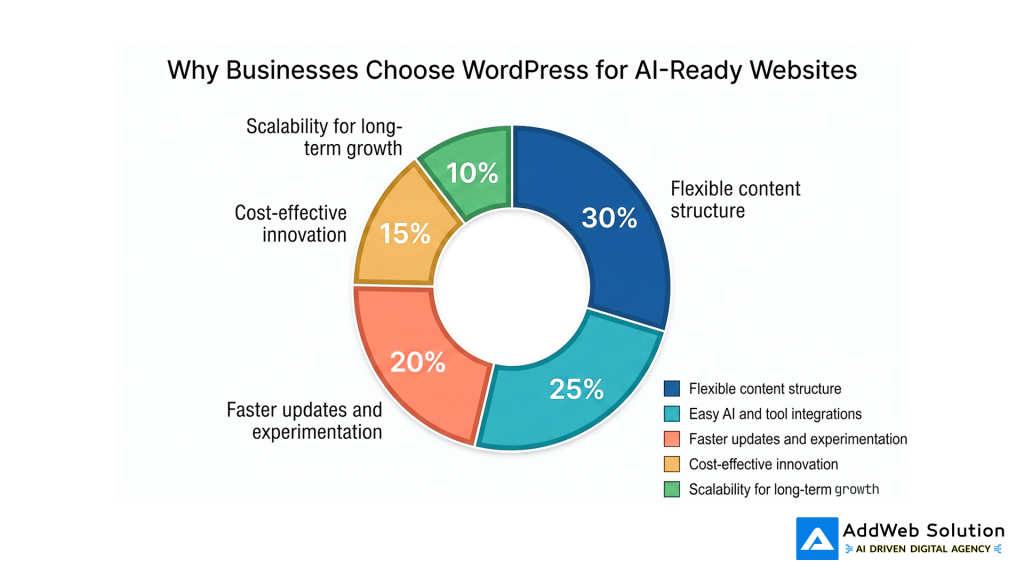
When businesses evaluate WordPress through an AI-readiness lens, content flexibility usually leads the conversation. Integration power comes next, followed by speed of execution, affordability, and scalability. That mix is exactly why using WordPress feels practical for companies that want to move toward AI without overcomplicating their website stack.
The real value is not AI hype, it is operational readiness
This is where many articles get it wrong.
They talk about AI-ready websites as if the whole story is about flashy tools. But most businesses do not benefit from hype. They benefit from websites that are operationally ready for change.
That includes questions like:
- Can your team publish and update content quickly?
- Can your website connect with smarter tools over time?
- Can you test new user experiences without breaking everything?
- Can your content support both human readers and AI-driven discovery?
- Can your website evolve without becoming a maintenance nightmare?
WordPress answers a lot of those questions surprisingly well.
That is why it is becoming the go-to platform in this space. Not because it is trendy, but because it is usable.
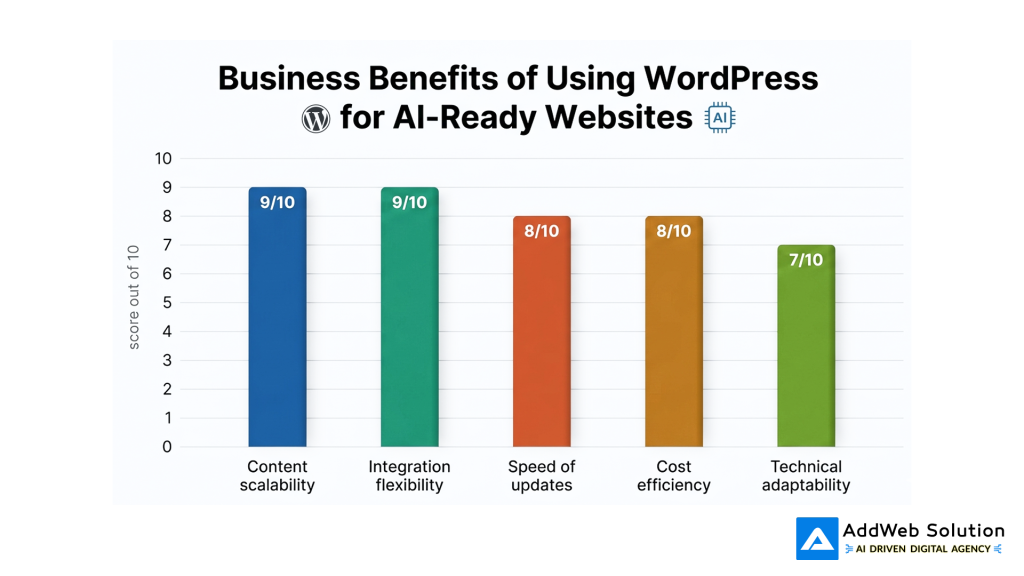
This graph helps shift the conversation from “What AI feature does WordPress have?” to “What business advantages does WordPress create in an AI-driven web environment?” That is a much better question because platform decisions should support growth, speed, and long-term digital flexibility.
Why this matters for search, SEO, and discoverability
The way people find websites is changing.
Search is becoming more conversational. Users ask full questions instead of typing short phrases. AI-generated summaries influence clicks. Search engines are getting better at evaluating relevance, usefulness, and page experience together rather than in isolation.
That means websites need more than keywords. They need clear architecture, strong internal linking, fresh content, helpful answers, fast loading, and a publishing system teams can actually maintain.
WordPress environment supports that kind of setting very well.
It helps businesses create topic clusters, expand content libraries, improve metadata workflows, update pages regularly, and build content ecosystems instead of isolated pages. That becomes increasingly valuable in a world where discoverability is not only about ranking but also about being understandable, referenceable, and useful.
Additional
Read

WordPress gives marketing teams more control
Another reason WordPress is becoming the go-to platform for AI-ready websites is that it gives marketers room to act.
That matters more than people think.
AI is accelerating the pace of digital marketing. Teams want to update offers faster, test new messaging sooner, launch campaign pages quickly, improve FAQs, respond to search changes, and build new content without waiting on a development bottleneck every single time.
A website platform that supports that kind of agility becomes a strategic advantage.
WordPress helps close the gap between idea and execution. And in a fast-changing AI landscape, execution speed can be the difference between staying relevant and falling behind.

This graph makes an important point: when businesses say they want an AI-ready website, they are usually not asking for something abstract. They want a platform that helps them move faster, connect smarter tools, stay visible, and scale without constant friction. That is exactly why the topic of WordPress keeps coming up in the conversation.
A simple business example
Imagine two companies in the same industry.
One has a rigid website that is hard to update, disconnected from key tools, slow to expand, and dependent on developers for even small changes. The other uses WordPress with a smart content structure, flexible integrations, fast publishing workflows, and room to layer in new automation over time.
Which one is better positioned for the next wave of digital change?
The second one, almost every time.
Not because WordPress is magical. But because it makes evolution easier.
And in the AI era, the businesses that can evolve faster usually gain the advantage.
What businesses should do next
If a company wants to become more AI-ready with WordPress, the smartest next step is not chasing every new AI plugin. It is building the right foundation first.
Focus on this:
- Improve content structure across key pages.
- Audit your website for speed, usability, and mobile experience.
- Reduce unnecessary complexity in themes and plugins.
- Strengthen your SEO and internal linking foundations.
- Connect the website more intelligently with CRM, analytics, and automation tools.
- Make sure your team can publish, update, and test efficiently.
That is what AI-readiness actually looks like in practice.
It is less about showing off smart features and more about building a website that can support smarter growth.
Final thoughts
WordPress is becoming the go-to platform for AI-ready websites because it offers something many businesses need right now: a realistic path forward.
It is flexible without being overwhelming. Scalable without requiring a full custom rebuild. Familiar enough for teams to use, but powerful enough to evolve with changing technology.
Most importantly, it supports the kind of website operations that matter in the AI era: structured content, faster updates, easier integrations, better experimentation, and room to grow.
That is why this shift matters.
Not because WordPress is trying to become an AI product.
But because it is becoming a very smart platform for businesses that want to be ready for what comes next.

Future-Proof Your Website with Expertise in WordPress

Pooja Upadhyay
Director Of People Operations & Client Relations
Source URLs:
https://wordpress.org/plugins/ai-plus-block-editor/
