


A car accident victim texts your firm at 11 PM. Forty-five seconds later, they know their case has merit, they’ve seen a consultation link, and your intake is half done, before any attorney wakes up.
Key numbers
- 45s: Inquiry to qualified
- 3x: More retainers
- 7: AI agents at work
The Problem: Most Law Firms Lose Cases Before a Lawyer Even Sees Them
Someone gets hurt in a rear-end collision. They search “personal injury lawyer near me” at 10 PM. They fill out three intake forms. Two firms reply the next business day. One replies in under a minute, with a case assessment. That firm signs the retainer.
Traditional Intake
Response time 8–24 hours
First reply “We’ll have someone call you”
Case assessment After consultation only
After-hours coverage Voicemail
Retainer rate ~12%
AI Case Screening
Response time 45 seconds
First reply “Based on what you described…”
Case assessment Pre-qualification in first text
After-hours coverage Full AI intake, 24/7
Retainer rate ~35%
3x
More retainers signed – same ad spend, same attorneys, different intake speed
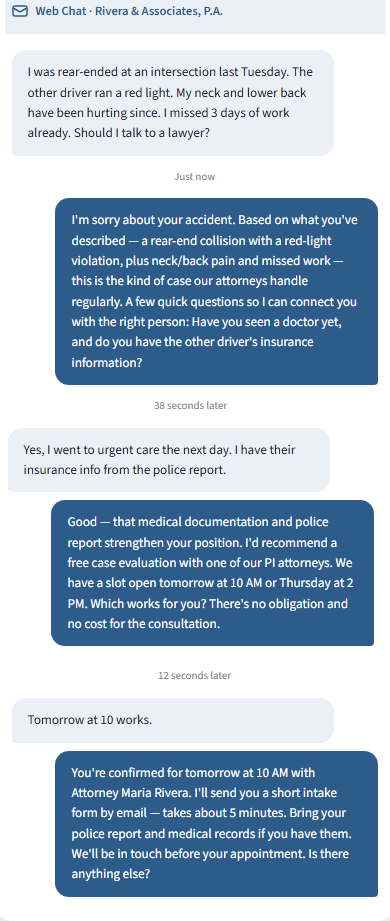
What the Prospect Sees: A Real Conversation – Inquiry to Consultation Booked
The AI sounds like a knowledgeable paralegal, not a chatbot. It qualifies the case, collects details, and books a consultation – all before anyone at the firm touches it.
Important: Compliance Built In
The AI never offers legal advice, never guarantees outcomes, and never establishes an attorney-client relationship. It screens, qualifies, and schedules, the same work a trained intake specialist does, at the speed a prospect expects.
The 45-Second Flow: From Inquiry to Qualified Consultation
Six steps, fully automated. Your attorneys only see cases that are already screened and scheduled.
1. Prospect Describes Their Situation (Second 0) Via web chat, SMS, or intake form – at any hour. The AI reads the message and identifies the practice area: PI, family, criminal, employment, or other.
2. AI Screens the Case Against Your Criteria (Second 5) Is this a case your firm takes? The AI checks practice area, jurisdiction, statute of limitations, and basic liability signals, the same checklist your intake coordinator uses.
3. AI Sends a Personalized Response (Second 12) Not a template. The reply references the prospect’s specific situation, explains why a consultation makes sense, and asks qualifying follow-ups (medical treatment, insurance, documentation).
4. Prospect Answers, AI Qualifies Further (Seconds 15–45) The conversation continues naturally. The AI collects the details an attorney needs before the first meeting: incident facts, injuries, existing documentation, opposing party info.
5. Consultation Booked, Intake Form Sent (Under 60 seconds total) The AI checks attorney calendars, books a slot, and sends the client a digital intake form – pre-filled with the details already collected during the chat.
6. Attorney Gets a Case Brief Before the Call (Automatic) A structured summary lands in the CRM: case type, liability assessment, injuries, documentation status, and the prospect’s own words. The attorney walks in prepared.


Why Speed Wins in Legal Intake: The Numbers Behind Instant Response
Potential clients don’t wait. The data says the firm that responds first wins the retainer.
- 78% of the time – First Responder Wins: The firm that responds first signs the client.
- 68% of legal inquiries – Come After Hours: Evenings, weekends, holidays – when nobody’s at the desk.
- 3x (12% → 35%) – Retainer Rate Lift: Modeled in Discovery on your numbers.
The Full System: 7 AI Agents Working 30 Days Per Lead
Case screening is just the entry point. Behind the scenes, seven agents handle intake, follow-up, reputation, and marketing – so attorneys focus on practicing law.
Intake Agent (Day 1):
Screens inbound cases 24/7 via SMS, web chat, and form submissions. Qualifies by practice area, jurisdiction, and merit.
Nurture Agent (Days 1–21):
Follows up with prospects who inquired but didn’t schedule. Practice-specific drip – statute of limitations reminders, FAQ answers.
Case Qualifier (Day 1):
Scores each case on liability, damages potential, and documentation. Flags high-value cases for priority scheduling with senior attorneys.
Consultation Agent (Day 1–2):
Books consultations, sends intake forms pre-filled from chat, delivers a structured case brief to the attorney before the meeting.
Follow-Up Agent (Days 3–30):
After consultation: retainer reminders, document collection nudges, review requests. After resolution: satisfaction check and referral ask.
Content Agent (Days 7–21):
Turns case outcomes (anonymized) into blog posts, FAQ pages, and social content. Writes in the firm’s voice – authoritative, not salesy.
SEO Agent (Days 7–30):
Publishes practice area pages, location-specific landing pages, and Google Business Profile posts. Builds local visibility for “[practice area] lawyer near me” searches.
Want to see all 7 agents running on a real legal CRM? We’ll demo the full pipeline, intake to content, scoped to your practice area. No slide deck. Book a Strategy Call

The Business Case: What This Costs – and What One Extra Retainer Is Worth
Law firms pay more for client acquisition than almost any industry. The math here is straightforward: if the system signs even one additional retainer per month, it pays for itself many times over.
- Your API costs: 95–215 USD
- Growth tier: 799–1,199 USD
- Full automation: 1,499–1,999 USD
- 70–85% gross margin per client, modeled at scale
Context: Cost per Acquisition in Legal A single personal injury retainer can be worth 5,000–50,000 USD or more in contingency fees. Most firms spend 500–2,000 USD per signed client on Google Ads alone. An AI intake system that converts even one extra lead per month dwarfs its own cost.
After the Retainer Is Signed: The Work That Keeps the Pipeline Full
Case screening gets the retainer. What happens next – SEO pages, FAQ libraries, anonymized case studies, review generation – is what turns a one-time system into a compounding growth engine.
Practice Area SEO Pages (2–4 pages / month):
Each practice area gets its own optimized page – “car accident lawyer in Miami,” “slip and fall attorney Tampa.” Written from real case patterns, not templates.
Legal FAQ Libraries (8–12 FAQs / month):
“How long do I have to file?” “What if I was partially at fault?” – the questions prospects Google before they ever contact the firm. Each one becomes a rankable page.
Anonymized Case Studies (1–2 studies / month):
Resolved cases become proof content – “Client in a multi-vehicle crash recovered 320,000 USD after insurance initially offered 15,000 USD.” Names removed, outcomes real.
Review Generation Sequences (Automated per closed case):
After case resolution, the Follow-Up Agent sends a timed review request – Google, Avvo, Lawyers.com. Happy clients get a one-tap link. The firm’s rating climbs on autopilot.
Google Business Profile Posts (2–3 posts / week):
Weekly GBP updates – new FAQ posts, case result highlights (anonymized), attorney spotlights. Signals freshness to Google and keeps the profile above competitors in map results.
Location Landing Pages (1–3 pages / month):
“Personal injury lawyer [city/county]” – one page per service area. Each page has the firm’s real case experience in that jurisdiction, not boilerplate.
The Content Flywheel: Every Closed Case Feeds the Next One Case Resolved → Case Study Written → FAQ Pages Published → SEO Ranks Climb → New Leads Arrive → AI Screens & Books ↻
Why This Matters for Law Firms Specifically
Legal content has long shelf life. An FAQ page about “What to do after a car accident in Florida” can rank for years and generate leads every week. Most firms never build this library because their attorneys don’t have time to write, and hiring a legal content writer costs 3,000–5,000 USD per month. The Content Agent produces the same output – reviewed by the firm before publishing – at a fraction of that cost.
Explore a working demonstration of automated legal intake, case qualification, and consultation booking.

Pooja Upadhyay
Director Of People Operations & Client Relations
Law firms don’t lose cases because of weak attorneys. They lose them in the first few minutes, when a prospect who is hurt, stressed, and searching at 10 PM chooses whichever firm answers first.
AI case screening closes that gap without adding headcount: every inquiry gets a personal reply in seconds, every qualified case lands on an attorney’s calendar with a full brief, and every closed case feeds the content that brings in the next lead.
The ad spend and the attorneys stay the same; the intake gets faster, and that is what turns a 12% retainer rate into 35%. If your firm is still telling prospects “we’ll have someone call you,” the next retainer is probably going to whoever replies first.
