


An EV can look perfect on the showroom floor. The paint shines, the dashboard glows, and the motor hums.
But the part that decides whether it is safe sits quietly under the seat or the footboard: the battery pack. Inside it, thousands of tiny joints carry the full current of the vehicle, every single day.
That is why India’s EV makers are putting robots, cameras and software at the heart of their factories.
Quick answer: In India’s EV manufacturing, robots handle repeatable pack steps like cell handling, dispensing and welding. AI vision and sensors inspect welds, alignment and sealing. Software ties it together with traceability and test records, which Indian standards now expect. The winners are the plants that treat inspection data as a safety record, not a report.
The market is moving fast. According to the IESA mobility report, India registered 2.55 million EV sales in FY2025-26, up 25 percent, reaching 8.3 percent of total vehicle registrations. Electric two-wheelers contributed nearly 58 percent of EV sales in the same report.
The supply chain is catching up. The Advanced Chemistry Cell PLI has an outlay of ₹18,100 crore, and one report says Amara Raja, Agratas (Tata) and Reliance are nearing commercial cell production, with commissioning set for late 2026 to 2027.
In this guide, you will learn:
- Where robots work on a battery pack line
- How AI inspection catches problems, and where cameras fall short
- What the software layer must record for Indian standards
- How Indian plants are approaching it
- A practical roadmap for pack makers
Outlining why robotic automation suits India’s EV pack lines.
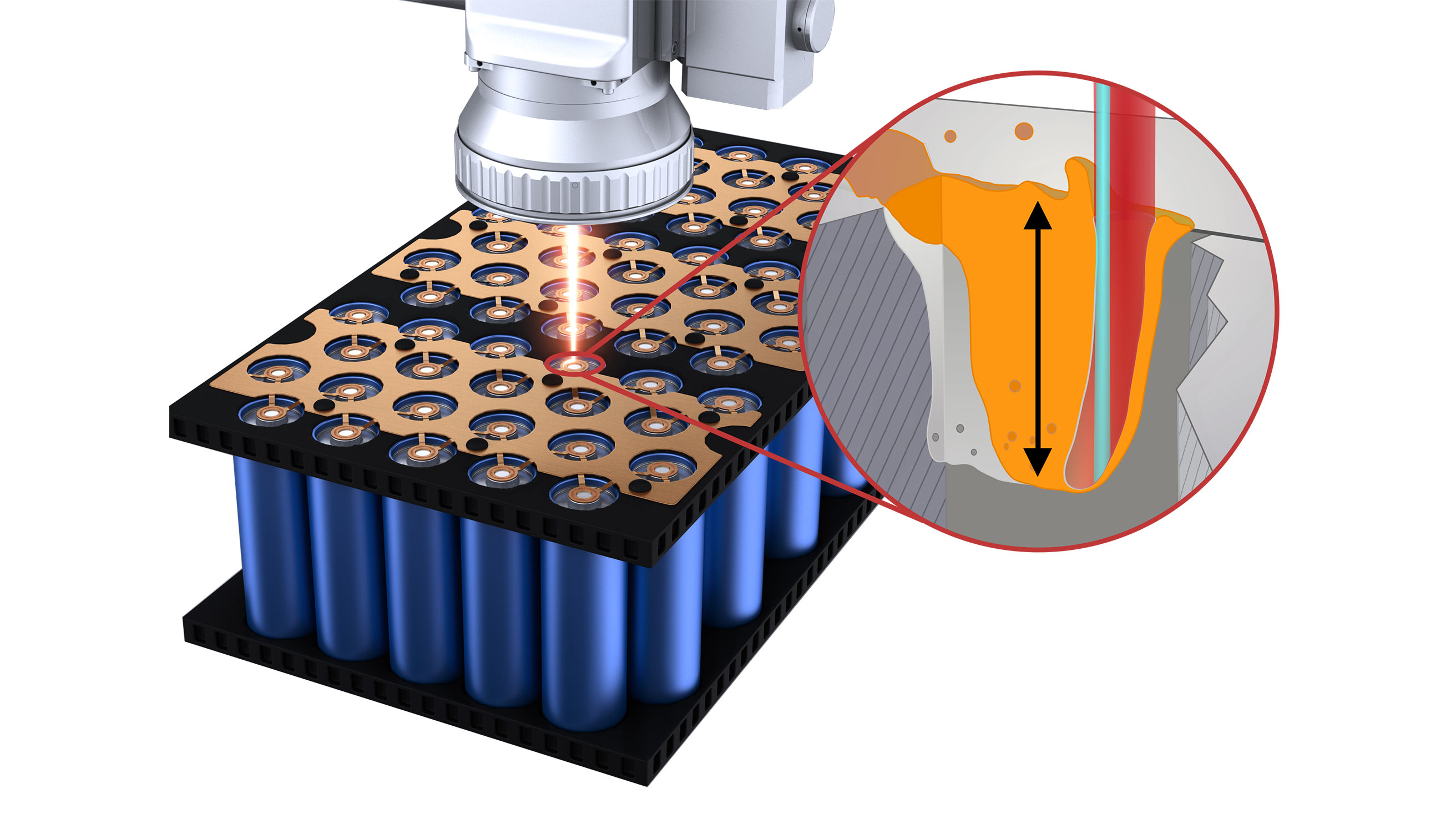
Inspection: Where AI Vision Helps, and Where It Is Blind
The stakes are clear. A weak joint is not a cosmetic flaw. One vendor guide explains that each tab and busbar weld carries the full current the pack delivers, so a porosity void or incomplete joint becomes a resistance point that heats under load.
What AI vision does well
AI vision inspects surface-visible features, such as:
- Cell and tab alignment
- Weld position and surface appearance
- Adhesive bead shape and coverage
- Seal and connector placement
One vendor reports ramp-up defect rates of 12 to 15 percent, versus 2 to 3 percent in mature ICE plants.
Another claims 95 to 99 percent detection accuracy on battery assembly defects. These are vendor figures, so verify them on your own packs.
What vision cannot see
The same vendor guide notes that vision is structurally blind to subsurface problems like internal porosity. That is why weld inspection often adds other methods:
- Ultrasonic or laser monitoring during welding
- Electrical resistance checks on each joint
- X-ray for internal structure, where cost and volume justify it
- Thermal imaging to spot hot spots
A practical approach
Use several layers, not one. Vision for surface checks, process monitoring for the weld, and electrical tests for the final proof. Then log everything against the pack serial number.
The Software Layer: Your Safety Record
Software turns machine data into evidence. In India, that evidence is now part of the rules.
What Indian battery standards expect
India’s traction battery standards, AIS-156 for L-category vehicles such as two- and three-wheelers and AIS-038 Rev 2 for M and N categories, have been mandatory since December 2022.
One compliance guide says they require thermal runaway propagation testing, IPX7 water ingress protection, RFID battery traceability and a microprocessor-based BMS with cell-level protections. AIS-038 Rev 2 received a fourth revision in August 2024.
Traceability matters for factories. One summary says requirements cover the pack, cell, BMS and charger levels, and the pack carries an RFID tag that stores key information.
Another explains that every pack must trace back to its cell batch and production lot, so field failures can be isolated.
What your factory software should record
For each pack, the system should link:
- Cell batch and supplier lot
- Weld parameters and inspection results
- Adhesive and assembly records
- Electrical test readings
- BMS software version and calibration
- Operator, station and timestamp
When a failure appears in the field, this record lets you narrow the problem to a batch instead of recalling everything.
Beyond traceability
Software also helps with:
- Predictive quality: Models that flag packs at higher risk, based on process conditions
- Digital twins and virtual commissioning: Ola Electric’s site says it uses both in its Futurefactory
- Remote monitoring: Robot health and line performance dashboards


How Indian Plants Are Approaching It
Public information shows a mix of strategies. Treat company claims as claims.
| Plant | What is publicly reported |
|---|---|
| Mahindra, Chakan (Pune) | A July 2026 report says about 1,500 robots and over 98% body-shop automation, with synchronised autonomous mobile robots; a dedicated EV battery assembly facility with layered end-of-line testing was unveiled earlier |
| Ola Electric (Krishnagiri) | Company site lists 100+ AI robots and digital twins at the Futurefactory; earlier reports mentioned plans for about 3,000 robots; a neighbouring gigafactory makes cells |
| Tata Group, Agratas (Sanand) | A 40 GWh gigafactory under phased construction, according to one industry report |
Robot counts differ by source and date, so check the latest company statements before quoting any number.
Where Smaller Pack Makers Should Start
Not every pack maker needs a robot-heavy line. Many Indian pack assemblers build for two- and three-wheelers in moderate volumes. A smart path is semi-automation first.
A practical sequence
- Digitize tooling. Torque tools and fixtures that log results.
- Add resistance and voltage testing at every joint.
- Introduce barcodes or QR on every cell and pack. Link them to a traceability database.
- Add vision at key points. Cell placement, weld position, adhesive bead.
- Automate welding if volumes justify. Choose laser or ultrasonic based on your cell and busbar design.
- Build an end-of-line tester with data logging.
- Prepare for thermal propagation and compliance evidence. Keep design, test and production records together.
An 8-Step Roadmap for Your Plant
- Map your pack process. List each step, defect risk and current check.
- Rank risks by safety impact. Welds, insulation and thermal paths come first.
- Baseline your data. Record defect types, scrap, rework and field returns.
- Fix traceability first. Every cell and pack needs an ID.
- Pilot one inspection point. Run it for several weeks beside your current check.
- Compare detection and false rejects. Test on real defects and edge cases.
- Link inspection to the BMS and test data. Keep one record per pack.
- Scale carefully. Re-validate after any change in cells, tooling or suppliers.
Mistakes to Avoid
- Relying on cameras alone. Vision misses internal flaws.
- Skipping traceability. Without it, a small problem becomes a large recall.
- Automating a weak process. Fix the process first.
- Ignoring test lab capacity. One summary noted many Indian labs were not initially equipped for thermal propagation tests, so plan certification time early.
- Forgetting people. Technicians still need to tune, maintain and investigate.
FAQ: People Also Ask
How are robots used in EV battery pack assembly?
Robots handle cell placement, adhesive dispensing, laser or ultrasonic welding of busbars and material handling. Vision and sensors guide them and check results.
How does AI inspect EV batteries?
AI vision checks alignment, weld appearance and adhesive beads. It is often combined with electrical, ultrasonic, thermal or X-ray methods for faults that cameras cannot see.
Can AI vision detect weld porosity?
Not reliably on its own. One vendor guide says vision is blind to subsurface porosity, which is why ultrasonic, laser and electrical monitoring are used.
What are AIS-156 and AIS-038 Rev 2?
They are India’s battery safety standards for traction batteries. AIS-156 covers L-category vehicles such as two- and three-wheelers, and AIS-038 Rev 2 covers M and N category vehicles. They require thermal propagation testing, traceability and BMS protections.
Is battery traceability mandatory in India?
The AIS standards include traceability at pack, cell, BMS and charger levels, with an RFID tag in the pack. Other rules, such as battery waste management, also affect record keeping.
How many EVs are sold in India?
According to IESA, India registered 2.55 million EV sales in FY2025-26, an increase of 25 percent, at 8.3 percent of total vehicle registrations. Other sources report slightly different totals.
Does India make its own battery cells?
Production is starting. Ola Electric has begun cell manufacturing, and one report says Amara Raja, Agratas and Reliance are nearing commercial production, with commissioning set for late 2026 to 2027.
Do small pack makers need robots?
Not at first. Many start with digital tooling, testing, traceability and targeted vision, then add robotic welding when volumes justify it.
What is the biggest risk in battery pack production?
Weak or defective joints and cells, which can raise resistance and heat. That is why 100 percent inspection and full traceability are standard goals.
Explore intelligent manufacturing solutions that help detect defects, connect inspection data, and strengthen quality assurance.

Pooja Upadhyay
Director Of People Operations & Client Relations
Ready to Build Safer Battery Packs With Smarter Lines?
Share your pack design, volumes and current inspection steps. Our team will map a practical plan covering robots, AI inspection and traceability software, with a clear order of investment.
