


Author’s Note
If someone asked me what has changed the most since I started my career in 2005, the answer would be easy.
Almost everything.
Programming languages.
Frameworks.
Cloud platforms.
Mobile technology.
Artificial intelligence.
The pace of change has been extraordinary.
Yet one observation has stayed with me.
The businesses I continue to admire today aren’t the ones that guessed every trend correctly.
They’re the ones that remained consistent in how they treated people while adapting to every trend that came along.
That consistency comes from values.
Not strategy.
Key Takeaways
- Strategy changes. Values should remain remarkably consistent.
- Values simplify difficult decisions.
- Trust grows when values remain consistent under pressure.
- Culture is the practical expression of values.
- Enduring businesses protect values while evolving strategy.
Introduction
Business advice often focuses on strategy.
Market positioning.
Competitive advantage.
Pricing.
Technology.
Growth.
All of those matter.
But after more than two decades in the industry, I’ve become convinced that strategy answers only one question.
“Where are we going?”
Values answer a different one.
“How will we get there?”
I’ve learned that businesses rarely struggle because they lack strategies.
They struggle when short-term opportunities tempt them to abandon the principles that earned trust in the first place.
That realization has changed how I think about building a company.
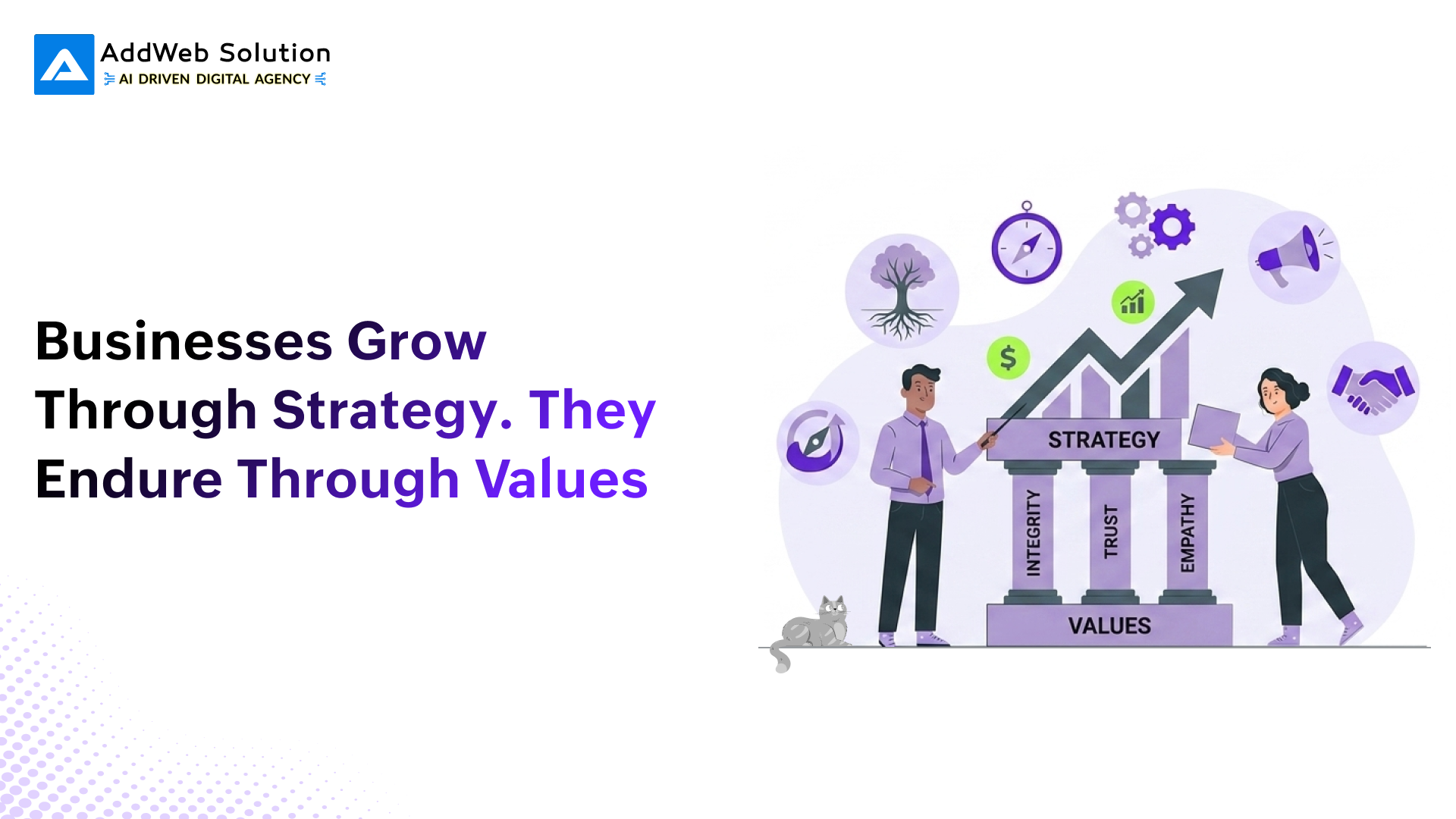
Strategy should evolve.
Values should provide continuity.
1. Why Strategy Must Change
If our agency still operated exactly as it did in 2012, we’d probably be struggling today.
The market has changed.
Clients have changed.
Technology has changed.
Good strategy changes with reality.
In fact, refusing to adapt isn’t consistency.
It’s rigidity.
One lesson experience has taught me is that businesses should be willing to change their methods without constantly changing their principles.
Those are very different things.
Michael Porter wrote,
“The essence of strategy is choosing what not to do.”
I agree.
But I’d add another thought.
The essence of values is deciding what you’ll never compromise.
Strategy guides choices.
Values define boundaries.
2. Values Create Consistency
Earlier in my career, I thought values belonged on office walls.
Today, I think they belong in everyday decisions.
How we communicate with clients.
How we treat employees.
How we respond when projects become difficult.
How we admit mistakes.
How we keep commitments.
Those aren’t branding exercises.
They’re demonstrations of values.
Clients may never read your mission statement.
But they’ll experience your values every time they work with your business.
Simon Sinek has often said,
“People don’t buy what you do; they buy why you do it.”
Whether every buying decision follows that principle or not, I believe the broader idea is true.
People are drawn to organizations whose actions consistently reflect their stated beliefs.
3. The Decisions Values Make Easier
One benefit of clear values is that they simplify difficult decisions.
When a tempting opportunity conflicts with your principles…
The answer becomes clearer.
When a shortcut promises immediate results but damages long-term trust…
The decision becomes easier.
Values don’t remove difficult choices.
They reduce uncertainty about how to approach them.
I’ve come to believe that one of the greatest benefits of values isn’t inspiration.
It’s consistency.
4. Culture Is Values in Action
One thing I’ve gradually come to believe is that culture isn’t created by what a company writes.
It’s created by what a company repeatedly does.
Mission statements are important.
Values printed on office walls have their place.
But people don’t experience values through documents.
They experience them through decisions.
How leaders respond when projects go off track.
How managers treat people under pressure.
How promises are kept when they’re no longer convenient.
Those moments shape culture far more than carefully written statements.
I’ve noticed that strong cultures rarely need constant explanation.
People understand them because they experience them consistently.
That’s when values stop being words.
They become habits.
Peter Drucker is widely credited with saying,
“Culture eats strategy for breakfast.”
Whether the wording has evolved over time or not, the principle remains powerful.
A brilliant strategy implemented within a weak culture rarely achieves its full potential.
A healthy culture, on the other hand, helps ordinary strategies perform exceptionally well.
5. Why Clients Notice Values
Clients may never ask about your company’s values during the first meeting.
But they’ll notice them over time.
They notice whether commitments are honoured.
Whether difficult conversations are avoided or addressed.
Whether responsibility is accepted when something goes wrong.
Whether recommendations are made in the client’s best interest rather than the agency’s convenience.
Those experiences quietly answer a question every client is asking.
“Can I trust these people?”
Trust isn’t created by saying,
“Integrity is one of our values.”
Trust is created when integrity becomes visible through everyday behaviour.
I’ve realised that values are most convincing when nobody needs to talk about them.
People simply experience them.
Stephen R. Covey wrote,
“We judge ourselves by our intentions and others by their behavior.”
That observation reminds me that businesses are ultimately evaluated by what they consistently do, not by what they intended to do.
Intentions explain.
Behaviour convinces.


6. Building for the Long Term
When I think about businesses that have remained respected for decades, I rarely remember the technologies they used.
I remember how they worked.
How they treated clients.
How they handled difficult situations.
How consistently they behaved.
Technology will continue changing.
Markets will continue evolving.
Business models will continue adapt.
Values provide stability while everything else changes.
Looking back over more than two decades in this industry, I don’t think enduring businesses succeed because they never change.
I think they succeed because they know exactly what should never change.
That distinction has become one of the most valuable lessons of my career.
Statistics
Research consistently shows that organizations with clearly demonstrated values build stronger trust, engagement, and long-term performance.
PwC’s Global Trust Survey highlights that trust is closely linked to consistent organizational behavior, ethical leadership, and transparent decision-making.
Source:
https://www.pwc.com/gx/en/issues/trust.html
Edelman’s Trust Barometer continues to show that trust significantly influences customer loyalty, employee engagement, and long-term business success.
Source:
Harvard Business Review has emphasized that organizational culture and shared values influence execution, innovation, and long-term organizational performance.
Source:
A Few Observations
- Strategy helps businesses compete. Values help businesses endure.
- Clients rarely remember value statements. They remember value-driven behavior.
- Culture is built through repeated actions, not occasional initiatives.
- The strongest businesses adapt their strategy without compromising their principles.
Frequently Asked Questions
Should business values ever change?
Core values should remain remarkably stable.
Strategies, products, and services should evolve as markets change.
Values provide continuity while strategy provides adaptability.
How do leaders reinforce company values?
By consistently demonstrating them through everyday decisions.
People learn more from behavior than from presentations.
Why do values matter during difficult times?
Because pressure reveals priorities.
Values become most visible when keeping them requires sacrifice.
Can values create a competitive advantage?
Yes.
Technology can be replicated.
Processes can be copied.
A deeply trusted culture built on consistent values is much harder to duplicate.
My Framework – The Values Compass
Every important business decision can be tested against the same simple compass.

The idea
Strategies answer:
“How do we grow?”
Values answer:
“How do we grow without losing who we are?”
When both remain aligned, businesses become remarkably resilient.
A Thought to Leave You With
Strategy determines where your business goes.
Values determine whether people want to go there with you.
Markets reward innovation.
People reward consistency.
The businesses that endure understand they need both.
Technology and strategy evolve, but trust lasts. Work with a team that delivers innovative digital solutions while staying true to its values.

Pooja Upadhyay
Director Of People Operations & Client Relations
Closing Thoughts
When I reflect on the companies I’ve admired throughout my career, one pattern keeps appearing.
Their success wasn’t built solely on brilliant strategies.
Strategies changed.
Products evolved.
Technologies were replaced.
What remained surprisingly consistent was the way they treated people.
The standards they refused to compromise.
The trust they protected.
The values they demonstrated long after those values stopped being words on a website.
That has shaped how I think about building a business.
I want our strategy to keep evolving.
I hope our values never need to.
Because while strategy helps businesses grow…
Values determine whether they’re still respected after the growth arrives.
My Principle
Strategy helps you win today’s opportunities. Values determine whether people still trust you tomorrow.
