


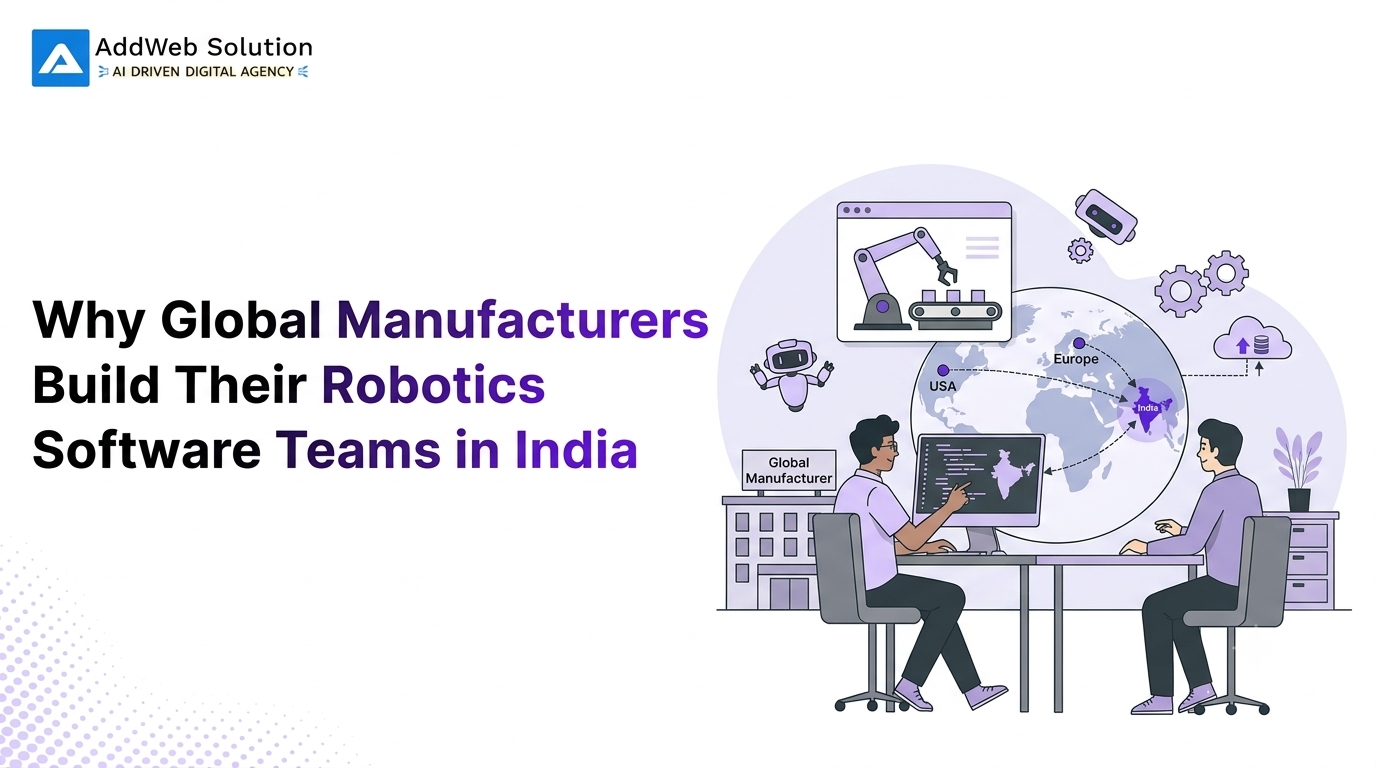
Picture a robot arm on a factory floor in Germany. It welds, lifts and packs all day without a break. Now ask a simple question. Who wrote the code that tells it what to do?
For a growing number of manufacturers, the answer is a team of engineers in Bengaluru, Pune or Coimbatore.
India now hosts over 1,760 global capability centers, according to Zinnov. In February 2026 alone, Festo opened a new engineering center in Bengaluru and Vanderlande opened an innovation center in Pune.
So why is India on so many manufacturers’ shortlists? And what should you check before you build a team there?
This guide answers both. You will see the talent numbers, real company examples, the risks, and a simple checklist to plan your first steps.
The Quick Answer
Global manufacturers build robotics software teams in India for four main reasons. India has a very large pool of engineers, a mature network of global engineering centers, strong software skills, and a fast-growing factory market at home.
Cost still helps. But today it is rarely the only reason. Many companies now treat India as a core engineering base, not a back office.
First, What Is a Robotics Software Team?
A robot is part machine and part code. The metal arm gets the attention, but software tells it what to do.
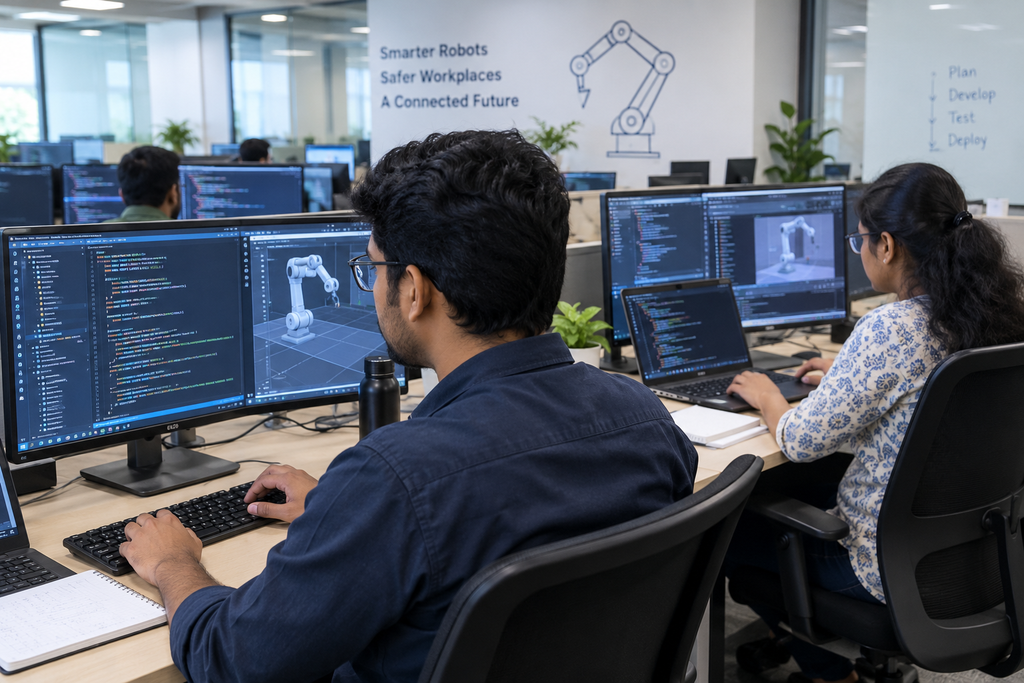
A robotics software team writes that code. Their work includes:
- Control software that moves the robot safely
- Vision systems that help robots “see” parts and products
- Fleet software that makes many robots work together
- Testing tools that find bugs before a robot reaches a factory floor
- Cybersecurity that keeps connected machines safe
This is why more manufacturers are becoming software companies. The hardware is only half the product.


India’s Talent Pool: Big, Young and Growing
Talent is the first reason, and the numbers are large.
One analysis of India’s higher education data estimates that the country produces about 2.5 million STEM graduates every year. That is a big base to hire from.
Hiring is not only about volume, though. Companies want engineers who can handle real-world products. That is where India’s engineering centers come in.
The Secret Weapon: Global Capability Centers
You will often hear the term GCC. It stands for Global Capability Center. It is a company-owned team in India that works for the parent company worldwide.
India is the world leader here. The numbers tell the story:
- India crossed 1,760 GCCs by the end of 2025, according to Zinnov.
- These centers employ over 1.9 million professionals.
- According to a Nasscom and Zinnov report, India hosts 17% of the world’s technology capability centers.
- India’s GCCs earned $64.6 billion in export revenue in FY2024.
- GCCs focused on engineering, research and development earned $36.4 billion of that, and grew 1.3 times faster than the overall sector.
The same report expects India to reach 2,100 to 2,200 GCCs by 2030, with 2.5 to 2.8 million employees.
For a manufacturer, this means they are not starting from zero. Hiring networks, office spaces, service partners and experienced managers already exist.

From Back Office to Brain Trust
The role of these centers has changed. Many started as support teams. Now they own products.
Here are two recent examples from the robotics and automation world.
Vanderlande, Pune (February 2026). Vanderlande makes warehouse and airport automation systems. It is a Netherlands-based company owned by Toyota Industries. It opened an India Innovation Centre in Pune. The center was once focused on support. Now its teams design, test and deploy automation systems for customers around the world. That includes the control software that makes many machines work together.
Festo, Bengaluru (February 2026). Festo is a German industrial automation company. It opened a 71,000 sq ft GCC in Bengaluru. The team will work on industrial automation software, data analytics and cybersecurity. Festo plans to grow the team to over 600 people by 2030.
The trend is clear. Companies are giving India real ownership of products, not only small tasks.
A Home Market That Is Heating Up
Manufacturers do not only build in India. They also sell there.
The International Federation of Robotics reports a record 9,100 industrial robot installations in India in 2024, up 7% from the year before. For comparison, 542,000 industrial robots were installed worldwide that year.
India’s number is still small next to the world total, but it is growing. That matters for software teams.
When engineers sit close to local factories, they see real problems. They learn about heat, dust, power cuts and tight budgets. Products built with that experience often work well in other emerging markets too.
More Than Cost: What Companies Really Want
Lower cost is still part of the story. But the Vanderlande case shows a shift in thinking. Industry observers now describe India less as a cost location and more as an engineering base for complex work like logistics automation and robotics.
Here is what companies often say they want:
- Speed: a team that can start hiring quickly
- Depth: engineers who know software, electronics and mechanics together
- Coverage: a team that works while the home office is asleep
- Scale: the ability to grow from 20 people to 200
- Ownership: a team that can run a product from idea to launch
Time zones help too. Teams in India can hand work to Europe in the morning and to the US later in the day.
Beyond the Big Cities
Bengaluru and Pune are the famous names. But talent is spreading.
The Nasscom and Zinnov report counts about 220 GCC units in Tier-2 and Tier-3 cities such as Ahmedabad, Kochi, Thiruvananthapuram and Coimbatore.
Why does it matter? Smaller cities can mean lower hiring competition, less staff turnover and lower office costs. Some also sit close to manufacturing clusters.
The Honest Part: Challenges to Plan For
India is not a magic fix. Smart companies plan for these risks.
Competition for top talent. Many global firms hire in the same cities. Good robotics engineers can switch jobs fast.
Skill gaps. Having many graduates does not mean every graduate is job-ready. Robotics needs hands-on skills. Training and on-the-job learning matter.
Research depth. One analysis notes that India spends about 0.64% of GDP on research and development. That is below the global average of about 1.7%. Advanced research roles can be harder to build.
Hardware access. Robotics teams need real machines to test on. Plan for labs, test rigs and shipping parts.
Distance and culture. Teams in different countries need clear goals, good documents and regular contact.
None of these are deal-breakers. They are things to plan for early.
A Simple Checklist Before You Build
Use these questions before you pick a city or a partner.
- What will the team own? Define a real product or module, not scattered tasks.
- Which skills do you need first? Embedded software, vision, simulation, testing or cybersecurity?
- Build or partner? You can set up your own center, hire a partner, or use a hybrid model.
- Where is your talent? Check hiring depth in each city.
- How will you test? Plan for hardware labs and simulation tools.
- How will you keep people? Offer growth paths, not only salaries.
- How will you protect your IP and data? Set security rules from day one.
Build, Partner or Hybrid?
| Option | Best for | Trade-off |
|---|---|---|
| Own center (GCC) | Long-term product ownership | Slower to start, higher setup effort |
| Partner or outsourced team | Fast start, flexible size | Less control over knowledge and culture |
| Hybrid | Starting small, then growing | Needs clear handover plans |
Many companies start with a partner, learn the market, then build their own center.
Frequently Asked Questions
Why do global manufacturers set up robotics software teams in India?
They get access to a large engineering talent pool, an established network of global capability centers, strong software skills and a growing local factory market. Cost helps, but many firms now also value India as a place to own and build complex products.
What is a global capability center (GCC)?
A GCC is a company-owned team in another country that does work for the parent company worldwide. In India, GCCs handle engineering, software, research and operations. According to Zinnov, India had over 1,760 GCCs by the end of 2025.
How many GCCs are there in India?
India had more than 1,760 GCCs by the end of 2025, according to Zinnov. They employ over 1.9 million professionals. A Nasscom and Zinnov report expects 2,100 to 2,200 GCCs by 2030.
Is India good for robotics software development?
Yes, for many tasks. India has a large software talent base and growing engineering centers focused on automation. Companies like Festo and Vanderlande have opened engineering hubs there. Teams still need good training, test hardware and clear goals.
Which Indian cities are best for robotics software teams?
Bengaluru and Pune are the best known, with strong talent and many existing engineering centers. Tier-2 cities like Coimbatore, Kochi, Ahmedabad and Thiruvananthapuram are also growing as options, with around 220 GCC units across smaller cities.
Is India a big market for industrial robots?
It is growing but still small next to China or Japan. The International Federation of Robotics recorded a record 9,100 industrial robot installations in India in 2024, up 7%. Worldwide, 542,000 industrial robots were installed that year.
Is it cheaper to build a robotics team in India?
Often yes, but cost depends on the role, city and seniority. Salaries for experienced robotics engineers can rise quickly due to competition. Most firms now treat cost as one benefit among several, not the main reason.
What are the risks of building a robotics team in India?
Common risks include competition for talent, uneven job-readiness among graduates, limited access to test hardware and communication gaps across time zones. Clear ownership, strong training and good documentation reduce these risks.
Should I build my own center or work with a partner?
Choose a partner for a fast, flexible start. Choose your own center for long-term product ownership and tighter control. Many companies do both, starting with a partner and moving to their own center once they know the market.
What skills do robotics software teams need?
Typical skills include embedded programming, control systems, computer vision, simulation, machine learning, testing and cybersecurity. Strong teams also need people who understand both software and the physical machine.
The Takeaway
India offers scale, skills and a proven model for building engineering teams. Manufacturers are moving from sending small tasks to giving real product ownership.
The winners plan well. They define what the team owns, invest in training, set up real test labs and keep strong links with headquarters.
Thinking about your own robotics software team? Talk to us for a free 30-minute planning call. We will help you decide what to build, where, and how to start.
Sources
- Zinnov, The 5 Shifts That Defined India’s GCC Story in 2025: zinnov.com/centers-of-excellence/5-shifts-defining-indias-global-capability-centers-gccs-story-in-2025-blog
- Nasscom and Zinnov GCC report (September 2024), as reported by IANS: ianslive.in/gccs-projected-to-create-up-to-28-lakh-jobs-in-india-by-2030–20240912133249
- Nasscom and Zinnov, via Business World (Tier-2 and Tier-3 city data, ER&D growth): businessworld.in/article/india%E2%80%99s-gcc-market-revenues-to-touch-99-105-bn-by-2030-532640
- International Federation of Robotics, World Robotics 2025: ifr.org/news/global-robot-demand-in-factories-doubles-over-10-years
- Education for All in India, The STEM Pipeline in India (analysis of AISHE data): educationforallinindia.com/the-stem-pipeline-in-india-from-science-classrooms-to-stem-degrees
- Festo Bengaluru GCC (February 2026): themachinemaker.com/news/festo-marks-40-years-in-india-opens-global-capability-centre-in-bengaluru
Talk to our team about a discovery sprint

Pooja Upadhyay
Director Of People Operations & Client Relations
