


It is the night before go-live. The robot cell is built. The vendor is smiling. The production plan is waiting.
Then someone asks a simple question: “Are we sure it is safe?”
If your answer is “I think so,” this guide is for you. It explains the standards that matter in India, the new law you now work under, and a practical checklist to finish before the first production run.
This guide is general information, not legal or engineering advice. Confirm details with your robot integrator, a qualified safety engineer and your state factory inspectorate.
The Quick Answer
Before go-live, every plant manager should confirm six things:
- A written risk assessment covers the whole robot cell.
- The design follows ISO 10218 (Indian Standard IS/ISO 10218 or IS 14530).
- Safety devices work and have been tested on site.
- Operators and maintenance staff are trained.
- Documents and records are complete.
- Your factory meets the current Indian law, now the OSH Code, 2020.
If any one of these is missing, delay go-live.
Why This Matters: A Look at Factory Safety Data
Indian factories already carry real risk, even before robots arrive.
Ministry of Labour data compiled by Dataful shows 1,090 fatal injuries in registered factories in 2023. That is about 5.46 fatal injuries per lakh workers.
Machines are a big part of the story. Over 2014 to 2023, mechanically powered machinery contributed to 1,231 fatal injuries and 9,386 non-fatal injuries, according to the same data source.
These are official numbers for registered factories only. Experts note that under-reporting is likely, so the true picture may be worse.
Robots are growing fast too. The International Federation of Robotics recorded a record 9,100 industrial robot installations in India in 2024. More robots mean more cells to commission safely.
The Law First: What Changed in November 2025
India’s workplace safety law changed recently, so check your paperwork.
The Occupational Safety, Health and Working Conditions Code, 2020 (the OSH Code) came into force on 21 November 2025. It brought 13 older laws into one code, including the Factories Act, 1948.
Key points for a plant manager:
- Your factory duties now come from the OSH Code.
- Existing licences and state factory rules continue during the transition period.
- Contract labour rules now apply from 50 workers, up from 20.
- State rules and notifications may still be updating.
What to do: Ask your safety officer or legal adviser to confirm which rules, licences and registers apply to your plant today. Check your state labour department portal for the latest notifications.
The Standards That Matter
Standards are the shared rulebook for safe design. For robots, one family leads.
ISO 10218 is the main international safety standard for industrial robots. It has two parts:
- Part 1 covers the robot itself. It is aimed at robot makers.
- Part 2 covers the robot application and cell. It is aimed at system integrators.
The standard was revised in 2025. This was its first major revision since 2011. The new editions:
- Make functional safety requirements clearer
- Bring in collaborative robot rules from ISO/TS 15066
- Add new robot classifications
- Add cybersecurity requirements for robot safety
And in India?
The Bureau of Indian Standards (BIS) publishes the Indian versions:
- IS 14530 (Part 1 and Part 2): 2019 are based on the older 2011 edition of ISO 10218.
- IS/ISO 10218-1:2025 is now listed on the BIS portal as a standard for robot safety requirements.
- BIS also publishes IS 17691 (Part 2): 2021 on safety design for manual load and unload stations.
For Part 2 of the 2025 edition, check the BIS portal for its current status.
Important: Ask your integrator in writing which edition the design follows. Do not assume.
Supporting Standards You Will Hear About
ISO 10218 points to other standards for specific parts of the safety system. The Indian versions list these references:
| Standard | What it covers |
|---|---|
| ISO 12100 | Risk assessment and risk reduction for machines |
| ISO 13850 | Emergency stop function |
| ISO 14119 | Interlocking devices linked to guards |
| ISO 14120 | Design of guards |
| ISO 13855 | Safe distances for approaching hazards |
| ISO 13849 | Functional safety of safety-related control systems |
You do not need to memorise them. You do need your integrator to name which ones they applied.
Cobots Are Not Automatically Safe
Collaborative robots, or cobots, work near people without a full fence. That does not mean they are harmless.
Safety depends on the whole application, not just the robot. A slow, light robot can still be dangerous if it holds a sharp tool or a heavy part.
Under the 2025 revision, collaborative rules now sit inside ISO 10218. That makes a proper risk assessment even more important for any cobot cell.
Ask your integrator how the cobot application limits force, speed or distance, and see the proof.
The 12-Point Go-Live Safety Check
Use this list in your final review meeting. Ask for evidence, not promises.
| # | Check | What good looks like | Proof to ask for |
|---|---|---|---|
| 1 | Risk assessment | Covers normal use, setup, cleaning, repair and fault situations | Signed risk assessment document |
| 2 | Standards declared | Integrator names the standards and editions used | Written compliance statement |
| 3 | Guarding | Fixed guards and gates block access to danger zones | Layout drawing and site photos |
| 4 | Safe distances | Fences and sensors sit far enough from the hazard | Distance calculation record |
| 5 | Emergency stops | Easy to reach, clearly marked, tested | Test log with dates |
| 6 | Interlocks | Opening a gate stops the robot, and it cannot restart by itself | Interlock test report |
| 7 | Safety controls | Safety circuits are separate and tested | Functional safety validation report |
| 8 | Collaborative limits (if cobots) | Force, speed and distance limits are measured | Measurement and validation records |
| 9 | Cybersecurity | Networked robots are protected from unauthorised changes | Access control and password policy |
| 10 | Lockout and tagout | Staff can isolate power and stored energy before maintenance | Written procedure and drill record |
| 11 | Training | Operators and maintenance staff are trained and signed off | Training register |
| 12 | Documents and signage | Manuals, drawings, warning signs and checklists are on site | Document folder, checked on site |


Run the Test, Don’t Just Read the Report
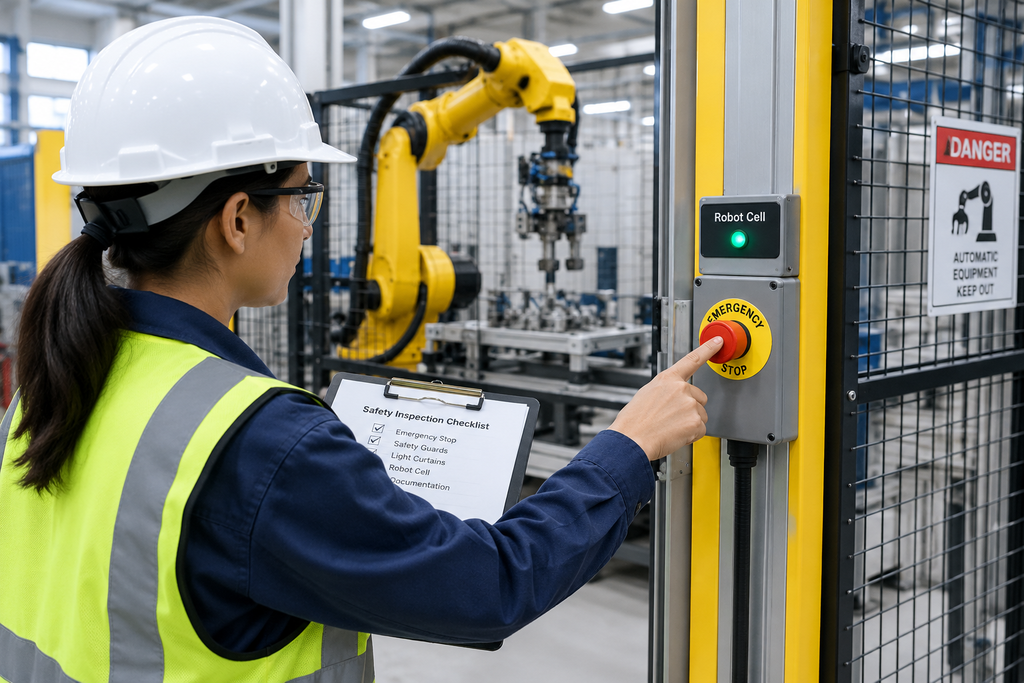
Paper checks are not enough. Before go-live, walk the cell with your safety lead and test it for real.
Try these tests:
- Open each gate during a run. Does the robot stop?
- Press every emergency stop. Does everything stop safely?
- Try to restart after a gate opens. Does it refuse until reset?
- Check that no one can reach the danger zone from any side.
- Test with the cell in manual or teach mode, which is often the riskiest.
- Run a power cut. Does the system fail safe?
Record each result with date, name and signature.
Common Mistakes at Go-Live
- Treating safety as the vendor’s job alone. You own the safety of your plant.
- Skipping the risk assessment because the robot is “certified.” A certified robot in an unsafe cell is still unsafe.
- Forgetting maintenance work. Many injuries happen during setup, cleaning and repair, not normal running.
- Bypassing guards to save time. This is a leading cause of serious injuries. Make bypass impossible, and make it a disciplinary matter.
- Rushing training. A short demo is not training.
- Ignoring changes later. If you move the cell, change the tool or edit the program, review the risk assessment again.
- Ignoring contract workers. Include them in training and rules.
Who Is Responsible for What?
| Role | Main safety job |
|---|---|
| Robot manufacturer | Build a robot that meets safety requirements (ISO 10218-1) |
| System integrator | Design and build a safe cell and application (ISO 10218-2) |
| Plant owner and manager | Provide a safe workplace, train people, keep records, follow the law |
| Operators and maintenance staff | Follow procedures, report faults, never bypass safety devices |
Even if the integrator did the design, the plant still has duties under law.
After Go-Live: Keep It Safe
Safety does not end on day one.
- Schedule regular tests of emergency stops and interlocks.
- Review near misses and fix the cause.
- Audit the cell after any change.
- Refresh training for new staff and contractors.
- Keep records neat and ready for inspection.
Frequently Asked Questions
What is the main safety standard for industrial robots?
ISO 10218 is the main international safety standard for industrial robots. Part 1 covers the robot itself, and Part 2 covers the robot application and cell. The standard was revised in 2025, its first major update since 2011.
Does India have its own robot safety standard?
Yes. The Bureau of Indian Standards publishes IS 14530 (Parts 1 and 2): 2019, based on the 2011 edition of ISO 10218. BIS also lists IS/ISO 10218-1:2025. Check the BIS portal for the latest status of each part.
What is new in ISO 10218:2025?
The 2025 editions clarify functional safety requirements, include collaborative robot rules previously found in ISO/TS 15066, add new robot classifications and add cybersecurity requirements. They are the first major revision since 2011.
Which law covers factory safety in India now?
The Occupational Safety, Health and Working Conditions Code, 2020 came into force on 21 November 2025. It replaced 13 older laws, including the Factories Act, 1948. Existing licences and state factory rules continue during the transition.
Is a risk assessment required before starting a robot cell?
It is the foundation of ISO 10218 and ISO 12100, and a widely accepted safe practice. Confirm legal requirements with your state factory inspectorate. In practice, you should never go live without a written risk assessment covering the whole cell.
Are cobots safe to use without fences?
Not automatically. Cobot safety depends on the full application, including the tool, the part being handled, speed, force and distance from people. A risk assessment must confirm that the setup is safe before you remove fences.
Who is responsible for robot safety, the integrator or the plant?
Both. The integrator designs a safe cell, but the plant owner has legal duties to provide a safe workplace, train workers and maintain records. Treat safety as shared, and get responsibilities in writing.
What tests should be done before go-live?
Test every emergency stop, door interlock and safety sensor. Check restart behaviour, manual and teach modes, and power failure response. Record each test with a date and signature. Re-test after any change to the cell.
How often should robot safety systems be checked?
Set a schedule based on your risk assessment and the manufacturer’s guidance. Many plants test emergency stops and interlocks regularly, and always after maintenance, repairs or changes to the cell. Keep a log of every check.
What happens if I skip safety checks?
You risk worker injury, production loss, legal action and reputational damage. Under the OSH Code, safety duties apply to the employer. Skipping checks is never worth the risk.
The Takeaway
A robot cell is only as good as its safety. The robot may be fast, but the plant must be safe.
Before go-live, confirm your standards, check your legal duties, test every safety device and train every person who will work near the cell.
Planning a robot cell? Talk to us for a free 30-minute pre-go-live safety review. We will help you find gaps before the first production run.
Sources
ISO, ISO 10218-1:2025 Robotics, Safety requirements, Part 1: Industrial robots: iso.org/standard/73933.html
Association for Advancing Automation (A3), Updated ISO 10218: Answers to FAQs: automate.org/robotics/blogs/updated-iso-10218-faq
BIS, IS/ISO 10218-1:2025 listing: services.bis.gov.in (Know Your Standards)
BIS, IS 14530 (Part 1): 2019 and IS 14530 (Part 2): 2019 listings: services.bis.gov.in (Know Your Standards)
Ready to make your factory automation-ready?

Pooja Upadhyay
Director Of People Operations & Client Relations
