


“By 2026, at least 70% of organizations will be mandated to acquire composable DXP technology, as opposed to monolithic DXP suites.”
Introduction
A few years ago, “digital experience platform” mostly meant buying a large suite and living with its limits. In 2026, that mindset feels outdated, especially for teams that need faster releases, cleaner integrations, and room to test AI-led personalization without a painful replatforming cycle.
Composable architecture is reshaping DXPs because it treats experience delivery like a system of building blocks rather than a single locked box.
For content, commerce, analytics, and personalization teams, that change is practical, not theoretical. It means marketers can move faster, developers can work in smaller slices, and businesses can adopt best-in-class services instead of compromising on a bundled suite.

Why composable matters
Composable architecture matters because customer experience no longer lives in one channel or one system. A single DXP has to support content publishing, search, commerce, experimentation, analytics, and AI-driven decisioning across web, mobile, and sometimes in-store experiences.
Traditional suites often struggle when teams want to evolve one layer without disturbing everything else.
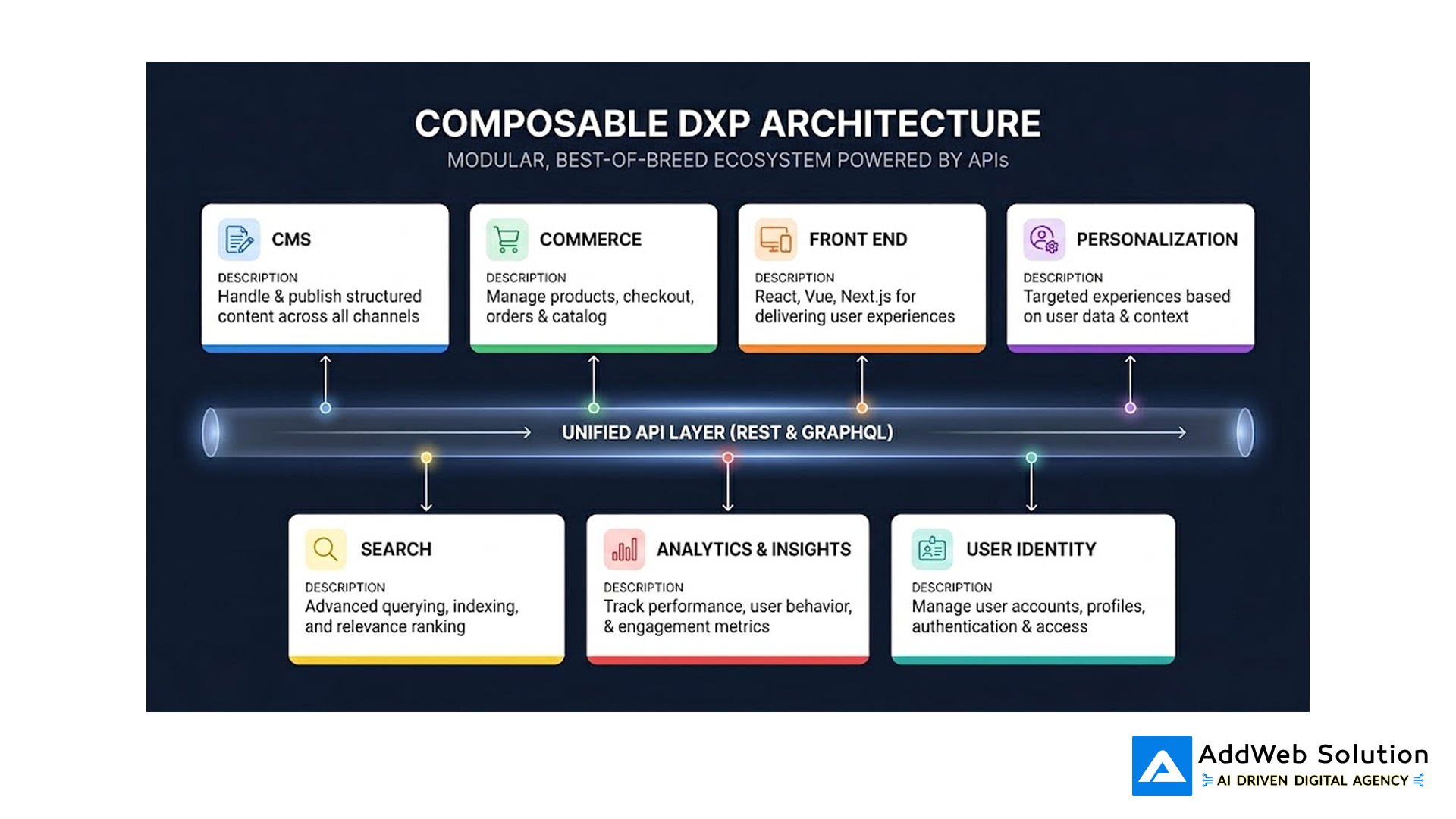
That is where the composable model wins. Instead of buying one giant platform, companies assemble capabilities through APIs and independently deployable services, which lets them replace weak components without waiting for a full vendor roadmap.
Real-world relevance: a retail brand can keep its content platform, swap in a better search engine, and add personalization from a separate service, all while keeping the front end intact. That is the kind of flexibility enterprises want when campaigns, product lines, and customer expectations keep shifting every quarter.
What it includes
A composable DXP usually combines a headless CMS, commerce engine, search layer, personalization service, analytics stack, and front-end framework. The core idea is that each part should be independently useful and connected through APIs rather than hardwired into a monolithic suite.
This also changes team collaboration. Marketers get more freedom to launch content quickly, while developers can focus on reusable components, performance, and integration quality instead of endless suite customizations.
Adoption and market shift
The adoption curve is no longer subtle. Gartner-linked reporting says 70% of organizations will be mandated to acquire composable DXP technology by 2026, up from 50% in 2023. MACH Alliance reporting adds that 91% of organizations increased their MACH infrastructure in the past year, and 61% expect their stack to be MACH by 2026.
Market forecasts also point to sustained growth in the broader DXP space. One report cited by CX Today notes forecasts ranging from about 11.87% to 16.1% CAGR depending on the research source, with market sizes projected into the tens of billions of dollars by 2030 to 2032.
Another 2026 market release says over 45% of new DXP deployments in 2025 already use a composable or headless approach, up from 18% in 2021.


Data table: What the market signals say

Platforms and tools
Not every vendor phrase that says “composable” truly behaves that way. The strongest candidates are typically API-first, cloud-native, and easy to pair with other services without forcing the rest of the stack to conform.
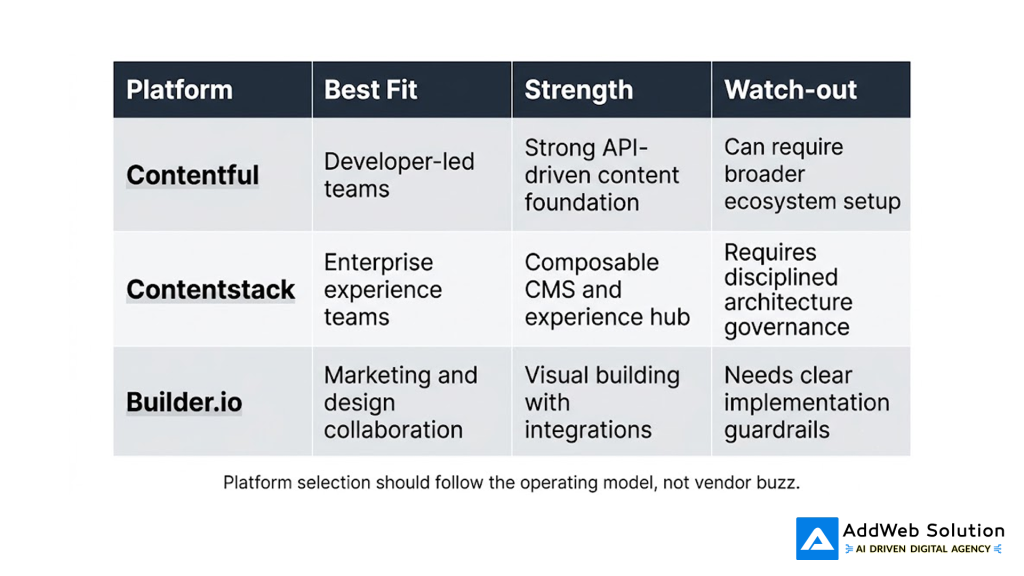
Contentful, Contentstack, and Builder.io are frequently cited as composable-friendly options because they allow teams to separate content operations from presentation and extend capabilities through integrations.
Here is a simple way to think about them. Contentful often works well as a structured content foundation, Contentstack is positioned as a composable experience hub, and Builder.io is useful when business teams need more visual control without losing developer flexibility.
The best choice depends on whether the organization is prioritizing content modeling, workflow governance, or marketer autonomy.

Practical implementation
The smartest implementations start with one business pain point, not a full-stack rewrite. Teams often begin with a headless CMS or a new front-end layer, then connect search, personalization, and commerce in phases as internal confidence rises. That lowers risk and creates visible wins early.
Governance still matters. Composable systems can become messy if every team picks tools independently without shared standards for APIs, content models, identity, observability, and deployment rules. That is why organizations succeeding with composable usually pair flexibility with architecture discipline.
For enterprise leaders, the main evaluation checklist should include:
- API maturity.
- Integration overhead.
- Content workflow fit.
- Security and compliance.
- Change management across business and technical teams.

Interesting facts
- Gartner-linked reporting says the share of organizations mandated toward composable DXP rises from 50% in 2023 to 70% by 2026.
- MACH Alliance research says 91% of organizations increased MACH infrastructure in the past year.
- Over 45% of new DXP deployments in 2025 reportedly used a composable or headless approach, compared with 18% in 2021.

Conclusion
Composable architecture is reshaping digital experience platforms in 2026 because it gives enterprises something monolithic suites rarely do well: controlled change. It lets companies modernize one capability at a time, keep pace with AI-driven experience demands, and avoid locking strategy to a single vendor’s roadmap.
For teams planning the next DXP move, the practical takeaway is simple: start with the business bottleneck, choose modular tools that fit your operating model, and build governance early.
That is the approach we see delivering the best results in real enterprise transformation work, and it is the kind of modernization AddWeb Solution helps teams plan with less risk and more momentum.
Modernize your digital experience without a risky replatform. Talk to AddWeb Solution about designing a composable architecture tailored to your business goals.

Pooja Upadhyay
Director Of People Operations & Client Relations
Source URLs
https://www.mckinsey.com/capabilities/quantumblack/our-insights/the-state-of-aimckinsey
https://www.ibm.com/think/topics/generative-ai-marketingibm
https://www.pewresearch.org/social-trends/2025/02/25/u-s-workers-are-more-worried-than-hopeful-about-future-ai-use-in-the-workpl/pewresearch
