


Author’s Note
One question has followed me throughout my career.
“Why do some clients happily pay higher prices while others negotiate every line item?”
Earlier in my career, I thought the answer was simple.
Some clients had bigger budgets.
Today, I don’t believe that’s the real reason.
I think most pricing conversations begin long before anyone discusses numbers.
They begin with perceived value.
And that’s what this article is about.
Key Takeaways
- Price objections often reveal value communication problems.
- Clients don’t buy hours, they buy outcomes and confidence.
- Strong positioning reduces pricing pressure.
- Trust influences pricing more than many founders realize.
- Agencies that articulate business impact compete less on price.
Introduction
Few conversations make agency founders more uncomfortable than pricing.
You’ve probably heard questions like these.
“Can you do it for less?”
“Another agency quoted a lower price.”
“This seems expensive.”
Earlier in my career, I assumed those conversations were purely about budget.
If we lost the project, I thought we had been too expensive.
Over time, I began noticing something interesting.
The same client who negotiated aggressively with one agency would willingly pay a premium to another.
The market hadn’t changed.
The client’s budget hadn’t magically doubled.
Something else had changed.
The client’s perception of value.
That realization forced me to rethink one of the most common assumptions in agency business.
Maybe clients aren’t questioning the price.
Maybe they’re questioning whether the value is obvious enough to justify it.
1. The Question Every Founder Asks
Almost every agency reaches a point where leadership starts asking the same question.
“Should we reduce our prices to win more business?”
At first glance, it feels like a reasonable discussion.
Lower prices should increase demand.
That’s basic economics.
But agency businesses aren’t selling commodities.
They’re selling judgment.
Creativity.
Problem-solving.
Reliability.
Partnership.
Those things are difficult to compare using price alone.
Yet many agencies accidentally encourage price comparisons by describing themselves exactly like everyone else.
“We build websites.”
“We develop apps.”
“We provide AI solutions.”
When the service sounds identical, buyers naturally compare the only thing left.
Price.
That’s not a pricing problem.
It’s a value communication problem.
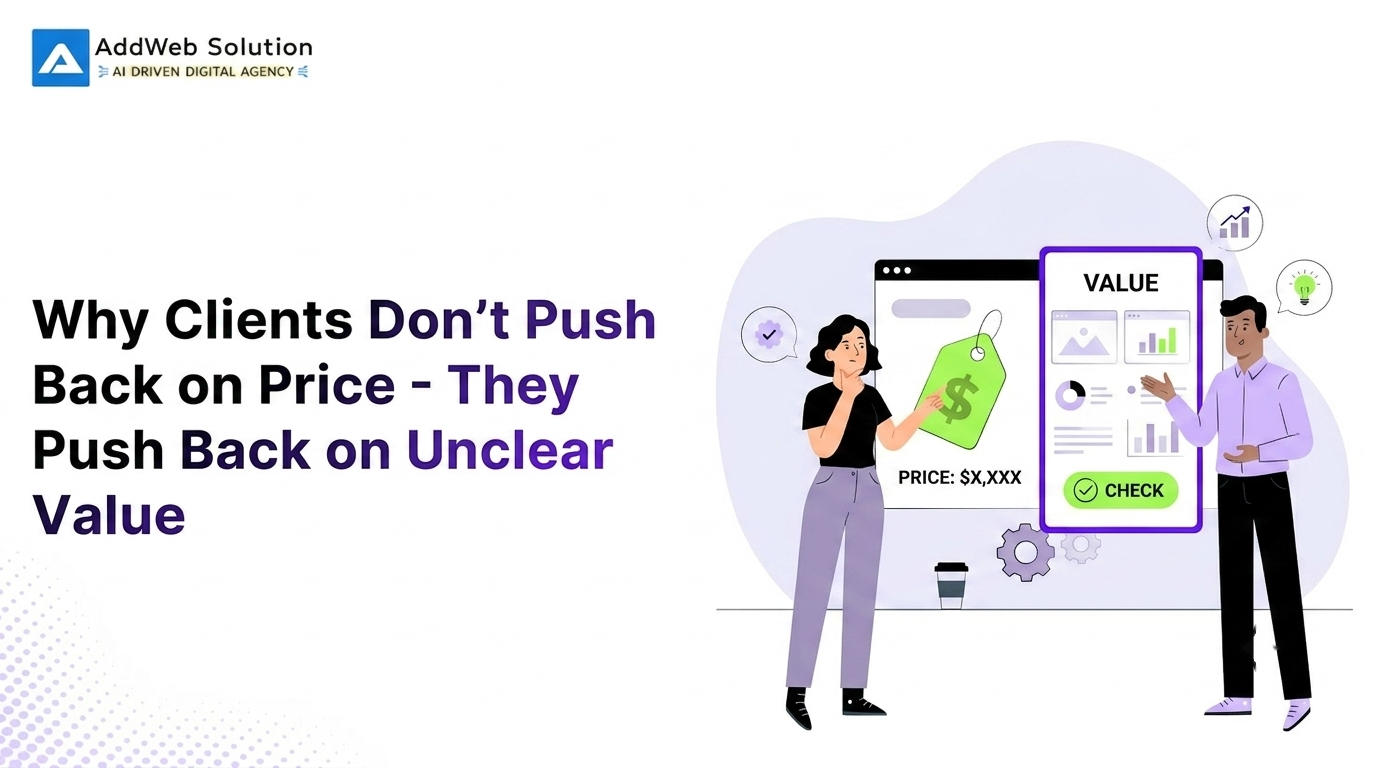
2. Why Price Gets Blamed First
Price is visible.
Value is interpreted.
That’s why price receives so much attention.
It can be measured immediately.
Value often becomes apparent much later.
After implementation.
After improved efficiency.
After revenue growth.
After reduced operational friction.
The challenge for agencies is helping clients understand future value before they experience it.
That’s not easy.
But it is leadership.
Warren Buffett famously said,
“Price is what you pay. Value is what you get.”
I’ve always liked that quote because it reminds us that price and value are connected, but they are not the same thing.
A higher price without value feels expensive.
A higher price with obvious value often feels justified.
That distinction changes the entire conversation.
3. Clients Compare Value, Not Numbers
Imagine two agencies submit proposals.
Both quote $75,000.
One proposal lists features.
Pages.
Hours.
Technologies.
Deliverables.
The other explains business outcomes.
Reduced manual work.
Faster customer onboarding.
Improved conversion rates.
Lower support costs.
The price is identical.
The perceived value is completely different.
Clients rarely celebrate spending money.
They celebrate solving important problems.
That’s why I’ve gradually stopped thinking about proposals as pricing documents.
They’re value documents.
4. The Cost of Selling Services Instead of Outcomes
One of the biggest mindset shifts I’ve experienced is this:
Clients don’t wake up looking for developers.
They don’t wake up looking for Laravel experts.
Or React developers.
Or QA engineers.
They wake up thinking about business problems.
How do we launch faster?
How do we reduce operational costs?
How do we improve customer experience?
How do we increase online revenue?
Technology is rarely the destination.
It’s the vehicle.
Yet many agencies continue selling the vehicle.
“We have certified developers.”
“We’ve completed 500 projects.”
“We work with modern technologies.”
Those statements build credibility.
They don’t necessarily create desire.
Business outcomes do.
I’ve gradually realised that clients don’t buy software because they enjoy buying software.
They buy software because they believe it will improve their business.
That subtle distinction changes the entire sales conversation.
Instead of explaining what you build…
You begin explaining what becomes possible after you’ve built it.
Theodore Levitt famously wrote,
“People don’t want to buy a quarter-inch drill. They want a quarter-inch hole.”
Although he wrote those words decades ago, I think they describe agency businesses remarkably well.
Clients rarely want code.
They want growth.
Efficiency.
Competitive advantage.
Peace of mind.
Technology simply happens to be the path that gets them there.

5. Confidence Is Part of the Product
One lesson took me years to understand.
Clients aren’t only buying deliverables.
They’re buying confidence.
Confidence that deadlines will be managed responsibly.
Confidence that unexpected problems won’t become disasters.
Confidence that someone is thinking beyond the current sprint.
Earlier in my career, I underestimated how valuable confidence really is.
I believed confidence naturally followed delivery.
Today, I think confidence begins much earlier.
It begins during conversations.
When expectations are realistic.
When risks are discussed openly.
When difficult questions receive thoughtful answers instead of optimistic promises.
Over time, I’ve realised something simple.
The agency experience starts long before development begins.
And confidence is part of that experience.
6. The Best Pricing Conversation Happens Before the Proposal
One observation has changed how I think about proposals.
The proposal rarely determines whether a client believes you’re expensive.
That decision usually happens much earlier.
During discovery.
During workshops.
During strategy discussions.
During the questions you ask.
Clients form opinions about value long before they see a number.
If every meeting focuses on features, timelines, and deliverables, the proposal naturally becomes a pricing comparison.
If those conversations focus on business priorities, commercial impact, operational efficiency, and long-term goals, the proposal becomes a business investment.
Those are very different buying experiences.
The proposal simply confirms what the client has already begun believing.
That’s why I’ve come to think the best pricing conversation isn’t about pricing at all.
It’s about understanding value.
David C. Baker, who has advised creative and digital agencies for decades, has often emphasized an idea that resonates deeply with me:
“The more clearly you define your expertise, the less you compete on price.”
I don’t interpret that as a pricing strategy.
I interpret it as a positioning strategy.
When expertise is obvious, price becomes one part of the conversation.
When expertise is unclear, price often becomes the conversation.
7. Value Changes How Clients Make Decisions
Looking back, I’ve noticed something interesting.
The strongest client relationships I’ve experienced weren’t built because we offered the lowest price.
They were built because both sides believed they were making a smart long-term decision.
That belief changes everything.
Projects become partnerships.
Conversations become collaborative.
Recommendations carry greater weight.
Ironically, when value is consistently demonstrated, pricing discussions often become shorter, not because budgets become unlimited, but because uncertainty becomes smaller.
And uncertainty is what buyers naturally try to reduce.
The clearer the value…
…the less energy clients spend questioning the investment.
Statistics
Research consistently shows that buyers prioritize expertise, trust, and business outcomes, not just price.
Edelman’s B2B Thought Leadership Impact Report found that high-quality thought leadership significantly increases buyer confidence, reduces perceived risk, and positively influences purchasing decisions.
Harvard Business Review has repeatedly highlighted that B2B buyers increasingly evaluate vendors based on their ability to solve business problems rather than simply provide products or services.
Source:
https://hbr.org
McKinsey & Company has found that B2B purchasing decisions are influenced by both economic value and the confidence buyers have in a supplier’s ability to deliver business outcomes.
Source:
https://www.mckinsey.com/capabilities/growth-marketing-and-sales/our-insights
A Few Observations
- Agencies that compete primarily on price often struggle to build long-term differentiation.
- The more clearly clients understand business impact, the less they focus on comparing deliverables line by line.
- Strong discovery conversations usually reduce pricing objections later in the sales process.
- Value isn’t created inside the proposal. The proposal simply communicates the value already established.
Frequently Asked Questions
Should agencies stop discussing price?
No
Price should always be discussed transparently.
The goal is to ensure clients understand the value before they evaluate the investment.
Does value-based selling mean charging premium prices?
Not necessarily.
It means aligning pricing with business impact rather than simply estimating effort.
How can smaller agencies compete against larger firms?
By demonstrating a deeper understanding of the client’s business, communicating clearly, and building confidence through expertise and trust.
Is price ever the deciding factor?
Yes.
For some buyers, budget constraints will always matter.
But in many competitive situations, the deciding factor is not the lowest price, it’s the strongest confidence that the investment will produce meaningful results.
A Thought to Leave You With
Clients rarely ask, “Why is this so expensive?”
They’re really asking, “Why is this worth it?”
Those are two completely different conversations.
The first is about price.
The second is about value.
Great agencies don’t spend all their energy defending numbers.
They spend their energy making the outcome so clear that the investment begins to make sense before the proposal is even opened.

Let’s build solutions that communicate business impact – not just technical deliverables.

Pooja Upadhyay
Director Of People Operations & Client Relations
Closing Thoughts
Earlier in my career, I believed pricing conversations were mostly about budgets.
Today, I believe they’re mostly about confidence.
When clients clearly understand the problem you’re solving…
When they trust your judgment…
When they believe your recommendations are aligned with their business goals…
Price still matters.
But it no longer stands alone.
I’ve come to believe that agencies don’t increase pricing power by becoming more persuasive.
They increase pricing power by becoming more valuable and by helping clients recognize that value long before a proposal is presented.
Because in the end, clients aren’t investing in hours.
They’re investing in outcomes.
And the agencies that communicate those outcomes clearly are usually the ones that stop competing on price and start competing on impact.
