


The quickest and safest route for most companies to begin AI development would be through cloud AI solutions, while self-hosted AI becomes compelling when workloads become significant, important, and predictable.
However, cloud vs. self-hosted is not necessarily the correct choice; a combination may be the optimal choice by leveraging cloud-first AI followed by on-premises deployment of important workloads.
Cloud AI vs. Self-Hosted: What We’re Comparing
Cloud AI services
This refers to managed AI services available over the cloud through platforms like AWS, Azure, Google Cloud, or dedicated AI platforms.
The consumption of the models is done through APIs (text, vision, speech, recommendations, etc.), and the vendor handles GPUs, scaling, patches, and even some security aspects for you.
Self-hosted AI solutions
In this case, you deploy and run the models within infrastructure that is under your control (such as in-house data centers or private cloud).
You use either open-source models (Llama, Mistral, etc.) or even licensed models through your own servers.
Where Enterprises Are Actually Running AI Today
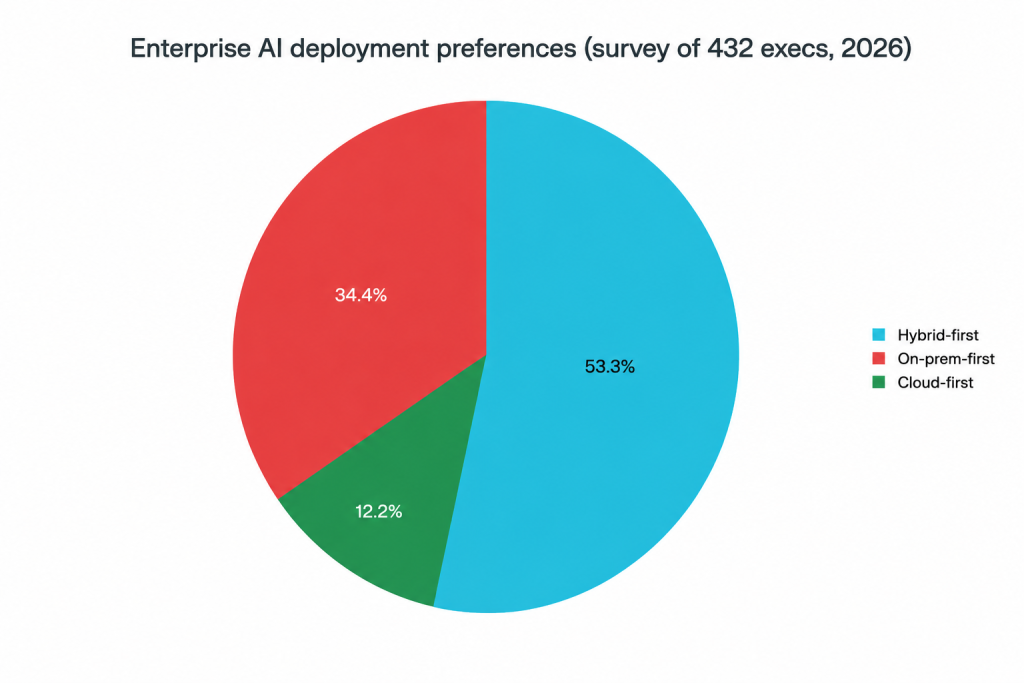
Surveys of enterprise executives conducted recently reveal an evident trend towards a move away from “cloud-only” AI. One survey conducted in 2026 among 432 enterprise executives revealed the following:
- 48% opted for a hybrid-first AI approach (a combination of cloud and on-premise).
- 31% opted for an on-premise first approach to AI workloads.
- Only 11% of those executives still prefer cloud-first.
Security and privacy, regulatory compliance, predictability of costs, and data residency were cited by executives as major determinants when deploying AI solutions over time to deploy or latest cloud AI solutions availability.
Infrastructure-wise, global cloud infrastructure expenditures totaled 399.6 billion USD in 2025, which means that cloud still prevails, although expenditures on on-premise AI infrastructure are growing fast.
Strengths of Cloud AI Services
The Cloud AI tends to be the obvious choice in many cases, due to its minimal friction and maximum speed.
1. Speed to value and experimentation
- The cloud AI can be deployed within days rather than months through the usage of pre-trained models via API rather than training clusters and MLOPs pipelines.
- It is perfect for innovation groups, product experiments, or even multiple smaller AI projects where there are still no clear indications of which use-cases should survive.
2. Access to cutting-edge capabilities
- Cloud vendors deliver state-of-the-art foundation models, embeddings, and dedicated services such as vision, speech, search, and personalization, without any management of the required GPU resources.
- You get constant model updates and performance improvements which are hard to implement internally.
3. Elastic scaling and global reach
- The Cloud AI can scale up or down depending on the need. You pay mostly via OPEX for what you consume.
- Regional and edge capabilities make it possible to serve your users closer to their locations with less latency without building any data centers around the world.
4. Managed security and compliance controls
- Major cloud service providers have enterprise-level IAM, encryption, logging and compliance services (ISO, SOC, HIPAA, GDPR, etc.) that make meeting baseline compliance easier.
- In many cases, the security stance provided by the cloud service provider exceeds what can be maintained by the company itself.
5. Lower upfront cost and simpler ops
- There is no huge cost of purchasing GPUs, network capacity, storage capacity, and the absence of an in-house AI Infrastructure team required for maintaining them.
- It is particularly useful if the workloads are periodic or small in scale.
Strengths of Self-Hosted AI
Self-hosting an AI model is about control, customizability, and economics of scale. It’s more than a “privacy play” since it starts to become strategic once you pass certain usage/sensitivity thresholds.
1. Strong data control and sovereignty
- By having models/data running in your environment, you’ll be able to limit any exposure risks and comply with data residency requirements or sectoral regulations (e.g., finance, healthcare, public sector).
- You will be able to tightly control what is going out of your environment, something important from the perspective of trade secrets, intellectual property, and personal data regulation.
2. Deep customization and domain fit
- Deeply customize models on your data, tune inference workflows, and connect with proprietary solutions in ways that managed cloud APIs won’t allow.
- As a result, you can achieve better accuracy and specialization for your domain, for example, for a specific legal, medical, or industrial application.
3. Cost efficiency at large, predictable scale
- In case of large and consistent (billions of tokens per month) AI workload, multiple independent studies have shown that an on-premises deployment can be significantly cheaper than the cloud API for a 3 to 5-year period.
- One example of the cost analysis for an enterprise handling 10 billion tokens per month showed that TCO on-prem for 3 years was about 1.43M USD vs 3.34M USD using cloud APIs, a 57% cost saving once consistent usage rate is achieved.
4. Performance tuning and latency control
- Processing AI closer to your data (in your data center or edge location) allows you to optimize throughput and latency, select optimal hardware, and build the network architecture.
- You won’t be limited by cloud instance sizes; you’ll build your own GPU clusters and network topology based on your requirements.
5. Offline and edge scenarios
- AI running on-premise can function in air-gapped settings or on the edge where internet connectivity is restricted or regulated, frequent in the military and critical infrastructures.
- This becomes necessary when regulatory or functional considerations prevent data from being sent to cloud endpoints.


Cloud vs. Self-Hosted: Key Trade-Offs in One Snapshot
Business-fit comparison
| Dimension | Cloud AI services | Self-hosted AI solutions |
| Time to first prototype | Days or weeks; minimal infra work. | Months; infra procurement, MLOps, and security setup required. |
| Upfront cost (Capex vs Opex) | Mostly OPEX; pay as you go. | Significant CAPEX for GPUs, storage, networking. |
| Cost at large scale | Can become expensive for sustained, heavy workloads. | Often cheaper if utilization is high and predictable. |
| Security & compliance | Strong baseline controls; shared responsibility. | Maximum control; higher burden to design & maintain. |
| Data residency & sovereignty | Depends on provider regions and controls. | Full control over where data and models live. |
| Customization depth | Limited by API/service design. | Very high; full access to model stack and pipelines. |
| Operational complexity | Lower; provider manages infra. | High; requires skilled infra and MLOps teams. |
| Vendor lock-in risk | Higher; tied to provider’s APIs and ecosystem. | Lower if you rely on open-source models and standard tooling. |
| Ideal for | Early-stage AI, multi-experiment environments, variable demand. | Regulated workloads, high-volume inference, strategic IP-sensitive AI. |
Cost and TCO: When Each Model Wins
Cloud AI tends to be more cost-effective when the workload is smaller and spiky, but less economical beyond specific scale limits.
- In analyses performed on workloads that were heavy on GPUs, the costs of running a high-end 8-GPU server in the on-prem environment (such as one running the H100-class GPU) would come to around 872k USD over five years, compared to more than 4.3M USD for renting the same on-demand in the cloud, producing a difference of more than 3.4M USD.
- According to industry TCO frameworks, on-prem solutions become economically viable once cloud pricing hits 60-70% of the on-prem TCO expectation, with workloads demonstrating consistent utilization.
Cloud is better suited when:
- You need to validate use cases and the workload is uncertain or volatile.
- There is no in-house expertise and you do not want to build an on-prem AI infrastructure team.
On-prem is better suited when:
- Workload utilization is high and consistent (large-scale inference, batch jobs).
- You wish to transition from unpredictable operating expenses to predictable capital expenditures and depreciation, which is preferred by many CFOs for AI projects.
Security, Compliance, and Risk
Security and compliance are now primary drivers of AI deployment decisions, not afterthoughts.
- Cloud-only AI can create blind spots when teams spin up tools without central governance, leading to “shadow AI” where sensitive data leaves official boundaries.
- Self-managed models, if poorly secured, can themselves become blind spots. Palo Alto Networks warns that unmonitored, self-hosted AI pipelines can bypass enterprise security controls and introduce new attack vectors.
Cloud AI security:
- Mature providers offer strong encryption, key management, network isolation, and extensive compliance certifications, which are essential for many organizations.
- However, sending data to third-party endpoints may conflict with strict data residency or sector-specific regulations unless carefully configured.
Self-hosted AI security:
- You can design controls explicitly for your risk profile, including air-gapped environments, custom access policies, and specialized monitoring.
- The flip side: you must invest in expertise and tooling; misconfigured self-hosted AI can be more dangerous than well-governed cloud services.
Performance, Latency, and Scalability
Cloud AI performance:
- Hyperscale clouds provide high-performance GPU clusters and managed services optimized for training and inference, which many enterprises can’t easily replicate.
- Multi-region deployments and CDNs help minimize latency for globally distributed users while maintaining elasticity for variable workloads.
Self-hosted AI performance:
- Placing AI close to your data (inside your data center or edge nodes) can reduce data movement and latency, especially for heavy analytics, streaming data, or industrial systems.
- AI-focused hardware stacks from vendors like HPE and Dell (“AI factories”) are designed for future-proof GPU upgrades and standardized clusters, aligning on-prem with hyperscale cloud advances.
People, Skills, and Operational Overhead
Cloud AI:
- Lets product and data teams focus on use-case design and prompt engineering rather than cluster management, networking, and firmware updates.
- Reduces the need to hire specialized infra roles (GPU cluster engineers, storage architects, etc.), which are expensive and scarce.
Self-hosted AI:
- Requires a mix of skills: infrastructure engineering, Kubernetes/containers, observability, MLOps, security, and compliance.
- Many enterprises move to self-hosting only after they’ve piloted in cloud, validated ROI, and justified building an internal “AI platform” team.
If your current team is heavily weighted toward application and product development rather than infra and operations, cloud is usually the more practical starting point.
When Cloud AI Services Usually Fit Better
You’ll generally favor cloud AI services if:
- You’re early in your AI journey. Your goal is to ship proofs of concept, internal copilots, or customer-facing features quickly without a heavy infra build.
- Your workloads are experimental or variable. Usage will spike around launches, campaigns, or specific initiatives, and you aren’t sure of long-term volume yet.
- You lack strict data residency rules. You can pseudonymize or tokenize sensitive data and rely on provider controls to meet compliance needs.
- Your team is product-centric. You want engineers focused on UX, business logic, and AI experience design, not managing racks and cooling.
Typical examples:
- E-commerce recommendations, marketing content generation, conversational agents for support.
- Analytics copilots and automation inside SaaS platforms such as CRM, ERP, and collaboration tools.
When Self-Hosted AI Is Likely Worth It
You’ll lean toward self-hosted AI if:
- Data sensitivity is extreme. You operate in finance, healthcare, defense, or other sectors where sending certain data to public cloud endpoints is unacceptable.
- Volume is large and predictable. You run sustained, high-throughput AI workloads (e.g., large-scale inference) where on-prem clusters will remain highly utilized.
- Regulation favors sovereignty. You must guarantee that data and models stay within specific borders or infrastructure you fully control.
- You have strong infra/MLOps maturity. Your team can operate clusters, containers, orchestration, and security at scale without compromising reliability.
Typical examples:
- Enterprise-wide LLMs trained on proprietary corpora and deployed behind the firewall for knowledge management and compliance.
- AI products in highly regulated sectors where both regulator and risk teams demand full, demonstrable control over infrastructure and data flows.
Hybrid AI: The Emerging Default
Most enterprises are not choosing only cloud or only on-prem; they’re designing hybrid strategies.
- Survey data shows hybrid-first is now the most common preference (48%), with on-prem-first also rising to 31%, leaving just 11% cloud-first.
- Nutanix’s Enterprise Cloud Index reports that nearly the same percentage of enterprises run containerized apps on-prem/private cloud (52%) as on public cloud (53%), with AI a major driver of this dual approach.
In practice, this looks like:
- Cloud for experimentation, rapid prototyping, and non-sensitive workloads.
- Self-hosted or private cloud environments for sensitive data, heavy inference, and regulated applications.
Visual Decision Framework: How to Choose for Your Business
Below is a simple way to think through your choice, use it as a checklist during strategy workshops.
1. Data sensitivity & regulation
- If you handle highly confidential, regulated data that must not leave your control, self-hosted or private cloud should be the default for core workloads.
- If you can anonymize or tokenize data and rely on provider certifications, cloud AI is acceptable for many use-cases.
2. Workload scale & pattern
- Low/medium, unpredictable usage → start with cloud AI services so you don’t overinvest.
- High, stable usage with clear ROI → assess an on-prem or hybrid TCO; self-hosted may win over 3–5 years.
3. Talent and operational readiness
- Strong product and ML teams but limited infra/MLOps → cloud-first, then gradually add private environments as capabilities grow.
- Established infra teams with containerization and security expertise → self-hosted/hybrid is viable sooner.
4. Strategic control and vendor dependence
- If you want to avoid deep lock-in to a single vendor’s AI ecosystem, emphasize open-source models and portable, containerized deployments, often self-hosted or in neutral clouds.
- If you prioritize speed and ecosystem integration over portability, a managed cloud AI stack is a pragmatic choice.
5. Timeline and business pressure
- If leadership expects AI impact in quarters, not years, start in the cloud, prove value, then shift heavy workloads as needed..
- If you’re designing foundational platforms with multi-year horizons, build a hybrid roadmap from day one, cloud for agility, self-hosted for sovereignty and economics.
How to use this for content and strategy
For your own blog or client-facing content, you can:
- Embed the pie chart on enterprise AI deployment preferences to visually show the dominance of hybrid strategies.
- Use the comparison table as a ready reference for C-suite or IT decision meetings.
- Layer in sector-specific examples (finance, healthcare, SaaS, e-commerce) so readers see themselves in the decision.
If you share your target audience (e.g., SaaS founders vs. CIOs vs. product leaders), I can help tailor this into a more narrative, conversion-focused piece while preserving the technical depth and visual structure.
Not sure whether cloud, self-hosted, or hybrid AI is right for your business?

Pooja Upadhyay
Director Of People Operations & Client Relations
Source URLs:
https://www.oracle.com/in/artificial-intelligence/ai-cloud-computing/
https://www.wwt.com/article/the-cloud-advantage-for-ai
https://www.nutanix.com/enterprise-cloud-index
