


“Drupal empowers content governance in numerous ways: flexible role management and built-in workflows.”
Large digital ecosystems get messy fast: more teams, more content, more approvals, more integrations, more risk. Drupal stands out because it turns that sprawl into a governed operating model, which is exactly why it keeps showing up in government, higher education, and enterprise environments where security and scale cannot be “good enough”
Introduction
If you have ever watched a website program grow from a handful of pages into a multi-brand, multi-region, multi-team operation, you know the pain points: inconsistent publishing, duplicated workflows, fragile integrations, and constant pressure from security and compliance. Drupal helps by giving organizations a structured way to manage content, permissions, workflows, and custom functionality without constantly rewriting the core platform.
What makes that valuable now is the modern digital reality: teams are expected to ship faster while handling more channels, tighter governance, and higher expectations from users and regulators. Drupal’s modular architecture and governance features are built for exactly that kind of environment.
Why Drupal Fits
Drupal is not trying to be the flashiest CMS on the market. It is designed to be the one you can rely on when the site is no longer “just a site” but a digital platform with many moving parts.
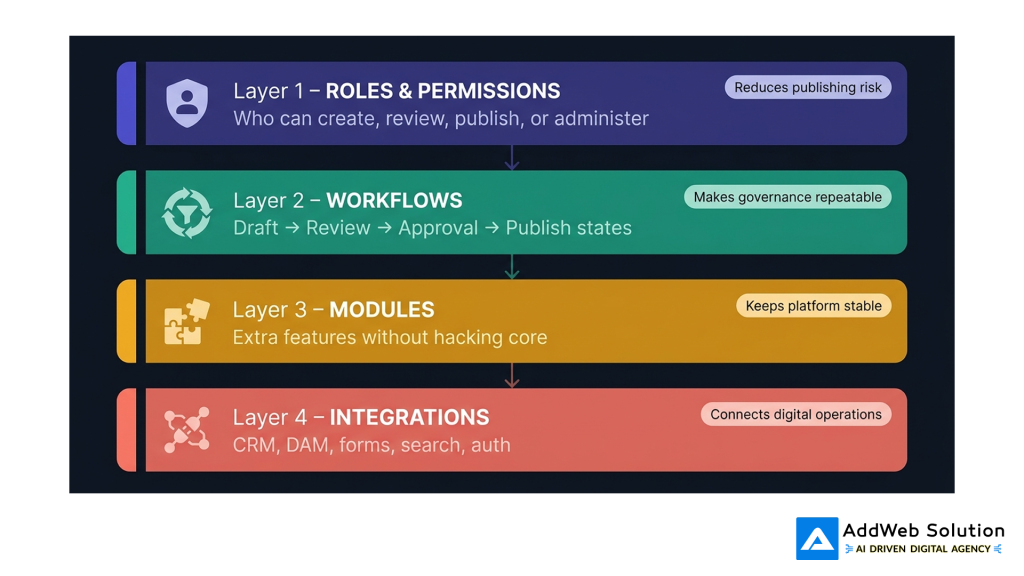
Its modular approach lets teams add functionality through modules rather than altering the core, which supports stability and easier upgrades over time. That matters in large organizations because every custom workaround eventually becomes technical debt.
Visual: Drupal’s control model
Alt text: Diagram showing how Drupal organizes content, roles, workflows, modules, and integrations into one governed operating layer.Caption: Drupal’s strength is not one feature; it is the way governance, extensibility, and integrations work together.
The Operating-Model Advantage
In large organizations, the real value of Drupal is control. Content governance is easier because permissions can be layered by role, review cycles can be built into the publishing process, and teams can maintain accountability through audit-friendly structures.
That is why government and public-sector teams often choose Drupal for high-stakes websites. Drupal is used by more than 150 national government websites, and Acquia notes that 56% of the world’s government websites used Drupal as of 2021. Those are not vanity metrics; they are signals that the platform handles strict oversight, multilingual needs, and service delivery at scale.
Visual: Where Drupal is strongest
Alt text: Pie chart concept showing Drupal’s strongest fit across government, enterprise, higher education, and regulated industries.
- Government and public services: 40%.
- Large enterprise portals: 25%.
- Higher education and research: 20%.
- Nonprofits and associations: 15%.
Caption: Drupal tends to win where content governance, compliance, and scale matter more than template simplicity.


Tools And Trends
Drupal’s flexible architecture is a major reason it supports large-scale operations so well. Modules let teams extend functionality without changing core code, which keeps systems easier to maintain and upgrade.
Here is a simple comparison of how Drupal differs from lighter CMS setups in operational environments.

Growth And Adoption
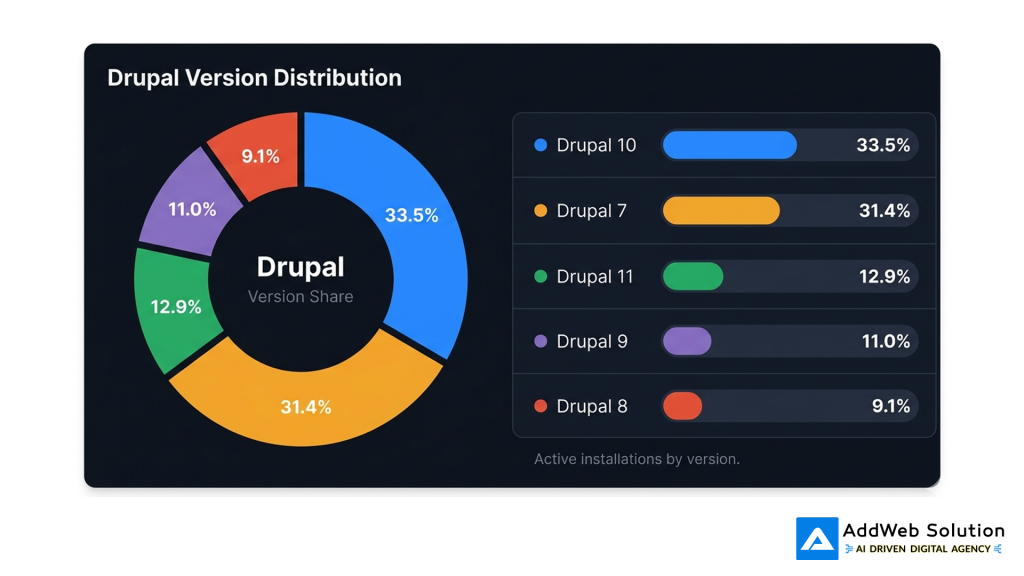
Drupal’s overall web share is smaller than WordPress, but that does not tell the whole story. W3Techs reports that Drupal powers 1.0% of websites whose CMS is known and 0.7% of all websites as of 1 April 2026, while version 10 accounts for 33.5% of Drupal sites and version 11 for 12.9%.
That version mix matters because it shows active modernization inside the ecosystem. It also suggests organizations are moving toward newer, supported releases rather than treating Drupal as legacy software.
Visual: Drupal version distribution
Alt text: Bar chart showing Drupal version usage, led by Drupal 10, Drupal 7, Drupal 11, Drupal 9, and Drupal 8.
What This Means In Practice
I have seen teams outgrow “easy” CMS platforms because easy becomes brittle once the organization has five editors, then fifty, then five hundred. Drupal is different because it is built for governance first and flexibility second, and that combination is what keeps large programs from becoming operational chaos.
A practical example: a government portal can route content from writer to reviewer to approver, enforce permissions by role, keep an audit trail, and connect to identity or content systems without rebuilding the site every time a department changes. That is not just CMS functionality; it is digital operations management.
Conclusion
Drupal simplifies large-scale digital operations by making them governable. When content, access, integrations, and publishing rules all need to work together, Drupal gives teams a system they can actually manage instead of a platform they have to fight.
For organizations planning a complex migration, a multi-site rollout, or a higher-compliance digital program, that difference is often the whole ballgame. At AddWeb Solution, we have seen how the right Drupal architecture can turn digital complexity into something teams can run with confidence.
Revolutionize your content management with Drupal 10

Pooja Upadhyay
Director Of People Operations & Client Relations
Source URLs
- https://w3techs.com/technologies/details/cm-drupal
- https://www.drupal.org/documentation
- https://www.drupal.org/docs/develop
- https://new.drupal.org/industries/government
- https://www.acquia.com/blog/drupal-for-government
- https://pantheon.io/learning-center/drupal/government
- https://www.credera.com/en-gb/insights/how-drupal-helps-governments-transform-their-website-experience
