


There’s a trend I’ve been noticing with store owners lately. They spend thousands on Google ads, get a decent chunk of traffic, watch conversions trickle in, then watch their CAC climb month after month. By month four, they’re burned out on paid channels and wondering if their products are even worth selling.
But here’s the thing: they’re measuring success against the wrong baseline.
The stores that are actually thriving right now aren’t doing it through paid traffic alone. They’re the ones who cracked the code on organic search. And I’m not talking about some expensive SEO agency or some secret ranking hack. I’m talking about fundamentals that have always worked—just executed with more intention than your competitors are willing to invest.
Let me show you the numbers, because they’re actually wild.
The Actual Math Behind Organic vs. Everything Else
Organic search drives 23.6% of all e-commerce orders. Not clicks. Not impressions. Actual revenue-generating transactions. And it accounts for 43-50% of all website traffic going into e-commerce stores.
Now compare that to paid social, which pulls in something like 1% conversion rates. Paid ads aren’t bad—they’re useful for scaling fast. But they’re not your baseline. Organic is. And most Shopify stores aren’t investing time there.
Here’s where it gets interesting for your wallet: organic traffic converts at 2.8%. Paid social? Usually 0.8-1.2%. That’s roughly 3x better conversion rates for organic. Same products. Same store. Different traffic source.
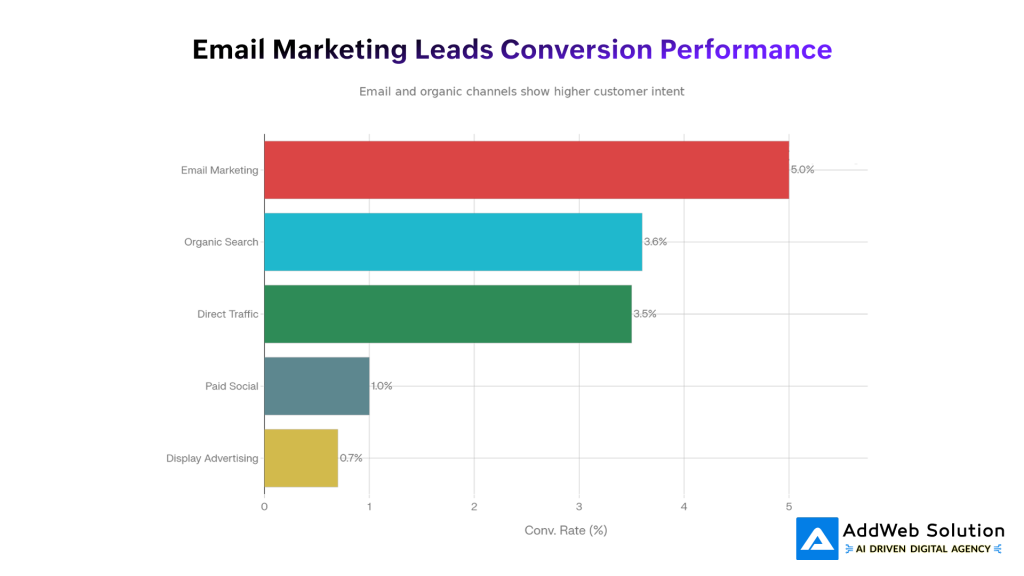
So if you’re doing 10,000 visits monthly from ads at 1% conversion, that’s 100 sales. Meanwhile, a store with 5,000 organic visits at 2.8% conversion is hitting 140 sales with half the traffic. They’re not spending on ads anymore. They’re growing for basically nothing—just compounding month after month.
This is exactly what happened with an outdoor equipment brand we looked at. They went from almost invisible to landing 3,403% more keyword rankings in just 9 months. Not through ads. Through smart, structured SEO. Same products they had before. Different visibility.
The Three Layers That Actually Drive Rankings
I’ve been tracking what’s working with Shopify stores in early 2026, and there’s a pattern. The stores that rank aren’t doing anything secret. They’re just nailing three specific areas:
1. Technical Foundation (Speed, Mobile, Structure)
A customer lands on your product page. It takes 3 seconds to load. One-second delay costs you 7% of conversions. Most Shopify stores don’t even know their load times.
We looked at a flooring store that redesigned for speed and mobile usability. Result? +448% traffic growth in six months. That’s not from new content. That’s from making the site actually work on phones.
Here’s what kills Shopify store speed: too many apps. Each app adds code. Most stores have 15+ apps running. Cut it down to the essentials. Then compress your product images before uploading (50-150KB per image, not 4MB). Run a PageSpeed audit. If your LCP (Largest Contentful Paint) is over 2.5 seconds, that’s your first project. This week. Not next month.

2. Content Built for Actual Buyer Intent (Not Just Volume)
Here’s what kills most stores: they copy product descriptions from their supplier. Google sees duplicate content, ranks it lower, and moves on.
The stores that rank? They write original descriptions that answer the specific questions their customers are asking. Not “moisture-wicking fabric.” But “this specific fabric keeps you dry during HIIT workouts without that clingy feel. We tested it for six weeks in our studio, and here’s what we noticed…”
That sounds oddly specific. It is. And it works because it actually answers what someone searching for is wondering.
A fashion store increased traffic by 100% by focusing on this—optimized product copy, support content like buyer’s guides, and targeted blog posts. Same products they had before.
The structure matters too. Think of your site like a hierarchy: Homepage → Category → Product. Google understands this structure. It ranks you for it. Then layer in internal linking between related products and content. A fashion store that improved internal linking started ranking for hundreds of new keyword variations.
3. Authority That Actually Matters (Backlinks + Schema)
Seventy-three percent of top-ranking pages use schema markup. Not 30%. Not 50%. Seventy-three percent.
Schema is technical but not complicated. It’s basically telling Google what your product is—its price, if it’s in stock, customer reviews, everything. Shopify adds basic schema automatically, but verify it’s correct using Google’s Rich Results Test. Then layer in apps if needed.
On backlinks: they matter, but context matters more. A link from a health blog to a juicer brand signals more authority than 10 links from random directories. Hurom, a juicer brand, went from low visibility to +847% shopping growth specifically because they targeted backlinks from lifestyle and health publications. Their audience trusted those sources, so Google did too.
Additional
Read

Real Examples: This Isn’t Theory
Let me walk through what actually worked for real stores, because data is more useful than advice.
Hurom (Juicer Brand): From Invisible to Dominant
Hurom sells premium juicers. Their market is competitive—lots of established players. Their strategy was surgical:
- Built content hubs around topics people actually search for (juicing benefits, recipes, health content)
- Acquired backlinks from health and lifestyle publications (not random SEO directories)
- Optimized product and category pages for non-branded keywords
Result: +160% increase in non-branded clicks, +847% spike in shopping traffic, 1,300+ keywords in featured snippets. They didn’t launch a new product line. They just showed up where people were already searching.
Outdoor Equipment Brand: +3,403% Keyword Growth
This niche brand was getting essentially zero traffic. Their products were solid, but nobody could find them. They fixed content—rewrote pages to match what people actually searched for, used internal linking to create topic clusters, and filled content gaps.
Within 9 months: +3,403% increase in keyword rankings. That’s a massive shift, and it all came from doing the basic work properly.
Flooring Company: Local + E-commerce Combined
This brand had brick-and-mortar locations and an online store. Their website was slow and outdated. They redesigned for speed, optimized Google Business Profiles for local search, created location-specific content (buying guides, installation tips), and built links from local and industry sites.
Six months later: +448% traffic growth. Faster site + proper local SEO + e-commerce fundamentals = compounding growth.
The AI Opportunity Everyone’s Missing
Okay, AI gets overhyped. But there’s one specific use case that’s genuinely moving conversion rates: instant answers to product questions.
A customer lands on your product page. They wonder: “Does this fit oversized?” “What’s the difference between this and the pro version?” Most stores make them dig through FAQ or send an email. That’s friction. They leave without buying.
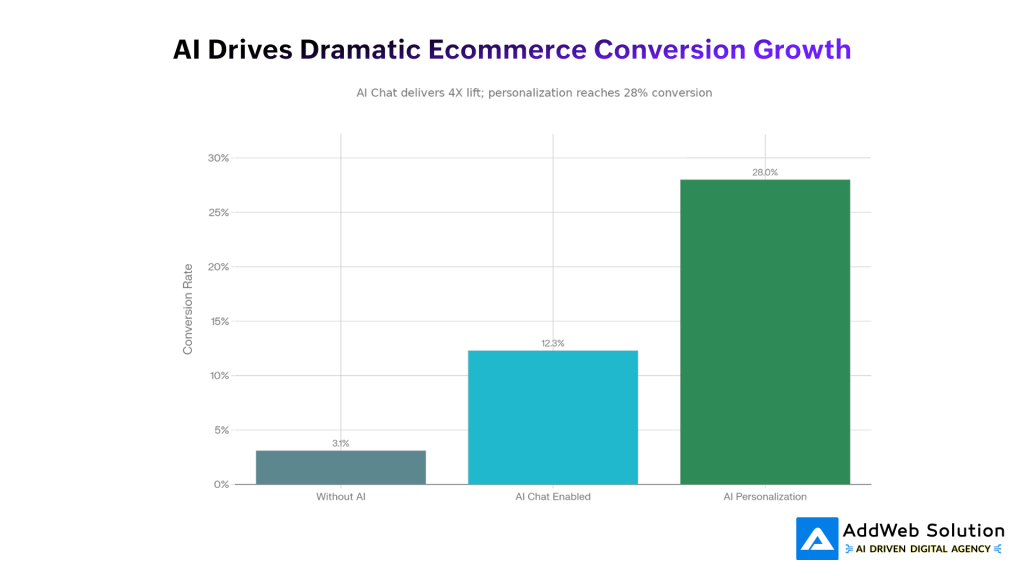
Stores using AI chatbots see 12.3% conversion rates. Without chatbots? 3.1%. That’s 4x better from a single change.
The best part is it’s not complicated. Install Gorgias, Drift, or any similar app. Train it on your FAQ and product specs. It handles 80% of questions. The other 20% go to a human. You’ve removed the biggest reason people bounce without buying.
Returning customers using AI recommendations spend 25% more than those who don’t. It’s not magic. It provides faster answers when needed.
The Shopify Reality Check
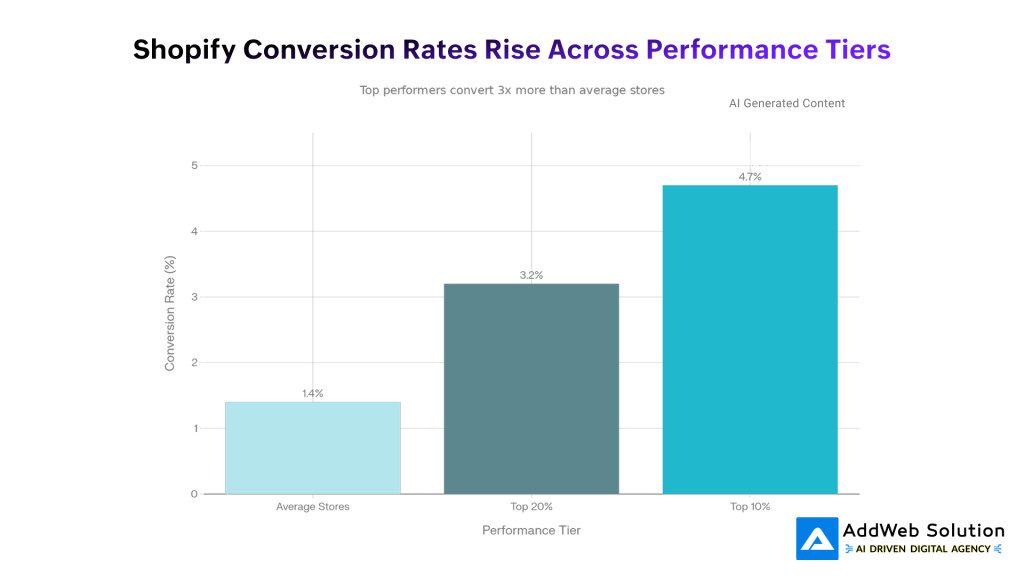
Let me be honest: Shopify’s success rate is only 5-10%. That means 90% of stores don’t make money. But that’s not a Shopify problem. It’s an execution problem. Stores that fail usually have:
- No clear strategy for who they’re selling to
- Heavy reliance on paid ads (and not enough on organic)
- Slow, unoptimized sites
- Copied product descriptions
- No link building or authority work
The 5-10% that succeed are doing the opposite. They’re building organic traffic that compounds. They’re optimizing for conversions, not just clicks. They’re investing in content that actually answers customer questions.
Interestingly, when a store gets those fundamentals right, organic ROI is something like $22 for every $1 invested. Compare that to paid channels where ROI shrinks constantly.
What You Should Implement This Week
Stop planning. Start executing.
Run a speed audit. Go to Google PageSpeed Insights. Test your store on mobile. If LCP is above 2.5 seconds, delete unnecessary apps and compress images. That’s it. One week of work, measurable impact.
Audit your product descriptions. Pick your top 10 sellers. Rewrite them. Answer specific customer concerns, not generic specs. Make them unique to your store. Copy-paste descriptions from manufacturers are dragging you down.
Add schema markup. Use Google’s Rich Results Test to check your product pages. If basic schema isn’t there, install an app to add it. This is foundational for both traditional SEO and AI-powered search.
Test AI chat. Pick an app (Gorgias is popular). Set it up to answer your five most common product questions. Configure it in two hours. You’ll see conversion differences within a month.
Start a backlink list. Write down 20 websites in your niche or adjacent spaces that your ideal customer reads. Reach out to five of them with an authentic pitch (guest post, product review, resource list). Quality over quantity. One good link beats 10 random ones.
That’s genuinely it. Not sexy. Not quick. But it works.

Contact us for AI-based Shopify store development

Pooja Upadhyay
Director Of People Operations & Client Relations
Sources
Backlinko – 36 Up-To-Date Ecommerce Statistics for 2026
Ruler Analytics – Average Conversion Rate by Industry and Marketing Channel
OptinMonster – 2026 Online Shopping Statistics
CleverTap – Average Website Conversion Rate: Benchmarks By Industry
