


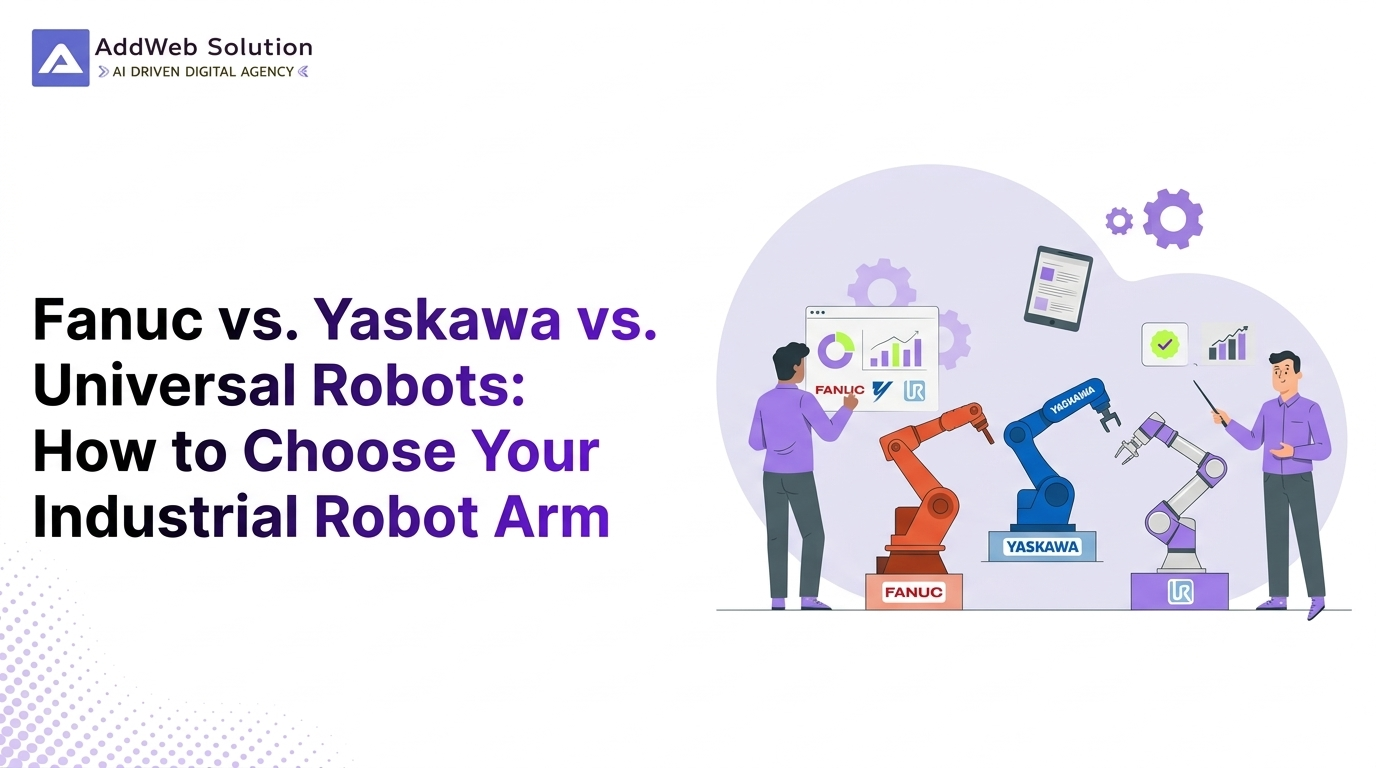
Three famous names. One robot arm to buy. And a salesperson from each brand telling you theirs is the best.
If that sounds familiar, you are not alone. Choosing a robot arm is one of the biggest buying decisions a plant makes, and a wrong pick can cost years of pain.
The market is huge and growing. The International Federation of Robotics (IFR) reports that 542,000 industrial robots were installed worldwide in 2024, more than double the number from ten years earlier.
So which brand should you trust? The honest answer is that there is no single winner. There is only the best fit for your job, your floor and your team.
This guide compares Fanuc, Yaskawa and Universal Robots in plain words. By the end, you will know what to ask, what to avoid, and how to build a smart shortlist.
Quick answer: Choose Universal Robots if you want an easy-to-program cobot that works near people. Choose Fanuc or Yaskawa if you need a wider range, including fast, heavy-duty robots, plus cobots. Always match the robot to your payload, reach, speed, safety and support needs, not to a brand name.
First, a Quick Question: Cobot or Classic Robot?
Before comparing brands, decide what type of arm you need.
A cobot (collaborative robot) is built to work close to people. With a proper safety check, it may not need a fence.
A classic industrial robot is built for speed and strength. It usually works inside a safety cell, away from people.
Here is where the three brands differ:
- Universal Robots makes cobots only.
- Fanuc makes cobots and a very wide range of classic robots.
- Yaskawa (Motoman) also makes both.
So your first choice often narrows the list.
Meet the Three Contenders
Universal Robots: The Easy Starter
Universal Robots (UR) is a Danish company that helped launch the cobot category. UR says it has sold more than 90,000 cobots worldwide.
Its lineup is simple. Payloads run from 3 kg to 30 kg:
- UR3e: 3 kg payload, 500 mm reach
- UR5e: 5 kg payload, 850 mm reach
- UR10e: 12.5 kg payload, 1,300 mm reach
- UR16e: 16 kg payload, 900 mm reach
- UR20: 20 kg payload, 1,750 mm reach
- UR30: 30 kg payload, 1,300 mm reach
Strengths: UR programs its cobots with its PolyScope software, and the company offers free online training through UR Academy. It also runs the UR+ ecosystem, which UR says now has over 500 products such as grippers, vision systems and software.
Watch out for: Cobots are not built for the highest speeds or the heaviest loads. If you need to move very heavy parts very fast, a classic robot may fit better.


Fanuc: The Wide Range Giant
Fanuc is a Japanese company with a huge catalogue. Its robots range from small, tabletop arms to giants that handle loads of up to 2,300 kg.
Its collaborative CR and CRX series cover payloads from about 3 kg to 50 kg. Fanuc says its CRX cobots are designed to help small and midsize businesses adopt automation. Users can teach points by hand guidance or with a tablet using drag-and-drop icons.
Fanuc’s popular LR Mate series of compact robots has more than 70,000 units installed globally.
Strengths: One brand can cover small cobots and big industrial robots. Fanuc also offers integrated vision, such as its iRVision sensors, for robot guidance and inspection.
Watch out for: The huge range can feel confusing. Compare model names and datasheets carefully, and ask your supplier to explain the differences in simple terms.
Yaskawa Motoman: The Reliable Workhorse
Yaskawa is another Japanese leader. Its Motoman robots come with payloads from 0.5 kg to 900 kg, and the company says over 500,000 Motoman robots are installed globally.
Its HC series cobots handle 10 kg, 20 kg and 30 kg payloads. Some models allow direct teaching by hand, without a pendant, and meet the IP67 rating for damp or splash-prone places.
Its GP series of fast handling robots offers payloads of 7, 8, 12 and 25 kg, also with IP67 protection.
Strengths: Strong range for welding, palletizing, handling and assembly. Fast, tough robots with a long track record.
Watch out for: Cobot options are fewer than the classic range, so check that the exact model matches your payload and reach.
Side by Side: The Simple Comparison
| Universal Robots | Fanuc | Yaskawa Motoman | |
|---|---|---|---|
| Home country | Denmark | Japan | Japan |
| Best known for | Easy-to-use cobots | Very wide robot range | Strong all-round range |
| Cobots | Yes (only cobots) | Yes (CR and CRX) | Yes (HC series) |
| Classic robots | No | Yes | Yes |
| Typical payload span | 3 to 30 kg | Under 5 kg up to 2,300 kg | 0.5 to 900 kg |
| Teaching style | PolyScope software | Hand guiding or tablet (CRX), teach pendant | Direct teach on some cobots, pendant |
| Add-on ecosystem | UR+ (500+ products) | Own vision and software | Own controllers and software |
Please note that payload and reach figures come from press releases and product pages. Always check the latest datasheet for the exact model before you buy.
The 7 Questions That Choose Your Robot
Skip the brand debate. Answer these seven questions first.
- How heavy is the load? Add the part weight and the gripper weight. Then add a safety margin.
- How far must it reach? Draw the real workspace. Do not guess.
- How fast must it go? Check your cycle time target for each part.
- Will people work close by? If yes, a cobot may fit. Do a proper risk assessment.
- What is the environment? Dust, water, heat and oil call for the right protection rating, such as IP67.
- Who will program it? Pick a system your own team can learn and manage.
- Who will support it? Check local service, spare parts and trained integrators near you.
Answer these honestly, and the shortlist often builds itself.
Match the Robot to the Job
All three brands offer models for common tasks. Here is a simple guide:
- Machine tending: All three can do it. UR says its UR10e is used for machine tending, palletizing and welding. Fanuc and Yaskawa also list it as a core use.
- Palletizing: UR30, Fanuc CRX models and Yaskawa’s HC30PL (30 kg) are made for this.
- Welding: Fanuc ARC Mate and Yaskawa AR series are built for arc welding. Cobot welding is possible too, in lighter jobs.
- Assembly and screwdriving: Small cobots such as the UR3e and UR5e suit light, precise work.
- High-speed handling: Fast robots like Yaskawa’s GP series or Fanuc’s M-series are better choices.
- Inspection with AI vision: Pick an arm that works well with your chosen camera and software. UR+ and Fanuc’s vision options are worth a look.
Think Total Cost, Not Sticker Price
A cheap arm can become expensive fast. The arm is only one part of the bill.
Add up these costs:
- The robot arm and controller
- Gripper, camera and tools
- Safety fencing, scanners and guarding
- Integration and programming
- Training for your team
- Spare parts and yearly service
Then use this simple check:
Payback in months = total upfront cost ÷ monthly net benefit
If the numbers do not work for one brand, they will not work for another. Compare total cost, not just price.
Image slot (add here): a Fanuc, Yaskawa or UR robot from your own installation. Alt text: “Industrial robot arm installed in a production cell.”
Mistakes That Cost Plants Money
- Buying a brand name instead of job needs
- Forgetting the gripper weight in the payload
- Choosing a cobot for a job that needs high speed
- Skipping a safety risk assessment
- Ignoring local support and spare parts
- Not testing the robot on your own parts first
A Simple Decision Guide
- Small payload, easy start, people nearby: shortlist UR and Fanuc CRX, then check Yaskawa HC.
- Heavy loads and high speed: shortlist Fanuc and Yaskawa classic robots.
- Mixed needs on one site: a brand with both cobots and classic robots may simplify training and spares.
- Welding or palletizing at scale: compare the dedicated models from all three, plus integrator experience.
Need help choosing between robot brands?

Pooja Upadhyay
Director Of People Operations & Client Relations
Your Questions, Answered (FAQ)
Which is better: Fanuc, Yaskawa or Universal Robots?
None is best for everyone. Universal Robots is known for easy cobots. Fanuc and Yaskawa offer both cobots and fast, heavy-duty robots. Choose by payload, reach, speed, safety and support.
What is the difference between a cobot and an industrial robot?
A cobot is built to work safely near people, often without a fence after a risk assessment. A classic industrial robot is built for speed and strength and usually works inside a safety cell.
Which robot arm is easiest to program?
Cobots are usually the easiest. Universal Robots uses PolyScope software, Fanuc CRX offers hand guiding and tablet programming, and some Yaskawa cobots allow direct teaching by hand.
Which brand has the highest payload?
Fanuc lists robots up to 2,300 kg and Yaskawa up to 900 kg. Universal Robots tops out at 30 kg, since it makes cobots only.
How much does an industrial robot arm cost?
Prices vary by model, payload, accessories and country, so we do not quote a number. Ask for a full quote that includes the gripper, safety, setup and training.
Do I need a safety fence?
It depends on your risk assessment. Yaskawa notes that its HC cobots can work without a safety fence depending on the risk assessment. Classic robots usually need guarding.
How do I choose the right payload?
Add the part weight and the gripper weight, then leave a safety margin. Always check the datasheet for the exact model.
Can small businesses use Fanuc, Yaskawa or UR robots?
Yes. Fanuc says its CRX cobots are designed to help small and midsize enterprises. UR and Yaskawa also offer smaller cobots. Start with one task and test first.
The Bottom Line
The best robot arm is not the one with the biggest name. It is the one that fits your load, your space, your people and your budget.
Write down your seven answers. Shortlist two or three models. Ask for a test on your own parts.
Then let the results, and not the brochure, make the call.
\
References
- Global robot installations (542,000 in 2024): IFR press release
- UR model payloads and reach: DirectIndustry, Universal Robots listing
- UR sales, PolyScope and ecosystem: Global Industrie, Universal Robots profile
- UR+ ecosystem (500+ products): Universal Robots news
- UR Academy free training: Automate.org, UR 10-year release
