


The backdrop: two waves colliding
Flutter and AI app builders represent two very different ways of shipping software:
- Flutter is a Google-backed, open‑source UI framework for building iOS, Android, web, desktop, and more from a single codebase using Dart.
- AI app builders sit on top of the no‑code/low‑code wave, promising production apps generated from natural‑language prompts and edited visually in the browser.
Meanwhile, the no‑code/low‑code market has exploded: recent estimates put no‑code development platforms around 35–36 billion USD in 2025, with forecasts ranging from roughly 100 to 165 billion by 2030–2031. Analysts expect this growth to be driven largely by “citizen developers” in business teams who build apps without formal programming backgrounds.
So yes, there is real momentum behind tools that make coding “optional” for many use cases—but it comes with sharp trade‑offs.
Quick snapshot: Flutter vs AI app builders
High-level comparison table
| Dimension | Flutter (coding) | AI app builders (no-code/AI) | Best suited for |
| Who it’s for | Professional dev teams, strong tech founders | Non‑technical founders, product managers, operations teams | Depends on in‑house skills and ambition |
| Platforms | iOS, Android, web, Windows, macOS, Linux from one codebase. | Typically web and mobile; some support native apps and app store publishing. | Multi‑platform reach vs. speed of launch |
| Performance | Near‑native performance, custom rendering engine, fine‑grained control. | Good enough for many CRUD and workflow apps; less control over internals. | High‑performance UX vs. “good enough” business apps |
| Speed to MVP | Fast once a team is fluent, but still real engineering effort | Very fast from idea to working prototype via AI prompts and visual editing. | Idea validation and internal tools |
| Customization depth | Essentially unlimited; you own the code | Constrained by platform’s components, plugins, and policies. | Product‑grade differentiation vs. standard patterns |
| Integrations | Anything with an API/SDK; can write connectors and native plugins. | Increasingly rich catalog of integrations, but limited to what the vendor exposes. | Complex system integration vs. quick SaaS automation |
| Vendor lock‑in | Codebase is portable, though rewriting for another stack is still work | High lock‑in; logic and data models are tied to the platform. | Short experiments vs. long‑term strategic products |
| Governance & compliance | Full control over architecture, security, and deployment model | Compliance posture depends heavily on the vendor and plan. | Heavily regulated industries vs. light‑weight SaaS |
What Flutter actually brings to the table
Flutter started life as a cross‑platform mobile framework, but now targets iOS, Android, web, Windows, macOS, and Linux from a single Dart codebase. It ships its own rendering engine and draws every pixel itself, which lets teams deliver consistent UIs across platforms and fine‑tune performance in ways many traditional cross‑platform stacks cannot.
A few characteristics stand out:
- Native‑feel performance – The rendering engine and compiled Dart code allow smooth animations, high FPS, and tight control over UI behavior.
- Single UI codebase – Teams can share not just business logic but also UI across platforms while still having the option to customize per platform when needed.
- Developer experience – “Hot reload” and strong tooling shorten the feedback loop, which matters a lot when building complex UIs or iterating rapidly.
In short, Flutter is real software engineering: you get power and precision, but you pay for it in developer time and required skill.
What AI app builders and no‑code AI platforms really are
Modern AI app builders combine three layers:
- A no‑code visual editor (screens, components, workflows).
- A managed backend (database, auth, hosting, deployments).
- An AI “co‑pilot” that can generate data models, flows, and full apps from text prompts.
Platforms like Bubble describe themselves as fully visual AI app builders where you can generate an app from a prompt, then refine the UI, logic, and data visually, with millions of users having already built millions of apps on the platform. Adalo similarly markets an AI builder (“Ada”) that generates complete multi‑screen apps—including database, navigation, and components—from a natural‑language description, ready to publish to iOS, Android, and web without writing code.
Across the category, common patterns include:
- Prompt‑to‑app – Type “I want a marketplace for local tutors with bookings and payments,” get scaffolding (pages, data types, workflows) pre‑generated
Visual edits instead of code – Click on components and tweak behaviors, styling, and data bindings via property panels and flow diagrams
Managed infrastructure – The platform handles hosting, scaling, security patches, and deployment pipelines.
The value proposition is clear: ship something useful without needing a professional dev team.
The market signal: demand for “no‑code first”
Multiple research firms now call out low‑code and no‑code as one of the fastest‑growing segments in enterprise software. One recent report estimates the no‑code development platforms market alone at about 35.61 billion USD in 2025, projected to reach 102.57 billion by 2030 at a 22.7 percent CAGR. Another forecasts the broader low‑code/no‑code development platform space to grow from roughly 36.06 billion USD in 2025 to 164.94 billion USD by 2031, at around 28.84 percent CAGR.
Across these reports, a recurring theme is the rise of “citizen developers”: non‑technical staff who build internal tools and lightweight applications without writing code, reducing dependence on central IT teams. This is exactly the audience AI app builders are chasing.
Visual: where the effort really goes in app development
Even on highly technical teams, raw coding is only part of the work; understanding the problem, designing UX, testing, and change management take a huge share of effort. The pie chart below is illustrative, not based on survey data—but it mirrors what many teams experience.

This is why “coding becoming optional” doesn’t automatically mean “software projects are easy now”—the non‑coding work doesn’t disappear just because AI can generate screens and data models.
Where AI app builders do make coding optional
For certain classes of apps, AI builders genuinely let you skip most traditional coding:
- Internal tools and dashboards – CRUD apps over a few key data sources, with role‑based access, filters, and charts, are squarely in no‑code’s sweet spot.
- Workflow automation and mini‑apps – Approvals, simple workflows, and integrations among well‑known SaaS tools can often be wired up visually.
- First‑pass MVPs – For early-stage validation, a Bubble or Adalo app that users can actually touch is often “good enough” to test demand
- Content‑driven experiences – Landing pages, basic portals, or directory‑style experiences with limited custom behavior are easy wins.
AI co‑pilots inside these platforms now auto‑generate logic rules, privacy rules, data types, and even copy, making it even more approachable for non‑technical creators. For a lot of founders and operations teams, that’s close to magic: you can move from idea to deployed app in hours, not weeks.
Where Flutter still wins decisively
The closer you get to “this is our core product and revenue engine,” the more Flutter’s strengths start to matter:
- Performance and UX polish – Apps that need buttery‑smooth animations, heavy custom graphics, offline‑first behavior, or game‑like interactions benefit from Flutter’s low‑level control and rendering engine.
- Complex domain logic – Financial, logistics, or healthcare applications with non‑trivial rules, calculations, and regulatory constraints are safer in a fully coded stack you fully understand.
- Deep integrations and hardware access – Bluetooth devices, custom sensors, proprietary SDKs, and platform‑specific capabilities are much easier to support when you can write native plugins and manage the build chain
- Strict compliance and governance – When you must dictate architecture, data residency, encryption standards, and operational controls, relying on a single SaaS vendor’s black box can be a non‑starter
Flutter’s multi‑platform reach means you can still keep your team relatively small while serving users on phones, browsers, and desktops with one shared codebase, which is a big deal at scale.
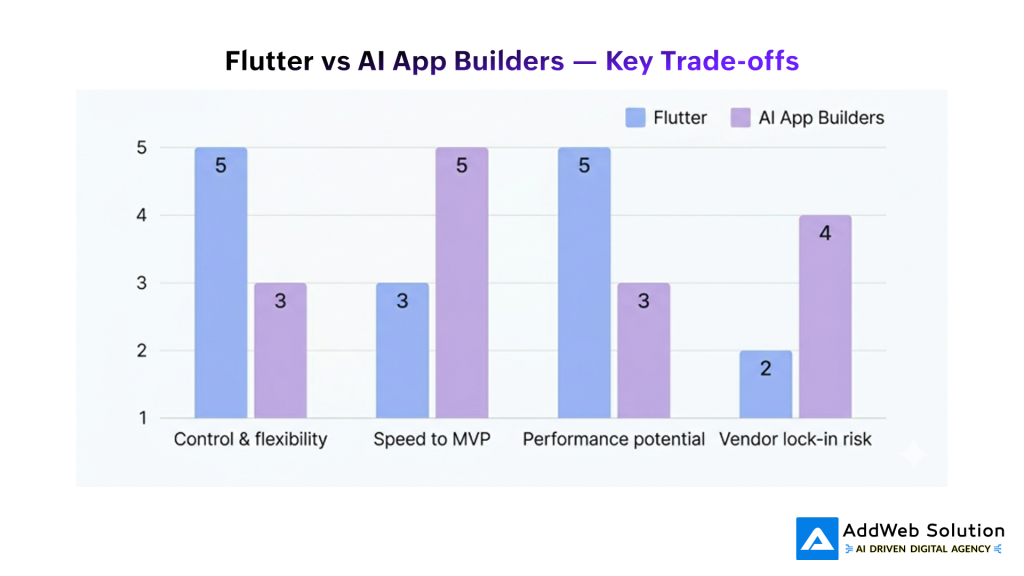
Visual: qualitative “scores” – Flutter vs AI app builders
The chart below gives a qualitative view of how Flutter and AI app builders tend to compare across a few axes. Again, these scores are illustrative, not empirical.
Read it like this:
- Flutter scores higher on control and raw performance potential.
- AI builders win on speed to MVP and inherently carry more vendor lock‑in risk.
That’s the basic trade‑off you’re navigating.
Practical decision matrix: how to choose
When a founder or product lead asks, “Flutter or AI builder?”, I usually walk through five questions.
1. What are you really building?
- Internal tool or non‑critical workflow? AI app builder is almost always the faster, cheaper starting point.
- User‑facing product you hope to scale and monetize? Lean toward Flutter once you pass the prototype stage.
2. How unique is your UX and logic?
- If your app looks like a standard admin or marketplace with light custom logic, a no‑code platform can take you far before hitting limits.
- If your differentiation is the UX, performance, or complex logic, you’ll outgrow the guardrails quickly and appreciate Flutter’s flexibility.
3. What’s your time vs. money constraint?
- Strict launch deadlines and limited budget with no devs in-house? No‑code/AI builders are designed for exactly that scenario.
- Healthy funding and a multi‑year roadmap? Investing in a solid Flutter codebase early can save painful migrations later.
4. How sensitive is your data and compliance story?
- For prototypes or internal apps with moderate sensitivity, mature vendors can still meet many companies’ security baselines
- For regulated industries or strict data residency needs, owning the stack with Flutter plus your own backend is far more controllable.
5. What skills do you actually have?
- Non‑technical founding team with no budget for full‑time engineers: forcing Flutter will likely stall you—AI builders are your pragmatic starting point
- Access to at least one strong engineer who understands architecture and DevOps: Flutter unlocks an entirely different tier of product quality and longevity


A more nuanced view of “coding is optional”
The industry trend is unambiguous: more of the plumbing and repetitive code generation is being automated or abstracted away by no‑code platforms and AI agents. Low‑code/no‑code tools are eating the long tail of simple apps and internal tools, freeing developers to focus on harder, higher‑leverage problems
But three things remain stubbornly non‑optional:
- Understanding the problem and domain. No tool can think strategically about your users, market, or regulatory context for you.
- System design and trade‑offs. Deciding how data should flow, how to handle edge cases, and how to secure your system is still human work—even if the final implementation is dragged onto a canvas.
- Ownership and evolution. As your product grows, you will run into edge cases the original platform never anticipated; then you either bend the platform to breaking point or re‑platform to a coded stack like Flutter.
For most serious businesses, this points toward a hybrid strategy:
- Prototype and validate with AI app builders when speed and learning are the priority.
- Consolidate and scale on Flutter (or another full‑code stack) once you have evidence that the product justifies deeper investment.
How to combine both in a modern stack
You don’t necessarily have to choose a single camp forever.
- Use an AI app builder for ops dashboards, admin panels, one‑off automations, and non‑core tools, where lock‑in is acceptable and migration pain is limited
- Use Flutter (backed by a robust API layer) for your customer‑facing product, SDKs, and any performance‑sensitive surfaces
- Gradually replace the highest‑impact no‑code surfaces with coded implementations as your team and funding grow, treating no‑code as scaffolding rather than the final structure.
This is also where solid API design pays off: if your domain logic and data live behind clean APIs, Flutter, AI builders, and other clients can all coexist and evolve more safely over time.
So… is coding becoming optional?
For simple apps, internal workflows, and first‑pass MVPs, coding is increasingly optional thanks to AI‑powered app builders and the maturation of no‑code platforms. For differentiated, large‑scale, performance‑critical, or heavily regulated products, coding—and stacks like Flutter—remains absolutely central.
If you’re technical, Flutter gives you long‑term leverage and control; if you’re non‑technical, AI app builders give you a way into the game without waiting for engineering capacity. The smartest teams learn to use both, picking the right level of abstraction for each problem instead of forcing a single hammer onto every nail
Talk to our Flutter experts and get a tailored recommendation for your project.

Pooja Upadhyay
Director Of People Operations & Client Relations
⁂
- https://www.thebusinessresearchcompany.com/report/no-code-development-platforms-global-market-report
- https://aws.amazon.com/what-is/flutter/
- https://www.precedenceresearch.com/low-code-and-no-code-development-platforms-market
- https://leancode.co/technologies/flutter
- https://bubble.io/blog/no-code-app-examples/
- https://www.adalo.com/products/ai-app-builder/
- https://www.adalo.com
- https://www.techsciresearch.com/report/low-code-no-code-development-platform-market/19063.html
- https://amoga.io/an-overview-of-low-code-no-code-market-2023-2030-2/
- https://www.mobiloud.com/blog/flutter-101
- https://en.wikipedia.org/wiki/Flutter_(software)
- https://designrevision.com/blog/low-code-no-code-complete-platform-comparison
- https://bubble.io/ai-app-generator
- https://developers.mews.com/intro-to-flutter-a-practical-guide-to-cross-platform-development/
- https://www.linkedin.com/posts/global-market-insights24_no-code-and-low-code-development-platforms-activity-7326119183946072065-ftZM
