


The reality in today’s network is that most significant cyber events already involve AI on both sides of the battlefield, where attackers use autonomous algorithms to attack, and defenders use AI-based systems to protect. This concept of an “AI vs. AI” cyber war is not theoretical; it is already influencing how security teams design their stacks, write their Python, and run their operations every single day.
From Human-Driven Hacking to Autonomous Attack Loops
In the past, cyberattacks were perpetrated by individuals or adversaries, with scripts written, IP addresses scanned, and vulnerabilities exploited. However, there have been three major changes in recent times, which have altered this scenario. These changes are as follows:
- AI-generated social engineering: There has been a rise in personalized phishing messages, leading to an over 1,200% rise in phishing messages. These messages have a higher click-through rate as well.
- Deepfake-enabled fraud: There have been instances of criminals using voice or video deepfakes to impersonate corporate or government officials. Industry reports have stated that there has been a rise of several hundred percent in deepfake-based cyberattacks.
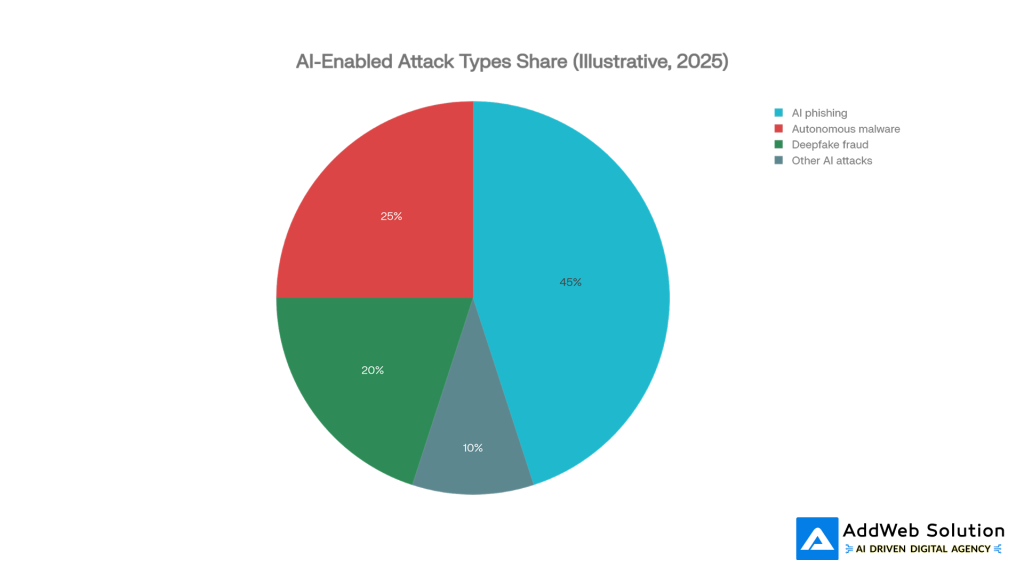
- Autonomous malware: There has been a rise in malware that has used AI for adapting to different scenarios, modifying their codes, or rerouting their commands. In some datasets for 2025, there has been a rise in such a type of malware, accounting for a quarter of all such instances.
In fact, there has been an estimate that there would be over 28 million AI-based cyberattacks in 2025, a rise of over 72% from the previous year.
What Attackers Actually Do with AI
The attack algorithms used in autonomous attacks are not single entities. They are a combination of several artificial intelligence-based attack methods used in the kill chain:
- Reconnaissance: Language models and classifiers use publicly available data, leaked credentials, code repositories, and social media feeds to develop detailed profiles of targets.
- Initial Access: Generative AI creates spear-phishing emails, chat messages, and voice calls using executives’ or suppliers’ personas. In some cases, artificial intelligence-based phishing campaigns report click rates several times higher than those of traditional phishing campaigns.
- Exploitation and Lateral Movement: Attackers use automated exploit selection, dynamic payload selection, and path-finding algorithms to try out different paths in your network. These algorithms will try different paths in your network, even if they are blocked.
- Persistence and evasion: Attackers use polymorphic code, artificial intelligence-based traffic, and behavioral manipulation to evade signature-based intrusion detection and heuristic filters.
Some reports indicate that a “non-trivial” percentage of large breaches—about one in seven—may now be “fully autonomous,” meaning “once an artificial intelligence-based attack campaign is launched, no human interacts with the keyboard again until the attack is complete.”
Visual Snapshot: AI-Enabled Attack Types
The conceptual chart below represents a hypothetical distribution of where AI is most prevalently used for attacks such as phishing, deep fake fraud, autonomous malware, etc. Although it is not based on actual data, it is based on patterns reported in 2025-26 threat surveys. This representation aims to assist non-technical stakeholders in understanding where the pressure of AI is greatest.
Why “Machine-Speed” Defense Matters
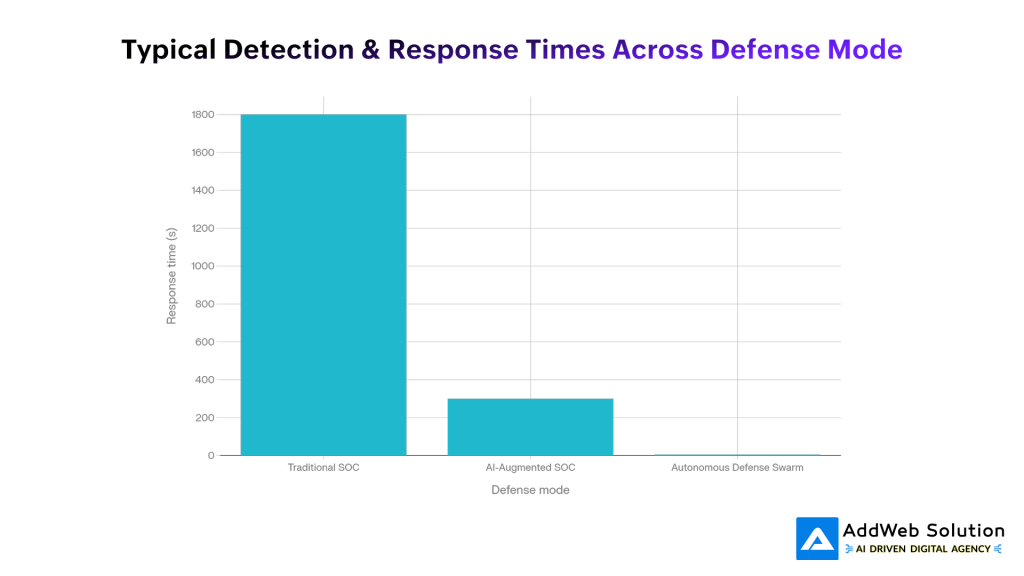
The traditional security operation center (SOC) is based on human workflows: an alert is generated, investigated, escalated, and then acted upon. Even in the best of circumstances, this process is measured in minutes or hours.
The autonomous nature of the cyber-attacks is not the same:
- Swarm-style AI-based cyber-attacks can traverse the network, pivot between hosts, and start encrypting or exfiltrating data within the time it takes a human simply to read the first alert.
- Experimental approaches to multi-agent-based defense mechanisms have demonstrated sub-second detection and response times, with some approaches reporting an average response time of under 1 millisecond in a simulated environment.
A U.S. federal research project on autonomous cyber defense approaches has a project objective of detecting cyber-attacks in under 2 seconds and responding within 5 seconds, with an 80% reduction in attacker dwell time compared to a baseline SIEM/SOAR system.
Attacker AI vs. Defender AI: Key Differences
| Dimension | Attacker AI Algorithms | Defender AI Systems (Python-centric) |
| Primary objective | Maximize impact (breach, exfiltration, extortion) | Minimize impact (fast detection, containment, recovery) |
| Data they learn from | Public data, stolen datasets, logs from previous campaigns | Telemetry, logs, threat intel feeds, labeled attack data |
| Autonomy level | Often fully autonomous once launched | Typically human-in-the-loop or human-on-the-loop for critical actions |
| Constraints | Few legal/ethical constraints, only resource and detection risk | Policy, compliance, explainability, and safety constraints |
| Success metric | Compromise rate, ransom payouts, dwell time | Mean Time to Detect (MTTD), Mean Time to Respond (MTTR), false positive/negative balance |
| Code stack | Mix of Python, C/C++, Go, scripts; often obfuscated | Often Python-heavy for analytics, ML, automation; integrated with existing SOC tools |
Where Python Fits in the Defense Stack
Python has managed to become a “lingua franca” for defensive AI systems for three main reasons: libraries, iteration speed, and integrability with other security tools. Python has been widely adopted for research, open-source, and commercial systems to:
- Capture, parse, and analyze traffic using Scapy or PyShark for real-time traffic inspection.
- Implement ML models (scikit-learn, PyTorch, TensorFlow) for anomaly detection, classification, or clustering.
- Orchestrate SOC tools through APIs for SIEM systems, endpoint detection and response systems, firewalls, cloud platforms, or messaging tools like Slack or email.
- Implement multi-agent defense systems that share information or make joint decisions about risks.
The reason why many defense systems offer a Python SDK is that it allows security engineers to combine traditional detection approaches (rules, signatures) with ML capabilities in a single programming language.
Python-Powered Intrusion Detection: Real-World Examples
Several projects have demonstrated the practicality of using Python-based systems to directly counter autonomous attack behaviors. For example:
- Lightweight Python IDS for evolving IoT threats
- A research paper published in 2025 presented a Python-based IDS using Scapy and PyShark to monitor real-time network traffic. The system was designed to detect anomalies such as port scans, SYN floods, unauthorized access, etc. The paper was published in 2025.
- The system uses a combination of rule-based detection and anomaly detection. The system was tested using a CICIDS2017 dataset with high detection rates. The system does not have the high system resources that traditional IDS systems like Snort or Suricata require.
- Step-by-step real-time IDS in Python
- A popular tutorial for engineers explains a real-time IDS using Python. The tutorial explains a real-time IDS system that uses a combination of rules (like detecting a SYN flood or port scan) and anomaly detection using Isolation Forest, trained on normal traffic.
- The system monitors features such as packet size, packet rate, byte rate, etc. The system then simulates attacks like a SYN flood or port scan.
- StratosphereLinuxIPS (Slips)
- Slips is an open-source behavioral-based IDS and IPS system written in Python. It uses machine learning to detect malicious activities in network traffic.
- It uses real-time network traffic, PCAPs, and network flows (e.g., Zeek/Bro, Suricata) and correlates them using ML, over 40 threat intelligence feeds, and heuristic rules.
- It focuses on detecting advanced threats such as targeted attacks and command and control activities, not merely commodity malware. There are also graphical interfaces for interactive analysis.
These projects demonstrate how real-world security problems can be solved using Python and how abstract ideas in AI can be turned into reality.
Inside a Python AI Defense Pipeline
A modern “AI vs. AI” defense stack built in Python usually follows a layered, almost industrial pattern:
- Sensors and collectors
- Packet capture (Scapy, PyShark), system call tracing, EDR data, cloud audit logs, identity events.
- Feature extraction and enrichment
- Transform raw events into structured features: connection patterns, process trees, authentication graphs, user behavior metrics, plus enrichment from threat intel APIs.
- Detection engines
- Signature/rule-based: classic IDS rules for known threats (SYN floods, brute force, known exploit chains).
- Anomaly and behavior-based: ML models (IsolationForest, autoencoders, graph neural networks) trained on “normal” patterns and tuned to flag suspicious deviations.
- Specialized deepfake/LLM detectors: models that spot synthetic voices, tampered video or AI-generated text attempting fraud.
- Decision and policy layer
- Python logic maps detections to response policies: what to auto-block, what to quarantine, what to escalate for human review, respecting business criticality and compliance rules.
- Automated response and orchestration
- Integration with SOAR, firewall APIs, EDR quarantines, identity tools (MFA challenges, step-up auth), and ticketing/notification systems for traceability.
In advanced setups, this pipeline is mirrored across multiple agents (host, gateway, cloud account), each running Python services that collaborate as a swarm.


Defense Swarms, Multi-Agent Systems, and Python
To counter distributed autonomous attacks, researchers and vendors are moving toward multi-agent defense architectures: coordinated teams of AI agents that share indicators, learn jointly, and adjust strategy in real time.
Key patterns include:
- Cyber defense swarms
- Sensor, analysis, intelligence, decision, and execution agents cooperate like an immune system, detecting anomalies, correlating them to known threats, and deploying mitigations in milliseconds.
- Microsoft’s Security Copilot and similar systems orchestrate multiple AI agents across products to reduce response times by significant margins, sometimes around 30% or more.
- Multi-Agent Reinforcement Learning (MARL)
- Research on multi-agent actor-critic algorithms shows that cooperating agents can learn to defend complex networks more effectively than single models, especially in simulated large-scale cyber-attack scenarios.
- Experiments with decentralized multi-agent swarms in industrial IoT environments have reported sub-millisecond threat response (around 0.85 ms on average) and high detection accuracy, including for zero-day attacks.
- Operational goals for autonomous defense
- Targets such as “detect in under 2 seconds, respond in under 5 seconds, with at least an 80% reduction in dwell time” are increasingly common in defense R&D documents.
Python’s role here is glue and intelligence: agents are often implemented as Python microservices, each wrapping ML models, business rules, and APIs, then orchestrated through message buses or event streams.
AI-Augmented SOC vs. Fully Autonomous Defense
Not every organization is ready (or allowed) to let AI take direct actions without human approval. In practice, you see three maturity levels:
| Defense Mode | How AI Is Used | Human Role |
| Traditional SOC | Basic correlation rules, dashboards, manual triage | Investigate and respond to almost every alert |
| AI-Augmented SOC | AI helps triage, prioritize alerts, summarize incidents, and suggest playbooks | Approve actions, handle complex/ambiguous situations |
| Autonomous Defense Swarm | Multi-agent systems detect and contain threats automatically within seconds | Oversight, policy definition, tuning, post-incident review |
For example, platforms like CrowdStrike’s Charlotte AI use AI to triage detections, group related activity, and recommend response actions, yet maintain human-in-the-loop control for key enforcement steps. At the same time, some experimental systems can automatically isolate hosts or block network segments based on AI decisions when policy thresholds are met.
Concrete Python Techniques to Counter Autonomous Attacks
If you are building or modernizing your own defenses, these are the kinds of practical Python patterns that map directly onto “AI vs. AI” use cases:
- Hybrid detection engines
- Combine rule-based checks for known attacks (e.g., port scans, SYN floods) with anomaly detection models such as IsolationForest or autoencoders trained on normal traffic.
- Use Python’s ML stack (scikit-learn, PyTorch) plus cybersecurity datasets like CICIDS2017 to train and validate models.
- Behavioral profiling and user/entity behavior analytics (UEBA)
- Build profiles of normal login times, locations, device fingerprints, and resource access, then alert when patterns deviate in risk-relevant ways.
- Python scripts orchestrate feature extraction from authentication logs and identity systems, running periodic retraining jobs.
- Graph-based detection
- Represent processes, network connections, and data flows as graphs and use graph neural networks or provenance-based methods (as seen in some open-source ML IDS projects) to detect unusual patterns of lateral movement.
- Adversarial-aware monitoring
- Monitor prompts, AI agent logs, and workflow invocations for signs of prompt injection, model abuse, or unauthorized actions when your environment itself runs LLMs.
- Automated response bots and playbooks
- Python-based bots respond to specific classes of alerts: disable risky accounts, revoke tokens, add just-in-time firewall rules, capture forensic data, and notify owners simultaneously.
Each of these techniques maps cleanly onto the Python tools you likely already use for data engineering and automation—only now the stakes are significantly higher.
Limits, Risks, and Human Responsibilities
AI-powered defense is not a silver bullet. There are important constraints you have to handle deliberately:
- False positives and false negatives
- Overly aggressive models can flood analysts and disrupt operations; too conservative ones will miss fast, low-and-slow attacks.
- Adversarial manipulation of models
- Attackers can poison training data, craft adversarial traffic, or misuse your own AI interfaces and automations as part of their campaigns.
- Explainability and accountability
- Regulatory and internal governance requirements often demand that automated decisions be explainable, logged, and auditable, especially when they affect customer data or critical infrastructure.
The most mature organizations use AI to handle scale and speed, but retain clear human accountability, strong policy constraints, and continuous evaluation of model behavior.
How to Start Building Python Defense Systems (Practically)
If you are a security engineer or architect thinking “Where do I begin?”, a pragmatic roadmap often looks like this:
- Instrument your environment
- Ensure you can capture logs and network telemetry in a structured way that Python tools can ingest (e.g., via message queues, data lakes, or APIs).
- Start with a Python-based IDS prototype
- Follow a step-by-step tutorial to build a basic IDS using Scapy, PyShark, and an ML model such as IsolationForest; use public datasets plus your own lab traffic for training and testing.
- Adopt and extend an open-source Python IDS/IPS
- Evaluate projects like StratosphereLinuxIPS (Slips) and similar ML-based systems, then tune modules and models for your environment.
- Introduce AI-assisted triage in your SOC
- Use Python to integrate with your SIEM/EDR platforms and build summarization, deduplication, and prioritization pipelines so analysts see fewer, richer alerts.
- Experiment with coordinated agents
- In controlled lab environments, explore simple multi-agent setups where host- and network-level Python services share signals and vote on risk scores before triggering responses.
- Wrap everything in governance
- Document policies for when AI can act automatically, when it must seek approval, and how every decision is logged, monitored, and reviewed.
Done well, this path turns Python from a scripting language you use for one-off tools into the backbone of a resilient, AI-native defense posture—one that can credibly stand up to autonomous attack algorithms instead of being outpaced by them.
Build Smarter Cybersecurity with Python.

Pooja Upadhyay
Director Of People Operations & Client Relations
⁂
- https://www.crowdstrike.com/en-us/blog/ai-vs-ai-cybersecurity-arms-race/
- https://arxiv.org/abs/2410.09134
- https://arxiv.org/html/2601.17303v1
- http://ir.lib.seu.ac.lk/xmlui/bitstream/handle/123456789/7700/ICST_2025_Proceedings_-19-
- 164-128-133.pdf?sequence=1&isAllowed=y
- https://ieeexplore.ieee.org/document/11074703/
- https://www.freecodecamp.org/news/build-a-real-time-intrusion-detection-system-with-pytho
- https://github.com/stratosphereips/StratosphereLinuxIPS
- https://github.com/topics/intrusion-detection-system
