


“AI enables nonprofits to predict which donors are most likely to contribute and at what levels.”
Nonprofit communication has always been about trust, timing, and clarity. But in 2026, it also has to compete with short attention spans, crowded inboxes, and donor expectations that are shaped by the same digital experiences people get from leading brands. That is where AI is becoming genuinely useful: not as a replacement for human storytelling, but as a support layer that helps mission-driven teams communicate faster, more personally, and with far less operational friction.
For many nonprofit teams, the challenge is not ideas. It is execution. There is always another campaign to launch, another donor update to send, another volunteer segment to manage, another social post to publish, and another report to prepare. AI helps reduce that pressure by handling repetitive communication work, identifying patterns in audience behavior, and making outreach more responsive without forcing a nonprofit to grow its headcount at the same pace as its responsibilities.
Introduction
A few years ago, AI in the nonprofit world sounded experimental. Today, it is becoming practical infrastructure. Teams are using it to draft emails, personalize donation appeals, summarize community feedback, write social captions, support chatbots, and even refine grant-related messaging. The most interesting part is that this shift is happening not just in large organizations, but also in smaller nonprofits that need every hour and every message to count.
The real opportunity is not efficiency alone. It is a better connection. A nonprofit that can respond faster, speak more clearly, and tailor communication to different supporter groups usually creates stronger trust. And in the nonprofit sector, trust is not a soft metric. It is the foundation of fundraising, volunteer engagement, advocacy, and long-term community support.
Why AI matters
Nonprofits have always been expected to do more with less. That reality has only intensified as supporter journeys have become more fragmented across email, social media, websites, SMS, and event platforms. AI helps bridge that gap by making it easier to produce consistent communication across channels while keeping messaging relevant to different audiences.
This matters because nonprofit audiences do not all behave the same way. A long-time donor may want impact updates and stewardship messages. A first-time volunteer may need simple onboarding information. A local community member may respond better to a story about direct outcomes. AI helps segment and adapt those messages quickly, which is especially valuable when campaigns need to go out fast but still feel personal.
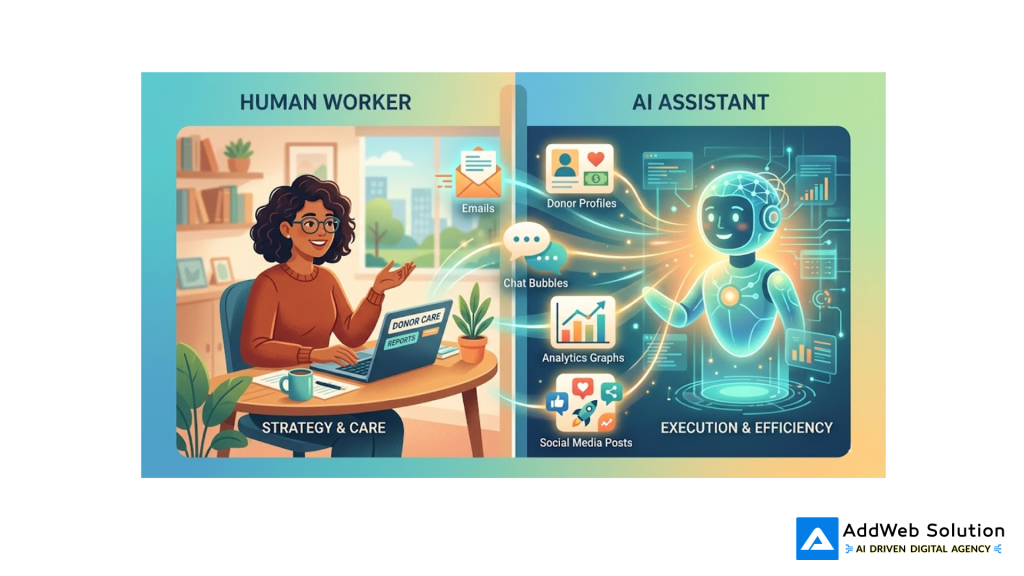
There is also a strategic benefit here. When communication teams spend less time on manual drafting and sorting, they can spend more time on the work that actually requires human judgment: story selection, tone, empathy, campaign planning, and relationship building. That is where the best nonprofit communication happens.
How AI helps outreach
AI can support nonprofit communication in several practical ways. One of the most common is content generation. Teams can use it to draft newsletter copy, donor email variations, event reminders, volunteer follow-ups, and social media posts. This is especially helpful when one campaign needs to be repurposed across multiple formats.
Another major use is personalization. Instead of sending the same appeal to everyone, nonprofits can create more tailored messaging based on donor history, interest areas, geography, or past engagement. That kind of specificity can make communication feel more thoughtful and less like mass outreach.
AI is also proving useful for response management. Chatbots and automated reply systems can answer common questions about donation methods, event logistics, volunteer registration, or service availability. For a small team, that can reduce repetitive inbox work and improve response speed.
The last big category is insight generation. AI can help summarize feedback from surveys, analyze which subject lines performed best, surface engagement patterns, and suggest which audience segments are most responsive. That does not replace strategy, but it gives teams a stronger base for making decisions.
Data and adoption
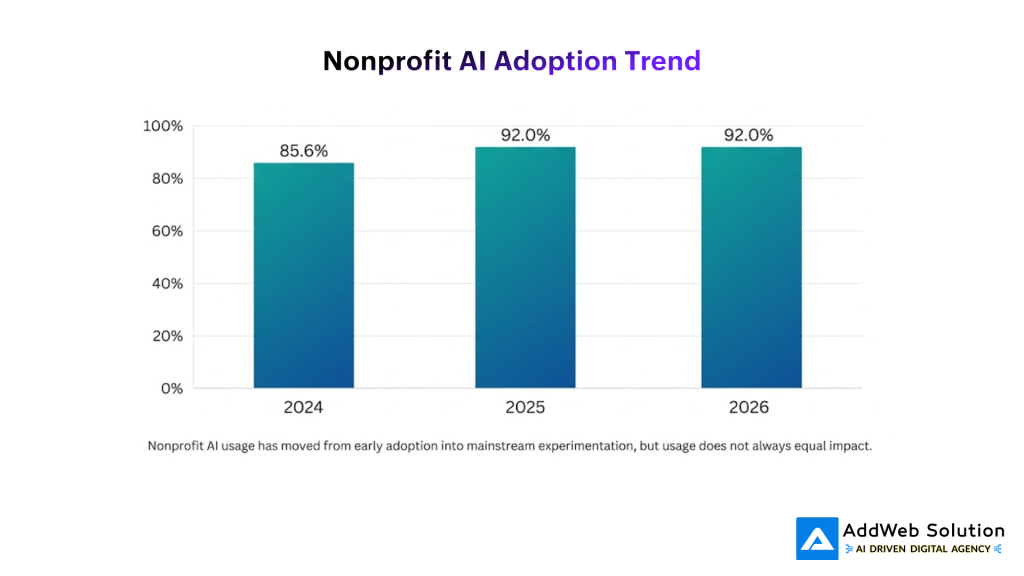
The nonprofit sector is no longer debating whether AI matters; it is deciding how to use it responsibly. Industry reporting in 2025 and 2026 shows that adoption is growing quickly, but impact is uneven. That is important because it tells us that access to tools is not the same as meaningful transformation.
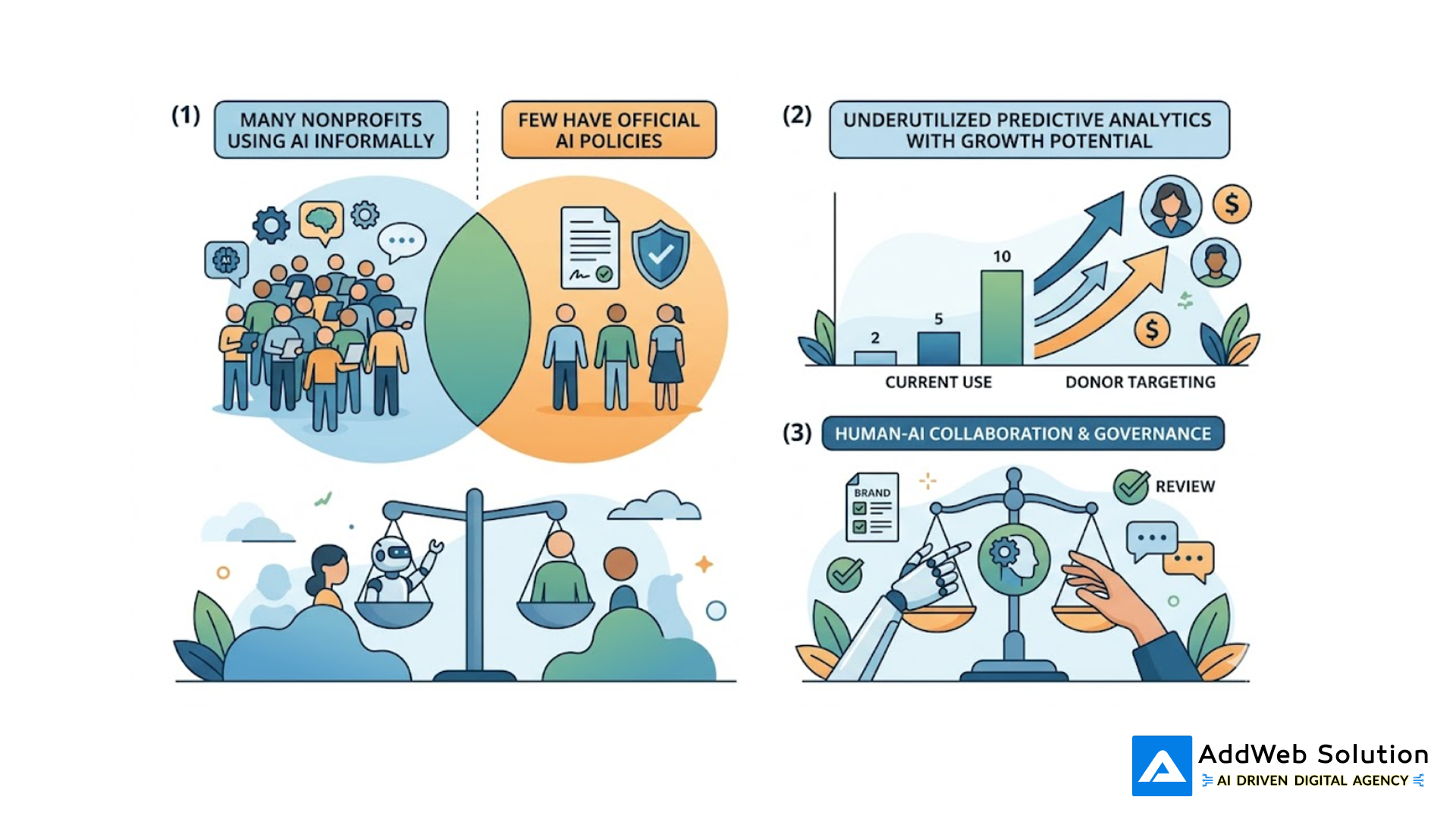
A recurring pattern across nonprofit surveys is that many organizations are experimenting with AI, but relatively few have a defined policy, training plan, or consistent workflow. That means the challenge is not only technical. It is organizational. The nonprofits that get the most value from AI are usually the ones that start with a clear communication problem and build around that problem step by step.
This is especially true in donor communication. For example, using AI to write 20 versions of a message is not valuable if the organization has not decided which audience should receive them, what action should be prompted, or how success will be measured. The better approach is to use AI as part of a communication system, not as a shortcut.
Tool comparison
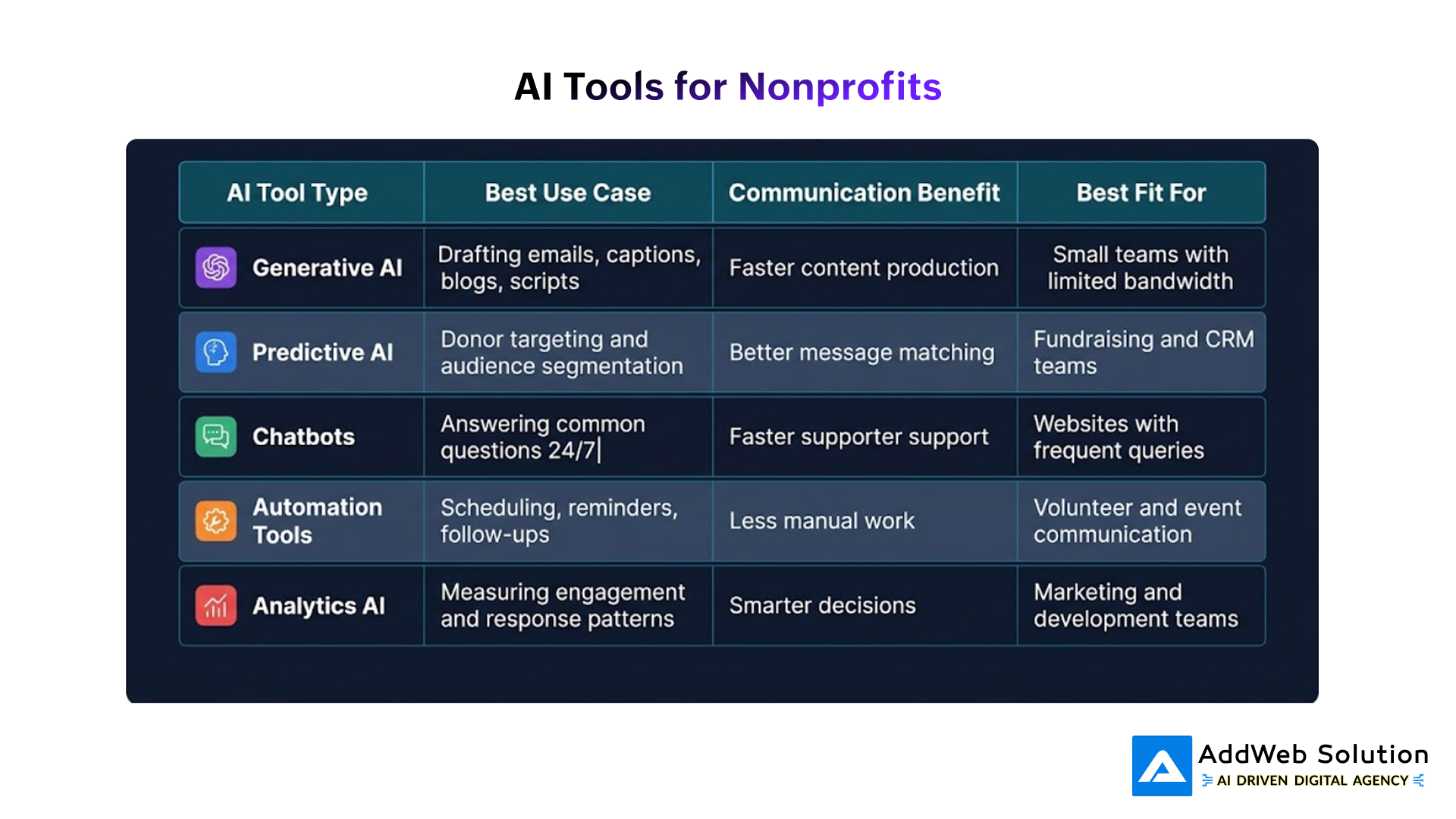
Different AI tools solve different nonprofit communication problems. The best choice depends on the team’s size, maturity, and workflow complexity.
Growth and performance
A useful way to look at the rise of AI in nonprofits is to separate adoption from maturity. Adoption means a team is using AI in some way. Maturity means the organization has integrated it into communication workflows in a way that is measurable, safe, and repeatable.
That distinction matters because many nonprofits are still in the early stage. They may use AI for subject lines, drafts, or brainstorming, but not yet for structured segmentation or campaign optimization. Others have moved further, using AI to identify likely supporters, generate content variants, and test what resonates best with different audience groups.
In practice, this creates a familiar digital transformation pattern: the tools spread quickly, but the process takes longer to evolve. Nonprofits that invest in training, governance, and content quality control tend to see better long-term results than those that rely on ad hoc usage.


Practical examples
One of the clearest real-world lessons comes from donor communication. Organizations that use AI to study engagement patterns can identify which stories, formats, or calls to action are most effective. That can lead to smarter outreach, better email performance, and more relevant message sequencing.
Another useful example is supporter service. A nonprofit running events or community programs often gets the same questions over and over again: where to register, what time to arrive, how to donate, who to contact, and whether a service is available in a specific area. AI-powered chat support can answer those questions instantly while reducing pressure on staff.
AI is also especially useful in content recycling. A single impact story can become a newsletter paragraph, a social post, a donor update, a short video script, and a web banner message. That reuse is not lazy — it is efficient storytelling. And for nonprofits, efficient storytelling is often the difference between publishing consistently and falling behind.
What nonprofits should do
If a nonprofit wants to start using AI in communication and outreach, the smartest move is to begin with one practical use case. That might be email drafting, donor segmentation, volunteer FAQs, or campaign repurposing. Starting small reduces risk and makes it easier to measure value.
Next, the organization should create a simple review process. AI output should never be published blindly. Every message should still be checked for accuracy, tone, sensitivity, and alignment with the nonprofit’s mission. This is especially important when the communication touches vulnerable communities or involves fundraising language.
Finally, nonprofits should train their teams. AI works best when people know how to prompt it, edit it, verify it, and use it responsibly. Without that discipline, the tool can create more noise than value.
Conclusion
AI is giving nonprofits a new way to scale communication without losing the human side of outreach. It can help teams write faster, segment more intelligently, support supporters more quickly, and turn scattered communication tasks into a more efficient system. But the real advantage comes when AI is used with structure, judgment, and clear purpose.
For nonprofits that want to improve outreach in a way that feels modern but still mission-first, the formula is simple: start small, stay human, and use technology to amplify the story you already want people to hear. That is the approach AddWeb Solution often recommends when digital transformation needs to feel practical, not overwhelming.
Transform your nonprofit communication with AI-driven strategies.

Pooja Upadhyay
Director Of People Operations & Client Relations
Source URLs
- https://www.nonprofitmarketingguide.com/2026-nonprofit-communications-trends-highlights/
- https://www.nonprofitmarketingguide.com/the-realities-of-nonprofit-communications-in-2026-managed-with-short-term-expectations/
- https://www.nonprofitpro.com/article/report-how-artificial-intelligence-is-changing-the-nonprofit-sector/
- https://www.nonprofitpro.com/article/study-reveals-donor-attitudes-toward-ai-in-charitable-organizations/
- https://blog.techsoup.org/posts/how-nonprofits-are-using-ai
- https://page.techsoup.org/ai-benchmark-report-2025
- https://www.comnetwork.org/blog/2026-call-to-action
