


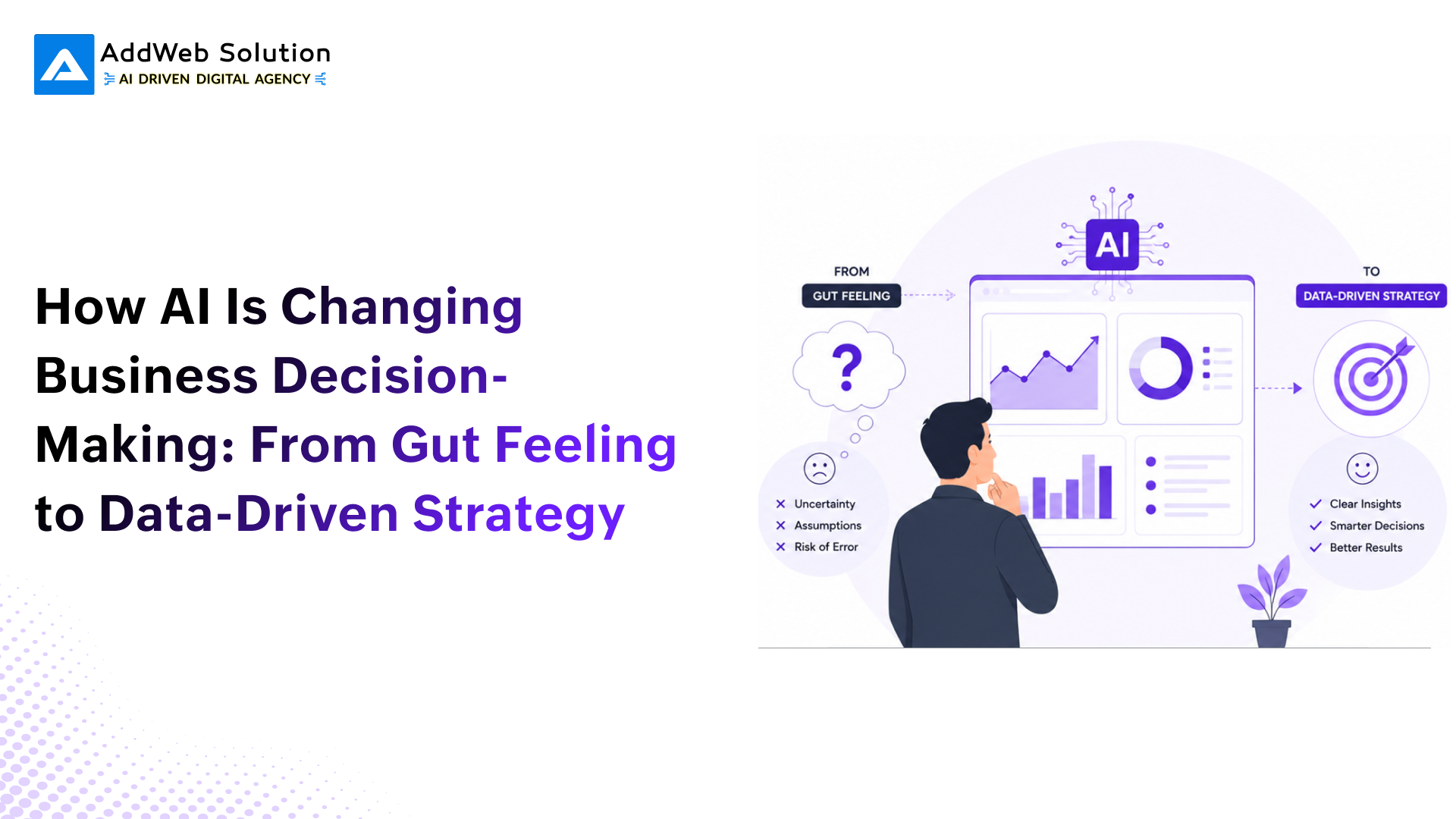
AI is transforming business decisions from those driven by gut feel and looking back to quicker, more transparent, data-based and testable decisions in virtually every function.
The executives are making more decisions together with AI as an equal partner and not just as an add-on tool for analyzing data, discovering patterns and simulating different situations.
From gut feeling to decision intelligence
The “big calls” were made based on the HiPPOs – Highest Paid Person’s Opinion, that was moderated by scarce reports and customer comments.
Now, more than half of organizations cite “increasing insights and decision making” as one of the top reasons for adopting AI technology, indicating a paradigm shift in terms of decision-making from being gut-driven.
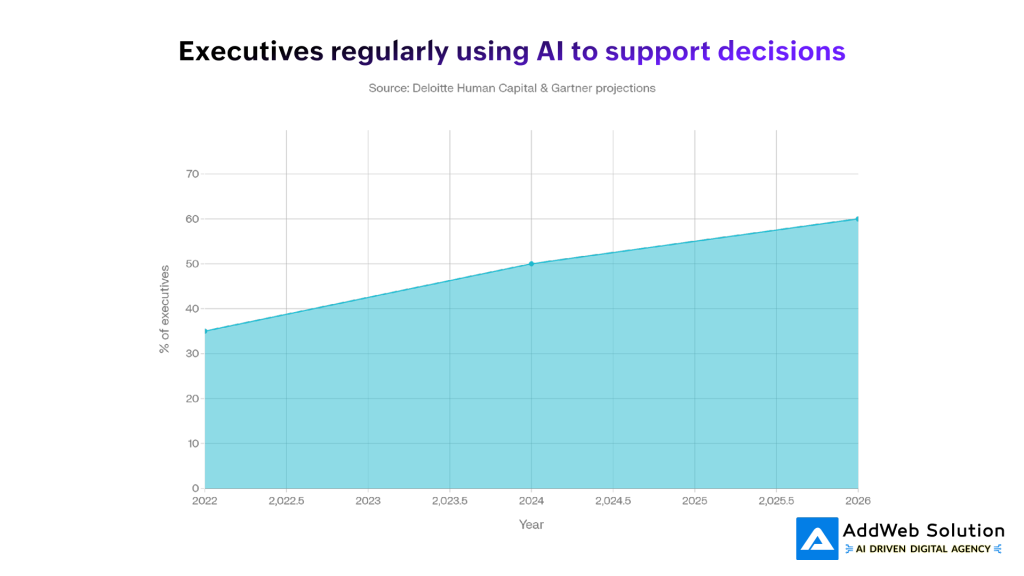
According to the research of Deloitte 2026 Global Human Capital Trends, 60% of executives currently make decisions with the help of AI and Gartner predicts that by 2027, half of all business decisions will be done through AI agents.
To achieve that kind of a shift in real-world operations, organizations are now developing “decision intelligence” capabilities where data pipelines, models, and business operations get integrated in a series of reproducible decision-making processes as opposed to one-off analyses.
Preliminary findings suggest that hybrid approaches that leverage the strengths of humans in providing context while algorithms detect patterns can lead to 20-25% better decision making than either one alone.
What AI is doing in decision making
For most companies, AI is not the CEO robot but the set of tools which:
- Automatically ingest and clean data to cut down on analyst report preparation time.
- Identify patterns, anomalies, and correlations that humans would otherwise miss.
- Produce predictions about demands, churns, risks and other variables critical for planning, pricing and resource allocation decisions.
- Condense qualitative inputs like customer comments or surveys into decision-ready themes.
Across 92 companies surveyed across industries, 93% claimed to be deploying AI applications mostly for customer service, forecasting, and decision support, primarily to enhance the speed and clarity of decision-making processes.
IBM’s Global AI Adoption Index indicates that 42% of enterprises are already leveraging AI while another 40% are still exploring its potential, with almost 60% increasing their investments in AI within the last two years in order to help them make better decisions.
Where AI makes the biggest difference in strategy
The executives do not look at the single-use of AI application but rather the entire set of decision-making levers in which AI has a different impact on them. Surveys among top executives revealed a distinct list of areas in which executives perceive the largest strategic impact of AI.
Impact of AI on business strategy (survey among executives)
- Data analytics and management: 21%
- Customer/market insight: 19%
- Forecasting: 17%
- Marketing campaigns performance: 17%
- Customer experience: 13%
- Building AI products/services: 13%

These objectives match up with other literature regarding AI adoption, whereby “improving insights and decision-making” remains the top priority benefit to expect, followed by cost savings and revenue growth, respectively.
This implies that AI has ceased being perceived merely as an automation solution but rather as a tool used to determine how and where to play.
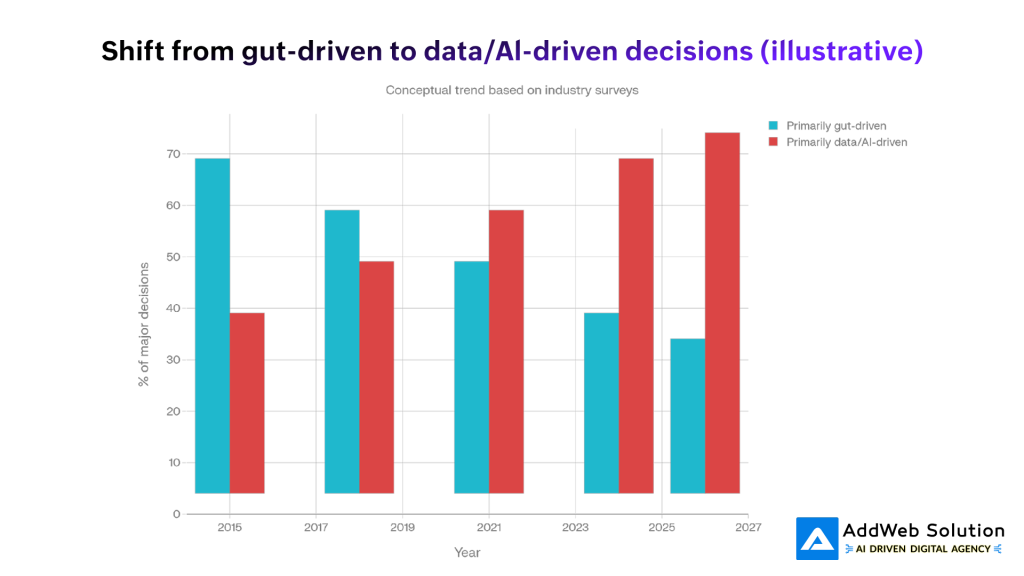
Visual representation: from gut-driven to data/AI driven
Although there is no perfect dataset that can represent the global move from gut-driven to data-/AI-driven decisions, all industry surveys confirm that the former approach’s importance is gradually declining, while the latter one gains prominence.
From a conceptual standpoint, it means a gradual crossover during which data-/AI-driven decision-making has become the prevalent approach when making “material” business decisions.
This is reflected in the trend towards widespread adoption of generative AI: Bain notes that 95% of US firms currently employ generative AI, with the number of use cases on average doubling within a year.
Over 80% of the use cases have met or exceeded expectations, while almost 90% of scaled implementations have met or exceeded their business objectives, a powerful demonstration that the new decision stack is working.
How AI transforms the decision-making process
Decision making driven by AI transforms not just what gets examined in the process, but the very process itself. In a standard process, the decision-making flow will be as follows:
- Data gathering: AI-driven technologies constantly gather transactional data, behavior data, market signals from external sources, as well as qualitative feedback.
- Interpretation: Models group customers, identify anomalies, score risks, predict future demand, and describe identified trends in natural language.
- What-if scenario simulation: Decision-makers experiment with “what-if” scenarios (such as price shifts, budgeting reallocations, product mix) using simulations to see the result.
- Execution and automation: When decisions are fully understood (such as route planning, recommendations, simple approvals), AI systems can execute actions automatically, within certain guardrails.
- Learning loop: Information about performance is fed back into the model, resulting in better recommendations and indicating areas where new rules should be created for humans.
According to Deloitte’s research, only about a third of organizations have redesigned critical processes for AI use. These organizations are the ones who have transformed their businesses by implementing AI, not optimized. Others still operate in “overlay mode,” putting AI on top of old decision-making processes.
Quantifying business impacts
A number of independent studies now paint a consistent picture on a few key quantitative aspects: AI-enabled decisions happen faster, make higher profits and are often more accurate, provided there is proper governance.
In macro-level estimates, the team from McKinsey finds that AI-powered decision-making can create annual business value from 3.5 to 5.8 trillion, depending on the industry and function.
Key stats:
- The application of AI enables companies to cut decision-making time by 40% in structured decision domains, such as pricing, risk-scoring and routing.
- AI-powered decision-making systems have achieved roughly 15% increase in sales productivity, and in the next decade are expected to contribute to a similar profit boost.
- According to IBM, two thirds of AI leaders experience over 25% increase in revenue growth due to better and faster resource allocation decisions.
- The global market for AI-powered decision-making is forecast to cross 20 billion USD by 2027.
Bain’s generative AI study also notes that budgets for genAI programs have more than doubled annually from early 2024 to late 2025, averaging 10 million USD per company, and most companies have incorporated AI into their operational budget plans.
Applications in the business organization
The applications of AI-powered decision making vary by function within the organization, but the fundamental logic remains the same.
Common decision use cases by function
| Function | AI-supported decisions (examples) | Primary benefit |
| Executive strategy | Portfolio allocation, M&A target screening, market entry, scenario planning. | Better capital allocation, risk-aware growth |
| Finance | Cash forecasting, credit scoring, fraud detection, working capital optimization. | Reduced risk, improved liquidity, lower leakages |
| Marketing & growth | Budget allocation, channel mix optimization, creative testing, LTV modeling. | Higher ROI, more precise targeting |
| Sales | Lead scoring, next-best-offer, territory and quota setting. | Higher conversion, better pipeline health |
| Operations & supply chain | Demand forecasting, inventory levels, routing, maintenance scheduling. | Lower stockouts, less waste, higher asset uptime |
| HR & talent | Workforce planning, attrition risk, skills-gap analysis, internal mobility recommendations. | Better talent retention and deployment |
| Customer experience | Dynamic routing, self-service flows, conversational agents, churn interventions. | Faster response times, higher satisfaction |
Each of these use cases comes back to a decision that used to happen rarely and manually but now can be reconsidered constantly through the insights generated by AI systems.
As the maturity of the organization grows, its focus moves from individual use cases (e.g., fraud scoring) to complete end-to-end, AI-enabled decision journey (e.g., from marketing contact to collection).
Human + machine: the new decision team
According to the research, the most productive decision occurs when the role of humans is complemented by machines rather than replaced by them. The simulations showed that the quality score for hybrid decision models, where algorithms do the calculation, while humans provide context and values, is 23% higher than for human-only or algorithm-only models.
In practice, this means:
- AI suggests; Humans decide: AI offers prioritized suggestions with probabilities and trade-offs; humans select and iterate according to their strategy and ethical stance.
- Humans question models: Decision makers ask questions, such as “Why?,” with explainability tools, questioning what features were the cause of making such a recommendation and if these features fit the policy framework.
- Feedback as a first-class citizen: On-the-ground experts report odd or risky recommendations; feedback is used to train better future behavior from the models.
As Deloitte’s decision maturity studies show, organizations that focus not on the tools, but explicitly on developing the decision-making skills of their employees, how to frame, design experiments, and question the model, perform significantly better than organizations focused solely on the tooling.
Trust, bias, and governance
With increasing reliance on AI in decision-making processes, issues related to biases, transparency, and accountability become inevitable.
For example, in a recent study of business decision-makers, almost 40-41% of respondents expressed concern over biased data affecting decisions, while nearly 45% admitted that data was available only for half or fewer decisions made by them.
Themes of risks commonly reported across multiple studies include the following:
- Biased data and signals: Historical discrimination or any form of bias may already exist in the training data and may result in unfair or inefficient results unless addressed.
- Over-reliance on AI: Several surveys note over-reliance as the number one implementation risk reported by executives; namely, over-reliance causes teams to stop asking obvious questions about the reasonability of the decisions.
- Opaqueness of the model: AI black box might cause difficulties justifying decisions before authorities, boards, and customers.
- Security and privacy: Risks in security and privacy increase with the amount of sensitive data used in decision-making systems.
The most successful businesses know the right guardrails to put in place: model risk frameworks, explainability demands, human-in-the-loop gateways for key decisions, and explicit limits on the type of decisions AI is allowed to make.
These companies also invest in high-quality data because even the smartest algorithms cannot save poorly collected or insufficiently curated data.
How surveys and qualitative data feed decisions
There is another more subtle development in how AI takes messy qualitative data and structures it into information to help with decision-making.
Today’s survey platforms are leveraging natural language processing in order to cluster open-ended responses, detect sentiment and identify themes out of tens of thousands of comments almost in real time.
What this means for decision makers and leadership is that they have a completely new approach to “soft” data: rather than analyzing only a few verbatim comments, they get a heatmap of issues by segment, sentiment trend lines and theme correlation with behavioral metrics such as churn and NPS.


Executives’ adoption curve
Executive behavior is often the bottleneck or accelerator for AI in decision-making. Deloitte reports that 60% of executives already use AI regularly in decisions, and WorldMetrics notes that 86% of executives believe AI will be highly important for decision-making within three years.
At the same time, surveys show that many leaders feel overwhelmed by data volume and unsure which metrics to trust, with some even delaying decisions because they do not trust their data.
Bain’s research indicates that while adoption is nearly ubiquitous, concerns about security and output quality still temper how aggressively boards and C-suites move to automate high-stakes choices.
Forward-leaning executives resolve this tension by defining clear “AI decision zones”: areas where AI has strong empirical performance and low downside (e.g., marketing optimization) are automated more aggressively, while high-stakes or values-laden decisions retain heavier human oversight.
That segmentation helps avoid both extremes of blind trust and blanket skepticism.
Quick framework: levels of AI in decision-making
To make this tangible, it is useful to think in levels of AI involvement rather than a binary switch.
Levels of AI involvement in business decisions
| Level | Role of AI | Typical examples | Human role |
| 0 | None | One-off intuitive calls, small team decisions | Full ownership |
| 1 | Informative dashboards | Descriptive BI, static reports | Interpret charts, decide manually |
| 2 | Decision support | Predictive scores, ranked recommendations | Accept/reject suggestions, adjust thresholds |
| 3 | Semi-automation with oversight | Automated routing, pricing suggestions, next-best-actions | Define rules, monitor exceptions |
| 4 | Full automation within guardrails | Real-time bidding, low-value approvals, micro-optimizations at scale | Set policy and guardrails, audit periodically |
Most organizations today sit between Levels 1 and 3 depending on the decision category, with risk, cost, and regulatory exposure determining how far they are willing to push.
The shift “from gut feeling to data-driven strategy” is essentially the journey from Level 0/1 into Level 2 and beyond for a critical mass of decisions across the enterprise.
Practical steps to get started (or to mature)
If you are designing or advising on AI-enabled decision-making, a pragmatic sequence helps keep things grounded.
1. Pick decisions, not tools
Start by listing 10–15 recurring decisions that materially affect value pricing, portfolio bets, hiring plans, inventory, credit limits, then rank them by business impact and feasibility. This avoids the trap of buying tools first and only later searching for a problem.
2. Map the current decision journey
For each priority decision, document the inputs, stakeholders, frequency, and failure modes today. This makes it easier to see where AI can realistically help (better signals, faster cycles, automated sub-steps) and where it should not be applied yet.
3. Build the data and feedback backbone
Invest in data pipelines, quality controls, and feedback loops before sophisticated modelling. AI amplifies whatever you feed it – good or bad.
4. Pilot hybrid decision flows
Start with AI as a decision-support layer, not a fully automated agent: let models propose options with explanations, then capture how humans accept, adjust, or reject them. Those patterns become training data for better future automations.
5. Wrap it in governance and education
Define policies for model risk, explainability requirements, and audit trails, and train managers on how to interrogate AI outputs, not just consume them. Decision skills, framing, experiment design, and critical thinking – remain as important as ever.
Turn Business Data into Better Decisions with AI Solutions

Pooja Upadhyay
Director Of People Operations & Client Relations
Source URLs:
https://arxiv.org/abs/2512.02048
https://www.bain.com/insights/survey-generative-ai-uptake-is-unprecedented-despite-roadblocks/
https://www.ibm.com/think/insights/ai-decision-making-where-do-businesses-draw-the-line
