


The enterprise technology landscape is in the process of fundamental change. Where generative AI could only create content and answer questions, a far more powerful evolution in the way businesses operate is underway: Agentic AI. It constitutes autonomous systems that perceive environments, reason out complex problems, plan strategies, and execute autonomous actions on their own to reach business outcomes. Python powers the frameworks that make truly autonomous decision-making possible.
This is a break from the more traditional notion of automation. While older AI setups demanded constant oversight from the human element, the new, agentic AI now demonstrates genuine autonomy, making nuanced decisions and adapting to changing conditions. The business case is rather compelling: organizations report productivity gains ranging from 25-40%, cost reductions from 30-68%, and improvements in the time it takes to resolve tasks by 50-52%. The global agentic AI market, estimated at USD 7.55 billion in 2025, will reach USD 199.05 billion by 2034: a CAGR of 43.84%.
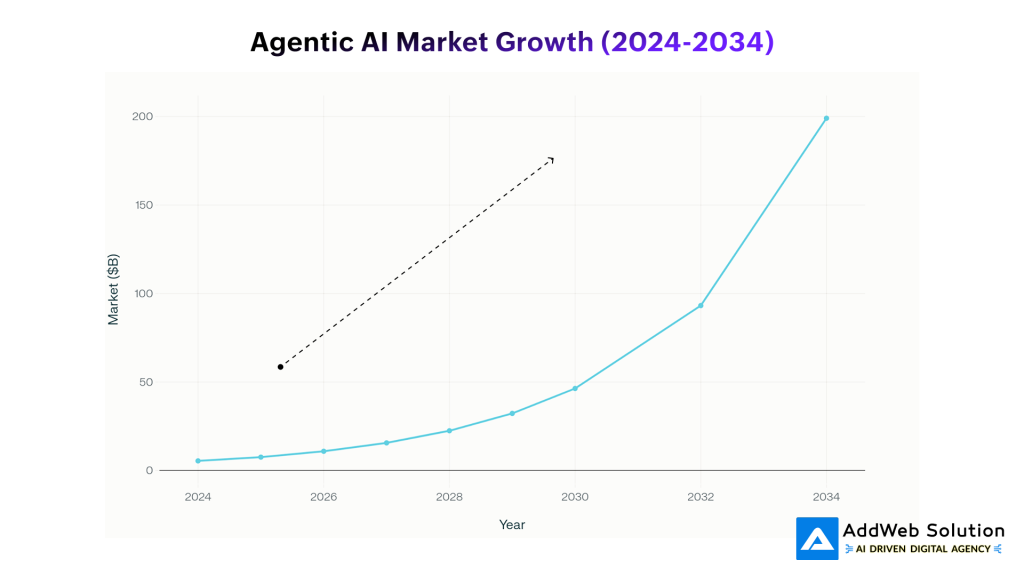
Explosive growth trajectory of the global agentic AI market from $5.43B in 2024 to $199.05B by 2034, representing a CAGR of 43.84%.


The Shift from Automation to Autonomy
Understanding Agentic AI’s Core Capabilities
Agentic AI systems differ from mainstream or conventional AI in that they possess these four core capabilities: reflection mechanisms evaluate continuous outputs for improvement in their performance through self-evaluation; tool integration provides for smooth access to a world of external APIs, databases, and enterprise systems; sophisticated planning mechanisms that allow agents to break down such complex objectives into subtasks and adjust strategies according to the situation; and multi-agent collaboration enables distributed intelligence by letting various specialized agents work together in achieving shared objectives.
The Market Momentum Behind Autonomous Intelligence
The adoption trajectory has never been so strong. Today, while 29% of organizations use agentic AI systems, 25% of enterprises using generative AI plan to launch agentic AI pilots in 2025; it will double to 50% in 2027. Technology executives are acting decisively: 48% have adopted or are currently deploying agentic AI, while 78% of organizations plan to increase AI investments. India leads globally, with 93% of business leaders intending to implement AI agents within 12-18 months.

Current and projected adoption rates showing that 29% of organizations already use agentic AI, with 50% expected adoption by 2027.
Python’s Central Role in the Agentic Revolution
Why Python Dominates Agentic AI Development
Python has become the unequivocal language in which to build agentic AI systems. Its syntax is readable, lowers barriers, yet still provides all the sophistication needed for complex autonomous systems. More importantly, Python’s ecosystem provides comprehensive tooling for every aspect: TensorFlow and PyTorch for neural networks, OpenAI Gym and Stable Baselines for reinforcement learning, integration libraries like Requests and SQLAlchemy for real-world connectivity.
Leading Python Frameworks for Building AI Agents
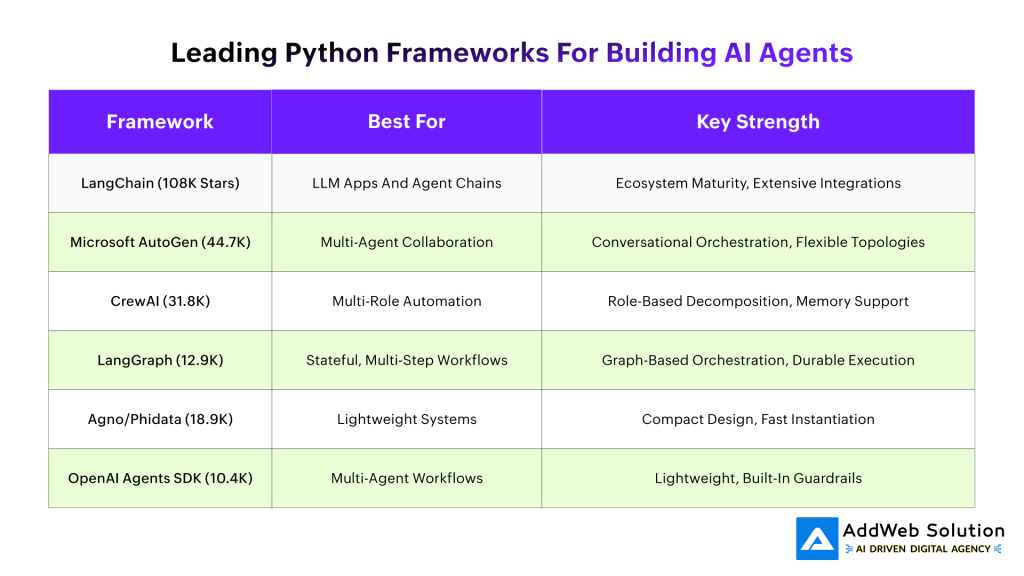
LangChain has the most mature integration ecosystem for enterprise tools. A financial services company automated compliance monitoring with LangChain, reducing manual review by 60%. CrewAI organizes AI into specialized “crews,” similar to how human teams work. An e-commerce company was able to decrease catalog update time by 75% by making use of CrewAI’s role-based agents. Microsoft AutoGen is all about conversational collaboration wherein agents critique and build on each other. A consulting company reduced research time by 40% through the use of AutoGen’s multi-agent knowledge assistant. LangGraph offers graph-based workflows ideal for complex decision-making pipelines with conditional logic and dynamic adaptation.
Transforming Decision-Making Across Industries
Customer Service: From Reactive to Proactive
The most mature application involves customer service, wherein systems field 95% of all customer interactions and resolve 80% of them independently. According to reports from organizations, resolution times have been reduced by 52%, first response times improved by 37-55%, and inquiries handled per agent have gone up by 13.8%. AI-powered systems offer 24/7 support, handle routine inquiries, and proactively identify problems that could be at risk before customers report them. Gartner foresees that by 2029, Agentic AI will resolve 80% of issues autonomously with a 30% reduction in operational costs.
Supply Chain and Logistics: Real-Time Autonomous Operations
Agentic AI transforms supply chain management, where decision-making occurs in real time, rather than weekly or monthly cycles. Almost 80% of supply chain decisions have to be made within hours—agentic AI shrinks the decision-making cycle from days to minutes. The major gains include: 15-25% improvements in demand forecasting accuracy, 30-50% planning efficiency gains, and real-time rerouting based on current conditions. Key improvements include: 15-25% improvements in demand forecasting accuracy, 30-50% planning efficiency gains, and dynamic rerouting based on real-time conditions. In addition to these, IBM’s research points to more and varied uses of agentic AI for dynamic sourcing, procurement optimization, and responding to disruptions rapidly with no human intervention.
Financial Services and Healthcare: Precision Intelligence
Financial institutions use Agentic AI in order to improve fraud detection, risk management, and regulatory compliance. Systems continuously monitor behavior patterns, detect anomalies, and perform immediate corrective actions, achieving a 30% reduction in risk through real-time detection. Healthcare is the fastest-growing adoption segment, while AI agents analyze medical imaging for personalized treatment planning and clinical decision-making support, improving patient outcomes. Manufacturing applications focus on predictive maintenance, reducing downtime by 30% while enabling autonomous quality control that is more consistent than humans.
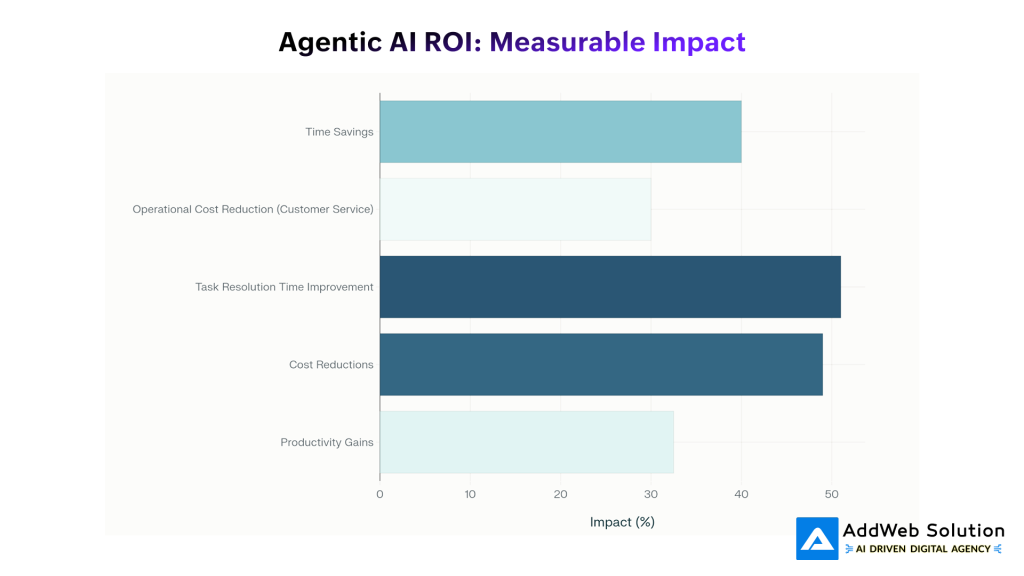
Quantifiable ROI metrics demonstrating how agentic AI delivers 25-68% improvements across productivity, cost reduction, and operational efficiency.
Measuring and Maximizing ROI from Agentic AI
Establishing Comprehensive ROI Frameworks
Successful measurement of ROI depends on the ability to establish baselines for calculations, track both quantitative benefits and qualitative improvements, and account for hard and soft KPIs. The standard formula remains: ROI = ((Total Benefits – Total Costs) / Total Costs) × 100. The hard components of ROI entail labor cost reduction, operational efficiencies, and increased revenues. The soft components of ROI involve enhancement in customer satisfaction, employee experience improvement, and compliance benefits.
Industry benchmarks indicate that middle-market enterprises with $500K-$2M investments achieve 200-400% ROI with payback periods within 8-15 months, while large enterprises investing between $2M-$10M achieve 300-600% ROI with payback periods within 6-12 months. Top performers reach a greater than 500%+ ROI through superior change management and strategic portfolio optimization.
Key Performance Indicators for Autonomous Systems
The key monitoring indicators of success are task completion rates, decision accuracy, the extent of cost reduction-which in some cases reportedly reaches as high as 40% operational cost savings-processing time improvements, impacts on customer-level metrics such as NPS, satisfaction, and retention, and system scaling in light of higher demand. Pre-versus-post comparisons isolate the specific contribution from the agentic AI.
Implementation Strategies and Overcoming Challenges
Assessing Organizational Readiness
Enterprises require complete infrastructure assessment with endorsement of computational capabilities, high-quality data availability, and integrated data sources across systems. Also, clear frameworks are needed on agent behavior, decision-making authority, and audit trails, especially for regulatory compliance. Strategic prioritization of high-impact areas that are ready to be deployed immediately.
Building Strategic Roadmaps
The progressive objectives include intelligent data orchestration, adaptive workflows, and human-AI collaboration frameworks. Organizations maximize value through strategic use case expansion, continuous monitoring via analytics dashboards, and robust change management with employee training and internal champions. Trust is again critical: confidence in autonomous agents declined from 43% to 27% year-over-year, driven by transparency and oversight concerns. It’s essential to address those concerns through clear communication and appropriate human-in-the-loop mechanisms.
Navigating Challenges
Technical challenges include system integration complexity and data quality requirements. Governance requires an active focus by AI ethics and compliance teams on explainability, transparency, and regulatory adherence. Bias in training data, privacy implications, and societal impacts by displacing human decision-makers demand comprehensive ethical frameworks.
The Future Trajectory of Autonomous Intelligence
By 2029, the bulk of regular business processes will be performed by autonomous AI systems, releasing humans to work on strategic initiatives that require creativity and emotional intelligence. Technological evolution points to more sophisticated reasoning, multimodal interaction, and self-improving systems. Market maturation suggests consolidation around proven use cases and vertical-specific solutions.
Early adopters are realizing significant competitive advantages: 25-40% productivity gains, 30-68% cost reductions, and 50-52% task resolution improvements add up over time as autonomous systems learn continuously. Multi-agent collaboration networks will also allow AI agents to solve complex tasks more efficiently than individual systems can. Hybrid architectures offer the right balance between control on-premise and scalability on the cloud. They will grow fastest for regulated industries dealing with sensitive data.
Success metrics should focus on performance, scalability, autonomy, and proactivity, rather than just traditional automation indicators. Some strategic imperatives include building AI-ready data strategies, investing in AI explainability for trust and compliance, and embracing multi-agent approaches that best optimize business processes and customer interactions.
The transformation from generative to agentic AI is more than technological evolution; it fundamentally signals a shift toward autonomous business operations that define competitive positioning in the digital economy. Organizations prepared to embrace this shift, powered with the strong framework provided by Python and strategic implementation approaches, can experience unparalleled capability in decision velocity, operational efficiency, and adaptive intelligence.
Contact our AI strategy team to assess readiness and roadmap for agentic AI adoption.

Pooja Upadhyay
Director Of People Operations & Client Relations
Resources:
- https://www.kdnuggets.com/top-7-python-frameworks-for-ai-agents
- https://www.digitalocean.com/community/tutorials/agentic-ai-frameworks-guide
- https://www.globenewswire.com/news-release/2025/09/04/3144393/0/en/Agentic-AI-Market-Size-to-Reach-USD-199-05-Billion-by-2034-Driven-by-Autonomous-Decision-Making-and-North-Americas-Leadership.html
- https://www.marketsandmarkets.com/Market-Reports/agentic-ai-market-208190735.html
- https://www.geeksforgeeks.org/machine-learning/top-7-python-libraries-for-reinforcement-learning/
- https://neptune.ai/blog/the-best-tools-for-reinforcement-learning-in-python
- https://www.ibm.com/think/insights/ai-roi
