


The context: Laravel worked – until your product changed
If you started with Laravel, you probably made the right call at the time. Laravel gives you batteries‑included scaffolding, auth, queues, mail, ORM, job scheduling, that ships a v1 or v2 remarkably fast.
For classic CRUD dashboards, content‑driven portals, and transactional back‑office tools, it still does an excellent job.
Where teams begin to feel the limits is when the product shifts from “page‑based” to “event‑driven”: live dashboards, collaborative features, in‑app messaging, real‑time bidding, and AI copilots that sit inside the UI and call multiple models per request.
Why Laravel teams are looking at Node.js now
Three structural forces are pushing mature Laravel products toward Node.js in 2025–2026:
- High concurrency and real‑time UX. Node.js’s non‑blocking, event‑driven I/O allows a single process to juggle thousands of concurrent connections without spawning a thread per request, which is exactly what you need for chat, notifications, streaming, and websockets.
- Microservices and event‑driven systems. Node.js aligns naturally with event‑driven architectures, where services publish and consume events asynchronously, decoupling business capabilities and improving scalability and fault tolerance.
- JS/TS across the stack + AI glue. With Node.js, you get TypeScript from frontend to backend, plus a rich ecosystem for orchestrating AI microservices, calling Python models, and streaming inference back to the browser over websockets or Server‑Sent Events.
The result is not “Laravel is bad, Node is good,” but rather that the shape of your application and especially your AI and real‑time ambitions may be misaligned with a traditional monolith.
How Node.js changes your architecture
In Laravel, the dominant pattern is a synchronous HTTP request per page or API call, processed by a short‑lived PHP worker managed by PHP‑FPM or a similar SAPI. In Node.js, the runtime is a long‑lived process, built around an event loop that continuously handles I/O and schedules callbacks as events arrive.
This shift drives several architectural changes:
- From blocking to non‑blocking I/O. Node’s event loop and non‑blocking I/O let your backend remain responsive while waiting on the database, external APIs, or GPT‑like model calls.
- From monolith to event‑driven services. It becomes natural to decompose your system into microservices communicating via events, queues, or streams, increasing decoupling and independent scalability.
- From “page load” mindset to “event stream” mindset. Instead of thinking in pages and forms, you start thinking in events: user joined room, model finished inference, payment updated, anomaly detected.
Here’s a typical Node.js microservices topology for an e‑commerce or SaaS platform:
For a Laravel team, this looks like taking the core monolith and progressively extracting slices, real‑time notifications, reporting pipelines, AI agents into Node‑based services that talk to the existing PHP core via APIs or queues.
Laravel vs Node.js in 2026: strengths by scenario
You’re probably not migrating because of a benchmark graph; you’re migrating because your product roadmap changed. Still, it helps to see how the two stacks line up.
Core trade‑offs at a glance
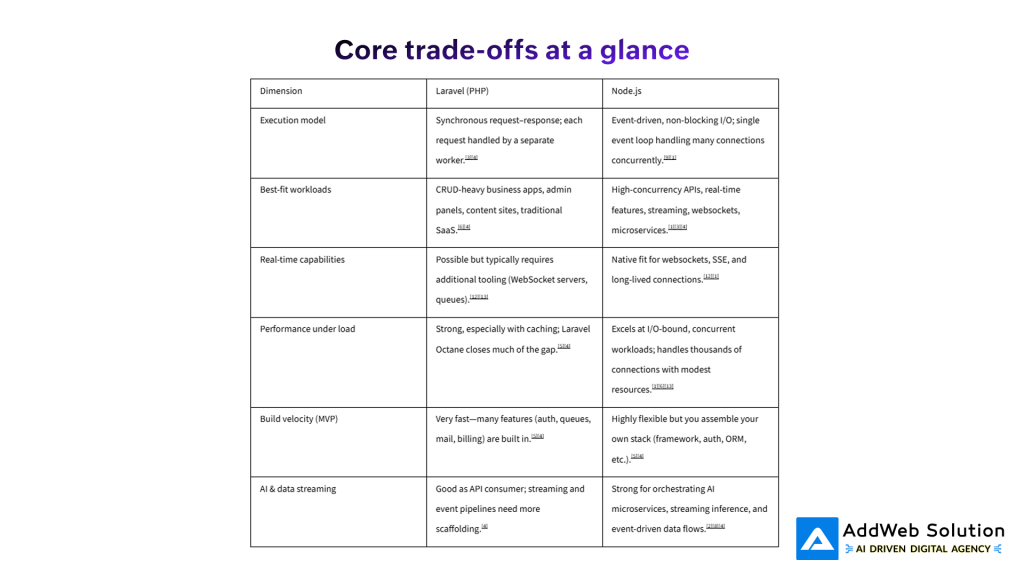
Two under‑appreciated realities you can highlight in your content:
- Laravel Octane narrows the “raw speed” gap. With Octane (Swoole/RoadRunner), Laravel can handle tens of thousands of requests per second, which makes Node’s raw throughput advantage irrelevant for the majority of CRUD‑heavy apps.
- The bottleneck is usually your database and queries, not the framework. For many products, switching to Node.js without fixing data access patterns doesn’t magically solve performance issues.
That’s why a migration only makes sense when the architecture itself, not just the runtime, needs to change.
AI era implications: from APIs to event streams
AI is not just another integration; it changes the structure of traffic and the shape of your backend:
- More long‑lived, chat‑like interactions. Instead of simple request-response, you stream tokens, partial results, or incremental tool calls back to the UI, all highly compatible with Node’s event‑driven model.
- More cross‑service orchestration. A single user action may invoke multiple models, call vector stores, hit feature flags, and write to analytics, all of which suit an event‑driven microservice topology.
- More real‑time signals. Think anomaly detection, personalization, and content recommendations updated as users interact, often via websockets or server‑sent events.
In practice, many teams end up with:
- Laravel still powering billing, admin, and legacy business logic.
- Node.js taking over as the real‑time API gateway, websocket hub, and AI orchestrator layer.
- Python services (FastAPI, Flask, etc.) hosting heavy ML models behind internal APIs or queues, called by Node.
Throughput and concurrency: a mental model
Benchmarks vary widely, but independent comparisons converge on a consistent pattern: Node.js handles high‑concurrency I/O workloads more efficiently than traditional PHP setups, especially for real‑time apps with thousands of simultaneous connections.
The bar chart below gives an indicative view of how teams often experience throughput when pushing Laravel and Node.js under heavy API load (think chat, notifications, or streaming data).
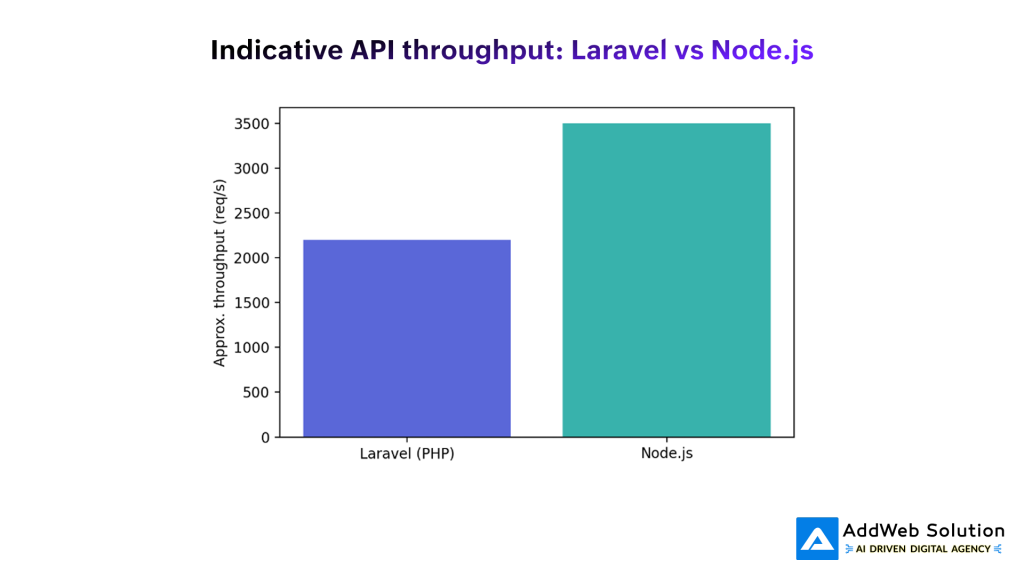
What matters for your narrative is not an exact number; it’s the shape of the curve: as concurrency grows and you add real‑time features, Node’s event loop tends to offer better resource utilization and responsiveness, while Laravel may demand more aggressive horizontal scaling or architecture changes.
Where migration effort actually goes
Many stakeholders assume “migration” means rewriting controllers and routes. In practice, a large share of effort goes into hardening architecture, surfacing observability, and not breaking the business.
Here’s a realistic breakdown of where teams often spend time:
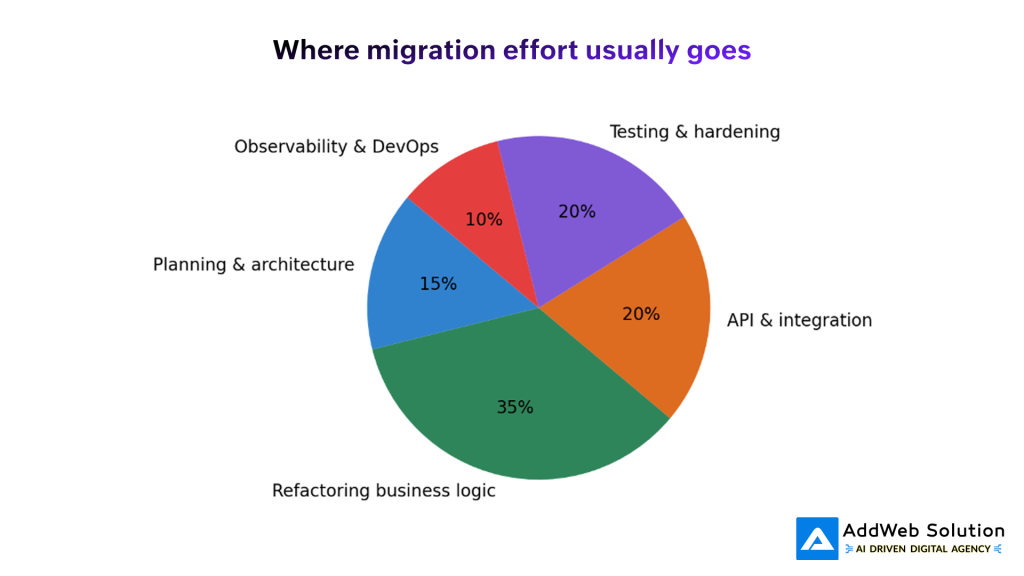
To make that concrete, think of your project in five phases:
- Planning & architecture (15-20%)
- Clarify why you are migrating, what must change, and what can safely stay in Laravel.
- Define target architecture: which services go to Node, which remain in PHP, and how AI services fit in.
- Refactoring business logic (30-40%)
- Identify domain rules buried in controllers, helpers, and views.
- Extract them into well‑defined services or modules before porting to Node.
- API & integration layer (15-25%)
- Design new APIs or event contracts.
- Decide which boundaries are synchronous (REST/gRPC) vs asynchronous (queues, Kafka, Redis streams).
- Testing & hardening (15-25%)
- Contract tests between old Laravel modules and new Node services.
- Load and chaos testing to validate behavior under real concurrency patterns.
- Observability & DevOps (10-15%)
- Centralized logging, metrics, tracing across both PHP and Node.
- Deployment, rollbacks, and blue‑green strategies so you can flip traffic safely.
Framing your migration this way helps non‑technical stakeholders understand that this is less “rewriting in JavaScript” and more “re‑platforming for the next decade of product growth.”


When staying on Laravel is the smarter move
A balanced article should explicitly call out where not to migrate. Here are scenarios where staying on Laravel (or augmenting it) is often more rational than a full move:
- Your app is mostly CRUD, reports, and internal tools. For classic line‑of‑business apps, Laravel with proper caching and query optimization is easily “fast enough.”
- You don’t need heavy real‑time or streaming yet. If “real‑time” means occasional notifications, you can handle this with queues, websockets via PHP integrations, or a small Node sidecar instead of a full rewrite.
- You can get what you need via Laravel Octane. Octane’s persistent process model (Swoole/RoadRunner) significantly boosts throughput, closing much of the gap with Node for many workloads.
- Your team is primarily PHP‑heavy. A rewrite into a stack your team doesn’t deeply understand can erase any theoretical performance gains.
A powerful content angle here is: “If you aren’t hitting the architectural ceilings yet, invest first in profiling, caching, and Octane before considering a full migration.”
Migration blueprint: a pragmatic, low‑drama path
For teams that genuinely need the shift, here’s a battle‑tested blueprint you can adapt into a visual or checklist.
1. Clarify drivers and guardrails
- Align stakeholders on why now: real‑time features, AI roadmap, scaling pain, or a broader microservice strategy.
- Set guardrails: acceptable downtime (ideally near‑zero), performance SLAs, error budgets during cutover.
2. Start with strangler‑fig, not big‑bang
Adopt the strangler‑fig pattern: wrap the existing Laravel app, and gradually route specific capabilities to Node.js instead of rewriting everything at once.
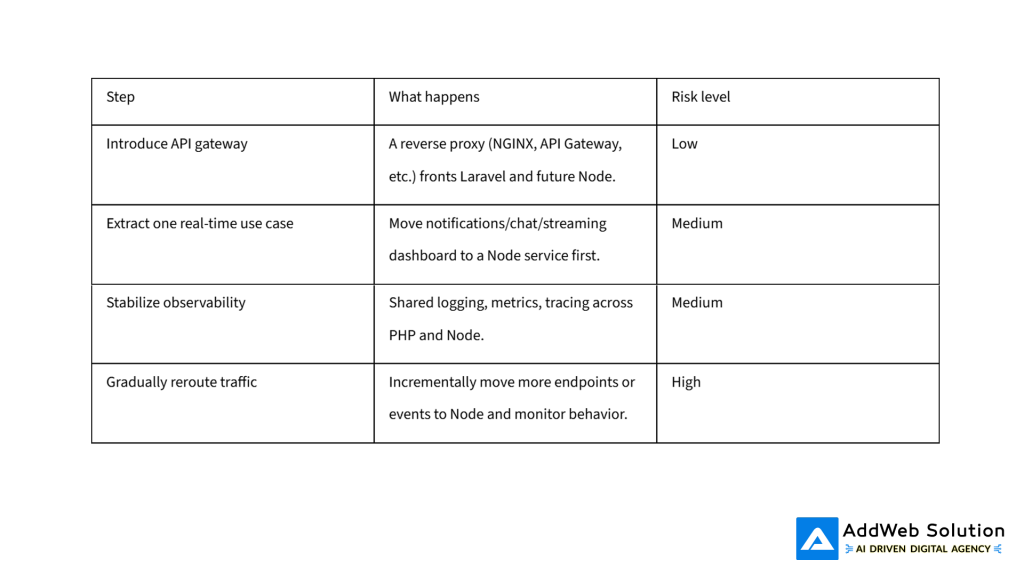
This de‑risks the migration while giving your Node stack time to mature.
3. Design Node.js with AI in mind
When you design the Node side, assume AI workloads will grow, not shrink:
- Prefer TypeScript for stronger contracts between services.
- Choose a framework that fits your style (NestJS, Fastify, Express + your own modules).
- Design for streaming from day one (websockets or SSE) so AI‑driven features can ship faster later.
- Treat calls to Python/ML services as first‑class citizens in your architecture: circuit breakers, timeouts, retries.
4. Stabilize data contracts early
- Define shared DTOs/schemas (OpenAPI, JSON Schema, or protobuf) and keep them in a central repo.
- Introduce contract tests so a change in Node or Laravel that breaks a contract is caught in CI, not production.
5. Cut over gradually and measure relentlessly
- Use feature flags or routing rules to move segments of traffic.
- Track latency, error rates, and resource usage before and after each migration step.
- Keep a clear rollback path, ideally a config change, not a new deploy.
Technical decisions you cannot skip
A thoughtful article should call out a few “non‑negotiables” that often separate successful migrations from painful ones:
- Framework choice and conventions. Pick a Node framework with opinions you can live with (NestJS for enterprise‑style structure, Fastify for performance, Express if you enforce your own architecture) and document conventions early.
- Centralized auth and identity. Avoid duplicating auth logic; centralize identity and token validation so PHP and Node see the same user model.
- Shared domain language. Keep ubiquitous language (entities, actions, events) consistent across Laravel and Node to avoid translation bugs.
- Observability as a feature. Instrument logs, metrics, and traces from day one; event‑driven systems without observability are extremely difficult to debug.
- AI as a first‑class citizen, not a plugin. Model calls, vector lookups, and agent orchestration should be treated like core services, with proper error handling, monitoring, and cost visibility.
Common pitfalls and anti‑patterns
You can also strengthen the post with a grounded cautionary section:
- Big‑bang rewrites. Shutting down the Laravel app and rebuilding from scratch in Node is usually the costliest, riskiest path unless the product itself is being replaced.
- Ignoring the database. Rewriting controllers without addressing N+1 queries, missing indexes, or a poor schema does not yield the performance gains people expect.
- Over‑microservicing too early. Splitting a small product into many Node services increases operational complexity without delivering proportional benefit.
- Insufficient load testing. Node can handle thousands of connections, but every system has limits; test with realistic traffic patterns to avoid surprise regressions.
- Under‑investing in team upskilling. A migration is also a people change: TypeScript, async patterns, event‑driven designs, and DevOps maturity all require deliberate training and hiring.
Quick decision checklist for founders, CTOs, and product leaders
Use something like this as a closing, scannable checklist in the blog:
- Your product requires or will soon require high‑concurrency real‑time features (chat, live dashboards, collaborative editing, streaming).
- You have a clear roadmap for AI‑driven experiences that depend on streaming, events, and orchestrating multiple models and data sources.
- Your team is ready or can realistically be made ready for TypeScript, event‑driven thinking, and improved DevOps practices.
- You’ve already exhausted Laravel optimizations (caching, database tuning, Octane) and still hit architectural ceilings.
- You can commit to a strangler‑fig migration, with observability and testing baked in, rather than a rushed big‑bang rewrite.
If you can honestly check these boxes, a phased migration from Laravel to Node.js, especially with AI at the center of your roadmap, is not just a technology upgrade; it is a strategic move toward a faster, smarter, and more scalable platform for the next wave of product growth.
Planning a Laravel to Node.js migration? Let’s build an AI-ready architecture together.

Pooja Upadhyay
Director Of People Operations & Client Relations
Source URLS:
https://www.geeksforgeeks.org/node-js/explain-the-event-driven-architecture-of-node-js/
https://www.php.org/result/in-what-scenarios-would-using-nodejs-154091
