


Most nonprofit leaders I talk to are stretched thin. Board packets need rewriting the night before the meeting. A funder asks for a refreshed theory of change on short notice. Program data sits in three different spreadsheets while the team debates what it actually means for next year’s priorities.
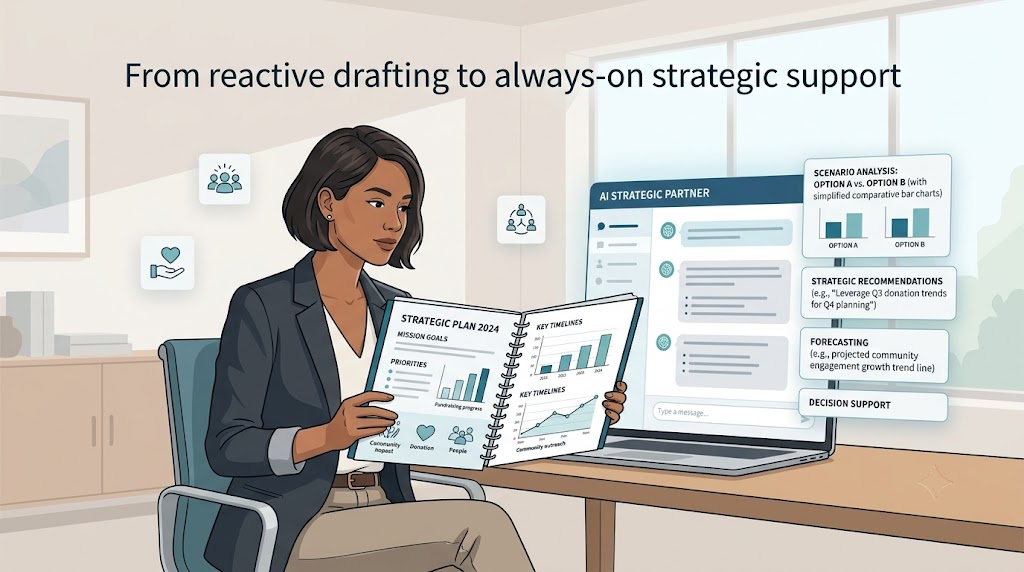
In 2026, large language models are quietly stepping into that gap – not as flashy chatbots, but as patient, always-available strategy partners that help small teams think bigger without hiring another consultant.
The shift feels less like science fiction and more like the moment spreadsheets stopped being optional. LLMs now help nonprofits pressure-test assumptions, draft scenario plans, surface patterns in messy data, and keep institutional knowledge from walking out the door when a key staffer leaves.
The organizations treating them this way are already seeing clearer decisions and faster cycles.
Why strategy work is the real opportunity
Fundraising copy and social posts were the easy first use cases. The higher-leverage work sits further upstream: clarifying mission logic, mapping stakeholder interests, stress-testing program designs, preparing board materials, and turning raw data into decisions.
An LLM can hold the full context of your last three strategic plans, current grant requirements, and recent outcome data at the same time. Ask it to play devil’s advocate on a new initiative, compare two theories of change, or generate the questions a skeptical funder might raise.
The output is not the final answer, it is a fast first draft of the thinking that used to take days of back-and-forth emails.
Teams that treat the model as a thinking partner rather than a content machine report the biggest gains. They keep humans in the loop for judgment, relationships, and values, while letting the model handle synthesis, structure, and rapid iteration.
Where LLMs are already acting like consultants
Real organizations are using these tools for work that once required expensive external support:
- Refining theories of change and logic models by feeding in program data and asking for clearer causal pathways.
- Preparing board and committee packets: summarizing reports, highlighting risks, and generating discussion questions.
- Running light scenario planning (“What happens to our service model if funding drops 20% and demand rises 15%?”).
- Accelerating grant strategy – extracting compliance requirements from dense RFPs, adapting master narratives to new word limits, and identifying alignment gaps.
- Synthesizing community feedback or monitoring data that would otherwise sit unread.
Mercy Corps has used Claude to compress multi-day market analyses into hours and to diagnose complex system issues across country programs. YMCA South Australia reports cutting operational report production from a full day to under 30 minutes and redirecting that time toward community work.
These are not edge cases; they are early signals of a broader pattern.
Adoption reality check: high usage, low strategic depth
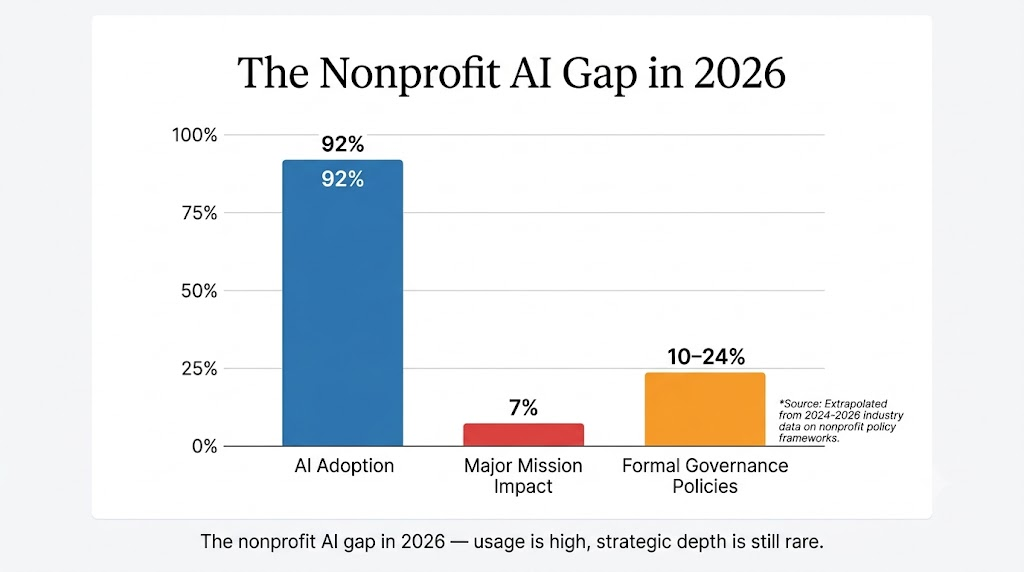
A 2026 survey of 346 nonprofits found 92% are using AI tools in some capacity. That number sounds transformative until you look closer. Only 7% report major improvements in their ability to achieve their mission.
Sixty-five percent describe their use as reactive and individual – staff experimenting on personal accounts with little coordination. Nearly half still lack any formal AI governance policy.
The gap is not technology. It is intentionality. Most organizations are stuck at the efficiency layer (faster emails, quicker first drafts). The ones moving into strategy are the ones that treat LLMs as part of their planning process, set clear guidelines, and measure whether the time saved actually reaches mission work.


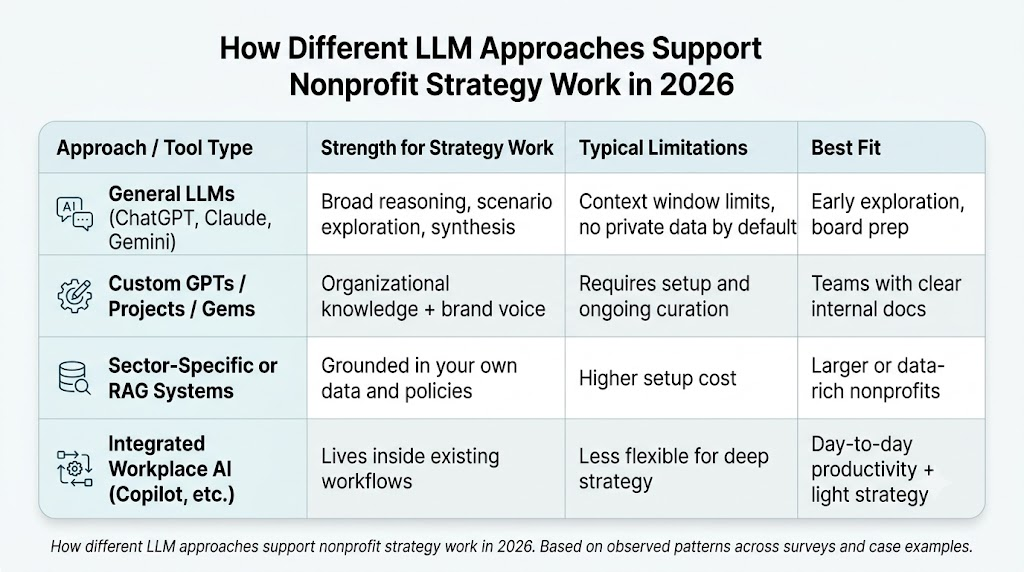
Practical comparison of common tools and approaches
What the numbers show about impact and growth
Overall AI adoption across organizations has climbed steadily. Generative AI use in at least one business function rose from roughly one-third a few years ago to around 70% in recent surveys. In the nonprofit space the pattern is similar: rapid experimentation followed by a slower climb toward embedded, strategic use.
The organizations that report the strongest results are those that reinvest the time savings into relationship work, deeper analysis, or program design rather than simply doing more of the same tasks faster.
Average weekly time savings appear across many studies; the difference between modest and transformative impact comes from what leaders choose to do with those hours.
Interesting Fact Box
- 92% of nonprofits in a 2026 benchmark of 346 organizations report using AI tools, yet only 7% say it has produced major improvements in mission delivery.
- 65% describe their AI use as reactive and individual rather than coordinated.
- Nearly half of organizations still operate without a formal AI governance policy. Sources: 2026 Nonprofit AI Adoption Report (Virtuous survey of 346 organizations); supporting sector surveys.
Practical takeaway
Start with one high-stakes strategic question your team already struggles to answer well. Feed the model the relevant documents, ask it to challenge your assumptions, and force yourself to improve the prompt until the output is useful. Document what worked. Set simple rules about data privacy and human review. Then expand.
The organizations that treat large language models as always-on strategy consultants in 2026 will not be the ones with the biggest budgets. They will be the ones that pair curiosity with discipline.
At AddWeb Solution we help nonprofits and social-impact teams design practical AI workflows that respect their values, protect their data, and free staff to focus on the relationships and decisions only humans can make.
Turn AI Into Your Nonprofit’s Strategy Partner

Pooja Upadhyay
Director Of People Operations & Client Relations
Source URLs:
https://virtuous.org/blog/2026-nonprofit-ai-adoption-report/
https://claude.com/customers/mercy-corps-qa
https://claude.com/customers/ymca-south-australia
https://institute.blackbaud.com/resources/ai-effectiveness-gap
https://www.philanthropy.com/solutions/make-ai-your-strategic-thought-partner-heres-how/
https://resourcera.com/data/artificial-intelligence/llm-statistics/
