


Modern FinTech solutions are employing Node.js as their technology of choice for developing real-time payment APIs, trading platforms, risk management systems, and digital wallets due to the ability of this technology to offer ultra-low latency due to its event-driven, asynchronous nature and scalability, yet being flexible and cloud-native.
With proper patterns being applied (caching, streaming, microservices, and performance tuning), Node.js allows FinTech applications to process millions of transactions and tens of thousands of concurrent connections.
Why Latency Is Existential in Modern FinTech
For most FinTech applications, latency is not a metric one could ignore, as it has a direct impact on their performance, financial results, risks, and overall user satisfaction.
For example, a payment API with 200–300ms additional latency may lead to cart abandonment, whereas an asynchronous trading platform being a few milliseconds behind the market may lose money on every order. Risk engines’ high latency may affect both approvals and potential fraud detection.
For high-frequency platforms such as trading engines, real-time wallets, and instant loan decisions, latency requirements are stringent: sub-100ms for mission-critical APIs and even sub-millisecond paths in certain trading conditions.
It’s precisely in meeting these requirements under conditions of burst traffic that Node.js, along with the proper architecture, shows its worth.
Why Node.js Fits Real-Time Finance
Node.js employs an event-driven, non-blocking I/O architecture that allows handling thousands of simultaneous network connections in one process without spawning a separate thread per each request.
Node.js is particularly well-suited for FinTech workloads that are I/O-intensive (network, database, APIs), not CPU-bound, such as payment processing, account balance queries, quotes, notifications, and real-time feed processing.
There are additional factors in the ecosystem that make Node.js a sensible choice.
Popular frameworks like NestJS and Express.js, streaming solutions like Socket.io, KafkaJS for streaming, Redis clients for caching, and Decimal.js for precise arithmetic are becoming de facto standards for building fintech applications using Node.js.
Well-established security mechanisms, such as Helmet.js and various validation frameworks, are another strong selling point for a regulated environment.
Where FinTech Companies Are Using Node.js Today
FinTech developers have a tendency to use Node.js in certain very specific areas of their stacks, those where concurrency, efficiency, and high-speed integrations matter.
Major Node.js Applications in FinTech
- Payment gateway and settlement APIs (card payments, UPI, wallets, P2P payments).
- Trading dashboards and market data streams using WebSockets for tickers, order books, and charting.
- Risk scoring and fraud detection systems based on streaming events using Kafka/Redis and scored almost in real time.
- Open banking and PSD2-style APIs providing access to account, transaction, and identity data.
- Digital wallets and neobank backend systems (multi-currency accounts, tokenized cards, real-time notifications).
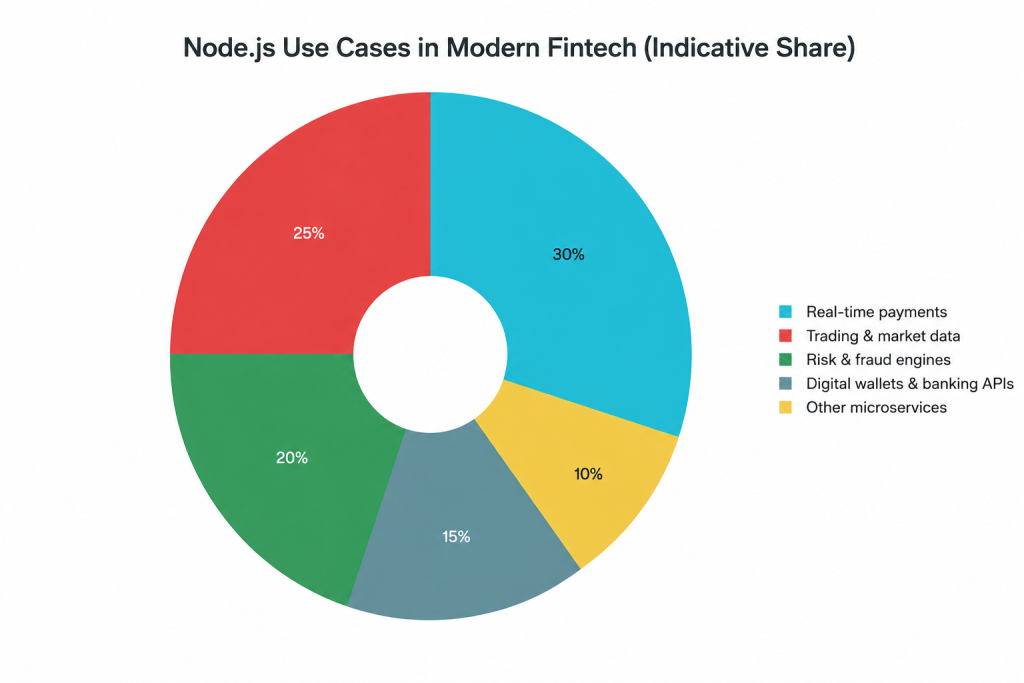
Conceptual Pie Chart: Node.js Use Cases in FinTech
The distribution below is indicative rather than a strict market share, but it reflects how Node.js is typically deployed across fintech workloads described in real case studies and service offerings.
Pie chart: Node.js use₹ cases in modern fintech
Performance Case Studies: What “High-Frequency, Low-Latency” Looks Like
These examples prove the potential of Node.js architecture when implemented correctly.
- Migration to microservices using Node.js for a financial platform allowed achieving throughputs of more than 2,500 requests per second with average response times less than 100ms and 99.99% uptime.
- Back-end of a digital payments application was migrated from legacy to Node.js (Express + Socket.io + Redis), which helped to scale from 10k to 500k users with the reduction of the response time from ~900ms to less than 150ms and 99.99% uptime.
- Match engine on Node.js (Redis + Kafka + Lua scripts + WebSockets) handles up to 80k–120k orders per second with real-time matching and order book synchronization.
Such results can be achieved only via consistent architectural principles: non-blocking I/O, caching, event streaming, microservices, and observability.
Table: Typical Node.js FinTech Workloads vs Platform Goals
| Workload | Primary Goal | Node.js Role |
| Real‑time payments API | Sub‑100ms response, high uptime | Non‑blocking REST/GraphQL layer, Redis caching.[2][4][6] |
| Trading dashboard & order feed | Live updates, low jitter | WebSockets, streaming via Kafka/Socket.io.[3][9] |
| Risk & fraud scoring pipeline | Near real‑time decisions | Event consumers, risk API frontends.[3][7][9] |
| Open Banking / partner APIs | Secure, high‑volume integrations | Microservices API gateway, validation & auth.[3][5] |
| Wallet & neobank backend | Scalability, UX responsiveness | Session handling, notifications, user APIs.[3][6] |
Architectural Patterns for Low-Latency Node.js FinTech Platforms
High‑frequency FinTech on Node.js is more about architecture and ops than just the language. And there are commonalities in the architectures of those that won.
1. Event-Driven Microservices
The FinTech industry is moving towards event-driven microservices where each microservice has a well-defined scope of work (“Payments API”, “Risk Scoring”, “Notifications”).
Node.js matches this pattern very well because service can respond to queues and streams in an asynchronous manner, handling huge amounts of messages without blocking threads.
This means that critical path of actions such as “place order” or “authorize payment” can stay short and fast while other intensive processes like analytics or reporting are performed by other consumers.
2. WebSockets and Streaming for Market & UX
Trading platforms and wallet applications need WebSockets or Server-Sent Events to receive continuous feed with price ticks, changes in the order book and balance and notifications.
Node.js with the use of Socket.io or built-in support for WebSockets can push notifications to thousands of users instantly without using expensive polling mechanisms.
Internal streaming also plays very important role: KafkaJS and other clients allow subscribing to real-time transaction or risk or ledger streaming.
3. Aggressive Caching and In-Memory Data Structures
In the FinTech industry, a lot of reliance is placed on the usage of Redis with Node.js. This may include caching user sessions, rate limiting, saving one-time passwords (OTPs), risk flags, and order books.
Since Redis is an in-memory database, there won’t be any round-trip time to a slower database to get commonly accessed data such as account summary, latest price, and risk scores.
Trading engines may have an in-memory order book and risk ledger powered by Lua scripts and pipelines capable of handling up to 10,000 transactions a second.
4. Binary Protocols and Compact Payloads
JSON verbosity through REST creates an overhead with every request and makes this approach costly for services that tend to communicate frequently. In order to achieve true low latency inter-service communication, binary protocols (gRPC, Protocol Buffers, MessagePack) are preferred by fintech Node teams.
It not only allows reducing the cost of serialization but also imposes strict schema constraints, which is crucial in financial systems where every field has legal consequences (currency, amount, risk flags).


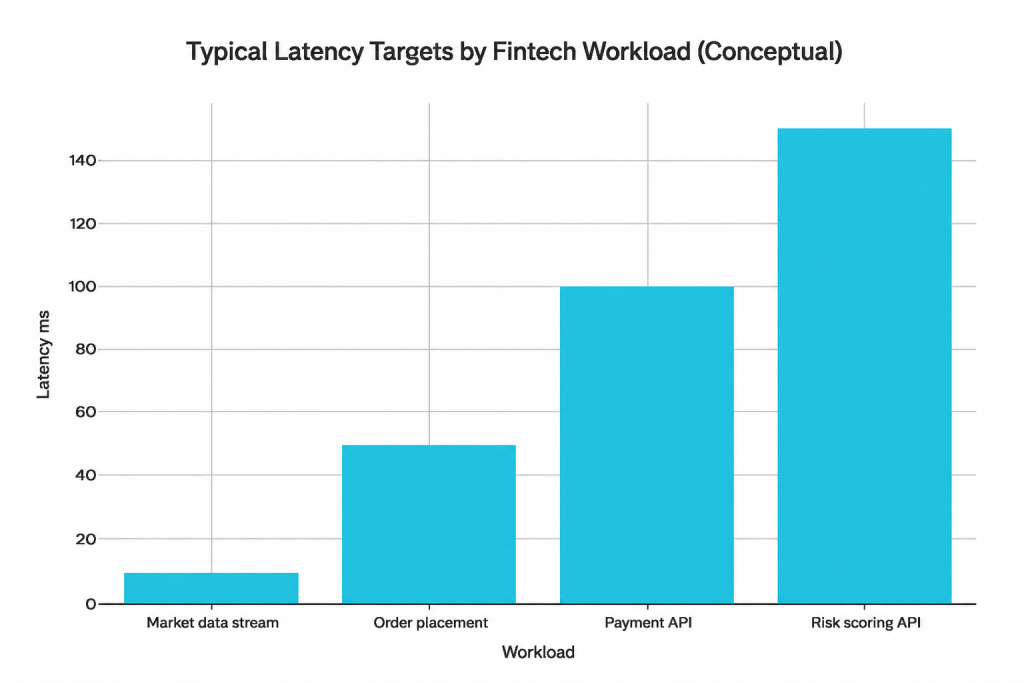
Chart: Conceptual Latency Targets by Workload
Different fintech use cases can endure different latencies, and internal service level objectives are defined for each workload based on these tolerances (e.g., <10ms on certain HFT paths, <50ms for placing an order end-points, 100-150ms for customer payment APIs).
Bar chart: conceptual latency targets by workload
Techniques Node.js Teams Use to Achieve Low Latency
In addition to the architectural approach, performance engineering techniques determine whether your system will be a real high-frequency platform or simply another “just Node.js” project.
1. Event Loop Isolation
Blocking operations, such as synchronous file system operations, intensive cryptography operations, or any intensive synchronous computation, can block the event loop and affect the latency. This is why FinTech companies:
- Use blocking API functions (for example, fs.readFileSync, synchronous cryptography).
- Move intense CPU-bound operations into workers or separate microservices.
- Keep track of event loop latency via perf_hooks or trace events.
2. Optimizing Networking and Serialization
Network latency adds up very fast with multiple calls between services for each request made. The following Node.js API optimizations are done for reducing number of hops and overhead:
- Utilizing HTTP/2 or gRPC for multiplexed, binary communication where low latency is a requirement.
- Optimizing serialization (Protocol Buffers, MessagePack) for internal calls between services over verbose JSON, especially in microservices architecture.
- Optimizing connection pool and timeout for upstream services like databases, risk engine or external payment gateways.
One such optimization write-up involves optimizing the Node.js API to have < 1ms latency for certain endpoints with fine-tuned event loops, low allocations, and optimized network settings, based on the realization that 1ms matters in financial trading.
3. Memory Management and Garbage Collection
As garbage collection stops can cause latency spikes, high frequency Node.js applications have to be cautious regarding allocation of memory. Teams:
- Opt for buffer reuse instead of allocating new buffers per request.
- Utilize memory profiling to detect memory leaks and large objects to reduce GC pressure.
- Tune Node.js runtime options based on their workload requirements.
4. Horizontal Scaling and Auto-Scaling
Even the most well-tuned Node.js applications have their limits when it comes to handling loads; horizontal scaling and autoscaling are necessary. FinTech applications employ:
- Cluster mode or container orchestration (Kubernetes, Amazon ECS) for running several Node.js instances behind load balancers.
- Autoscaling policies depending on CPU, memory usage, queue length, or latency SLA to start and stop instances as needed.
- Blue/green or rolling deployments with health checks and connection draining to prevent outages during deployment.
Example: A Node.js HFT Match Engine
An open-source HFT project serves as an example of the use of Node.js for high-frequency matching with extremely high throughput. This architecture involves:
- Node.js for the core logic of the match engine and web-socket based front-ends.
- Redis for maintaining order books and running Lua scripts processing the orders in-memory with extremely high performance.
- Kafka for sending orders, trades, and charts streams to different consumers in real-time.
This particular engine processes around 80k-120k orders per second in price-time order, partially filling the orders and synchronizing the order books, demonstrating that Node.js is capable of being part of the serious trading infrastructure, especially when used in conjunction with special infrastructure, such as in-memory storage and message brokers.
Meanwhile, community discussions show that ultra-low latency HFT at the nanosecond level in the traditional capital markets usually requires C++ or highly optimized Java stack.
Limits and the “Right Workload” for Node.js
There’s not always a place for fintech workloads in Node.js, and high-frequency teams often use a mix of technologies. Java and .NET continue to rule many bank engines and risk engines because of legacy investments, multithreading support, and strict regulatory environments.
Node.js works best if:
- There’s lots of I/O (network, API calls, database) rather than number-crunching.
- Real-time UX and responsiveness are more valuable than absolute low-latency of single operations (like consumer payments versus sub-microsecond algo trades).
- Speed of development, a single programming language for both front- and backends, and a great web-friendly ecosystem are priorities.
Hybrid architecture solutions are increasingly popular: Java does all the risk and settlement processing; Node.js powers real-time APIs, dashboards, notification systems, and partner integration. And that’s how Node.js works its magic quietly behind many successful fintech solutions.
Table: Node.js Strengths vs Trade-Offs in High-Frequency Finance
| Aspect | Node.js Strengths | Trade-Offs / Considerations |
| Concurrency | Excellent for handling thousands of concurrent requests. | Single‑threaded event loop; CPU‑heavy tasks need offloading. |
| Latency | Very low latency on I/O‑bound APIs with proper tuning. | GC pauses and blocking calls can create spikes if not managed. |
| Ecosystem | Rich tooling for web, streaming, security, and microservices. | Financial math and legacy integrations may require extra libraries or services. |
| Compliance | Can be made PCI‑DSS / SOC2‑aligned with proper practices. | Requires discipline in dependency auditing and secure coding. |
| HFT suitability | Strong for high‑volume I/O and order routing with in‑memory stores. | Deep, ultra‑low latency HFT often still favors C++/Java. |
Implementation Checklist for CTOs and Lead Engineers
To make this article directly useful for your enterprise audience, here is a concise checklist you can adapt into your own content or internal decks:
- Clarify latency SLOs per workload (payments, trading, risk, wallets) before choosing tools.
- Identify I/O‑heavy paths that are strong candidates for Node.js (APIs, dashboards, streaming feeds).
- Design event‑driven microservices with Kafka/Redis where Node.js services focus on fast I/O and orchestration.
- Use WebSockets for live UX instead of polling wherever market data, balances, or notifications need to feel real‑time.
- Adopt binary protocols and compact payloads for internal calls where latency really matters.
- Instrument event loop latency, memory, and GC and treat spikes as production incidents.
- Separate CPU‑heavy analytics (risk, pricing, simulation) into services more suited for multi‑threaded or compiled environments, exposing them via fast APIs to Node.js frontends.
- Bake compliance and security into the pipeline: PCI‑DSS readiness, OAuth2/OpenID Connect, dependency scanning, audit logging.
This framing should align well with your usual enterprise‑focused, visually rich, SEO‑optimized content style for AddWeb: it treats Node.js not as hype, but as a pragmatic choice for high‑frequency, low‑latency fintech workloads when used with the right architecture and performance engineering discipline.
Let’s design a Node.js architecture that delivers real-time performance, enterprise-grade security, and seamless scalability.

Pooja Upadhyay
Director Of People Operations & Client Relations
⁂
- https://www.unosquare.com/nodejs-development-for-fintech/
- https://marketplace.quicknode.com/add-on/address-risk-scores
- https://www.reddit.com/r/node/comments/br41xw/is_nodejs_suitable_to_develop_enterprise_fintech/
- https://github.com/opensourcerisk/engine
- https://www.index.dev/skill-vs-skill/fintech-backend-expressjs-vs-koajs-vs-fastify
- https://medium.com/@dickensjuma13/building-a-scalable-fintech-api-with-node-js-and-redis-b6d489e2c5a7
- https://medium.com/@hadiyolworld007/node-js-microseconds-cutting-latency-below-1ms-for-apis-4a08a53a74c2
