


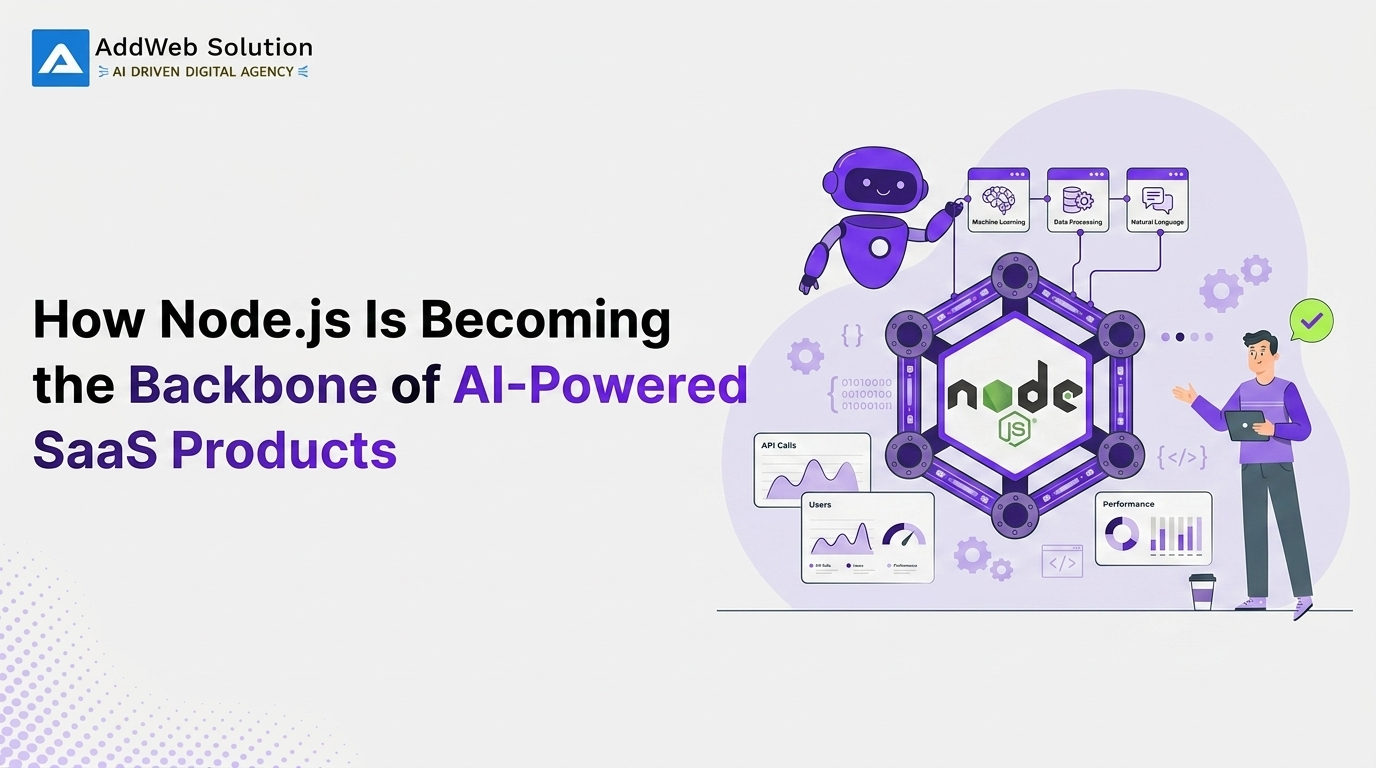
In addition to these features, Node.js has become the go-to framework for the backend of many AI-powered SaaS startups owing to its ability to work with data in real time and its huge developer community.
As people implement LLM APIs, data pipelines, and billing services into their product, they build backend with Node.js.
Why AI-Powered SaaS Needs Powerful Backend?
Nowadays AI is not an additional component for your app, it is a core one. By 2026, 80% of all SaaS apps will use some kind of AI capabilities due to automation, intelligence and data-driven insights.
A typical architecture of an AI-powered SaaS app includes:
- Real-time processing of user interactions (chat, search, assistants).
- Coordination of requests to other AI APIs (such as OpenAI or Anthropic).
- Returning answers to user query token by token, not waiting for the whole response.
- Handling complex workflows (queueing, webhooks, scheduling tasks).
- Integration with payment providers, CRM and analytics systems.
All these features combined together can be implemented on the Node.js backend.
Node.js Adoption: The Numbers Behind the Trend
It is not only highly used, but also widely adopted in production systems.
- According to various statistics, at least 30 million websites in the world operate using Node.js as of 2026.
- Node.js constitutes 6.6% of all websites that have web servers detected and is used by popular sites like Netflix, PayPal, Zoom, GitHub, Spotify and others in subdomains and inner pages.
- Node.js is downloaded more than 130 million times per month with an increase of roughly 40% per year.
- More than 36% of professionals use Node.js for building apps, and 271,000 companies started using Node.js in 2024.
- Among JavaScript backends, Node.js takes up more than 90% of the market, while among all server-side frameworks Node.js takes up more than 35% in certain sources.
In other words, if you are building JavaScript backends for SaaS products, then Node.js is your go-to solution.
Typical AI SaaS Architecture with Node.js
The structure of an SaaS solution built on the basis of AI may look like this:
- Frontend: React, Next.js, SvelteKit, Flutter for web, or any other frontend solution.
- Backend: Node.js (often together with Express, NestJS, Fastify, or any serverless solution).
- AI layer: external LLM APIs (OpenAI, Anthropic, Groq), as well as some Python microservices for classic machine learning solutions.
- Database layer: Postgres, MySQL, MongoDB, vector databases (Pinecone, pgvector, Qdrant).
- Infrastructure: Docker, Kubernetes, serverless functions, queues, and cloud (AWS, Azure, GCP).
For instance, Node.js can be used for:
- Gateway and Orchestrator for the AI API, databases, and connection with other services.
- Webhooks and Background Processes (payments, notifications, retraining).
- Real-time server for streaming tokens into UI using WebSockets or Server-Sent Events.
Where Node.js Sits in the AI SaaS Stack
Here’s a concise view of how Node.js fits into a typical AI SaaS product:
Node.js in the AI SaaS Layered Stack
| Layer | Responsibility | Typical Node.js Role | Why Node.js Works Well |
| Presentation (Frontend) | UI, dashboards, chat interfaces | Not applicable (consumed via REST/GraphQL/WebSockets) | Tight integration via JSON APIs |
| API & Orchestration | Routing, auth, streaming, rate‑limits | Express/NestJS/Fastify, serverless functions, BFF pattern | Non‑blocking I/O, easy middleware, JWT/session auth |
| AI Integration | LLM calls, tool orchestration, prompt flows | Node clients for OpenAI, Anthropic, Groq, custom AI proxy layer | Easy to stream responses, centralize guardrails |
| Data & Persistence | Relational, NoSQL, vector, cache | Node ORM (Prisma, TypeORM), direct drivers, Redis, queues | Async DB access, worker queues, event‑driven design |
| Billing & Webhooks | Payments, subscription lifecycle | Stripe webhooks, event handlers, audit logging | Strong ecosystem, secure server‑side key handling |
| Operations & DevOps | Deployment, monitoring, scaling | Node microservices, Dockerized apps, serverless handlers | Lightweight runtime, works well with cloud tooling |
This is the backbone role: Node.js is the “traffic controller” for AI features, tying UI, AI services, data, and billing into one coherent product.
Visual: Typical AI SaaS Features Running on Node.js
It’s not just the presence of AI features in AI SaaS that is prevalent; rather, it’s the many layers of AI workflows running on the same Node.js backend.
Common categories of features include:
- AI chatbots and virtual assistants for customer support.
- Insights from the data (including forecasting and anomaly detection).
- Automated workflow tasks (ticket routing, lead scoring, follow-ups).
- Recommendation systems (for content, products, actions).
Below is the pie chart giving an illustrative idea of where Node.js fits in the AI SaaS features (the figures shown are indicative, based on no one particular data set):

You can adapt this distribution to your own product by replacing the labels with your actual feature mix (support, analytics, ops tooling, etc.).
Why Node.js is an obvious choice for AI-powered SaaS services
There were several issues that Node.js solved perfectly and that led to it becoming a standard in the field of AI-powered SaaS development.
1. Non-blocking, event-driven I/O
An AI-based SaaS will have lots of parallel requests to make to external resources: AI API services, databases, search indexes, payments systems, webhooks.
The architecture of Node.js allows making thousands of such requests in a non-blocking and event-driven way without creating costly threads for each request.
It is most important when you have to:
- Streaming AI response as well as fetching user context from the database.
- Using several services for search, retrieval and calculation in one AI call.
- Executing background tasks for training and reindexing concurrently.
2. Real‑Time Streaming and UX
No one wants to look at a spinner while the AI is thinking. SvelteKit and Next.js AI SaaS developers consider token streaming as a mandatory part of user experience.
Node.js allows you to easily:
- Stream tokens one-by-one from LLM APIs to the front-end through Server-Sent events or WebSockets.
- Notify users about the completion of lengthy operations (forecasting, data ingestion).
- Ensure responsiveness even with lots of traffic.
3. Huge Ecosystem (npm) and AI‑Friendly Libraries
There are millions of packages available on npm and Node.js serves as the default run-time engine.
This implies that for AI SaaS there will be:
- Official and community SDKs of OpenAI, Anthropic, Groq and other AI providers
- Proven libraries for HTTP, WebSockets, queue (Express, Fastify, Socket.IO, BullMQ)
- Integrations for Stripe, PayPal, HubSpot, Salesforce and other critical SaaS systems
- Dev tooling for logging, observability, configuration and testing
Usually you won’t have to reinvent the wheel when connecting your AI capabilities to the rest of your SaaS infrastructure.
4. Developer Adoption and Hiring Advantage
One-third of all professional developers currently leverage Node.js, and its popularity keeps rising. Over 90% of websites utilize JavaScript, and studies show that about 68% of backend developers are familiar with Node.js.
From a practical perspective, you get:
- A large pool of candidates for backend and full-stack development.
- Smoothing up the learning curve for frontend developers switching to backend.
- Common language (TypeScript/JavaScript) for frontend, backend, and dev tools.
For a founder or CTO of SaaS startup, it’s a low-risk solution: recruiting more people or contractors to join your Node-based stack is easier than with niche runtimes.


Visual: Reasons for Using Node.js for AI SaaS
Interviews, articles discussing architecture, and other sources highlight some common reasons for which Node.js is preferred for AI SaaS by different teams.
Below is a bar graph showing the reasons in comparison with each other (concepts again and not from a particular survey dataset):

This can be mapped directly to your situation:
- For products that have streaming and integration capabilities, “Real-time I/O” and “npm ecosystem” will matter most to you.
- For optimization around hiring and maintenance, “Developer adoption” is more important.
- When working in Kubernetes and serverless environments, “Cloud-native tooling” is what makes Node.js appealing.
Node.js and AI APIs: Practical Integration Patterns
On the ground, AI SaaS teams are doing three things repeatedly in Node.js backends.
1. Secure AI API Proxy
Best practice is to never call AI APIs directly from the browser; keys should stay on the server.
Node.js typically:
- Exposes a secure endpoint (e.g., /api/assistant) that receives user messages.
- Enforces authentication, rate limits, and input validation (to avoid prompt injection and abuse).
- Calls the AI provider (OpenAI, Anthropic, Groq) from the server using official SDKs.
- Streams the response back to the client in real time.
This pattern lets you swap AI vendors later without changing frontend code and keeps keys off the client.
2. Caching and Cost Control
AI calls are powerful but expensive. Teams integrate caching strategies directly into Node.js middlewares and services.
Common patterns:
- Store repeatable results (summaries, embeddings for the same document) in Redis or MongoDB keyed by a hash of the input.
- Use background jobs to precompute embeddings or summaries for frequently accessed documents.
- Track token usage per user or per workspace and enforce soft and hard limits to control spend.
Because Node.js is event‑driven, these caches and jobs can be wired in without blocking interactive requests.
3. Hybrid AI + Traditional ML
Many serious AI SaaS platforms combine LLMs with traditional ML and forecasting models. An example production stack:
- Backend: Node.js + Express for auth, data ingestion, and assistant endpoints.
- ML Service: Python + FastAPI hosting models like Prophet for 30‑day revenue forecasts.
- Database: PostgreSQL + Prisma ORM for relational data and forecasts.
- AI Assistant: LLM (e.g., Groq Llama 3.3, OpenAI, Anthropic) answering questions about the company’s real data.
Node.js coordinates the data flows: uploading CSVs, mapping columns, calling the ML service, storing predictions, and exposing them to the AI assistant and dashboard.
Node.js vs Other Backends for AI SaaS
Node.js isn’t the only runtime used for AI SaaS, but its trade‑offs are favorable for many products.
Comparing Node.js with Python and Deno/Bun
| Criteria | Node.js | Python | Deno/Bun |
| AI ecosystem integration | Strong SDKs for LLM APIs, SaaS tools | Very strong for ML frameworks | Growing, not yet as broad |
| Real‑time streaming | Excellent for WebSockets/SSE | Possible, but more boilerplate for async | Good, still maturing |
| ML model hosting | Usually delegates to Python microservices | Native; ideal for training/inference | Often proxies to other services |
| Developer adoption | ~36% of pros use Node.js; 271k companies in 2024. | Widely used in data/ML engineering | Rising in experimental projects. |
| Ecosystem & packages | npm, millions of packages, JS/TS focus. | pip/conda, data science focus | Smaller ecosystems, modern APIs. |
| Fit for AI SaaS backbone | Very strong for orchestration & UX | Strong for ML, good as core backend too | Strong for greenfield projects, less proven |
The common pattern is: Python for ML engines, Node.js for SaaS orchestration. Deno and Bun are interesting but still emerging in production for complex AI SaaS workloads.
Business Impact: Why Node.js Matters Beyond the Tech
Ultimately, Node.js is becoming the backbone of AI‑powered SaaS not just because engineers like it, but because it supports key business outcomes.
- Faster time‑to‑market: With ready‑made boilerplates and starter kits, teams can launch AI tools over a single weekend using SvelteKit or Next.js frontends and Node.js proxies.
- Lower operational costs: AI + Node.js can automate up to 70% of support queries via chatbots, and some CRM platforms report around 40% reductions in manual lead qualification when they add AI automation on top of Node.js backends.
- Scalability: Node.js’s performance profile and ecosystem help reduce loading times by up to 50–60% and even cut development costs, according to several industry reports.
- Competitive advantage: Early adopters of AI‑powered Node.js solutions gain faster workflows, more intelligent products, and more responsive user experiences.
If you’re building or scaling an AI‑driven SaaS, treating Node.js as your backbone runtime is not just a technical preference, it’s a strategic decision that can directly influence your product velocity, UX quality, and operating margin.
Practical Suggestions for Your Next AI SaaS Build
To make this concrete for your own content and product strategy, here are some actionable angles you can use:
- Architecture blog idea: “From LLM Prototype to Production AI SaaS: Our Node.js Stack”, walk through your API gateway, streaming implementation, caching layer, and observability.
- Technical deep‑dive: A post on streaming responses in Node.js with SSE/WebSockets while proxying OpenAI/Anthropic APIs, including cost and guardrail patterns.
- Business‑focused content: Case study on how AI chatbots and predictive analytics built on a Node.js backend reduced support load or improved sales forecasting.
- SEO‑friendly pillar page: Comprehensive guide comparing Node.js vs Python vs Deno/Bun for AI SaaS, with clear use‑case recommendations backed by adoption stats.
These angles let you stay factual, visually interesting (with charts, tables, and diagrams), and aligned with how teams are actually shipping AI‑powered SaaS products in 2026.
Need a backend that can handle AI workloads efficiently? Let our experienced Node.js developers build a future-ready SaaS architecture tailored to your business.

Pooja Upadhyay
Director Of People Operations & Client Relations
- https://w3techs.com/technologies/details/ws-nodejs
- https://gitnux.org/javascript-statistics/
- https://www.pyboilerplate.com/en/boilerplates/backend-framework/nodejs/
- https://dev.to/saqibshah/architecting-a-profitable-ai-saas-in-2026-sveltekit-nodejs-3omk
- https://medium.com/@srikanthenjamoori/supercharging-your-node-js-app-with-openai-gpt-apis-a-practical-guide-0fc357d4e7b6
- https://w3techs.com/technologies/breakdown/ws-nodejs/programming_language
- https://www.programming-helper.com/tech/node-js-2026-runtime-adoption-deno-bun-python


