


Business process automation has progressed from being a source of competitiveness to a requirement in the current fast-paced digital world. Organizations in various industries are adopting Python-driven automation solutions to automate processes, minimize expenses, and speed up growth. The latest industry statistics indicate that companies deploying Python business process automation earn an average ROI of 240% within 6-9 months, with high-flying organizations yielding up to 390% ROI. This outstanding return on investment is a result of Python’s special blend of ease of use, versatility, and high-level automation features that turn tedious manual operations into high-productivity, flawless workflows.
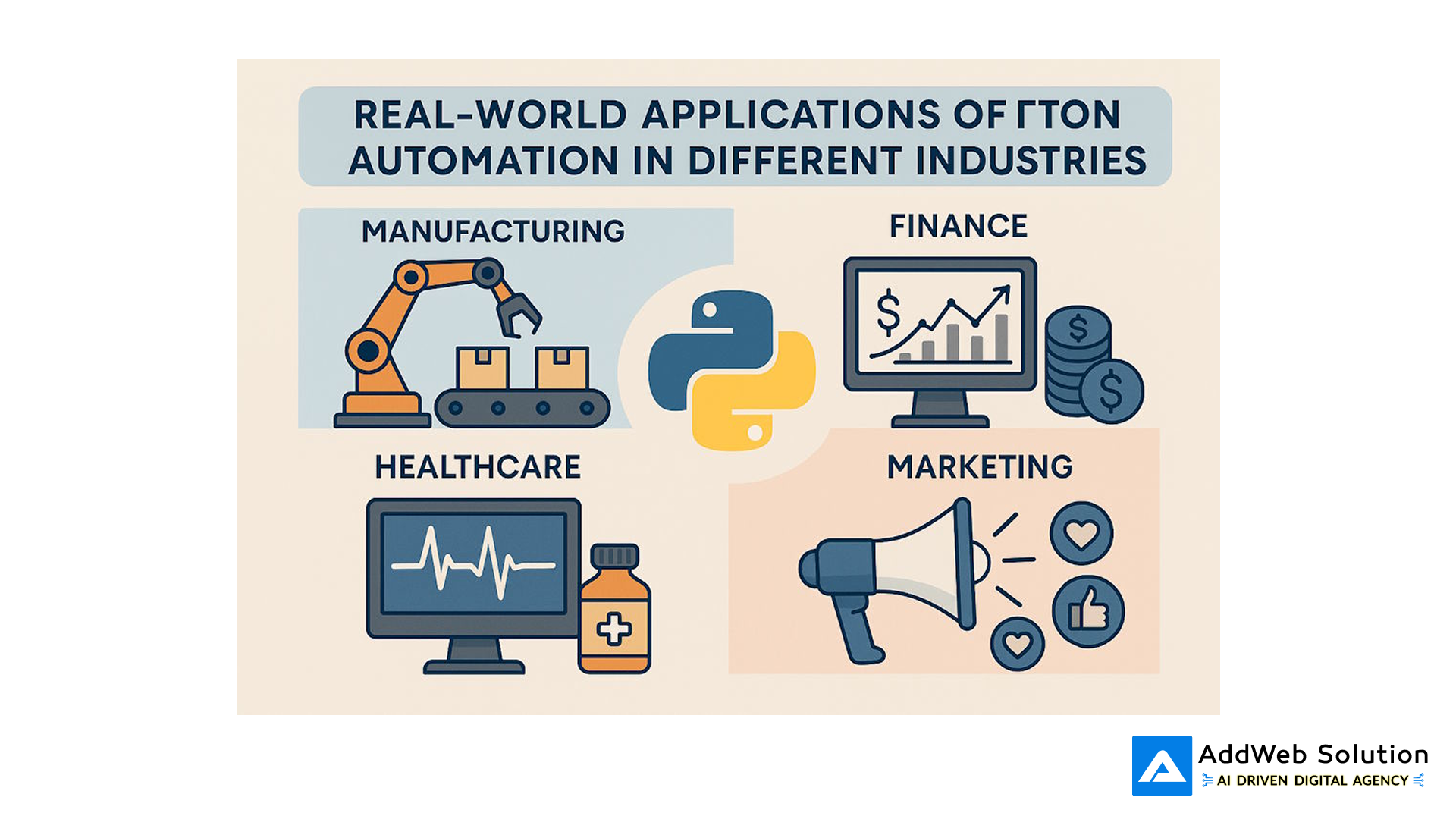
Real-world applications of Python automation in manufacturing, finance, healthcare, and marketing industries
The Business Case for Python Automation
Quantifiable Financial Impact
The economic advantages of Python automation go far beyond mere cost savings. Studies show that organisations leveraging Python-based business process automation produce considerable measurable gains in many areas of operation. Organisations achieve average annual cost benefits of $202,000 per automation project, time savings of 74.3%, and error reduction to 91.3%. These gains directly equate to bottom-line outcomes that pay for the investment in a few months instead of years.
Rapid Implementation and ROI Realization
In contrast to conventional enterprise automation platforms that demand long-term licensing costs and long implementation periods, Python automation projects do not have such timelines. The standard implementation takes 29 weeks over six critical phases with early ROI returns showing as early as the third phase in the development and testing stage. Businesses start experiencing concrete returns in 15% ROI by week 13, increasing to 45% ROI at deployment, and to complete 240% ROI by month 7.
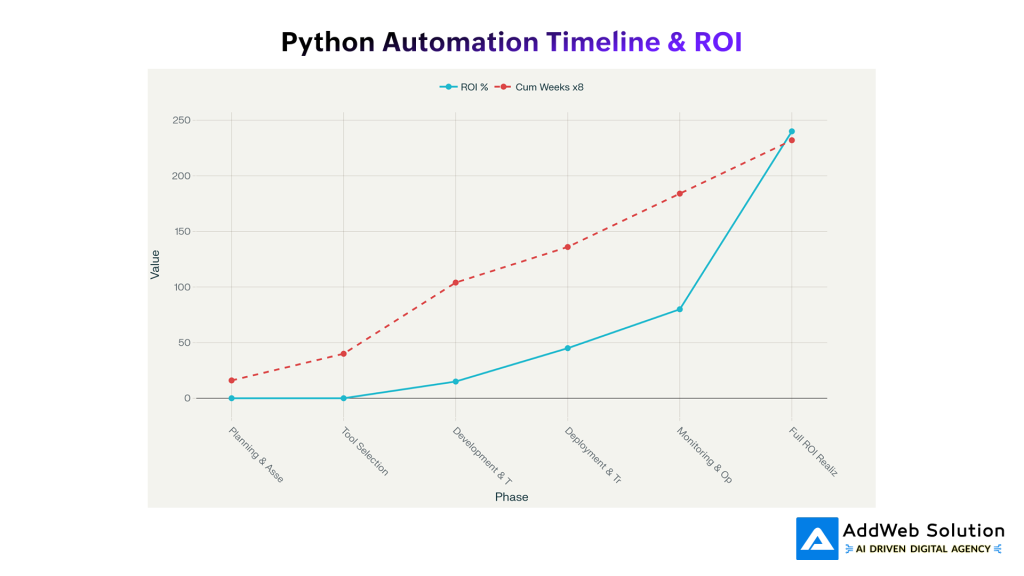
Python Automation Implementation Timeline showing the 6-phase process over 29 weeks with progressive ROI achievement reaching 240%
Industry-Wide Adoption and Success
Python automation has been successful in various industry segments, each achieving impressive returns to suit their own operational requirements. Financial services firms enjoy a 300% average ROI with 2-month paybacks, while manufacturing firms experience 40% ROI with 7-month cycles. The telecommunication industry exhibits outstanding results at 200% ROI and saving over $12 million annually, proving that Python can scale from small business use cases to enterprise-wide transformations.


Core Benefits Driving ROI Success
Operational Efficiency Gains
Python automation provides quantifiable gains in efficiency that accumulate over time to create high ROI. Customer service functions normally realize 80% time saving and 95% error savings, leading to $300,000 in cost savings annually with only a 2-month deployment. Finance functions realize 60% time saving and 88% error reduction, creating $200,000 in yearly savings within 3 months. These gains in efficiency provide much-needed human resources for higher-value strategic work while preserving superior quality of service.
Cost Structure Optimization
The cost benefit of Python automation appears when matching overall project expenditure with ongoing operational cost savings. The average Python automation project will cost $100,000-$200,000 to implement, with development staff accounting for 40% of expense, infrastructure and tools for 25%, and training for 15%. This upfront investment saves average annual cost of $2,005,143 over successful implementations, forming a compelling financial case that warrants executive sign-off and budgeting.
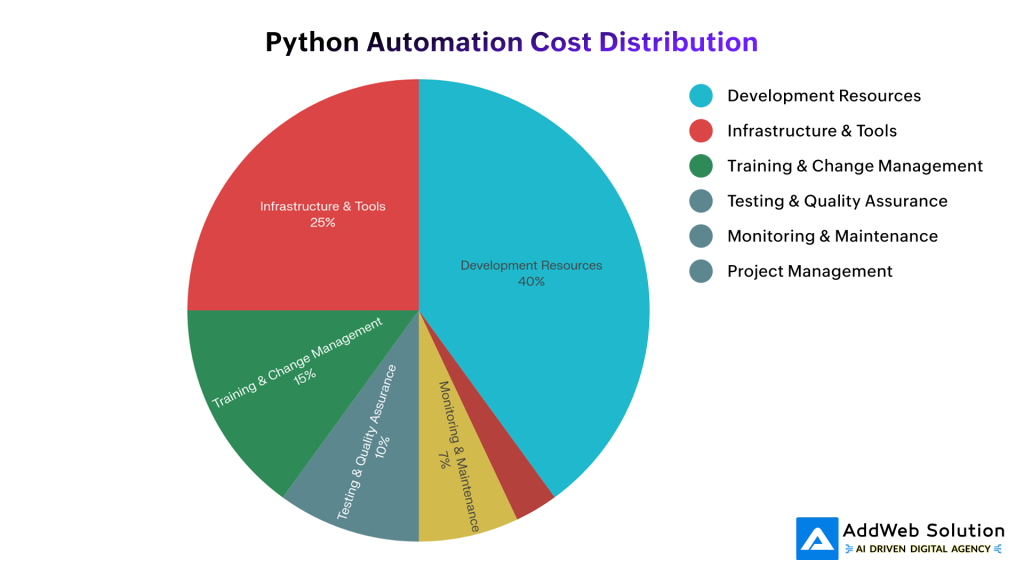
Python Automation Project Cost Distribution showing that Development Resources account for 40% of total project costs
Risk Reduction and Compliance Benefits
Python automation minimizes operational risk by delivering enhanced accuracy and uniform process execution. Automation of compliance and risk management realizes 90% time savings and 99% error elimination, for a total of $250,000 in yearly savings within 6 months. Quality assurance activities realize 65% time savings and 90% error reduction, generating $140,000 yearly savings even though they take 8 months to implement fully because they are so complex. Risk reduction benefits offer value that will not necessarily show up in calculations for direct ROI but deliver value toward long-term organizational stability and regulatory compliance.
Real-World Success Stories
Financial Services Transformation
Barclays Bank is a prime example of how Python automation can be used in finance by its loan processing transformation program. The bank used AI-driven Python automation to automate document verification, risk analysis, and approval processes. Before automation, loan processing took 10-15 days at an error rate of 20% and with customer satisfaction at 60%. Post-implementation outcomes revealed astounding gains: processing times fell by 70% to 3-4 days, error rates fell to 5%, and customer satisfaction reached 90%. This change achieved significant cost savings while enhancing competitive ground in the consumer lending business.
Manufacturing Excellence
Toyota Motor Corporation illustrates Python automation’s influence in manufacturing with its predictive maintenance initiative. The business placed sensors on production equipment to gather performance data and piped that data into Python-driven machine learning algorithms to predict failures. Outcomes were 25% less downtime, 15% higher overall equipment effectiveness, and $10 million in yearly cost savings. Return on investment for this predictive maintenance strategy hit around 300%, illustrating how Python automation converts reactive maintenance to proactive optimization.
Healthcare Process Optimization
A multi-branch medical center automated the processing of insurance claims with Python-embedded RPA solutions, resolving issues with claim verification timelines. Automation cut claim processing from 4 days to 5 hours and facilitated reimbursements 50% faster. This healthcare use case illustrates how Python can tackle complicated, regulated processes while achieving instant operating enhancements that accrue to the organization as well as its patients.
E-commerce and Travel Industry
eSky, an award-winning travel portal, used Python automation to track price and policy updates on more than 200 airlines and insurance company sites. The automation replaced human monitoring that was time-consuming and prone to errors. Outcomes were 1.5 full-time equivalents saved each month with a payback period of 2 months. This example shows the ability of Python to excel in web scraping and data monitoring applications demanding real-time precision and scalability.
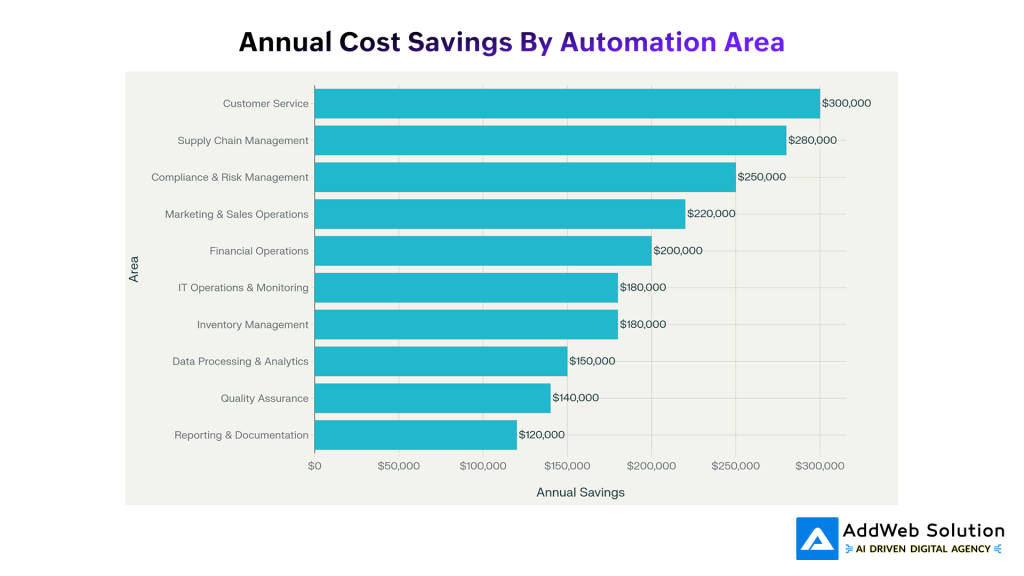
Annual Cost Savings by Python Automation Area showing Customer Service delivering the highest savings at $300,000 annually
Implementation Strategy and Best Practices
Phase-Based Approach
Successful Python automation deployments use a traditional six-phase method that achieves maximum ROI with minimal risk. The planning and evaluation phase (2 weeks) sets objectives and ROI estimates clearly. Tool selection and initialization (3 weeks) is concerned with Python environment configuration and infrastructure readiness. Development and testing (8 weeks) is the longest phase that includes script development and full-scale testing cycles. Deployment and training (4 weeks) guarantees production rollout smoothness and adoption by users. Monitoring and optimization (6 weeks) also optimizes performance and solves any problems. Full ROI realization (12 weeks) identifies opportunities to scale successful implementations and develop further automation opportunities.
Success Factor Prioritization
Eight key success factors were identified by research as having a significant influence on Python automation ROI. Professional development teams yield the greatest contribution with a 45% increase in success rates at the cost of increased implementation expenses. Scalable design of architecture provides the maximum success rate boost of 50%, with long-term value generated from automation investments. Endorsement by executive leadership and ongoing monitoring provide 25% and 40% increases in success rates respectively at minimal implementation expenses. Organizations focusing on these contributors achieve much higher ROI and shorter time-to-value.
Risk Mitigation Strategies
Successful risk management guarantees Python automation projects provide committed ROI within anticipated timelines. Initiating pilot projects in report or customer service domains offers immediate victories with 2-month ROI horizons and $120,000-$300,000 in annual savings. Organizational confidence increases through early successes and offers proof-of-concept for bigger automation projects. Steering clear of complicated processes such as quality assurance or IT operations monitoring in initial phases avoids long 7-8 month implementation cycles that slow down ROI realization.
Measuring and Maximizing ROI
Key Performance Indicators
Effective Python automation initiatives set definite measurements tracking financial and operational gains. Key financial measurements are overall cost savings, implementation expense, and payback period estimates. Operational measurements involve reduction in processing time, error rate enhancements, and employee productivity increase. Successful companies monitor these measurements continually, with 70% of business leaders reporting that process automation enables them to reach strategic objectives. Ongoing monitoring allows proactive refinement and reveals areas for leveraging successful automation methodologies.
Long-term Value Creation
Python automation provides compounding value that goes beyond early ROI estimates. Firms indicate that automation investments keep paying dividends for 3-5 years after implementation in the form of decreased maintenance expenses, better scalability, and increased employee satisfaction. The mean automation project will break-even within 12-18 months and then create pure profit for the rest of the years. This long-term value creation is a factor making Python automation one of the most rewarding technology investments for current businesses.
Scaling Success
Firms realizing 240%+ ROI on a consistent basis deploy scaling methods that leverage the first-time success in automation. They apply best practices in automation to other processes with similar logic from various departments, use Python components to be reused and minimize future development expenses, and set up centers of excellence that codify automation best practices. Research reveals that 76% of firms utilize automation for making day-to-day work more standardized, and 58% utilize automation for data and reporting purposes that aid in strategic planning.
Future-Proofing Automation Investments
Technology Evolution and Integration
Python’s broad ecosystem prevents automation investments from becoming obsolete as technology changes. The language’s interoperability with artificial intelligence, machine learning, and cloud platforms prepares organizations for future technology development without necessitating total system rebuilds. Organizations say Python automation is a building block for more sophisticated AI implementations, resulting in a technology stack that appreciates in value over time instead of depreciating.
Organizational Transformation
In addition to direct ROI improvements, Python automation fuels organization-wide change that builds long-term sustainable competitive value. People relieved of mundane tasks concentrate on innovation and key initiatives, enhancing job satisfaction and employee retention. Customer experience enhancements from enhanced speed and accuracy drive revenue growth compounding automation ROI. These change benefits frequently exceed upfront cost savings, building value that continues to accrue well past recovery of initial implementation expenses.
See how Python business automation delivers exceptional ROI in months

Pooja Upadhyay
Director Of People Operations & Client Relations
Conclusion
Python business process automation is a tried and tested route to high ROI that can reshape organizational efficiency within months, not years. With average ROIs of 240% in 6-9 months and top achievers with 390% ROI, Python automation is one of the most attractive technology investments open to contemporary businesses. The integration of aggressive implementation schedules, quantifiable operational optimizations, and lasting long-term value creation makes Python automation crucial to organizations that are looking for competitiveness in increasingly automated markets.
Success is based on strategic execution that focuses on high-impact, low-complexity processes and organizational capabilities for continued automation growth. The greatest returns on Python automation investment come to those firms that spend money building knowledgeable development teams, scalable architectures, and ongoing monitoring. With digital transformation in industries racing forward, Python automation offers the foundation for long-term growth, operational excellence, and market leadership that warrants executive investment and delivers quantifiable business outcomes.
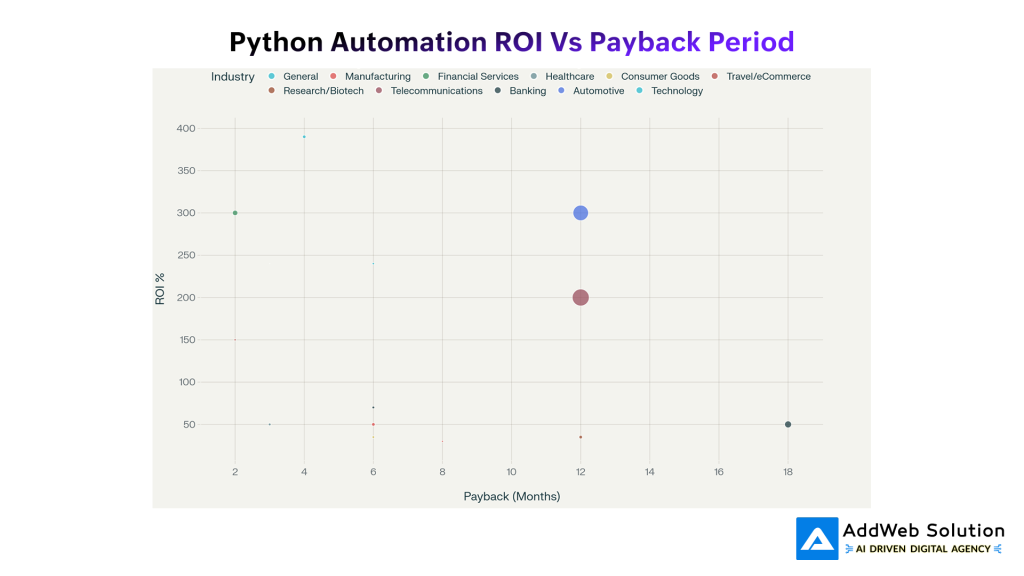
Python Business Process Automation ROI Analysis Dashboard – showing ROI distribution, industry comparisons, and payback periods based on real case studies
About the Authors
Ravi Maniyar – Senior Python Developer & Architecture Specialist
Ravi Maniyar has over 13 years of experience in Python development and software architecture. He specializes in modernizing legacy systems, improving performance, and designing scalable solutions. Known for his ability to cut deployment times and streamline processes, Ravi combines technical depth with practical problem-solving.
References:
- https://pythonrpa.org/cut-your-automation-costs-by-50-the-advantages-of-using-python-rpa/
- https://www.linkedin.com/posts/yes-boss-technology_businessautomation-roi-aitools-activity-7357040025139662848-W8gA
- https://www.coursera.org/articles/python-automation
- https://python.plainenglish.io/3-real-world-python-projects-that-solved-actual-business-problems-ac3a52d1187c
- https://pub.towardsai.net/building-python-automation-systems-that-saved-me-months-of-work-800a1111add7
- https://www.accelq.com/blog/test-automation-roi/
- https://www.freecodecamp.org/news/legacy-software-maintenance-challenges/
