


Retailers do not lose a sale due to a change of mind. More frequently, the product wasn’t on the shelf, the recommendation wasn’t right, or the price was not correct for the time. Those are forecasting, inventory and experience issues, but they’re the kinds of areas where AI is making a clear impact.
In summary, AI in retail leverages machine learning, computer vision, and language models to anticipate demand, maintain optimal inventory levels, and personalize customer interactions.
This guide details each piece’s functionality, the evidence that backs it, why so many projects don’t succeed, and how to begin with a use case that has a place.
What Does AI in Retail Actually Do?
The technology performs 3 related tasks. Forecasting is predicting future sales based on past sales and indicators like promotions, weather, local events and price.
That estimate becomes a decision on how much, where and when to order stock, and when to discount it. Customer experience is based on the same data and what each customer sees, is offered and is told.
The value compounds since one data source supplies all three. The fewer the stockouts, the fewer the stockouts, and the better the shopper’s experience, the better the demand data for the next forecast. Retailers that consider the three as distinct projects don’t reap the lion’s share of that loop.
The Cost of Getting Inventory Wrong
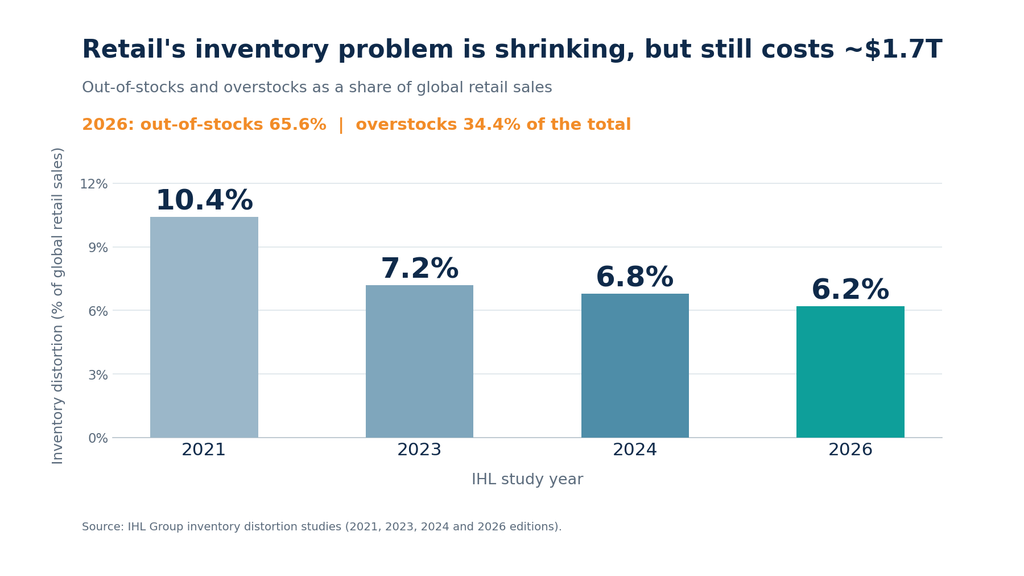
IHL Group estimates that, globally, the total cost of inventory distortion (i.e. out-of-stock and overstock) was approximately USD 1.7 trillion in 2026, representing 6.2% of the total value of retail sales worldwide.
Of those, out-of-stocks account for 65.6% and overstocks make up the remainder 34.4%. The share is down from 10.4% in 2021, indicating good progress with better planning tools, although this is still a very high number of lost margins.
A shortfall is detrimental to the sale and possibly the customer. A surplus is an investment of cash that in most cases results in a markdown.
The root causes of both halves of the problem were: making decisions on forecasts that were too slow, or too coarse, or too optimistic.
You can’t get an answer from a weekly category forecast that one store in Pune will run out of rain jackets on Thursday, while another in Jaipur will have plenty of them on hand.
AI Demand Forecasting: How It Works and What to Expect
Beyond the historical average
Traditional forecasting is based on extrapolating past sales. Machine learning models also consume price changes, promotions, seasonality, weather, local events, and competitor activity; and then learn how these factors relate to each other at SKU and store level.
They can also predict new products by mimicking patterns of similar products, which is something that spreadsheet techniques do not do very well.
What accuracy gains are realistic
AI can cut down on demand forecast errors by 20% to 50% compared to traditional forecasting, according to McKinsey’s research on supply chains, and IHL’s 2026 retail study estimates it to be 20% to 40%. Don’t consider these as promises, rather ranges.
These results are based on data quality, forecast horizon, volatility of demand, promotions and the position of a product during its lifecycle. The weather for the month looks stable. Certain categories, such as fashion and promotion, are more difficult and require the most attention by the model.
Why forecasts fail without clean stock data
All forecasting models rely on data of accurately kept stock levels and numerous stockouts are caused even when the product is physically in the retail network somewhere.
Even a perfect forecast is a poor decision if the system thinks there are four units in a store and it is empty. Retailers can often achieve record accuracy in the first cost-effective place by employing ‘RFID or shelf scanning’ and this makes the implementation of the other AI solutions much more effective.


Smarter Inventory Management in Practice
Replenishment and allocation
Once a forecast exists, optimisation engines translate it into order quantities, safety stock and store-level allocation, taking lead times and supplier constraints into account.
For grocers, perishability governs the calculation, so models set quantities with shelf life in mind to trim both waste and gaps. For fashion retailers the question is size and colour mix by location, and where to redirect stock mid-season when a style outperforms.
Real-time visibility
The system and the shelf are brought together by computer vision and RFID. In Zara stores, for instance, Inditex has introduced RFID tagging to provide the staff and planners with near real-time insight into the stock, aiding replenishment and click and collect.
The smaller retailers need not have a store-wide programme to benefit from. A few high-value categories can be targeted with handheld scanning or shelf cameras to determine the concentration of record errors before broader investment is made.
Pricing and markdowns
The models for markdown optimisation take into account the amount of stock available, the number of days left in the season and the price sensitivity, and they determine when and how much to discount, instead of doing so at the end of the season.
One of the more direct methods to help preserve margin is to get the timing of markdowns right since a significant amount of inventory distortion is caused by overstocks.
How Forecasting, Inventory and Experience Connect
The three capabilities are best suited to be used in a cycle. Demand signals drive the forecast, the forecast influences replenishment and pricing, availability influences what the shopper can be offered and the shopper’s response is the next demand signal.
If one link of the chain is weak, the rest is weak: a recommendation engine that suggests products that are out of stock makes customers mad; a forecasting system based on skewed sales due to stockouts overestimates actual demand.

Improving Customer Experience with AI
According to McKinley’s research, Next in Personalization, 71% of consumers want companies to provide personalised interactions and 76% are frustrated when they don’t.
According to the same research study, personalisation can generate a 10-15% revenue boost, ranging from 5% to 25% depending on the specific company, sector and implementation.
It should be noted that the survey was conducted with the US consumer base in 2021 and the data is only meant as an indicator and not a benchmark for Indian consumers.
Recommendations and search
Browsing and purchasing habits are already used in most stores to show similar products, and they’re often the best place to begin as there is already data available in the store.
The test of the recommendations is whether they are respectful to inventory and context. Not recommending a product that is not in the shopper’s pincode loses the moment.
Conversational assistants
Language-model assistants are able to respond to product inquiries, manage orders and assist with returns round-the-clock. They are a valuable asset as long as they are integrated.
Attached to the live inventory & order systems, they provide correct responses. When left to their own devices, they invent availability, and they destroy trust.
One view of the customer across channels
Unifying online and in-store data lets a retailer honour a wishlist in the store, show accurate pickup availability and keep loyalty offers consistent. It also removes a common irritation: promotions that make sense online but are ignored at the till. AddWeb Solution’s AI personalised customer experience work follows this same principle of using behaviour, preferences and interaction history to tailor recommendations and engagement across touchpoints.
Why Many Retail AI Projects Stall
According to IHL’s Retail Transformation Study 2026, less than 30% of AI projects reach beyond the pilot phase in retail. These are commonly caused by incoherent data, pilots that have no business owner or success metric, models that never get plugged into the ordering or merchandising process and planners who don’t believe in the results because they are not explainable.
The solutions are realistic. Select one measurable target and one category, e.g., Forecast error, In-stock rate. Use model outputs to inform planning teams’ planning tools. Allow planners to waive recommendations and make use of the waiving of recommendations.
If you report on business outcomes and not model metrics then a business forecast that does not result in a change of orders is a forecast that hasn’t changed.
A Practical Roadmap for Retailers
Conduct an audit of data first, such as sales history, stock records, product master data and promotion calendars. Correct the highest level of stock inaccuracies before creating models.
Forecasting for one category and region only, then benchmarking against the current system over a number of cycles and determining the level of success beforehand.
Once results are in, link to replenishment and markdown decisions; also leverage same data foundation for personalisation and conversational. The approach of doing the work in this order ensures that each step receives information from the previous step and makes budget discussions simpler.
Frequently Asked Questions
How is AI used in retail?
Retailers use AI for demand forecasting, inventory replenishment, markdown and price optimisation, product recommendations, search, customer service assistants and shelf monitoring. The common thread is using data to make faster, more granular decisions than manual processes allow.
How does AI improve demand forecasting in retail?
Machine-learning models learn from sales history together with promotions, pricing, weather, seasonality and local events, and forecast at SKU-and-store level. Research cited by McKinsey and IHL indicates forecast-error reductions in the range of 20% to 50% versus traditional methods, depending on data quality and category.
How accurate is AI demand forecasting?
Accuracy varies by category, forecast horizon and data quality. Stable, high-volume products forecast far better than new launches or heavily promoted items. Measure against your own baseline with a controlled pilot rather than relying on industry averages.
What data do I need to start with AI in retail?
At minimum, clean transaction history at product and location level, reliable stock records, product attributes and a promotion and pricing calendar. External signals such as weather and events improve results but are not required for a first pilot.
Is AI only practical for large retail chains?
No. Mid-sized and online retailers often move faster because they have fewer legacy systems. A focused pilot on one category, using existing data and cloud-based tools, can show whether the approach pays off before a wider commitment.
Ready to make your retail operations smarter with AI?

Pooja Upadhyay
Director Of People Operations & Client Relations
Turn Better Forecasts into Better Margins
The retailers seeing results from AI are not the ones with the most tools. They are the ones with clean data, a clear first use case and a plan for connecting predictions to real operating decisions. If you are planning to modernise forecasting, inventory or customer experience, AddWeb Solution’s team can help you scope a pilot, integrate it with your existing commerce and ERP stack, and measure the outcome. Talk to our AI experts about your retail roadmap.
