


Open-source AI versus commercial AI: Most companies do not have to choose sides between the two. Your actual choice lies in the positioning of each within your stack.
Open-source AI offers transparency, control, and economic benefits, while commercial AI tends to have the edge on usability and reliability.
What We Mean by Open Source vs. Commercial AI
Open source AI
In the domain of AI, “open source” means that the users have access to the code of the model, the architecture used, and sometimes also the weights and the recipe for how to train the data – under license terms that allow them to use, modify, and redistribute the work.
The examples of these include frameworks such as TensorFlow and PyTorch, and the majority of LLMs available on Hugging Face.
Commercial / proprietary AI
Commercial AI is associated with the models and platforms that are controlled and owned by companies such as OpenAI, Anthropic, Cohere, Google, or vendors that provide AI solutions specific to a particular industry.
The users gain access to these models through paid APIs and licenses from the companies. In return, they get good SLAs, integration, and production-ready features.
Why This Choice Matters Now
AI is not just a side thing anymore, some 72% of enterprises had adopted AI into at least one business process by 2024, and the pace of adoption only increased since.
Tech-savvy companies have started using both approaches to combine open-source and proprietary AI solutions instead of choosing just one of them.
In fact, one research study shows that some 72% of tech-savvy businesses have started using open-source AI models, while 48% of them utilize proprietary solutions for faster and more convenient implementation.
In other words, the question is not “open or commercial?” but “what tasks require us control and customization, and what tasks require reliable plug-and-play solutions?”
How Organizations Actually Mix Open Source and Commercial AI
Industry surveys show a clear pattern: mixed usage dominates, with smaller segments going “all‑in” on either open-source or proprietary models.
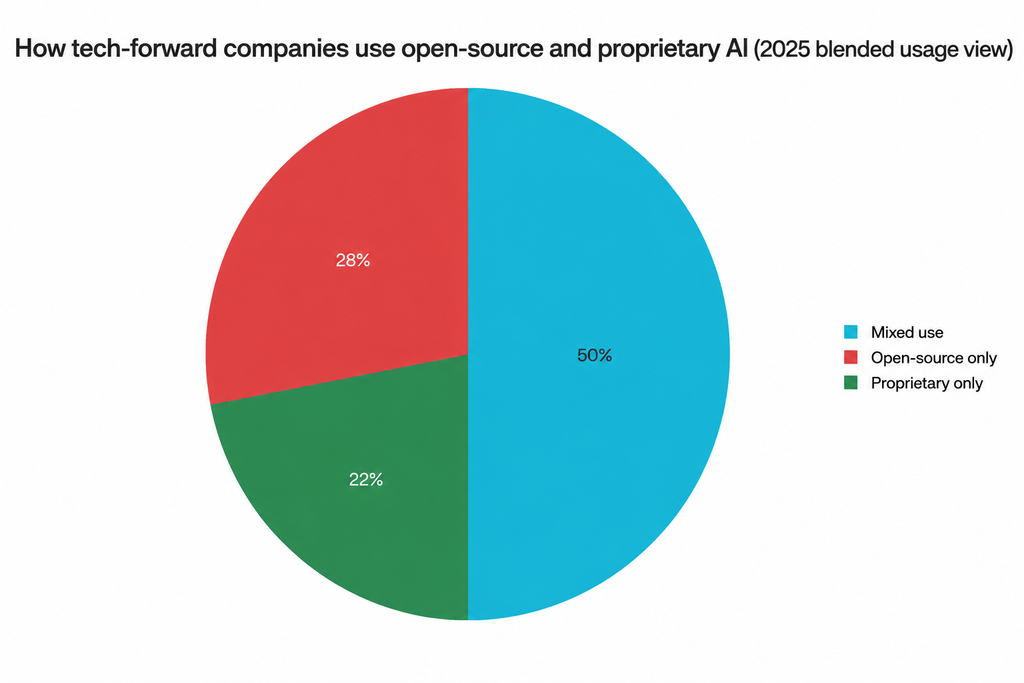
In other words, most enterprises are already operating along a spectrum of openness, using open-source models for innovation, customization, and cost control, and proprietary models where uptime, latency, and compliance responsibilities matter more.
Open Source AI: Key Advantages
1. Transparency and Trust
- Transparent and genuine open source or close to it allows teams to check the architectures, training pipeline, and even data recipes to get clarity on model behavior and biases.
- This transparency enables audits, ethical assessments of the AI, and compliance with new laws requiring explainability and accountability.
2. Deep customization and control
- Using open source models, your team will be able to fine-tune the model using proprietary data and even change architecture, as well as embed the model into your own pipeline and/or hardware.
- This is especially useful in niche industries (industrial, legal, medical, multilingual) where generic models do not work well and require adaptation.
3. Cost structure and long‑term economics
- There are no licensing costs in open-source paradigms; thus, you have better control over TCO and may use budgets not for subscriptions but for infrastructure and talent.
- A few studies reveal that an open-source paradigm may help achieve lower implementation costs (by about 60%) and lower maintenance costs (by about 46%) for companies willing to invest in the necessary talent.
4. Innovation and talent magnet
- Open-source communities develop rapidly, producing new approaches to software engineering; moreover, contributors are exactly the type of engineers that many companies want to hire.
- Using and developing open-source AI technologies may enhance your company’s reputation and help attract talent.
Open Source AI: Real Risks and Trade‑Offs
1. Infrastructure and expertise burden
- Running and fine‑tuning open-source models requires GPUs, storage, orchestration (often Kubernetes), observability, and MLOps – skills many organizations don’t yet have.
- For teams without strong infra chops, “free” open source quickly turns into expensive engineering projects and operational overhead.
2. Quality variability and model selection
- There are now more than a million models on Hugging Face; choosing the right one for each use case is non‑trivial and demands deep ML expertise.
- Model quality is uneven, documentation can be sparse, and evaluating or benchmarking candidates requires time and rigorous processes.
3. Support, SLAs, and accountability
- Community support is powerful but informal – there’s no guaranteed response time or uptime commitment if your production system breaks.
- For mission‑critical workflows, the absence of SLAs and formal liability can be a blocker for risk‑averse enterprises.
4. Licensing and IP complexity
- Open-source licensing conflicts are at an all‑time high: one 2026 OSSRA report found that two‑thirds of audited commercial codebases had open-source license conflicts, with some containing thousands of distinct issues.
- AI‑generated code and “license laundering” (e.g., GPL‑derived snippets without attribution) further complicate IP risk, making proper scanning and governance mandatory.


Commercial AI: Key Advantages
1. Ease of use and integration
- Proprietary AI platforms emphasize straightforward integration via well‑documented APIs, SDKs, and enterprise connectors, reducing the time from idea to live feature.
- Many products ship with embedded AI features – search, recommendations, summarization – that require little ML expertise, just configuration and UX work.
2. Enterprise‑grade support and reliability
- Vendors provide structured support, SLAs, and regular updates, which is crucial when AI powers customer‑facing experiences or regulated processes.
- You get help with troubleshooting, performance issues, and security patches, rather than relying on community forums.
3. Performance, latency, and scale out of the box
- Major providers operate large, optimized infrastructure designed for low latency and high throughput across millions of requests, something hard to match with a DIY stack.
- This makes proprietary models particularly attractive for conversational interfaces, virtual assistants, and high‑volume consumer applications.
4. Compliance and governance “lift”
- Providers increasingly shoulder parts of the regulatory burden, offering tools and documentation to help customers meet requirements under regimes such as the EU AI Act.
- For teams without dedicated AI compliance resources, this packaged governance can be a major advantage.
Commercial AI: Risks and Limitations
1. Vendor lock‑in and dependency
- Deep integration into one provider’s APIs and ecosystem makes it hard and costly to switch later, especially if pricing or terms change.
- Critical questions – data retention, upgrade cadence, deprecation policies – are largely outside your control.
2. Limited transparency and customization
- Closed models rarely expose training data or full architectures, limiting your ability to audit bias, explain decisions, or deeply customize behavior.
- While fine‑tuning and prompt engineering are available, they’re constrained by what the provider allows and supports.
3. Cost at scale
- Proprietary models are often cost‑effective for early adoption and moderate usage but can become expensive at very large, sustained scales because you pay margins on top of infra costs.
- Without careful monitoring and optimization, enterprises can face bill shock as AI usage grows.
4. Security and trust assumptions
- You must trust that vendors implement strong security and respond quickly to vulnerabilities, but lack of transparency can hide issues.
- Breaches or misconfigurations at the provider level can affect many customers simultaneously.
Visual Snapshot: What Decision‑Makers Optimize For
Different stakeholders value different things when choosing between open source and commercial AI – CTOs, CIOs, CFOs, heads of product all weigh factors differently.
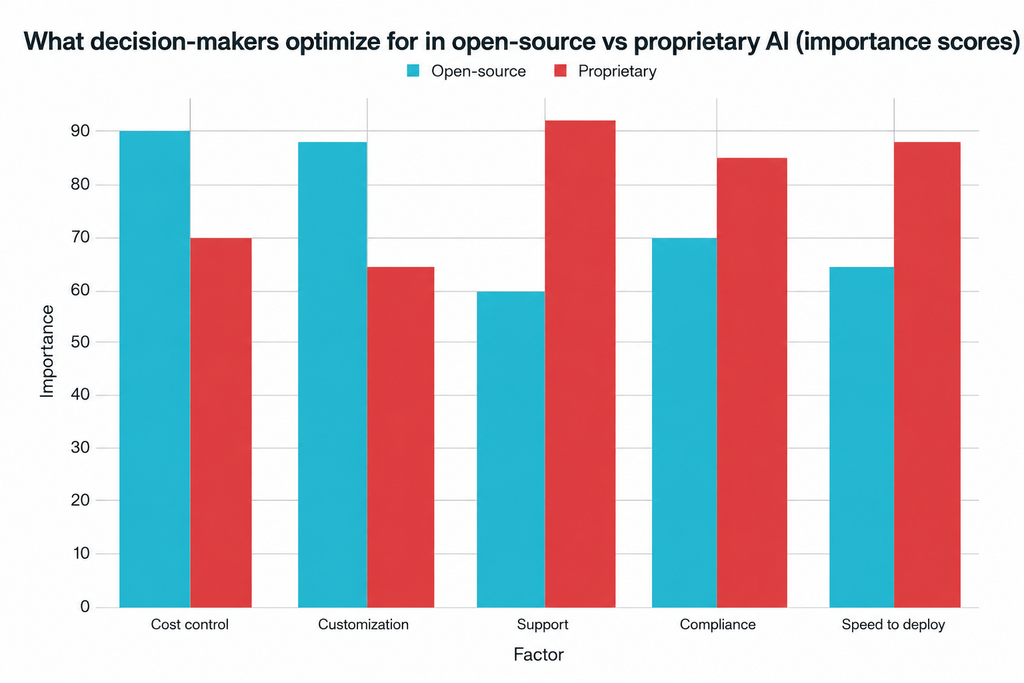
At a high level:
- Open source tends to score highest on cost control and customization, and strongly on data control and IP ownership.
- Proprietary models usually rank highest on support, compliance help, speed to deploy, and predictable reliability.
Side‑by‑Side Comparison: Open Source vs. Commercial AI
Strategic comparison table
| Dimension | Open source AI | Commercial / proprietary AI |
| Transparency | High; code and often architectures visible. | Low; internals typically closed. |
| Customization depth | Very high; full stack tweakable. | Moderate; via APIs, config, fine‑tuning. |
| Cost & licensing | No license fees; infra and staff costs instead. | License/API fees; lower infra burden. |
| Support & SLAs | Community‑driven; no formal guarantees. | Vendor support with SLAs and liability. |
| Governance & compliance | You own most responsibilities. | Vendor helps shoulder compliance and documentation. |
| Security posture | Transparent but DIY; depends on your practices. | Centralized; opaque but professionally managed. |
| Talent requirements | Strong infra & MLOps needed. | Strong product & integration skills; less infra. |
| Lock‑in risk | Lower if you use open standards. | Higher; switching costs can be significant. |
| Best suited for | Custom, domain‑heavy, IP‑sensitive workloads. | Consumer‑scale, regulated, uptime‑sensitive workloads. |
Security, Privacy, and Regulatory Considerations
Security and compliance are now primary drivers in open vs commercial AI decisions, not side notes.
- Open-source models benefit from community security review: vulnerabilities can be spotted and patched by global experts, and you can run models entirely on‑prem to avoid third‑party data exposure.
- At the same time, OSSRA data shows rising risks from unmanaged components and outdated libraries, 93% of codebases contained components that hadn’t seen active development in two years.
With proprietary models:
- Providers often help with compliance and monitoring, offering logs, controls, and documentation for audits.
- But the closed nature of systems means you rely on vendors to discover and fix vulnerabilities, which can be a concern in highly regulated or national‑security contexts.
Regulators are also differentiating between open and closed systems: the EU AI Act sets stronger transparency and accountability expectations for certain high‑risk proprietary systems, while US bodies are exploring risk‑based openness guidelines.
Cost, TCO, and “Build vs. Rent” Thinking
A useful mental model is the “build vs. rent” framing:
- Open source is build: you invest in infrastructure, people, and governance, trading higher upfront effort for lower long‑term licensing costs and more strategic control.
- Commercial AI is rent: you pay to access someone else’s infrastructure, models, and governance, trading higher variable costs and dependency for speed and reduced operational burden.
Several studies highlight that open-source AI tends to be cheaper over time if you reach sufficient scale and have the skills to keep infra and operations efficient.
Proprietary AI often wins on short‑term ROI, especially when a vendor already embeds AI in tools your teams use daily.
When Open Source AI Usually Fits Better
Consider prioritizing open-source AI when:
- You need deep customization and differentiation. You’re building AI into your core product or process and want behavior that goes far beyond what generic APIs offer.
- Data sovereignty and IP control are critical. You operate in sectors where data cannot leave your premises or where you want to keep fine‑tuned weights as proprietary assets.
- You have strong infra and MLOps maturity. Your teams can manage clusters, CI/CD, monitoring, and governance for ML workloads.
- You’re playing a long game. You’re prepared to invest now in skills and systems that reduce dependency and cost over the next 3–5 years.
When Commercial AI Usually Fits Better
Commercial AI is often the right call when:
- You need results fast. Leadership expects AI impact in quarters, not years, and you want quick wins without building a platform team first.
- Your workloads are volatile or exploratory. Usage may spike around campaigns or events, and you don’t yet know long‑term volume or use‑case stability.
- You lack specialized infra talent. Your engineers are excellent at product and data work but you don’t have dedicated GPU, MLOps, or security expertise for AI infra.
- Uptime and liability are non‑negotiable. Customer‑facing assistants, financial advice, or regulated reporting need strong SLAs and clear vendor accountability.
The Hybrid Reality: Designing a Portfolio, Not a Single Bet
Most sophisticated organizations now treat AI as a portfolio:
- R&D and internal innovation: open-source models for experimentation, IP capture, and domain‑specific fine‑tuning.
- Production at scale: proprietary models for customer‑facing and compliance‑sensitive workloads where reliability and support are paramount.
Practical steps you can use in strategy workshops:
- Segment use‑cases by reliability vs customization needs, and map them to open or proprietary approaches accordingly.
- Invest in MLOps and data engineering so you can responsibly leverage open-source assets where they matter most.
- Architect for portability: separate data, orchestration, and model layers so you can swap models (open or proprietary) without rewriting everything.
- Calculate true TCO – infra, staffing, governance, and migration costs, not just licensing line items.
- Build a governance framework early, covering security, bias, privacy, and licensing for both open and commercial tools.
If you tell me your primary audience (CIOs, product leaders, startup founders, etc.), I can help you tighten this into a more opinionated, conversion‑oriented version with tailored examples while keeping the visuals, tables, and tone aligned with your content strategy.
Let’s design an AI strategy aligned with your business goals.

Pooja Upadhyay
Director Of People Operations & Client Relations
Source URLs:
https://acecloud.ai/blog/open-source-vs-proprietary-llms/
https://menlovc.com/perspective/2025-the-state-of-generative-ai-in-the-enterprise/
https://deepchecks.com/open-source-vs-proprietary-llms-when-to-use/
https://northflank.com/blog/self-hosting-ai-models-guide
https://www.aicerts.ai/news/evolving-llm-market-anthropic-leads-2025-enterprise-share/
