


“Digital transformation for nonprofits is not about adopting every shiny tool. It’s about using technology to deepen relationships with the people who care about your mission.”
If you work with an NGO, you’ve probably felt the shift already: donors expect seamless digital experiences, beneficiaries discover you on social media before they ever meet your team, and your board asks why online donations are not growing faster than last year. Digital is no longer a “nice-to-have campaign channel” — it sits at the heart of how modern NGOs earn trust, scale programs, and sustain impact over time.
According to Nonprofit Tech for Good, online giving already represents 13.4% of total revenue for small nonprofits, 8.3% for medium-sized organizations, and 4.1% for large ones, and nearly half of all online donations now happen on mobile devices. For NGOs that still treat digital as an afterthought, this gap becomes a risk to both funding and mission.
This article breaks down a practical, 5‑pillar digital growth strategy that NGOs of any size can apply — backed by real numbers, modern tools, and field experience from digital transformation projects.


Why Digital Growth Matters
Digital engagement is now baked into how supporters discover, research, and decide to back a cause. Salesforce’s Nonprofit Trends reports show that digitally mature nonprofits are almost twice as likely to exceed their mission and fundraising goals compared to less mature peers. Another snapshot from the same research: more than half of nonprofit leaders say they must invest in technology to increase fundraising, and a majority believe donors expect better digital experiences than what their current systems provide.
On the donor side, behavior is already ahead of many NGOs’ internal systems. Nonprofit Tech for Good reports that 45% of online donations in 2024 were made via mobile devices, while email still contributes about 11% of all online revenue — proving that mobile-optimized, multichannel journeys are no longer optional. Research from Nonprofits Source further shows that 51% of high‑wealth donors (earning 200k+ annually) now prefer to give online, and 67% of nonprofits worldwide are already set up to accept online donations.
In short: donors are digital; NGOs that want sustainable impact need to be as well.
The 5 Pillars of NGO Digital Growth
A practical digital growth strategy for NGOs can be built around five reinforcing pillars:
- Digital-first storytelling and content
- Optimized donation and payment experiences
- CRM‑driven relationships and segmentation
- Data, analytics, and feedback loops
- Team capability, governance, and tech stack

1. Digital-First Storytelling
Donors don’t fund programs; they fund stories they believe in. Digital channels let NGOs tell those stories with video, short-form content, and immersive formats at a fraction of traditional media costs. Studies on nonprofit digital marketing trends highlight personalization, mini‑infographics, and snackable content (Reels, Shorts, TikTok) as key drivers of engagement in 2024. For small NGOs with limited budgets, a consistent cadence of authentic, mobile‑friendly content usually outperforms glossy, rare “hero” campaigns.
2. Frictionless Giving Journeys
When 45% of online donations are already made via mobile and more than half of website visitors arrive from phones, every extra form field or slow loading page is lost revenue. Payment preferences are changing as well — from card and netbanking to UPI, QR, and one‑tap wallets in markets like India. NGOs that streamline these experiences (short forms, saved payment methods, recurring options, multiple local payment modes) see better conversion without needing more traffic.
3. CRM-Driven Relationships
Digital growth is not just about acquisition; it’s about lifetime value. NextAfter’s 2024 Digital Fundraising Benchmark Report, summarized by NonprofitPro, found that donors acquired online were 48% more valuable than their offline counterparts in their first year of giving. That uplift only shows up if NGOs actually track donor behavior, segment communications, and nurture supporters through a CRM — rather than sending one “blast” newsletter to everyone.
4. Data, Analytics, and Feedback Loops
Digital channels make near real‑time feedback possible: you see which campaigns convert, which audiences respond, and which causes move the needle. Yet many NGOs still under‑use their data. Salesforce’s Nonprofit Trends research notes strong correlations between digital maturity and performance, but also highlights gaps around cybersecurity, data quality, and skills. A growth‑focused NGO does not need a data science team, but it does need basic dashboards, clear KPIs, and a habit of acting on what the data says.
5. Team Capability and Tech Stack
Finally, tools are only as effective as the people using them. Salesforce’s 7th Nonprofit Trends snapshot shows AI usage among nonprofits jumping from 12% to 55% in a year — but many organizations admit they lack skills and safeguards to use these tools responsibly. The winning NGOs invest in training, document their processes, and treat digital skills (CRM, analytics, content, automation) as core roles, not “extra work” for already-stretched staff.
Visualizing Your Channel Mix (Pie Chart)
Before going deep into tools, it helps to visualize how your current effort is spread across channels — and what a more strategic mix might look like. Many NGOs discover that nearly all their energy goes into short bursts on social media, with little attention to owned channels like email, website, or automation.
Below is a recommended starting mix for a mid‑sized NGO beginning a structured digital growth program. This is a strategic model, not a market statistic.

Suggested effort allocation:
- Website & landing pages: 25% (content, UX, accessibility, donation flows)
- Email & automation: 20% (welcome journeys, drip campaigns, renewal nudges)
- Social & community: 20% (Instagram, LinkedIn, Facebook, YouTube, local platforms)
- Paid media: 15% (Google Ad Grants, retargeting, high‑intent search)
- Messaging & SMS: 10% (WhatsApp, text campaigns, volunteer updates)
- Experiments: 10% (AI‑assisted campaigns, micro‑influencers, new platforms)
For NGOs that still rely heavily on one or two channels, simply rebalancing toward this kind of mix often creates growth without increasing the total budget.
Tools and Trends: Comparison Table
There is no one “right” tech stack for NGOs, but certain patterns keep showing up in organizations that are growing consistently. The table below compares three common postures we see in the sector.

As sector reports repeatedly show, NGOs that move toward the hybrid growth‑focused column — combining offline strengths with data‑driven digital — tend to be better positioned to weather fundraising volatility and shifts in donor behavior.linkedin+1
Tracking Growth: Sample Digital Impact Graph
Once your 5‑pillar strategy is in place, you need a simple way to show the board or leadership team whether it’s actually working. Below is an illustrative example of what a mid‑sized NGO might see over 18 months after committing to a structured digital growth plan.
This is a hypothetical but realistic scenario based on patterns highlighted in sector benchmarks, such as digital‑first donors being 48% more valuable than offline donors on average.
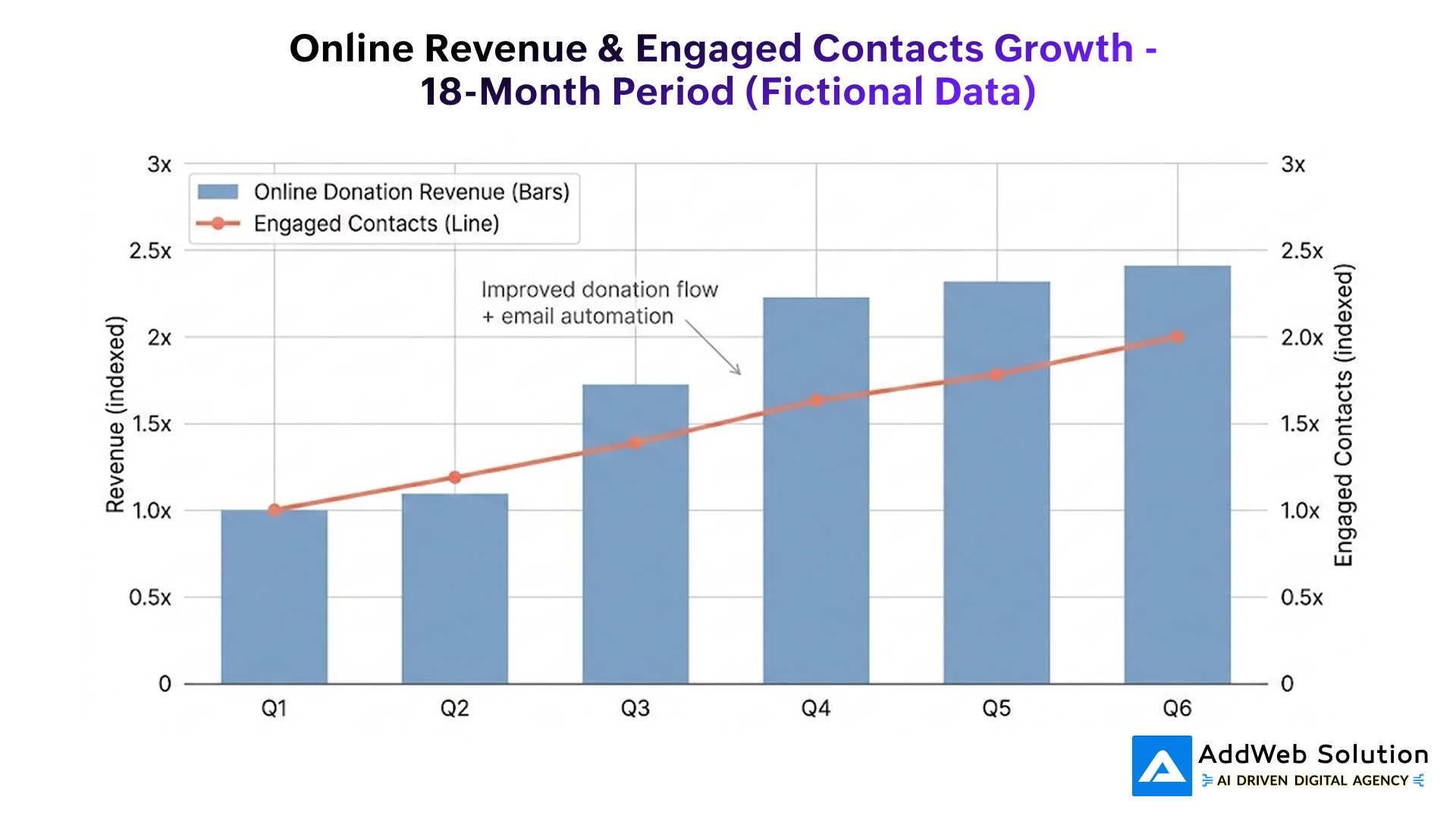
What this kind of chart typically shows when the strategy is working:
- Gradual but steady increase in online revenue quarter by quarter.
- Sharpest uptick after key changes: improved donation flow, segmented email automation, or a refined content strategy.
- Engaged contact list (email + WhatsApp + SMS subscribers) growing consistently, not just during campaigns.
- A noticeable drop in “dead” contacts as you re‑engage or clean your lists.
Having one simple chart like this in every quarterly review keeps the conversation focused on outcomes, not just activities.
Bringing It All Together
A sustainable digital growth strategy for NGOs doesn’t require Silicon Valley budgets. It requires clarity around five things: the stories you tell, the journeys donors and beneficiaries actually experience, the way you organize your supporter data, the feedback loops you run, and how seriously you invest in your people and platforms.
Practically, that often looks like:
- Fixing the basics on your website and donation flows.
- Getting one solid CRM in place and actually using it.
- Designing a realistic, multichannel content and campaign calendar.
- Building simple dashboards for leadership (online revenue, retention, engaged contacts, cost per acquisition).
- Training your internal team while carefully introducing automation and AI where it genuinely saves time.
At AddWeb Solution, we’ve seen NGOs unlock meaningful growth by pairing sector knowledge with a robust digital stack — from WordPress or headless websites to CRM integrations, analytics, and marketing automation tuned for nonprofit realities rather than corporate complexity. When your digital foundation is strong, the 5 pillars outlined here stop being theory and start showing up as higher retention, better campaigns, and more lives reached.
If your NGO is planning its next three‑year strategy cycle, this is the moment to put digital growth on the same level as programs and fundraising — not as a side note at the end of the plan.
Empower your NGO with digital transformation strategies for 2026 success

Pooja Upadhyay
Director Of People Operations & Client Relations
Source URLs
- https://www.nptechforgood.com/101-best-practices/online-fundraising-statistics-for-nonprofits/
- https://nonprofitssource.com/online-giving-statistics/
- https://www.salesforce.org/wp-content/uploads/2024/03/Salesforce-2023-Nonprofit-Trends-Report-2024-03-06.pdf
- https://www.salesforce.com/en-us/wp-content/uploads/sites/4/2025/05/s-org-7th-edition-nonprofit-trends-report-2025.pdf
- https://www.nonprofitpro.com/article/15-compelling-nonprofit-stats-from-2024/
- https://www.nptechforgood.com/101-best-practices/ai-marketing-fundraising-statistics-for-nonprofits/
- https://www.nptrust.org/philanthropic-resources/charitable-giving-statistics/
