


Your Competitor Doesn’t Have a ₹50 Lakh Budget Either, They Have Better Prompts
A boutique apparel seller in Lucknow used to spend 4 hours every Sunday writing the week’s social posts.
A coaching institute owner in Haldwani personally called 40 leads a day, half of them dead numbers.
Neither had a marketing team. Both now use free AI tools that do in minutes what used to take hours.
The Number That Should Change How You Think About This: 62% Already Did It
If you haven’t touched AI in your business yet, you’re now behind most of your peers, not ahead of the curve.
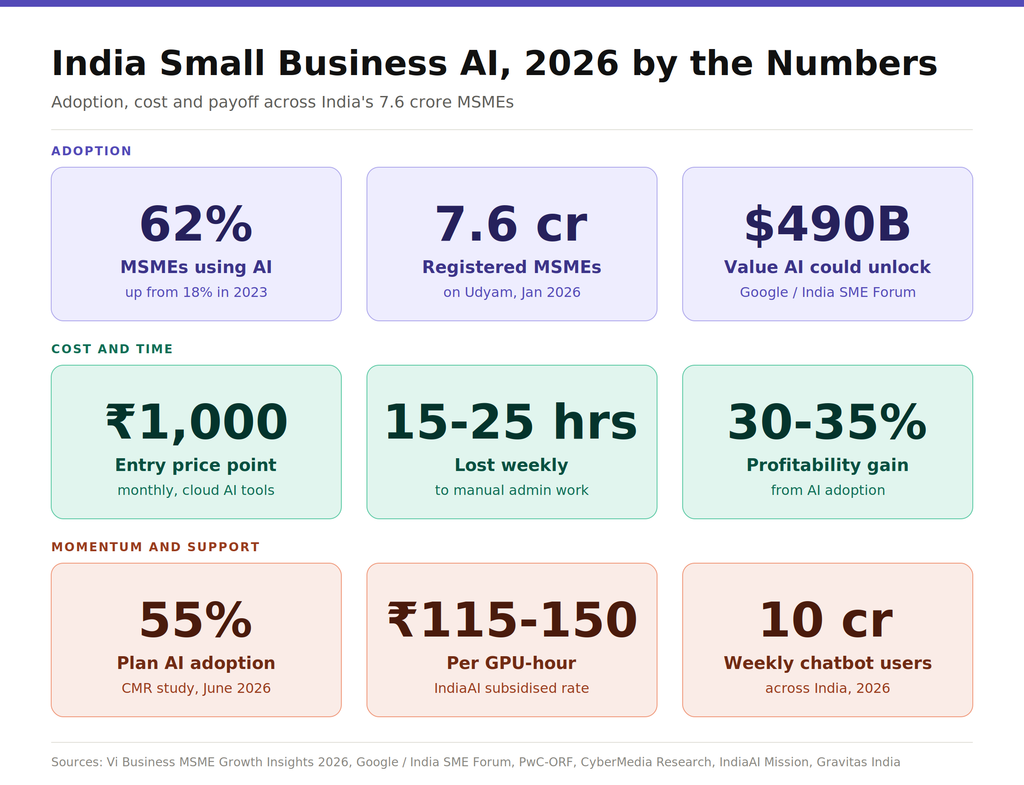
As of 2026, nearly 62% of small and medium enterprises in India have adopted at least one AI-powered tool, up from just 18% in 2023.
India has over seven crore registered MSMEs on the Udyam portal, and a growing share of them are moving past digital adoption into actual AI use.
What This Is Actually Worth to You, Not Just to the Economy
Big numbers are easy to skim past. Here is the one that applies directly to your shop or office.
AI adoption by Indian MSMEs could unlock more than $490 billion in economic value, while improving business profitability by 30 to 35%, according to a joint report by Google and the India SME Forum based on a survey of 3,249 MSMEs.
Separately, most small businesses in India still lose 15 to 25 hours every week to manual work such as replying to WhatsApp, sending quotations, and chasing payments.
That is close to three working days a week, recovered.
The Real Barrier Was Never Cost, It Was Not Knowing Where to Start
Ask ten small business owners why they haven’t used AI and eight will say some version of “I don’t know where to begin,” not “it’s too expensive.”
Cloud-based AI tools with monthly subscriptions as low as ₹1,000 have democratised access to technology that was once enterprise-only.
Many of the highest-impact tools, in fact, cost nothing at all to start.


Start Here If You Sell Anything on WhatsApp
WhatsApp is not a nice-to-have channel in India. For most small businesses, it is the business.
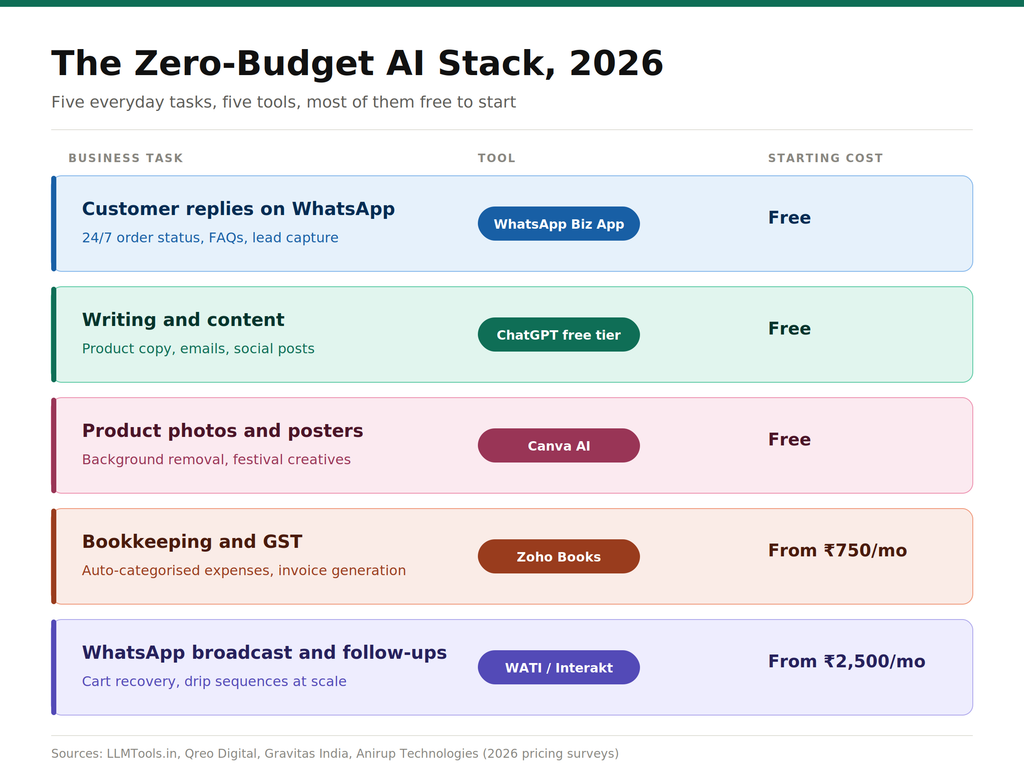
The WhatsApp Business App itself is free and handles automated greetings, quick replies and catalogues for shops with under 50 queries a day.
A 2026 WhatsApp AI chatbot goes even further: it reads a customer’s informal message such as “bro, cancel Monday’s session, I need a refund,” pulls up the booking, checks the policy, processes the refund, and replies in Hindi, all without a human touching it.
Once volume grows past what the free app can handle, WATI and Interakt run WhatsApp Business API automation, broadcast campaigns, and abandoned cart recovery, typically for ₹2,500 to ₹5,000 a month.
Writing, Photos and Social Media: The Genuinely Free Layer
This is the part of the AI stack that costs zero rupees and still saves the most hours.
ChatGPT’s free tier remains one of the most versatile tools available and now runs on GPT-5.1, capable enough for product descriptions, WhatsApp replies, and a month of social content in one sitting.
Canva’s free AI tools remove image backgrounds in one click, essential for Indian ecommerce sellers on Meesho, Flipkart and Amazon India who need to turn phone photos into clean product images instantly.
Bookkeeping Is Where AI Quietly Saves the Most Money
Nobody enjoys GST filing. AI has made it considerably less painful, and this is where the return on ₹750 a month becomes obvious.
AI now reads product details, applies pricing rules and generates a branded quotation or GST-split invoice in seconds instead of the 20 to 30 minutes it used to take manually.
When wired into Tally or Zoho Books, accounts teams stop re-entering data by hand entirely.
A single automation can pull sales from your POS, orders from your website and expenses from a spreadsheet, then drop a WhatsApp summary into your business group every night at 9 pm.
No more “send me today’s figures” messages.
The Kirana Store Problem AI Is Now Actually Solving
India’s 13 million kirana stores generate 88% of the country’s ₹4.3 trillion FMCG sector’s sales, yet 78% of kirana owners operate without any meaningful digital tools.
In 2024 alone, 200,000 of these stores shut down as urban outlets absorbed a 25% revenue hit from quick commerce.
The gap was never a lack of data. It was that owners had no time to log into a dashboard between customers, phone calls and credit management.
The fix that is actually spreading now doesn’t ask shopkeepers to type anything.
Apps like Dukaan Digital ask for a photo of a messy, handwritten distributor invoice or a crowded shelf, and an AI model reads it back as a structured inventory list, product, category, brand, quantity and price, no manual entry required.
What Bigger MSMEs Are Already Proving Works
If you run a slightly larger operation, here is what AI adoption looks like once it moves past chat and content.
A textile manufacturer in Surat cut fabric defect rates by 50% using computer vision AI for quality control, down from a 12% rejection rate. A pharmaceutical distributor in Pune now forecasts demand with 92% accuracy. A packaging business in Ahmedabad cut production downtime from 12% to 4.8%.
Across sectors, AI chatbots now handle 70 to 80% of routine customer queries in multiple Indian languages, cutting response time from 24 hours to under 2 minutes.
The Government Is Quietly Subsidising Your AI Compute Too
This is the part most small business guides skip, because it sounds like it’s only for tech startups. It isn’t.
The IndiaAI Mission is a ₹10,371 crore programme aimed specifically at driving AI adoption among micro, small and medium enterprises through compute capacity, datasets and application development support.
Startups and MSMEs can access GPU compute at ₹115 to ₹150 per hour, roughly 42% below market rates, with eligible projects receiving up to a 40% additional subsidy.
You are unlikely to need raw GPU access to run a shop or a services business, but if you’re building anything custom on top of AI, whether that’s a local-language ordering bot or an inventory model, this is the infrastructure layer that makes it affordable.
What Experts Are Actually Telling MSME Owners
The optimism is real, but so is the advice to be deliberate rather than to chase every shiny tool.
Anand Kumar Bajaj, Founder, MD and CEO of PayNearby, frames the stakes plainly: “MSMEs are the everyday engines of India’s growth.
From kirana stores and small service points to local manufacturers and neighbourhood entrepreneurs, they keep commerce moving, create livelihoods and serve communities across Bharat.
” According to PayNearby’s MSME Digital Index 2026, 82% of MSMEs say they are confident using digital tools, and 87% report being more confident than they were the previous year.
Government messaging has been equally direct about intent.
A statement from Shobha Karandlaje, Minister of State for MSME, read at a 2026 report launch, put it this way: “Technology is reshaping grassroots commerce, allowing a business in any district to command visibility and engage consumers directly.”
Industry researchers, meanwhile, caution against treating AI as a checklist item.
A recent CyberMedia Research study found that 78% of Indian MSMEs now rank operational efficiency as their top business priority, ahead of revenue growth, which suggests the businesses winning with AI are the ones solving a specific bottleneck, not adopting tools for their own sake.
People Also Ask
What is the cheapest way for a small business in India to start using AI?
Start with tools that are already free: the WhatsApp Business App for customer replies, ChatGPT’s free tier for writing, and Canva AI for product photos.
These three alone cover customer service, content and visuals at zero cost.
How much does AI automation cost for a small business in India?
A starter automation, such as connecting a lead form to WhatsApp and a CRM, typically costs ₹15,000 to ₹35,000 as a one-time setup, plus a few hundred rupees a month to run.
Ongoing SaaS tools like WhatsApp broadcast platforms range from ₹2,500 to ₹5,000 a month.
Can a one-person business really use AI without hiring anyone?
Yes. Most of the tools covered here, ChatGPT, Canva AI, and the WhatsApp Business App, are built for solo operators and require no technical setup.
A resort owner or boutique seller can be running all three within a day.
Is there government support for AI adoption for small businesses in India?
Yes. The IndiaAI Mission specifically targets MSME AI adoption through subsidised compute, a datasets platform and application development funding, though the minister has noted no dedicated budget breakdown for MSMEs specifically has been published.
What AI tool should a kirana store owner use first?
Photo-based inventory tools that read a distributor invoice or a shelf photo and convert it into a structured stock list are the lowest-effort entry point, since they require no typing or dashboard use.
Does AI actually save small businesses money in India?
Yes, and the effect compounds.
AI adoption is projected to improve business profitability by 30 to 35% for MSMEs that adopt it strategically, according to the Google and India SME Forum study, largely through time saved on repetitive admin work.
How many Indian small businesses use AI in 2026?
62% of Indian MSMEs have adopted at least one AI tool as of 2026, up from 18% in 2023.
What is the cheapest AI tool for Indian small businesses?
The WhatsApp Business App, ChatGPT’s free tier, and Canva AI are all free to start and cover customer service, writing and product visuals.
How much time can AI save a small business owner in India each week?
Small businesses in India typically lose 15 to 25 hours a week to manual admin work; AI automation removes most of this.
What is the IndiaAI Mission?
A ₹10,371 crore government programme that subsidises AI compute and supports AI adoption specifically among MSMEs, startups and researchers.
Where This Goes Wrong, and How to Not Be the Cautionary Tale
Tool adoption without a clear problem to solve is the single most common failure pattern reported in MSME AI research.
Owners install a chatbot because a friend has one, not because they know which queries are eating their time.
The fix is sequencing, not spending. Pick the one task that costs you the most hours this week, whether that’s WhatsApp replies, writing captions, or chasing GST invoices, and solve only that first with a free tool before adding anything paid.
The Bottom Line
You do not need a ₹50 lakh marketing budget to compete with a business that has one.
You need the same three or four tools thousands of Indian shop owners, coaches and manufacturers are already running for free or near-free, applied to the one bottleneck that is actually slowing you down.
The businesses falling behind in 2026 are not the ones with small budgets.
They’re the ones who assumed AI needed a big one.
Talk to our automation and AI experts

Pooja Upadhyay
Director Of People Operations & Client Relations
References;
MSME Ministry — https://msme.gov.in
ONDC — https://ondc.org
Bhashini — https://bhashini.gov.in
Digital India — https://digitalindia.gov.in
GST Portal — https://gst.gov.in
